Some Uses of CE "Using Consumer Theory to Test Business Cycle - - PowerPoint PPT Presentation

some uses of ce
SMART_READER_LITE
LIVE PREVIEW

Some Uses of CE "Using Consumer Theory to Test Business Cycle - - PowerPoint PPT Presentation

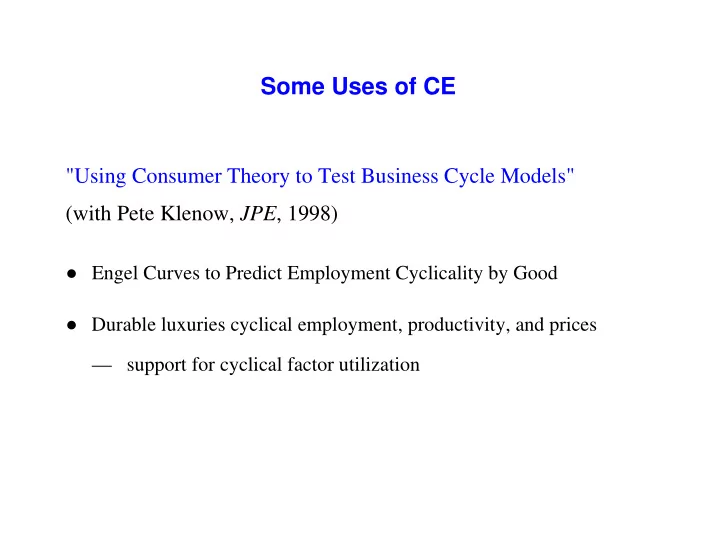
Some Uses of CE "Using Consumer Theory to Test Business Cycle Models" (with Pete Klenow, JPE , 1998) Engel Curves to Predict Employment Cyclicality by Good Durable luxuries cyclical employment, productivity, and prices


slide-1
SLIDE 1

Some Uses of CE

"Using Consumer Theory to Test Business Cycle Models" (with Pete Klenow, JPE, 1998)

  • Engel Curves to Predict Employment Cyclicality by Good
  • Durable luxuries cyclical employment, productivity, and prices

— support for cyclical factor utilization

slide-2
SLIDE 2

"Quantifying Quality Growth" (with Pete Klenow, AER, 2001)

  • Estimate Quality Engel Curves for Durables
  • Use Quality Engel Curves as instrument for Quality
  • Predicts Unit-Price inflation 1980-1996 across goods
  • Also Predicts CPI inflation across goods
slide-3
SLIDE 3
  • 1.0
  • 0.5

0.0 0.5 1.0

  • 1.0
  • 0.5

0.0 0.5 1.0

real price of car purchased (in logs) household real nondurable consumption (in logs) OLS Kernel

Quality Engel Curve for CARS

Figure 3

slide-4
SLIDE 4
  • 0.2
  • 0.1

0.0 0.1 0.2 0.3

  • 1.0
  • 0.5

0.0 0.5 1.0

real price of vacuum purchased (in logs) household real nondurable consumption (in logs)

Quality Engel Curve for VACUUMS

OLS Kernel

Figure 4

slide-5
SLIDE 5
  • 10
  • 5

5 0.0 0.2 0.4 0.6 0.8 1.0 1.2 Quality Slope 1980-1996 Unit Price Inflation

Figure 5

corr = .51

slide-6
SLIDE 6

"Has Consumption Inequality Mirrored Income Inequality?" (with Mark Aguiar, 2010)

  • Large increase in income inequality over last 30 years
  • Consumption inequality, measured by CE, rose much less

— e.g., Slesnick (2001), Krueger and Perri (2006)

  • Use budget constraint and CE data on savings to check consistency
  • Use Engel curves across goods for alternative measure

— Corrects for systematic errors by good or income

slide-7
SLIDE 7

Implied Consumption Inequality

0.00 0.05 0.10 0.15 0.20 0.25 0.30 0.35 0.40

1980 1983 1986 1989 1992 1996 1999 2002 2005 Log Change from 1980-82

After Tax Income

slide-8
SLIDE 8

Implied Consumption Inequality

0.00 0.05 0.10 0.15 0.20 0.25 0.30 0.35 0.40

1980 1983 1986 1989 1992 1996 1999 2002 2005 Log Change from 1980-82

After Tax Income Reported Expenditure

slide-9
SLIDE 9

Implied Consumption Inequality

0.00 0.05 0.10 0.15 0.20 0.25 0.30 0.35 0.40

1980 1983 1986 1989 1992 1996 1999 2002 2005 Log Change from 1980-82

After Tax Income Reported Expenditure Y-S

slide-10
SLIDE 10

Two Good Example: Food and Entertainment

1 2 3 4 5 6 7 8 9 1980 1983 1986 1989 1992 1996 1999 2002 2005

Rel at i ve Spendi ng

YEAR Nondurable Entertainment Total Expenditure Food at Home

slide-11
SLIDE 11

Implied Consumption Inequality

0.00 0.05 0.10 0.15 0.20 0.25 0.30 0.35 0.40

1980 1983 1986 1989 1992 1996 1999 2002 2005 Log Change from 1980-82

After Tax Income Reported Expenditure Y-S

slide-12
SLIDE 12

Implied Consumption Inequality

0.00 0.05 0.10 0.15 0.20 0.25 0.30 0.35 0.40

1980 1983 1986 1989 1992 1996 1999 2002 2005 Log Change from 1980-82

After Tax Income Reported Expenditure Estimated Expenditure Y-S

slide-13
SLIDE 13

Description of Data Used

  • Panel feature of data

— to match expenditures to income — to instrument across surveys to address measurement error

  • All available years (including 1972-73) to uncover long-term trends
  • Interview files: Family, ITAB, and MTAB files

(MTABS for finer disaggregation, for unit prices for durables)

slide-14
SLIDE 14

Suggestions for CE Survey and Products

For many questions aggregate household consumption is key

  • Exploit household budget constraint as check
  • Begin with estimate aggregate expenditures

— bring records of check, credit spending, estimate currency flow

  • Then drop number of questions that generate little expenditure share
slide-15
SLIDE 15

For many questions need CE’s short panel

— match income/spending, estimate life cycle or allow fixed effects

  • Reductions in attrition would be great
  • Bring in households only for full cycle
  • Make existing years easier to use as panel

— e.g., consistent set of ID’s across census changes — perhaps produce panel version