Growth and Innovation in the Digital Era Fifth Ministerial - - PowerPoint PPT Presentation

growth and innovation in the digital era
SMART_READER_LITE
LIVE PREVIEW

Growth and Innovation in the Digital Era Fifth Ministerial - - PowerPoint PPT Presentation

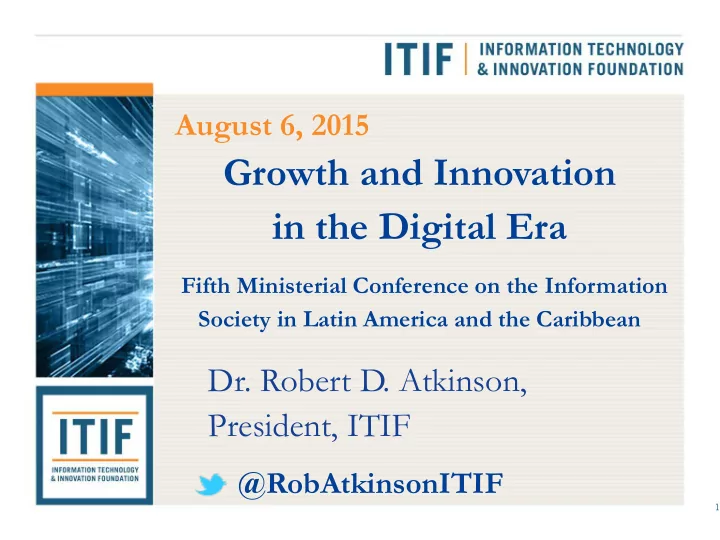
August 6, 2015 Growth and Innovation in the Digital Era Fifth Ministerial Conference on the Information Society in Latin America and the Caribbean Dr. Robert D. Atkinson, President, ITIF @RobAtkinsonITIF 1 ITIF: Who We Are The Information


slide-1
SLIDE 1

1

Growth and Innovation in the Digital Era Fifth Ministerial Conference on the Information

Society in Latin America and the Caribbean

August 6, 2015

  • Dr. Robert D. Atkinson,

President, ITIF

@RobAtkinsonITIF

slide-2
SLIDE 2

ITIF: Who We Are

2

The Information Technology and Innovation Foundation is a think tank at the cutting edge of designing innovation policies and exploring how innovation drives boost growth and

  • competitiveness. ITIF focuses on:
  • Innovation processes, policy, and metrics,
  • Internet, big data and ICT policy,
  • ICT and economic productivity,
  • Science and tech policy, and
  • Innovation and trade policy.
slide-3
SLIDE 3

3

ITIF Global Engagement

slide-4
SLIDE 4

Today’s Presentation

3 2

“Silicon Valley” or ICT-Enabled Economy? ICT and Growth

1

4

ICT Policy: Fairness or Growth?

slide-5
SLIDE 5

Productivity Grows the “Pie”

5

slide-6
SLIDE 6

6

20,000 40,000 60,000 80,000 100,000 120,000 140,000

Productivity Differs by Nation

Productivity Per Person Employed, 2015 (PPP, US$) (Conference Board, Total Economy Data Base)

slide-7
SLIDE 7

Where Does Productivity Come From?: Better Tools

7

slide-8
SLIDE 8

Today’s Better Tools Are ICT Tools

8

slide-9
SLIDE 9

Moore’s Law Drives ICT Tool Progress

9

  • 1,215,500,000,000,000,000,000

transistors in 2014

slide-10
SLIDE 10

?: Transistor Growth Since 2000

10

A) 14.3 times B) 143 times C) 1,430 times D) 14,300 times

slide-11
SLIDE 11

?: Transistor Growth Since 2000

11

A) 14.3 times B) 143 times C) 1,430 times D) 14,300 times

slide-12
SLIDE 12

1) $35.20 2) $352 3) $3,520

4) $35,200

5 GBs cost $1.5 billion in 1960

?: Today’s Cost of 32GB of Storage Using 1995 Technology

12

slide-13
SLIDE 13

1) $35.20 2) $352 3) $3,520

4) $35,200 ?: Today’s Cost of 32GB of Storage Using 1995 Technology

13

slide-14
SLIDE 14

?: Monthly Cost of 1 Gig. Broadband in U.S. With 1999 Technology (in 2015$)

14

A) $95 B) $950 C) $9,560 D) $95,600

slide-15
SLIDE 15

?: Monthly Cost of 1 Gig. Broadband in U.S. With 1999 Technology (in 2015$)

15

A) $95 B) $950 C) $9,560

D) $95,600

slide-16
SLIDE 16

Past-Current Current-Future

  • Slow copper Fast fiber/DOCSIS3.1

16

slide-17
SLIDE 17

Past-Current Current-Future

  • Slow copper Fast fiber/DOCSIS3.1
  • 2G-3G wireless LTE-Advanced

17

slide-18
SLIDE 18

Past-Current Current-Future

  • Slow copper Fast fiber/DOCSIS3.1
  • 2G-3G wireless LTE-Advanced
  • Hardware defined Software defined

networks networks

18

slide-19
SLIDE 19

Past-Current Current-Future

  • Slow copper Fast fiber/DOCSIS3.1
  • 2G-3G wireless LTE-Advanced
  • Hardware defined Software defined

networks networks

  • Desktops/laptops Tablets, smartphones, etc

19

slide-20
SLIDE 20

Past-Current Current-Future

  • Slow copper Fast fiber/DOCSIS3.1
  • 2G-3G wireless LTE-Advanced
  • Hardware defined Software defined

networks networks

  • Desktops/laptops Tablets, smartphones, etc
  • Client-server Cloud

20

slide-21
SLIDE 21

Past-Current Current-Future

  • Slow copper Fast fiber/DOCSIS3.1
  • 2G-3G wireless LTE-Advanced
  • Hardware defined Software defined

networks networks

  • Desktops/laptops Tablets, smartphones, etc
  • Client-server Cloud
  • Few sensors Internet of Things

21

slide-22
SLIDE 22

Past-Current Current-Future

  • Slow copper Fast fiber/DOCSIS3.1
  • 2G-3G wireless LTE-Advanced
  • Hardware defined Software defined

networks networks

  • Desktops/laptops Tablets, smartphones, etc
  • Client-server Cloud
  • Few sensors Internet of Things
  • Limited data Big data/powerful

analytics

22

slide-23
SLIDE 23

Current/Future System Enables Software To “Eat the World”

23

slide-24
SLIDE 24

Using ICT Tools is Much More Important Than Making Them

  • Over 80% of benefits from ICT in the

U.S. are related to its use by

  • rganizations, rather than its production

by the ICT industry.

24

slide-25
SLIDE 25
  • In large U.S. firms, $1 dollar of IT capital is associated with $25
  • f market value. $1 of non-IT capital associated with $1 of value.
  • Between 2006 and 2010, U.S. corporations that invested more in

IT increased productivity three times faster.

  • IT has 3 to 7 times more impact on productivity.
  • IT was responsible for 75% of U.S. productivity growth from

1995 to 2002, and 44% from 2000 to 2006.

  • A 10% increase in a country’s IT capital stock adds approximately

0.45 percentage points to GDP.

ICT Drives Enterprise Growth

25

slide-26
SLIDE 26

Today’s Presentation

3 2

“Silicon Valley” or ICT-Enabled Economy?

ICT and Growth 1

26

ICT Policy: Fairness or Growth?

slide-27
SLIDE 27

ICT Development vs. Deployment Policy Matrix

27

Supports “Silicon Valley” Hurts “Silicon Valley”

Supports ICT Economy

  • Tax incentives for ICT adoption
  • ICT skills development
  • Open data policies
  • Tax incentives for ICT adoption
  • Broadband deployment support
  • More spectrum
  • Digital literacy policies
  • E-government, including e-procurment
  • Digital transformation strategies (transportation, health care, etc.)
  • Support ICT platforms (mobile payments, digital signatures, etc.)
  • Latin American Digital Single Market

Hurts ICT Economy

  • ICT Tariffs
  • Data center localization requirements
  • Local content requirements
  • Procurement preferences for domestic companies
  • ICT Taxes
  • Cross Border Data Flow Limits
  • Labor market regulations
  • Product market regulations (e.g.,

ban on Uber)

  • Strict privacy regulations
  • Limits on FDI
  • Small business preferences
slide-28
SLIDE 28

ICT Development vs. Deployment Policy Matrix

28

Supports “Silicon Valley” Supports ICT Economy

  • Tax incentives for ICT adoption
slide-29
SLIDE 29

ICT Development vs. Deployment Policy Matrix

29

Supports “Silicon Valley” Supports ICT Economy

  • Tax incentives for ICT adoption
  • ICT skills development
slide-30
SLIDE 30

MOOCs as an Opportunity

30

Entrepreneurship 102: ¿Que puedes hacer por tu cliente? Apúntante a la versión "Verified" de nuestro curso, consigue el certificado, y gana un año de subscripción gratis a AWS Activate, con 1000$ de crédito y otras muchas ventajas. Introduction to Computer Science & Programming Using Python 6.00.1x is an introduction to computer science as a tool to solve real-world analytical problems.

slide-31
SLIDE 31

ICT Development vs. Deployment Policy Matrix

31

Supports “Silicon Valley” Supports ICT Economy

  • Tax incentives for ICT adoption
  • ICT skills development
  • Digital transformation strategies (transportation,

health care, agriculture, etc.)

  • Support ICT platforms (mobile payments, digital

signatures, etc.)

  • E-government, including e-procurement
  • Open data policies
  • Digital literacy policies
  • More spectrum and more efficient spectrum use
  • Broadband deployment support
  • Latin American Digital Single Market
slide-32
SLIDE 32

ICT Development vs. Deployment Policy Matrix

32

Supports “Silicon Valley” Hurts ICT Economy

  • ICT Tariffs
slide-33
SLIDE 33

33

Lower ICT Tariffs Drive ICT Exports

0.0% 10.0% 20.0% 30.0% 40.0% 50.0% 60.0% Philippines Malaysia China Thailand Indonesia India Vietnam Brazil Argentina Chile

ICT Goods Exports as Percentage of Total Goods Exports, 2009

ITA Member Non-ITA Member

slide-34
SLIDE 34

ICT Development vs. Deployment Policy Matrix

34

Supports “Silicon Valley” Hurts ICT Economy

  • ICT Tariffs
  • Data center localization requirements
  • Local content requirements
  • Procurement preferences for domestic

companies

slide-35
SLIDE 35

ICT Development vs. Deployment Policy Matrix

35

Hurts “Silicon Valley” Hurts ICT Economy

  • ICT Taxes
slide-36
SLIDE 36

Keeping IT Prices Low is Key to Growth

  • IT tariffs and discriminatory taxes sectors mean consumers/firms have to

pay more while often receiving inferior products/services.

  • This makes downstream IT-using firms/sectors less competitive.
  • Diminishes productivity of financial, transportation, etc. sectors.
  • For every $1 of tariffs India applied to imported computers, the country

lost $1.30 due to lost spillover effects. (Kaushik and Singh, 2004).

  • For every 1 percent drop in price in ICT products, there is a 1.5 percent

increase in demand. (Gurbaxani, 2003).

  • Tariffs on IT products do not create a competitive domestic hardware

industry, but they do limit adoption of ICT by keeping prices high.

slide-37
SLIDE 37

Taxes and Tariffs for Consumer ICT Products and Services

37

Ben Miller and Robert D. Atkinson, “Digital Drag: Ranking 125 Nations on Taxes and Tariffs on ICT Goods and Services,” (Information Technology and Innovation Foundation, October 2014), http://www.itif.org/publications/2014/10/24/digital-drag- ranking-125-nations-taxes-and-tariffs-ict-goods-and-services.

slide-38
SLIDE 38

38

Taxes and Tariffs for Business-Use ICT Products and Services

Ben Miller and Robert D. Atkinson, “Digital Drag.”

slide-39
SLIDE 39

Latin America and Caribbean Nations Impose Higher ICT Taxes/Tariffs Than N. America

39

Ben Miller and Robert D. Atkinson, “Digital Drag.”

0% 2% 4% 6% 8% 10% 12% 14% 16% 18% 20%

East Asia Europe and Central Asia Latin America and the Caribbean Middle East and North Africa North America Southeast Asia Sub-Saharan Africa

Extra Taxes Tariffs

slide-40
SLIDE 40

ICT Development vs. Deployment Policy Matrix

40

Hurts “Silicon Valley” Hurts ICT Economy

  • ICT Taxes
  • Limits on cross border data flows
  • Labor market regulations
  • Product market regulations (e.g., ban on Uber)
  • Strict privacy regulations
  • Limits on FDI
  • Small business preferences
slide-41
SLIDE 41

Today’s Presentation

3 2

“Silicon Valley” or ICT-Enabled Economy? IT and Growth

1

41

ICT Policy: Fairness or Growth?

slide-42
SLIDE 42

Competing Visions for ICT Policy: Fairness or Growth?

42

slide-43
SLIDE 43

Digital Fairness…

  • Internet is principally a tool for communications

by individuals

  • Priority on digital adoption by individuals
  • Regulation to protect consumers
  • Weak content protection to make it more affordable
  • To extent focus is on enterprises, it’s on SMEs
  • Telecom competition to keep prices low

43

slide-44
SLIDE 44

Digital Growth…

  • Internet is principally a tool for commerce by

enterprises

  • Priority on digital adoption by enterprises,
  • Policies to support enterprise innovation
  • Stronger content protection for incentive to produce
  • Support ICT use by the most productive enterprises,

regardless of size

  • Focus on enabling telecom capital investment

44

slide-45
SLIDE 45

Won’t Fewer SME’s and More Productivity Cost Jobs?

  • Higher productivity leads to more, not fewer jobs
  • United National Industrial Development

Organization finds “productivity is the key to employment growth”1

  • World Bank finds businesses in low-middle income

countries using more IT have higher productivity but also faster sales and employment growth.

45

1 Anders Isaksson, Thiam Hee Ng, and Ghislain Robyn, Productivity in Developing Countries: Trends and Policies (Vienna: UNIDO, 2005), 139

slide-46
SLIDE 46

www.globalinnovationrace.com

46

slide-47
SLIDE 47

Rob Atkinson

ratkinson@itif.org

Thank You

Rob Atkinson

ratkinson@itif.org

@robatkinsonitif facebook.com/innovationpolicy www.innovationpolicy.org www.itif.org Follow ITIF:

Thank You