
SLIDE 1
Grid-Based Genetic Algorithm Approach to Colour Image Segmentation - - PowerPoint PPT Presentation
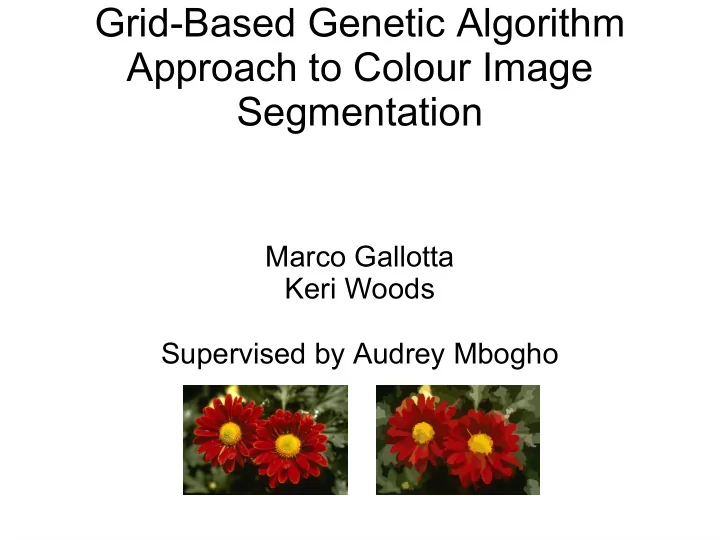
Grid-Based Genetic Algorithm Approach to Colour Image Segmentation Marco Gallotta Keri Woods Supervised by Audrey Mbogho Image Segmentation Identifying and extracting distinct, homogeneous regions from an image Simplifies the image
Identifying and extracting distinct,
Simplifies the image for further processing:
− shape recognition, medical imaging, face detection
Problem: How do we
− Each petal as a
− Stigma as a region? − Group flowers as
− Segment the
Segmentation
Results confirm
Optimisation technique that works on large
Biological evolution
Chromosome encodes a potential solution Contains parameters The chromosome is optimised using:
− mutation
Fitness function evaluates an individual and
Used to select fittest individuals for next
Crucial in producing good results
A system that coordinates resources that are
Dedicated and non-dedicated resources Multiple organisations pooling their unused
Lots of computing power
Segmentation of great importance No general method of image segmentation Wide variety of images Parameters need to be tuned to get optimal
Segmentation involves much uncertainty GA cope well with uncertainty Alter parameters to optimise segmentation
Image segmentation and genetic algorithms
Combined VERY computationally expensive Solution?
− Work harder − Work smarter − Get help
Genetic algorithms easily parallelisable Grid supplies “free” computational resources
Edge detection Histogram thresholding Watershed Region based techniques Clustering techniques Model based techniques Many others
Chose to implement:
− Watershed − Region Growing − Region Merging
Calculate a gradient magnitude image Consider this as a topographic surface Consider dropping water at each pixel and
Pixels with the same end point form a region
(a) Example gradient magnitude image (b) The two regions that are identified
Start off with small regions and grow them Each iteration considers all pixels neighbouring
Pixel with the minimum δ is added to the region This continues until all pixels are assigned to a
The above method requires manual seeds To automate we introduce a threshold T If the minimum δ exceeds T then a new region
Start with an arbitrary pixel as the first region
Initially each pixel a region Adjacent regions merged if criteria met Continue until no regions meet criteria
Merge if fusion factor less than scale parameter Fusion factor: change in heterogeneity if
Heterogeneity: colour, compactness,
Scale parameter controls size of resulting
All successful but different results Effect of scale parameter on region merging
− Large scale parameter => large regions
[Can get some results off website at
Drives evolution of chromosomes Evaluate quality of segmentation Unsupervised segmentation
− No external information − Properties of image itself
How much colour within each region varies Low fitness = good segmentation
For each region standard deviation multiplied
Sum all regions Add 1 Multiply by number of regions
GA with segmentation very computationally
Unable to explore full potential Extremely slow Therefore grid
Two common models:
− master-slave (left) − Island model (right)
With the Grid, communication between nodes
Even with communication, building a topology
All existing research has used the master-slave
Our model uses ideas
Root node (dedicated
No direct communication
We were heavily restricted in testing and could
Tests showed the communication overhead
Results were positive when testing on simple
Unsuccessful at migrating the segmentation
Experimented with 3 segmentation algorithms Selected region merging for our genetic
Genetic algorithm provides potential for
Grid computing showed positive results
As we only tested on
Most Grids are very
The next stage is to
Watershed with genetic algorithm Investigate different fitness functions Genetic programming to evolve fitness function
− Train for each desired application
http://people.cs.uct.ac.za/~mgallott/honsproj/