Generic programming Define software components with type parameters - - PowerPoint PPT Presentation

generic programming
SMART_READER_LITE
LIVE PREVIEW

Generic programming Define software components with type parameters - - PowerPoint PPT Presentation

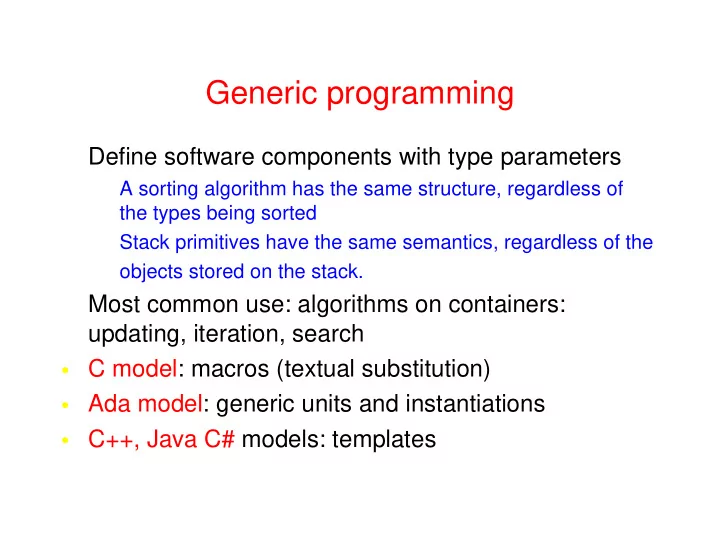
Generic programming Define software components with type parameters A sorting algorithm has the same structure, regardless of the types being sorted Stack primitives have the same semantics, regardless of the objects stored on


slide-1
SLIDE 1

Generic programming

  • Define software components with type parameters

– A sorting algorithm has the same structure, regardless of the types being sorted – Stack primitives have the same semantics, regardless of the – objects stored on the stack.

  • Most common use: algorithms on containers:

updating, iteration, search

  • C model: macros (textual substitution)
  • Ada model: generic units and instantiations
  • C++, Java C# models: templates
slide-2
SLIDE 2

Parametrizing software components

  • Construct parameter supplying parameter

array values (bounds) declaring object declaring subtype record discriminant object/subtype subprogram values (actuals) calling subprogram generic unit types, values instantiating template classes, values instantiating, specializing

slide-3
SLIDE 3

Generics in Ada95

  • I/O for integer types. Identical implementation, but need

separate procedures for strong-typing reasons.

generic

type Elem is range <> ; -- any integer type package Integer_IO is procedure Put (Item : Elem);

...

slide-4
SLIDE 4

generic

type Elem is private; -- parameter package Stacks is type Stack is private; procedure Push (X : Elem; On : in out Stack); … private type Cell; type Stack is access Cell; -- linked list representation type Cell is record Val : Elem; Next : Ptr; end record; end Stacks;

A generic Package

slide-5
SLIDE 5

Instantiations

with Stacks;

procedure Test_Stacks is package Int_Stack is new Stacks (Integer); -- list of integers package Float_Stack is new Stacks (Float); -- list of floats S1 : Int_Stack.Stack; -- a stack object S2 : Float_Stack.Stack; use Int_Stack, Float_Stack; -- ok, regular packages begin Push (15, S1); -- Int_Stack.Push Push (3.5 * Pi, S2); ... end Test_Stacks;

slide-6
SLIDE 6

Type parameters

  • The generic type declaration specifies the class of types for

which an instance of the generic will work:

  • type T is private; --- any type with assignment (Non-limited)
  • type T is limited private; -- any type (no required operations)
  • type T is range <>; -- any integer type (arithmetic operations)
  • type T is (<>); -- any discrete type (enumeration or
  • - integer)
  • type T is digits <>; -- any floating-point type
  • type T is delta <>; -- any fixed-point type
  • Within the generic, the operations that apply to any type of the class

can be used.

  • The instantiation must use a specific type of the class
slide-7
SLIDE 7

A generic function

generic

type T is range <>; -- parameter of some integer type

type Arr is array (Integer range <>) of T;

  • - parameter is array of those

function Sum_Array (A : Arr) return T;

  • - Body identical to non-generic version

function Sum_array (A : Arr) return T is Result : T := 0; -- some integer type, so literal 0 is legal begin for J in A’range loop -- some array type, so attribute is available Result := Result + A (J); -- some integer type, so “+” available. end loop; return Result; end;

slide-8
SLIDE 8

Instantiating a generic function

type Apple is range 1 .. 2 **15 - 1;

type Production is array (1..12) of Apple; type Sick_Days is range 1..5; type Absences is array (1 .. 52) of Sick_Days; function Get_Crop is new Sum_array (Apple, Production); function Lost_Work is new Sum_array (Sick_Days, Absences);

slide-9
SLIDE 9

generic private types

  • Only available operations are assignment and equality.

generic type T is private; procedure Swap (X, Y : in out T); procedure Swap (X, Y : in out T) is Temp : constant T := X; -- no other properties of T

  • - are needed

begin X := Y; Y := Temp; end Swap;

slide-10
SLIDE 10

Subprogram parameters

  • A generic sorting routine should apply to any array whose

components are comparable, i.e. for which an ordering predicate exists. This class includes more that the numeric types: generic type T is private; -- parameter with function “<“ (X, Y : T) return Boolean; -- parameter type Arr is array (Integer range <>) of T; -- parameter procedure Sort (A : in out Arr);

slide-11
SLIDE 11

Supplying subprogram parameters

  • The actual must have a matching signature, not necessarily the

same name: procedure Sort_Up is new Sort (Integer, “<“, …); procedure Sort_Down is new Sort (Integer, “>”, … ); type Employee is record .. end record; function Senior (E1, E2 : Employee) return Boolean; function Rank is new Sort (Employee, Senior, …);

slide-12
SLIDE 12

Value parameters

Useful to parametrize containers by size:

generic

type Elem is private; -- type parameter

Size : Positive; -- value parameter package Queues is type Queue is private; procedure Enqueue (X : Elem; On : in out Queue); procedure Dequeue (X : out Elem; From : in out Queue); function Full (Q : Queue) return Boolean; function Empty (Q : Queue) return Boolean; private type Contents is array (Natural range <>) of Elem; type Queue is record Front, Back: Natural; C : Contents (0 .. Size); end record; end Queues;

slide-13
SLIDE 13

Packages as parameters

  • If interface includes a type and its operations, the parameter can

be a single generic package:

generic type Real is digits <>; -- any floating type package generic_complex_types is

  • - complex is a record with two real components
  • - package declares all complex operations: +, -, Re, Im...

end generic_complex_types;

  • We also want to define a package for elementary functions (sin, cos,

etc.) on complex numbers. We need the complex operations, which are parametrized by the corresponding real value.

slide-14
SLIDE 14

The instantiation requires an instance of the package parameter

with generic_complex_types; generic with package compl is new generic_complex_types (<>); package generic_complex_elementary_functions is

  • - trigonometric, exponential, hyperbolic functions.

end generic_complex_elementary_functions;

  • Instantiate complex types with long_float components:

package long_complex is new generic_complex_type (long_float);

  • Instantiate complex functions for long_complex types:

package long_complex_functions is new generic_complex_elementary_functions (long_complex);

slide-15
SLIDE 15

Templates in C++ template <class T> class Vector {

public: Vector (size_t n); -- constructor T& operator [ ] (size_t); -- subscript (hopefully with checks!) private: … // a struct with a size and a pointer to an array }; Vector<int> V1 (100); -- instantiation Vector <int> Vdef; -- use default constructor typedef Vector<employee> Dept; -- named instance

slide-16
SLIDE 16

Class and value parameters

template <class T, int i> class Buffer { T v [i]; -- storage for buffer int sz; -- total capacity int count; -- current contents public: Buffer( ) : sz (i) , count (0) { }; T read (); void write (T elem);

}; Buffer <Shape, 100> picture; -- instance for a graphics app.

slide-17
SLIDE 17

Template hopes for the best

template <class T> class List { struct Link { // for a list node Link* pre; // doubly linked Link* succ; T val; Link (Link* p, s, const T& v): pre (p), succ(s), val (v) { }; } Link * head; public: void print_all () { for Link*p = head; p; p=p->succ) cout << p -> val << ‘\n’; // operator<< better exist for T! };

slide-18
SLIDE 18

Function templates

  • Instantiated implicitly at point of call.

template <class T> void sort (vector <T>&) {..}; void testit (<vector<int>&vi) { sort (vi); // implicit instantiation // can also write sort<int> (vi); };

slide-19
SLIDE 19

Functions and function templates

  • Templates and regular functions overload each other:

template <class T> class complex {…};

template <class T> T sqrt (T); -- template template <class T> complex <T> sqrt (complex <T>);

  • - different algorithm

double sqrt (double); -- regular function void testit (complex<double> cd) { sqrt (2); // sqrt<int>: specialization of template sqrt (2.0); // sqrt (double): regular function sqrt (cd); // sqrt(<double>(complex<double>): specialization };

slide-20
SLIDE 20

Iterators and containers

  • Containers are standard data structures to manage

collections

– insert, delete, search, count

  • Standard algorithms over collections use iterators:

template <class Coll, class Elem> Iterator { Iterator (Coll over) { ..}; // build iterator for given collection Elem First_Elem (); // start iteration Elem Next_Elem (); // move to next element in collection bool done (); // termination condition };

slide-21
SLIDE 21

The Standard Template Library

  • A set of useful data structures and algorithms, mostly

to handle collections.

  • Sequential containers: List vector deque
  • Associative containers: set, map
  • Iterators provided:

– vector <T>::iterator – vector <T>::const_iterator – vector <T>::reverse_iterator – vector <T>::const_reverse_iterator

slide-22
SLIDE 22

Generics in Java

  • Only class parameters
  • Implementation by type erasure: all instances share

code

  • interface Collection <E> {
  • public void add (E x);
  • public Iterator<E> iterator ();
  • }
  • Collection <Thing> is a parametrized type
  • Collection (by itself) is a raw type
slide-23
SLIDE 23

Generic methods in Java

  • class Collection <A> {
  • public static <A extends Comparable <A>>
  • max (Collection <A> xs) {
  • Iterator <A> xi = xs.iterator();
  • A biggest = xi.next();
  • while (xi.hasNext ( )) {
  • A x = x.next();
  • if (w.compareTo(x) < 0) biggest = x;
  • }
  • return biggest;
  • }
  • }