Green Truck Partnership Steering Group Meeting, 17 th August 2016 ss - - PowerPoint PPT Presentation

green truck partnership
SMART_READER_LITE
LIVE PREVIEW

Green Truck Partnership Steering Group Meeting, 17 th August 2016 ss - - PowerPoint PPT Presentation

TODAYs TRUCKS Green Truck Partnership Steering Group Meeting, 17 th August 2016 ss Mark Hammond, Chief Technical Officer - TIC 1 Todays Presentation Who is TIC? T-Mark Data The Australian Truck Market Alternatively Fuelled and Powered


slide-1
SLIDE 1

Green Truck Partnership

Steering Group Meeting, 17th August 2016

ss

Mark Hammond, Chief Technical Officer - TIC

1
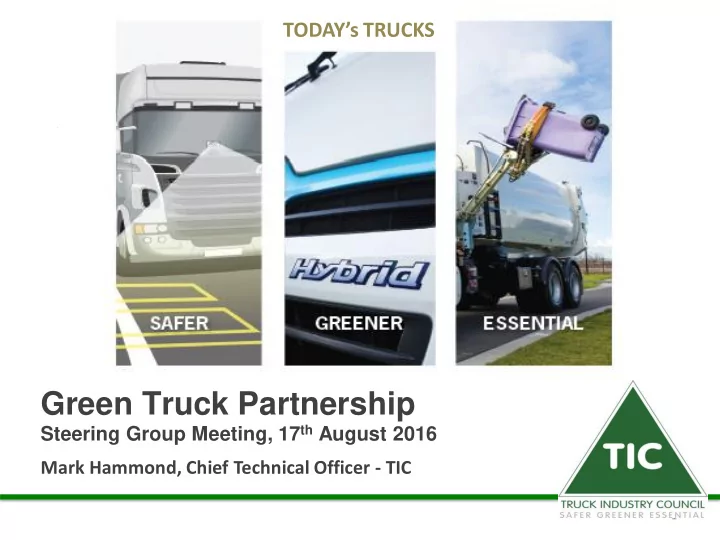
TODAY’s TRUCKS

slide-2
SLIDE 2

Todays Presentation

Who is TIC? T-Mark Data The Australian Truck Market Alternatively Fuelled and Powered Heavy Vehicles in Australia Our Aging Truck Fleet RUC - Incentive or Disincentive? TIC’s National Truck Plan Current “Green Truck” Possibilities Future “Green Truck” Possibilities Conclusions and TIC’s Actions

Today’s Trucks: Safer, Greener, Essential 2

slide-3
SLIDE 3

Who is TIC?

Truck Industry Council (TIC) is the peak industry body for truck manufacturers and importers in Australia and was formed in 2001 (Previously Commercial Vehicle Committee

  • f the Federal Chamber of Automotive Industries – FCAI)

Positioning Statement:

“Today’s Trucks: Safer, Greener, Essential”

9 Members, → 17 truck brands 3 Associate members (engine & component suppliers)

Today’s Trucks: Safer, Greener, Essential 3

slide-4
SLIDE 4

Our Members

Today’s Trucks: Safer, Greener, Essential 4

slide-5
SLIDE 5

TIC T-Mark Data

➢ TIC collects new truck sales data from its Members every month ➢ TIC Members have access to the data that they use for:

  • Market trends and competitor analysis
  • Sales and product planning
  • Production planning and forecasting

➢ TIC uses the data for:

  • Analyse long term market trends
  • Development of policy (eg: TIC’s National Truck Plan)
  • Market take-up of ADR changes (eg: emission & safety features)
  • Media and Government statistics (eg: Auto media, Reserve Bank)

Today’s Trucks: Safer, Greener, Essential 5

slide-6
SLIDE 6

➢ Simplified definition of a truck in Australia is: “a vehicle above 3.5t GVM carrying less than 8 persons” ➢ Total number of trucks (on-road): 590,660 vehicles** ➢ In 2015 new truck sales were split by Source of Origin: Japan, 50.3%, European 30.6%, Australia 15.0%, USA 3.7%, Other 0.5%* ➢ New heavy vehicle sales approximately 31,000/year ➢ TIC members represented 99.5% of all on-road trucks sold above 4.5t GVM in 2015

* TIC T-Mark data ** ABS Motor Vehicles Census Jan 2016

Today’s Trucks: Safer, Greener, Essential 6

The Australian Truck Market

slide-7
SLIDE 7

The Australian Truck Market

New Truck Sales Trends by Segment* (HD, MD, LD and LDV)

Today’s Trucks: Safer, Greener, Essential 7

0% 10% 20% 30% 40% 50% 60% 70% 80% 90% 100% 2000 2001 2002 2003 2004 2005 2006 2007 2008 2009 2010 2011 2012 2013 2014 2015 2016 Mar YTD

6.9% 19.5% 35.7% 32.1% 28.1% 20.3% 29.2% 28.1% Van LD Truck MD Truck HD Truck

YTD June

* TIC T-Mark data

slide-8
SLIDE 8

Alternatively Fuelled and Powered Trucks

Alternatively Fuelled and Powered Trucks as a percentage of (5 year average: 2011 to 2015)*: ➢ Total Heavy Vehicle market: 0.25% (77 trucks/year) ➢ 78% Diesel/Electric Hybrid and 22% CNG ➢ 0% LD Vans, 81% LD Trucks, 19% MD Trucks, 0% HD Trucks ➢ 57% Hino, 22% Isuzu, 21% Fuso ➢ YTD (June) 2016 Alternatively Fuelled and Powered Trucks sales are down 40% on the 5 year average

* TIC T-Mark data

Today’s Trucks: Safer, Greener, Essential 8

slide-9
SLIDE 9

Today’s Trucks: Safer, Greener, Essential 9

The Australian Truck Park

10000 20000 30000 40000 50000 60000 70000 80000 90000 100000

Number of Trucks Year

Australian Truck Fleet Age by Engine Emission Standard (above 4.5t GVM)

ADR 80/03 Euro 5 ADR 80/02 Euro 4 ADR 80/00 Euro 3 ADR 70/00 Euro 1 No Emission Standard

Australian Truck Park by Age and Emission Standard

70,325 trucks (15.6%) 58,861 trucks (13.1%) 105,342 trucks (23.4%) 77,856 trucks (17.4%) 137,001 trucks (30.5%)

ABS Motor Vehicles Census Jan 2015

slide-10
SLIDE 10

The Australian Truck Park

New Truck Sales (>3.5t GVM) vs Truck Fleet Age vs Freight Task

Today’s Trucks: Safer, Greener, Essential 10

19724 19758 24609 27317 31673 34732 33499 38131 36622 28654 29393 27858 30745 3072930804 32003 33918 35833 37748 39663 41578 43493 45408 47008 48608 14.55 14.71 14.62 14.57 14.36 14.18 14.00 13.76 13.66 13.68 13.77 13.85 13.84 13.91 13.00 13.20 13.40 13.60 13.80 14.00 14.20 14.40 14.60 14.80 10000 20000 30000 40000 50000 60000 2000 2001 2002 2003 2004 2005 2006 2007 2008 2009 2010 2011 2012 2013 2014 2015 2016 2017 2018 2019 2020 2021 2022 2023 2024 Trucks Sales Ave Truck Age (years) ABS Motor Vehicles Census Jan 2015

TIC T-Mark data

Average Age >4.5t GVM is 14.8 years

slide-11
SLIDE 11

The Australian Truck Park

Today’s Trucks: Safer, Greener, Essential 11

Global Context: Average Age of Truck Fleet

ABS Motor Vehicles Census Jan 2015 RL Polk data

slide-12
SLIDE 12

RUC - Incentive or Disincentive?

➢ Fixed vehicle registration charge dependent on the GVM, number of axles and truck or trailer “type” ➢ Current RUC is independent of distance travelled per year, mass carried, roads travelled (location) and the environmental performance of the vehicle (toll roads are an additional cost) ➢ Fuel tax credit of 13.7 cents/litre can be claimed for every vehicle registered for business use above 4.5t GVM. Reviewed twice a year and indexed to CPI, typically increases

Today’s Trucks: Safer, Greener, Essential 12

Heavy Vehicle Road User Charging (RUC) scheme

slide-13
SLIDE 13

RUC - Incentive or Disincentive?

➢ The fuel credit is irrespective of the engine’s emission or environmental performance, the more fuel you use the more money you get ➢ If you run a more efficient diesel/electric hybrid you will get a LESS money back from the government than if you were running the equivalent diesel only truck ➢ If you run a CNG, or full electric truck you get NO rebate ➢ The system is fundamentally flawed, it is a disincentive to reduce diesel fuel use and CO2 emissions

Today’s Trucks: Safer, Greener, Essential 13

Heavy Vehicle Road User Charging (RUC) scheme

slide-14
SLIDE 14

Real Incentives for Alternatively Powered and Fuelled Trucks

➢ Road User Charging (RUC) reform. New scheme to be based

  • n Mass, Distance, Location, Environment (CO2 tax)

(MUST include the redistribution of the Fuel Tax Credit/Rebate)

➢ Taxation Reform (accelerated depreciation, etc) ➢ Financial Rebates (grant/rebate, zero interest loans, etc for the purchase of alternatively powered and fuelled trucks) ➢ Additional Mass Concessions to compensate for the additional mass of alternatively powered and fuelled heavy vehicles

Today’s Trucks: Safer, Greener, Essential 14

slide-15
SLIDE 15

15

20000 40000 60000 80000 100000 120000 Pre 1990 1990 1991 1992 1993 1994 1995 1996 1997 1998 1999 2000 2001 2002 2003 2004 2005 2006 2007 2008 2009 2010 2011 2012 2013 2014 EST

Number of Trucks Year

Australian Truck Fleet Age by Engine Emission Standard (above 4.5t GVM)

ADR 80/03 Euro 5 ADR 80/02 Euro 4 ADR 80/00 Euro 3 ADR 70/00 Euro 1 No Emission Standard

NO Fuel Tax Credit 50% Fuel Tax Credit 100% Fuel Tax Credit

TIC’s National Truck Plan - One Potential Funding Option

Today’s Trucks: Safer, Greener, Essential

70,325 trucks (15.6%) 58,861 trucks (13.1%) 105,342 trucks (23.4%) 77,856 trucks (17.4%) 137,001 trucks (30.5%)

slide-16
SLIDE 16

Current “Green Truck” Possibilities

➢ Dennis Eagle and Iveco ACCO CNG Refuse Trucks ➢ Dennis Eagle Diesel/Hydraulic Hybrid Refuse Trucks ➢ Iveco Daily High Efficiency CNG Light Duty Vans and Trucks ➢ C-ITS “green corridor”, Heavy Vehicles communicating with traffic lights and modifying signal phasing ➢ ELGAS Diesel/Propane Hybrid Prime Mover (43t GCM)

Today’s Trucks: Safer, Greener, Essential 16

slide-17
SLIDE 17

Today’s Trucks: Safer, Greener, Essential 17

Traffic Light/Heavy Vehicle phase management (the “green corridor”)

C-ITS equipped trucks “talking to” traffic lights, with loaded trucks gaining both priority and favourable traffic light phasing: ➢ Reduced traffic congestion, keep the trucks (and cars) moving ➢ Fuel, CO2 and time savings (increased productivity) ➢ All road users benefit ➢ Positive public perception Conclusion: Trials required (and already underway in NSW). However there is no doubt that Traffic Light/Heavy Vehicle phase management will reduce traffic congestion, deliver fuel (and CO2) savings and productivity improvements for truck

  • perators and ease traffic congestion for all road users

Current “Green Truck” Possibilities

slide-18
SLIDE 18

Today’s Trucks: Safer, Greener, Essential 18

ELGAS Diesel/Propane Hybrid Prime Mover (43t GCM)

510hp Volvo Prime Mover equipped with dual fuel (diesel + propane) system running single trailer line haul operations ➢ A practical single trailer line-haul prime mover combination running at 43t GCM carting LPG ➢ NHVR permit approved for extended Australian trials ➢ Portable Emission Testing System (PEMS) device measuring “real world” exhaust emissions using diesel only (baseline) and diesel + propane fuels Conclusion: Trials underway. Early indications point to fuel (and hence CO2) savings, as well as a reduction in Particulate Matter emissions (relative to diesel

  • nly). Could be the first practical line haul application for a hybrid fuel Prime

Mover in Australia

Current “Green Truck” Possibilities

slide-19
SLIDE 19

Future “Green Truck” Possibilities

➢ Fuso Light Duty Electric Truck (Canter E-CELL) ➢ Truck Platooning? ➢ C-ITS (trucks communicating with each other to further reduce traffic congestion)

Today’s Trucks: Safer, Greener, Essential 19

slide-20
SLIDE 20

Today’s Trucks: Safer, Greener, Essential 20

Fuso Light Duty Electric Truck

➢ 8 vehicles, 12 month, trial in Lisbon Portugal in 2015 ➢ Trials to begin in the USA in late 2016

slide-21
SLIDE 21

Today’s Trucks: Safer, Greener, Essential 21

Fuso Light Duty Electric Truck

➢ Portugal trials showed over 100km range ➢ 4.5t to 6.0t GVM ➢ Up to 3.0t payload ➢ 110kW (147hp) engine ➢ 7hr recharge time using 30A charger (230V) ➢ Less than 1hr recharge time using 100A charger (290V) ➢ Fuso Australia and Japan are currently developing a business case for an Australian trial

slide-22
SLIDE 22

Truck Platooning

Today’s Trucks: Safer, Greener, Essential 22

European truck platooning challenge 2016 The Netherlands April 2016

slide-23
SLIDE 23

Truck Platooning

Today’s Trucks: Safer, Greener, Essential 23

European truck platooning challenge 2016

➢ Single (not multi) brand platooning (6 manufacturers used 5 different technical solutions) ➢ Maximum 3 trucks per platoon (prime mover with single trailer), 5m to 7m spacing ➢ Scania used 3 x B-double combinations to the boarder of Denmark then 3 x single trailer combinations ➢ Fuel Savings:

5% Fuel Saving 12% Fuel Saving 10% Fuel Saving

slide-24
SLIDE 24

Today’s Trucks: Safer, Greener, Essential 24

Truck platooning case study

➢ Fuel savings: Case 1: Assume 6 x 500hp Prime Movers with single trailers (43t GCM each) Verses, Case 2: Same 6 trucks in two platoons each having 3 x trucks with single trailers Verses, Case 3: 3 x 600hp Prime Movers with B-Doubles (65t GCM each) Verses, Case 4: 2 x 600hp Prime Movers with B-Triples (84t GCM each) In each case above we have 6 trailers with roughly the same amount of freight

Truck Platooning

slide-25
SLIDE 25

Today’s Trucks: Safer, Greener, Essential 25

Truck platooning case study

➢ Fuel savings: Australia’s current heavy vehicle combinations are far more fuel efficient Configuration 6 x 500hp Prime Movers with Single Trailers 2 x Platoons with 3 x 500hp Prime Movers with Single Trailers 3 x 600hp Prime Movers with B-Double Trailers 2 x 600hp Prime Movers with B-Triple Trailers Total fuel used per 100km (Litres) 250 228 160 125

Truck Platooning

slide-26
SLIDE 26

Today’s Trucks: Safer, Greener, Essential 26

Truck platooning case study

➢ 3 x 26m B-Doubles, platoon length over 90m for (almost the length of a football field, or 2 x Olympic swimming pools) ➢ Other road users, should not be disadvantaged, nor advantaged, poor perception ➢ Public perception, unlikely to be positive ➢ Who would likely benefit from truck platooning? Big fleets. Owner drivers and small fleets could be significantly disadvantaged, if they were to platoon with other small operators how could they share fuel savings?

➢ Quantity and timing of road freight, would even the big fleets benefit? Conclusion: Trials are essential, however platooning is unlikely to deliver significant fuel savings for operators. High Productivity, Performance Based Standard vehicles (particularly B-Triples) offer much better short term gains

Truck Platooning

slide-27
SLIDE 27

Conclusion and TIC’s Actions

  • Australia’s average truck fleet age is high (effectively

twice that of most other Western nations)

  • Good choice of alternative fuelled and powered heavy

vehicle product (less at the very heavy end)

  • Australia’s “take-up” of alternatively powered and fuel

trucks is poor by international benchmarks

  • Australia’s high average truck fleet age requires a

government action plan, that MUST include Road User Charging reform combined with some form of incentive/bonus/reward for alternative fuelled and powered heavy vehicles that reduce CO2 emissions

27 Today’s Trucks: Safer, Greener, Essential

slide-28
SLIDE 28

“TIC National Truck Fleet Report 2015” PDF download is available on the TIC web site: www.truck-industry-council.org

Thank you

Today’s Trucks: Safer, Greener, Essential