Green Density at the Center City UM Prof. Doug Kelbaugh FAIA, Dean - - PowerPoint PPT Presentation

green density at the center city
SMART_READER_LITE
LIVE PREVIEW

Green Density at the Center City UM Prof. Doug Kelbaugh FAIA, Dean - - PowerPoint PPT Presentation

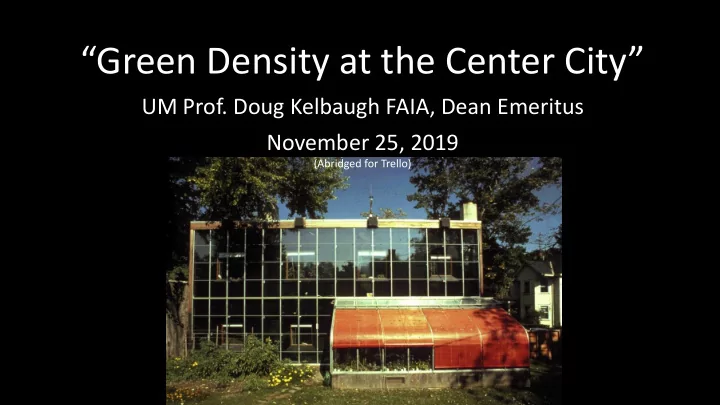
Green Density at the Center City UM Prof. Doug Kelbaugh FAIA, Dean Emeritus November 25, 2019 (Abridged for Trello) Some laws of urban scaling As cities grow, the number of interactions increases at the square of the population.


slide-1
SLIDE 1

“Green Density at the Center City”

UM Prof. Doug Kelbaugh FAIA, Dean Emeritus November 25, 2019

(Abridged for Trello)
slide-2
SLIDE 2

Some “laws” of urban scaling

  • As cities grow, the number of interactions

increases at the square of the population.

  • As cities get bigger, income and wealth

increase faster than population.

  • As cities get larger, there are less of them.
  • “Everything is related to everything else, but

near things are more related than distant things.”

  • As cities get bigger, they get more sustainable -

the environmental paradox of cities.

slide-3
SLIDE 3

Cities are very energy- and carbon- intensive.

Cities consume most of the world’s energy, and produce most of the CO2; and they are projected to get worse, and yet…

slide-4
SLIDE 4

The ”environmental paradox of cities” is counter-intuitive.

slide-5
SLIDE 5

Some cities are much “greener” than others!

slide-6
SLIDE 6

The “Urban Heat Island Effect” is the build up of

sensible heat from hot tailpipe and chimney emissions, and from dark surfaces heated by the

  • sun. It is not the same thing as greenhouse

heating of the atmosphere.

slide-7
SLIDE 7

“…large cities in the U.S. tend to be warming at more than twice the rate of the planet as a whole as a result of the loss of naturally vegetated land covers…global estimates of climate change are likely to underestimate rates

  • f warming in the very places where

most of the global population now resides: cities.”

Brian Stone, G.I.T. Urban Climate Lab

slide-8
SLIDE 8

We are SO lucky: The 4 strategies to mitigate and adapt to Urban Heat Islands are consistent with strategies to deal with Climate Change.

slide-9
SLIDE 9
  • 1. Albedo enhancement =

Lighter colored pavement and roofs

slide-10
SLIDE 10

A white roof reflects 4X solar rays as a dark roof, and is 3X more effective than a green roof against CC.

The simplest passive solar technology: white paint!

slide-11
SLIDE 11
  • 2. Less Waste Heat from tailpipes, through more walkable,

transit-oriented and less auto-dependent cities.

slide-12
SLIDE 12
  • 3. The

Urban Section – Open and lighten up street canyons, which trap heat.

slide-13
SLIDE 13

Trees are multi-taskers:

  • beautify, lend biophilic presence
  • provide cool shade
  • retain soil/prevent erosion
  • detain and retain storm water
  • sequester CO2
  • produce oxygen
  • filter particulate pollution
  • cool the air by evapo-transpiration
  • provide bird/animal habitat
  • produce flowers, fruit, fragrance
  • offer tree climbing for children
  • absorb sound
  • reduce crime
  • increase real estate values
  • wood for construction, furniture… -
  • wood for fuel
  • planting and maintenance jobs
  • humanize over-scaled urban spaces
  • soothe the psyche
  • “soak up nuclear blasts”! (Poland)
slide-14
SLIDE 14
slide-15
SLIDE 15
slide-16
SLIDE 16
slide-17
SLIDE 17

Infill housing on Liberty and Washington is compact, efficient, walkable, bike-able and transit-served.

slide-18
SLIDE 18
slide-19
SLIDE 19

Catherine and 4th Ave.

slide-20
SLIDE 20