
SLIDE 1
Graphs
Walks and Paths
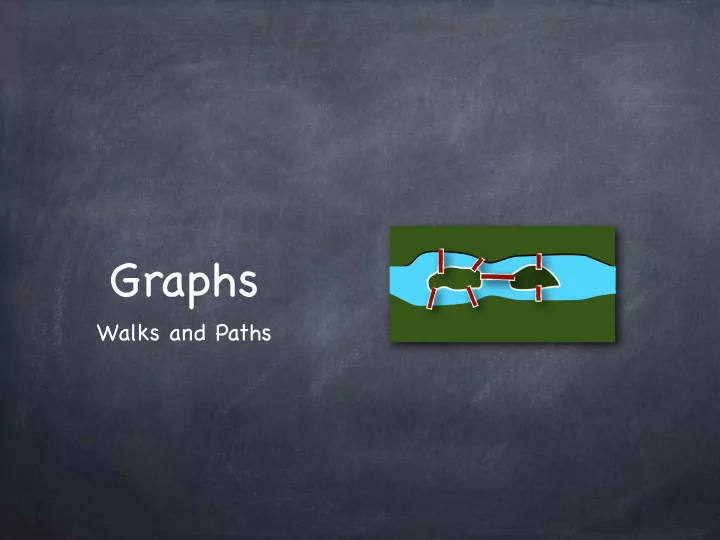
Graphs Walks and Paths Bridges of Knigsberg Cross each bridge - - PowerPoint PPT Presentation
Graphs Walks and Paths Bridges of Knigsberg Cross each bridge exactly once ?! Impossible! But how do we know for sure? Bridges of Knigsberg Cross each bridge exactly once Add a node for each bridge too, if we want it to be a simple
Walks and Paths
Cross each bridge exactly once Impossible! But how do we know for sure?
Cross each bridge exactly once Impossible! But how do we know for sure?
Add a node for each bridge too, if we want it to be a simple graph
A walk (of length k, k ≥ 0) from node a to node b is a sequence of nodes (v0, v1, ... , vk) such that v0 = a, vk = b for all i ∈ {0,...,k-1}, the edge {vi,vi+1} ∈ E Length is the number of edges in a walk. Could be 0. If a walk has no node repeating, then it is called a path If a walk of length k≥3 has v0=vk, but no other two nodes are equal, then it is called a cycle Note: we require a cycle to be of length at least 3 A graph is acyclic if it has no cycles (i.e., no Ck is a subgraph of G)
Given a graph G, whether there is a path between two nodes u and v is an important question regarding G u is said to be connected to v if there is such a path u connected to v iff there is a walk from u to v Relation Connected(u,v) is an equivalence relation Reflexive, Symmetric and Transitive Equivalence classes of this relation are called the connected components of G
Walks can be spliced together to get walks
Given a simple graph G = (V ,E), for each node v∈V , the degree of v is the number of edges incident on v Formally, deg(v) = | { u : {u,v} ∈ E } | Counting edges in two different ways: 2 ⋅ |E| = ∑v∈V deg(v) Degree sequence: sorted list of degrees. (e.g.: 0,1,2,2,3) Degree sequence invariant under isomorphism
Note: Definition restricted to simple graphs
Eulerian trail: a walk visiting every edge exactly once Eulerian trail exists → at most 2 odd degree nodes Enter(v) = { {vi-1,vi} | vi = v }, Exit(v) = { {vi,vi+1} | vi = v } partition all the edges incident on v. |Enter(v)|=|Exit(v)| for all v except the start and end nodes of the walk. Eulerian circuit: a closed walk visiting every edge exactly once Eulerian circuit exists → no odd degree nodes If no odd degree nodes and all edges in one connected component, then must have an Eulerian circuit! Proof sketch: Must be cyclic [Why?] Remove a cycle: still no
connected component in the remaining graph. Can stitch them all onto the removed cycle into one circuit.
Eulerian circuit: a closed walk visiting every edge exactly once Eulerian circuit exists ⟷ all edges in the same connected component and no odd degree nodes Can efficiently find one if they exist Hamiltonian Cycle: a cycle that contains all the nodes in the graph No efficient algorithm known to check if a graph has a Hamiltonian cycle! An “NP-hard” problem. Widely believed that no efficient algorithm exists! (cf. Graph Isomorphism: It is believed to be hard, but also believed to be not NP-hard)
Shortest walk between nodes u and v is always a path Shortest path is of great interest in many applications e.g., nodes correspond to locations on a map and edges are roads, optic fibers etc. Also, graph can be used to model probabilistic processes, with shortest path indicating the most likely outcome Length of the shortest path between u and v is called the distance between u and v (∞ if no path) Diameter is the largest distance in a graph (can be ∞)
In many applications, the edges on the graph will have “lengths”. In simple graphs, all edges are of length 1.
min W: u-v walk Length(W) maxu,v Distance(u,v) = maxu,v minW: u-v walk Length(W)
Prove via contradiction Hence, ∃ walk → ∃ path
Obvious example: nodes correspond to locations on a map and edges are roads, optic fibers etc. Weighted edges: each edge has its own “length” (instead of 1) But also over more abstract graphs e.g., Graph-based models in AI/machine-learning for modeling probabilistic systems e.g., a graph, modeling speech production: nodes correspond to various “states” the vocal chords/lips etc. could be in while producing a given a sound sequence. Edges show transitions (next state) over time. Shortest path in this graph gives the “most likely” word that was spoken.
Graphs in action