Gradual Program Verification (with Implicit Dynamic Frames) Johannes - - PowerPoint PPT Presentation

gradual program verification
SMART_READER_LITE
LIVE PREVIEW

Gradual Program Verification (with Implicit Dynamic Frames) Johannes - - PowerPoint PPT Presentation

Gradual Program Verification (with Implicit Dynamic Frames) Johannes Bader , Karlsruhe Institute of Technology / Microsoft Jonathan Aldrich , Carnegie Mellon University ric Tanter , University of Chile int getFour(int i) requires ?; // not sure


slide-1
SLIDE 1

Gradual Program Verification

(with Implicit Dynamic Frames)

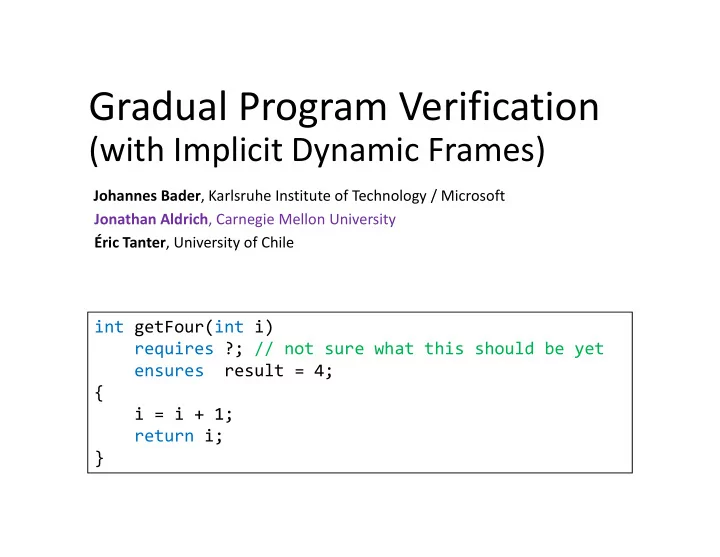
int getFour(int i) requires ?; // not sure what this should be yet ensures result = 4; { i = i + 1; return i; }

Johannes Bader, Karlsruhe Institute of Technology / Microsoft Jonathan Aldrich, Carnegie Mellon University Éric Tanter, University of Chile

slide-2
SLIDE 2

Motivation

  • Program verification (against some specification)
  • Two flavors: dynamic & static

// spec: callable only if (this.balance >= amount) void withdrawCoins(int amount) { // business logic this.balance ‐= amount; }

3 Johannes Bader Gradual Verification

slide-3
SLIDE 3

// spec: callable only if (this.balance >= amount) void withdrawCoins(int amount) { // business logic this.balance ‐= amount; }

Dynamic Verification

  • runtime checks
  • testing techniques
  • guarantee compliance at run time

void withdrawCoins(int amount) { assert this.balance >= amount; // business logic this.balance ‐= amount; }

4 Johannes Bader Gradual Verification

slide-4
SLIDE 4

Dynamic Verification – Drawbacks

  • runtime checks
  • testing techniques
  • guarantee compliance at run time

void withdrawCoins(int amount) { assert this.balance >= amount; // business logic this.balance ‐= amount; } runtime overhead additional effort late detection

5 Johannes Bader Gradual Verification

slide-5
SLIDE 5

Static Verification

  • declarative
  • formal logic
  • guarantee compliance in advance

void withdrawCoins(int amount) requires this.balance >= amount; { // business logic this.balance ‐= amount; }

6 Johannes Bader Gradual Verification

slide-6
SLIDE 6

Static Verification – Drawbacks

  • declarative
  • formal logic
  • guarantee compliance in advance

void withdrawCoins(int amount) requires this.balance >= amount; { // business logic this.balance ‐= amount; } limited expressiveness and/or decidability annotation overhead (viral) void withdrawCoins(int amount) requires this.balance >= amount; ensures this.balance == old(this.balance) – amount; { // business logic this.balance ‐= amount; }

7 Johannes Bader Gradual Verification

slide-7
SLIDE 7

Viral Specifications

… acc.balance = 100; acc.withdrawCoins(50); // statically checks OK! acc.withdrawCoins(30); // oops, don’t know balance!

Johannes Bader Gradual Verification 8

void withdrawCoins(int amount) requires this.balance >= amount; { // business logic this.balance ‐= amount; } void withdrawCoins(int amount) requires this.balance >= amount; ensures this.balance == old(this.balance) – amount; { // business logic this.balance ‐= amount; }

Can only remove false warnings by adding specifications Specification becomes almost all‐or‐nothing; keep getting warnings until spec is highly complete. Want gradual return on investment—reasonable behavior at every level of specification.!
slide-8
SLIDE 8

Solution: Combining Static + Dynamic

  • Hybrid approach
  • Static checking, but failure is only a warning
  • Run‐time assertions catch anything missed statically
  • Benefits

+ Catch some errors early + Still catch remaining errors dynamically + Can eliminate run‐time overhead if an assertion is statically discharged

  • Drawbacks

‐ Still false positive warnings / viral specification problem ‐ Run‐time checking may still impose too much overhead, and/or is an open problem (e.g. for implicit dynamic frames)

  • Challenges / opportunities
  • Can we warn statically only if there is a definite error, and avoid viral specifications?
  • Can we reduce run‐time overhead when we have partial information?
  • How to support dynamic checks for more powerful specification approaches (e.g. implicit

dynamic frames)

9 Johannes Bader Gradual Verification

slide-9
SLIDE 9

Engineering Verification

  • Ideal: an engineering approach to verification
  • Choose what to specify based on costs, benefits
  • May focus on critical components
  • Leave others unspecified
  • May focus on certain properties
  • Those most critical to users
  • Those easiest to verify
  • May add more specifications over time
  • Want incremental costs/rewards
  • Viral nature of static checkers makes this difficult
  • Warnings when unspecified code calls specified code
  • May have to write many extra specifications to verify the
  • nes you care about

Johannes Bader Gradual Verification 10

slide-10
SLIDE 10

void withdrawCoins(int amount) requires ?; ensures ?;

Gradual Verification

A verification approach that supports gradually adding specifications to a program

  • Novel feature: support unknown and imprecise specs
  • Analogous to Gradual Typing [Siek & Taha, 2006]

Johannes Bader Gradual Verification 11

void withdrawCoins(int amount) requires ? && this.balance >= amount; ensures ?; void withdrawCoins(int amount) requires ? && this.balance >= amount; ensures ? && this.balance < old(this.balance); void withdrawCoins(int amount) requires amount > 0 && this.balance >= amount; ensures ? && this.balance < old(this.balance); void withdrawCoins(int amount) requires amount > 0 && this.balance >= amount; ensures this.balance = old(this.balance) – amount;

slide-11
SLIDE 11

Gradual Verification

A verification approach that supports gradually adding specifications to a program

  • Novel feature: support unknown and imprecise specs
  • Warning if we statically detect an inconsistency
  • The spec above would be statically OK with a ? added to

the precondition, or an assertion that amount > 0

  • But the given precondition alone can’t assure the part of

the postcondition that we know

Johannes Bader Gradual Verification 12

void withdrawCoins(int amount) requires this.balance >= amount; ensures ? && this.balance < old(this.balance);

slide-12
SLIDE 12

Gradual Verification

A verification approach that supports gradually adding specifications to a program

  • Novel feature: support unknown and imprecise specs
  • Warning if we statically detect an inconsistency
  • Warning if spec is violated at run time

acc.balance = 100; acc.withdrawCoins(50); // statically guaranteed safe acc.withdrawCoins(30); // dynamic check OK acc.withdrawCoins(30); // dynamic check: error!

Johannes Bader Gradual Verification 13

void withdrawCoins(int amount) requires ? && this.balance >= amount; ensures ? && this.balance < old(this.balance);

slide-13
SLIDE 13

Gradual Verification

A verification approach that supports gradually adding specifications to a program

  • Novel feature: support unknown and imprecise specs
  • Engineering properties
  • Same as dynamic verification when specs fully imprecise
  • Same as static verification when specs fully precise
  • Applies to any part of the program whose code and libraries used

are specified precisely

  • Smooth path from dynamic to static checking (non‐viral)
  • Gradual Guarantee [Siek et al. 2015]: Given a verified program and

correct input, no static or dynamic errors will be raised for the same program and input with a less‐precise specification

Johannes Bader Gradual Verification 14

slide-14
SLIDE 14

True ≠ ?

  • Prior verifiers are not “gradual”
  • No support for imprecise/unknown specifications
  • Treating missing specs as “true” is insufficient

class Account { void withdrawCoins(int amount) requires this.balance >= amount; ensures true; ... } Account a = new Account(100) a.withdrawCoins(40); a.withdrawCoins(30); // error: only know “true” here

Johannes Bader Gradual Verification 15

slide-15
SLIDE 15

True ≠ ?

  • Prior verifiers are not “gradual”
  • No support for imprecise/unknown specifications
  • Treating missing specs as “true” is insufficient

class Account { void withdrawCoins(int amount) requires this.balance >= amount; ensures ?; ... } Account a = new Account(100) a.withdrawCoins(40); a.withdrawCoins(30); // OK: ? consistent with precondition

Johannes Bader Gradual Verification 16

slide-16
SLIDE 16

Gradual Verification Roadmap

  • Motivation and Intuition
  • Engineering: need good support for partial specs
  • Key new idea: a (partly) unknown spec: “?”
  • Overview: Abstracting Gradual Verification
  • A static verification system
  • Deriving a gradual verification system
  • Demonstration!
  • Extension to Implicit Dynamic Frames

Johannes Bader Gradual Verification 17

slide-17
SLIDE 17

Gradual Verification Roadmap

  • Motivation and Intuition
  • Engineering: need good support for partial specs
  • Key new idea: a (partly) unknown spec: “?”
  • Overview: Abstracting Gradual Verification
  • A static verification system
  • Deriving a gradual verification system
  • Demonstration!
  • Extension to Implicit Dynamic Frames

Johannes Bader Gradual Verification 18

slide-18
SLIDE 18

Inspiration: Gradual Typing [Siek & Taha, 2006]

  • Allows programmers to selectively omit types
  • Mixing dynamically‐typed code (e.g. as in Python) with statically‐typed

code

  • Missing types denoted with a “?” or “dynamic” keyword
  • Can have “partly dynamic” types like “? ‐> int”

Johannes Bader Gradual Verification 19

slide-19
SLIDE 19

Abstracting Gradual Typing [Garcia et al., 2016]

  • Semantic foundation for Gradual Typing
  • Gradual types represent sets of possible static types
  • Use abstract interpretation to derive gradual type system from static type

system

Johannes Bader Gradual Verification 20

Gradual System Static System

gradual lifting

slide-20
SLIDE 20

How does this relate to Verification?

Johannes Bader Gradual Verification 21

int getFour(int i) requires ?; // not sure what this should be yet ensures result = 4; { i = i + 1; return i; }

Types restrict which values are valid for a certain variable Formulas restrict which program states are valid at a certain point during execution

slide-21
SLIDE 21

Abstracting Gradual Typing

22 Johannes Bader Gradual Verification

Gradual System Static System

Ronald Garcia, Alison M. Clark, and Éric Tanter

slide-22
SLIDE 22

Abstracting Gradual Typing

23 Johannes Bader Gradual Verification

Gradual System Static System

Ronald Garcia, Alison M. Clark, and Éric Tanter Verification

slide-23
SLIDE 23

Abstracting Gradual Typing

24 Johannes Bader Gradual Verification

Gradual System Static System

Ronald Garcia, Alison M. Clark, and Éric Tanter Verification Benefits: if we choose , , and  to create a sound abstraction, we automatically get:

  • The gradual guarantee: a smooth path

from dynamic to static verification

  • A principled approach to optimizing run‐

time assertion checking

slide-24
SLIDE 24

Gradualization – Overview

25 25

Gradualization

Johannes Bader Gradual Verification

slide-25
SLIDE 25

Gradualization – Starting Point

26 26 Johannes Bader Gradual Verification

slide-26
SLIDE 26

Gradualization – Starting Point

27 27 Johannes Bader Gradual Verification

slide-27
SLIDE 27

Gradualization – Starting Point

28 28 Johannes Bader Gradual Verification

slide-28
SLIDE 28

Gradualization – Starting Point

29 29 Johannes Bader Gradual Verification

slide-29
SLIDE 29

Gradualization – Starting Point

30 30 Johannes Bader Gradual Verification

slide-30
SLIDE 30

Gradualization – Starting Point

31 31 Johannes Bader Gradual Verification

Semantic validity of Hoare triples

slide-31
SLIDE 31

Gradualization – Overview

32 32

Gradualization

Johannes Bader Gradual Verification

slide-32
SLIDE 32

Gradualization – Approach

33

syntax extension

Johannes Bader Gradual Verification

Design Principles Concrete Design

slide-33
SLIDE 33

Gradualization – Approach

34

syntax extension

Johannes Bader Gradual Verification

Design Principles Concrete Design

slide-34
SLIDE 34

Sidebar: Why Must ? Be Satisfiable?

  • Should “?  (x = 3)” imply “x = 2”?
  • Intuitively, no
  • But if we choose ? to be 0=1, the implication would

(vacuously) hold

  • (x = 2) would be similarly problematic
  • Thus the completed formula must be satisfiable

Johannes Bader Gradual Verification 35

slide-35
SLIDE 35

Gradualization – Approach

36

syntax extension

Johannes Bader Gradual Verification

syntax extension Design Principles Concrete Design

slide-36
SLIDE 36

37 Johannes Bader Gradual Verification

Gradual System Static System

Gradual Lifting

slide-37
SLIDE 37

Gradualization – Approach

38

syntax extension

Johannes Bader Gradual Verification

syntax extension Design Principles Concrete Design extension

slide-38
SLIDE 38

Gradual Lifting

39 Johannes Bader Gradual Verification

Gradual System Static System

slide-39
SLIDE 39

Gradual Lifting

40 Johannes Bader Gradual Verification

Gradual System Static System

slide-40
SLIDE 40

Gradual Lifting

41 Johannes Bader Gradual Verification

Gradual System Static System

slide-41
SLIDE 41

Gradual Verification ‐ Approach

42

syntax extension

Johannes Bader Gradual Verification

syntax extension extension function lifting predicate lifting predicate lifting

slide-42
SLIDE 42

Predicate Lifting in a Nutshell

Johannes Bader Gradual Verification 43

lifting

slide-43
SLIDE 43

Predicate Lifting in a Nutshell

Johannes Bader Gradual Verification 44

all gradually lifted predicates satisfy

slide-44
SLIDE 44

Predicate Lifting in a Nutshell

Johannes Bader Gradual Verification 45

all gradually lifted predicates satisfy

slide-45
SLIDE 45

Lifting Dynamic Semantics

  • We borrow the idea of evidence from AGT
  • Intuitively, a witness for why a judgment holds, e.g.
  • The contents of variables witnesses a well‐formed

configuration

  • A pair of representative concrete formulas witnesses that one

gradual formula can imply another

Johannes Bader Gradual Verification 46

Want evidence for Example evidence: Want most general evidence – a valid piece of evidence that generalizes all

  • thers (e.g. pre‐ and post‐states are implied by those of other valid evidence).

The evidence above is the most general evidence for the example implication.

slide-46
SLIDE 46

Lifting Dynamic Semantics

  • We borrow the idea of evidence from AGT
  • Intuitively, a witness for why a judgment holds, e.g.
  • The contents of variables witnesses a well‐formed

configuration

  • A pair of representative concrete formulas witnesses that one

gradual formula can imply another

  • When program executes, we combine evidence
  • E.g. combine the evidence for the current program

configuration with the evidence for the next statement, to yield the next program configuration

  • Or an error if the next program configuration is not well‐

formed – could happen if gradual spec was too approximate

  • Conveniently, combining evidence is equivalent to

checking assertions in program text!

Johannes Bader Gradual Verification 47

slide-47
SLIDE 47

Optimization: Checking Residuals

  • If we know some information statically, we may not

need to verify all of an assertion

  • We compute the residual of a run‐time check
  • Assume we are checking B and we know A. Assume B is in

conjuctive normal form. Example:

  • A = (x > 5)
  • B = (y > x  y > 4)
  • We remove any conjunct of B that is implied by A and the

remaining conjuncts of B.

  • Example: residual is (y > x)
  • Best case: static verification (A implies B)
  • All run‐time checking is removed!

Johannes Bader Gradual Verification 48

slide-48
SLIDE 48

Some Theorems

(stated formally in our draft paper, but have not laid the groundwork here)

  • Soundness: standard progress and preservation
  • Note: run‐time errors may occur due to assertion

failures

  • Static gradual guarantee: if a program checks

statically, it will still do so if the precision of its specifications is reduced

  • Dynamic gradual guarantee: if a program executes

without error, it will still do so if the precision of its specifications is reduced

  • We get the last two “for free” based on the

properties of abstract interpretation

Johannes Bader Gradual Verification 49

slide-49
SLIDE 49

Demonstration

http://olydis.github.io/GradVer/impl/HTML5wp/

Johannes Bader Gradual Verification 50

slide-50
SLIDE 50

The Challenge of Aliasing

Johannes Bader Gradual Verification 51

Not valid if p1 = p2! Traditional Hoare Logic solution {(p1.age = 19)  (p2.age = 19)  p1 ≠ p2} p1.age++ {(p1.age = 20)  (p2.age = 19)  p1 ≠ p2} Issue: scalability. What if we have 4 pointers? {...  p1 ≠ p2  p1 ≠ p3  p1 ≠ p4  p2 ≠ p3  p2 ≠ p4  p3 ≠ p4} Alias information scales quadratically (n * n‐1) with the number of pointer variables!

slide-51
SLIDE 51

Implicit Dynamic Frames [Smans et al. 2009]

Johannes Bader Gradual Verification 52

Not valid if p1 = p2! OK! p1 and p2 may not overlap Implicit Dynamic Frames rules:

  • acc(p1.age) denotes permission to access p1.age
  • if p1.age is used in a formula, acc(p1.age) must appear earlier (‘self‐framing’)
  • acc(x.f) may only appear once for each object/field combination
slide-52
SLIDE 52

{ P } S { Q } R is self‐framed

The Frame Rule

  • Example application

{ acc(p1.age) * p1.age = 19 * acc(p2.age) * p2.age = 19 } p1.age++ { /* what goes here? */ }

Johannes Bader Gradual Verification 53

{ P * R } S { Q * R }

slide-53
SLIDE 53

{ P * R } S { Q * R } R is self‐framed

The Frame Rule

  • Example application

{ acc(p1.age) * p1.age = 19 * acc(p2.age) * p2.age = 19 } p1.age++ { /* what goes here? */ }

Johannes Bader Gradual Verification 54

{ P * R } S { Q * R } note: R is self‐framed!

slide-54
SLIDE 54

{ P * R } S { Q * R } R is self‐framed

The Frame Rule

  • Example application

{ acc(p1.age) * p1.age = 19 * R } p1.age++ { acc(p1.age) * p1.age = 20 * R }

Johannes Bader Gradual Verification 55

{ P * R } S { Q * R } Apply the normal assignment rule

slide-55
SLIDE 55

{ P * R } S { Q * R } R is self‐framed

The Frame Rule

  • Example application

{ acc(p1.age) * p1.age = 19 * acc(p2.age) * p2.age = 19 } p1.age++ { acc(p1.age) * p1.age = 20 * acc(p2.age) * p2.age = 19 }

Johannes Bader Gradual Verification 56

{ P * R } S { Q * R } Frame back on the rest of the formula

slide-56
SLIDE 56

{ P * R } S { Q * R } R is self‐framed

The Frame Rule

  • Anti‐example

{ acc(p1.age) * p1.age = 19 * p2.age = 19 } p1.age++ { /* what goes here? */ }

Johannes Bader Gradual Verification 57

{ P * R } S { Q * R } R is not self‐framed. Cannot apply the frame rule!

slide-57
SLIDE 57

{ P * R } S { Q * R } R is self‐framed

The Frame Rule

  • Anti‐example

{ acc(p1.age) * p1.age = 19 * p2.age = 19 } p1.age++ { acc(p1.age) * p1.age = 20 }

Johannes Bader Gradual Verification 58

{ P * R } S { Q * R } R is not self‐framed. Cannot apply the frame rule! The best we can do is drop the unframed information from the formula

slide-58
SLIDE 58

Gradual Implicit Dynamic Frames

Johannes Bader Gradual Verification 59

Not valid if p1 = p2! OK! p1 and p2 may not overlap OK statically; requires run‐time check Useful if you don’t want to specify whether p1 and p2 alias: ? could be “acc(p1.age) && p1 = p2”

slide-59
SLIDE 59

Consequences of Implicit Dynamic Frames

  • Gradual types can help with self‐framing
  • We can ignore frames just by writing “?  P” where P does

not include acc(…)

  • Any invalid assumptions due to framing will be caught at run time
  • We can always add framing later
  • Evidence: must track ownership of heap in the runtime
  • Allows for testing acc(x.f) in assertions
  • Of course, in statically verified code we can optimize this

away!

  • Residual testing gets more interesting. Example:
  • A = (?  x.f = 2)
  • B = (acc(x.f)  x.f =2  y = 5)
  • Residual is y = 5
  • Don’t need to check acc(x.f) because ? must include acc(x.f) for the

x.f = 2 statement to be well‐formed

Johannes Bader Gradual Verification 60

slide-60
SLIDE 60

Demonstration: Implicit Dynamic Frames

Johannes Bader Gradual Verification 61

slide-61
SLIDE 61

Gradual Verification

  • Engineering approach to verification
  • Choose what properties & components to specify
  • Support for unknown formulas ?
  • Model partly specified properties, components
  • Semantically: replace with anything that leaves the formula

satisfiable

  • Gradual Verification
  • Derived as an abstraction of static verification
  • Gradual guarantee: making formulas less precise will not

cause compile‐time or run‐time failures

  • Future work
  • Efficient implementation
  • Richer verification system

Johannes Bader Gradual Verification 62