Google matrix of the world trade network Leonardo Ermann and Dima - - PowerPoint PPT Presentation

google matrix of the world trade network
SMART_READER_LITE
LIVE PREVIEW

Google matrix of the world trade network Leonardo Ermann and Dima - - PowerPoint PPT Presentation

Google matrix of the world trade network Leonardo Ermann and Dima Shepelyansky (CNRS, Toulouse) www.quantware.ups-tlse.fr/dima * Quantware group: classical/quantum chaos, dynamical systems, large matrices * How Google search works, PageRank,


slide-1
SLIDE 1

Google matrix

  • f the world trade network

Leonardo Ermann and Dima Shepelyansky (CNRS, Toulouse) www.quantware.ups-tlse.fr/dima

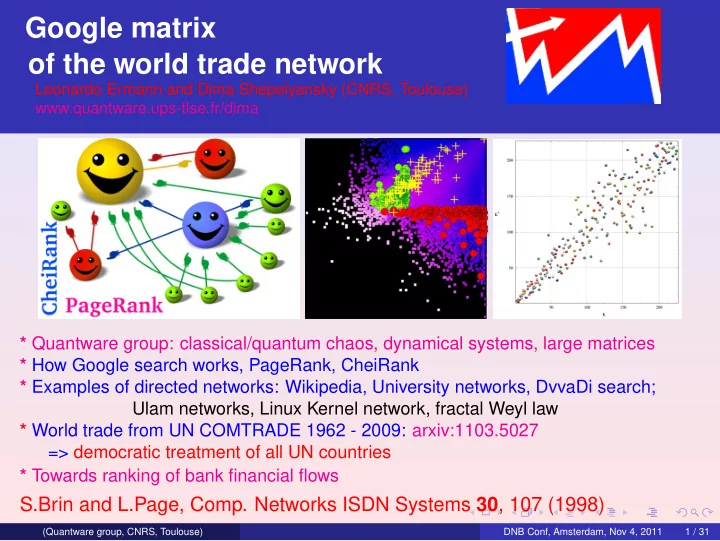
* Quantware group: classical/quantum chaos, dynamical systems, large matrices * How Google search works, PageRank, CheiRank * Examples of directed networks: Wikipedia, University networks, DvvaDi search; Ulam networks, Linux Kernel network, fractal Weyl law * World trade from UN COMTRADE 1962 - 2009: arxiv:1103.5027 => democratic treatment of all UN countries * Towards ranking of bank financial flows

S.Brin and L.Page, Comp. Networks ISDN Systems 30, 107 (1998)

(Quantware group, CNRS, Toulouse) DNB Conf, Amsterdam, Nov 4, 2011 1 / 31

slide-2
SLIDE 2

How Google works

Markov chains (1906) and Directed networks

5 1 2 3 4 6 7

Weighted adjacency matrix S =          

1 3 1 3 1 2 1 3

1 1 1

1 2

1           For a directed network with N nodes the adjacency matrix A is defined as Aij = 1 if there is a link from node j to node i and Aij = 0 otherwise. The weighted adjacency matrix is Sij = Aij/

  • k

Akj In addition the elements of columns with only zeros elements are replaced by 1/N.

(Quantware group, CNRS, Toulouse) DNB Conf, Amsterdam, Nov 4, 2011 2 / 31

slide-3
SLIDE 3

How Google works

Google Matrix and Computation of PageRank

P = SP ⇒ P= stationary vector of S; can be computed by iteration of S. To remove convergence problems: Replace columns of 0 (dangling nodes) by 1

N :

S =          

1 7 1 3 1 7 1 3 1 7 1 2 1 3 1 7

1 1 1

1 7 1 2

1

1 7 1 7

          ; S∗ =          

1 7

1

1 2 1 4 1 7 1 7

1

1 7 1 7 1 7 1 7 1 2

1

1 7 1 7 1 4 1 7 1 7 1 4 1 7 1 7 1 4 1 7

          . To remove degeneracies of λ = 1, replace S by Google matrix

G = αS + (1 − α) E

N ;

GP = λP

=> Perron-Frobenius operator

α models a random surfer with a random jump after approximately 6 clicks (usually α = 0.85); PageRank vector => P at λ = 1 (

j Pj = 1).

CheiRank vector P∗: G∗ = αS∗ + (1 − α) E

N , G∗P∗ = P∗

(S∗ with inverted link directions) Fogaras (2003) ... Chepelianskii arXiv:1003.5455 (2010) ...

(Quantware group, CNRS, Toulouse) DNB Conf, Amsterdam, Nov 4, 2011 3 / 31

slide-4
SLIDE 4

Real directed networks

Real networks are characterized by: small world property: average distance between 2 nodes ∼ log N scale-free property: distribution of the number of ingoing or outgoing links ρ(k) ∼ k−ν PageRank vector for large WWW: P(K) ∼ 1/K β, where K is the ordered rank index number of nodes Nn with PageRank P scales as Nn ∼ 1/Pν with numerical values ν = 1 + 1/β ≈ 2.1 and β ≈ 0.9. PageRank P(K) on average is proportional to the number of ingoing links CheiRank P∗(K ∗) ∼ 1/K ∗β on average is proportional to the number of

  • utgoing links (ν ≈ 2.7; β = 1/(ν − 1) ≈ 0.6)

WWW at present: ∼ 1011 web pages Donato et al. EPJB 38, 239 (2004)

(Quantware group, CNRS, Toulouse) DNB Conf, Amsterdam, Nov 4, 2011 4 / 31

slide-5
SLIDE 5

From Encyclopédie (1751) to Wikipedia (2009)

“The library exists ab aeterno.” Jorge Luis Borges The Library of Babel, Ficciones

(Quantware group, CNRS, Toulouse) DNB Conf, Amsterdam, Nov 4, 2011 5 / 31

slide-6
SLIDE 6

Wikipedia ranking of human knowledge

Wikipedia English articles N = 3282257 dated Aug 18, 2009

  • 15
  • 10
  • 5

5 10 15

ln P, ln P ∗ ln K, ln K∗

Dependence of probability of PagRank P (red) and CheiRank P∗ (blue) on corresponding rank indexes K, K ∗; lines show slopes β = 1/(ν − 1) with β = 0.92; 0.57 respectively for ν = 2.09; 2.76.

[Zhirov, Zhirov, DS EPJB 77, 523 (2010)]

(Quantware group, CNRS, Toulouse) DNB Conf, Amsterdam, Nov 4, 2011 6 / 31

slide-7
SLIDE 7

Two-dimensional ranking of Wikipedia articles

Density distribution in plane of PageRank and CheiRank indexes (ln K, ln K∗): (a)100 top countries from 2DRank (red), 100 top from SJR (yellow), 30 Dow-Jones companies (cyan); (b)100 top universities from 2DRank (red) and Shanghai (yellow); (c)100 top personalities from PageRank (green), CheiRank (red) and Hart book (yellow); (d)758 physicists (green) and 193 Nobel laureates (red). (Quantware group, CNRS, Toulouse) DNB Conf, Amsterdam, Nov 4, 2011 7 / 31

slide-8
SLIDE 8

Wikipedia ranking of universities, personalities

Universities: PageRank: 1. Harvard, 2. Oxford, 3. Cambridge, 4. Columbia, 5. Yale, 6. MIT, 7. Stanford, 8. Berkeley, 9. Princeton, 10. Cornell. 2DRank: 1. Columbia, 2. U. of Florida, 3. Florida State U., 4. Berkeley, 5. Northwestern U., 6. Brown, 7. U. Southern CA, 8. Carnegie Mellon, 9. MIT, 10. U. Michigan. CheiRank: 1. Columbia, 2. U. of Florida, 3. Florida State U., 4. Brooklyn College, 5. Amherst College, 6. U. of Western Ontario, 7. U. Sheffield, 8. Berkeley, 9. Northwestern U., 10. Northeastern U. Personalities: PageRank: 1. Napoleon I of France, 2. George W. Bush, 3. Elizabeth II of the United Kingdom, 4. William Shakespeare, 5. Carl Linnaeus, 6. Adolf Hitler, 7. Aristotle, 8. Bill Clinton, 9. Franklin D. Roosevelt, 10. Ronald Reagan. 2DRank: 1. Michael Jackson, 2. Frank Lloyd Wright, 3. David Bowie, 4. Hillary Rodham Clinton, 5. Charles Darwin, 6. Stephen King, 7. Richard Nixon, 8. Isaac Asimov, 9. Frank Sinatra, 10. Elvis Presley. CheiRank: 1. Kasey S. Pipes, 2. Roger Calmel, 3. Yury G. Chernavsky, 4. Josh Billings (pitcher), 5. George Lyell, 6. Landon Donovan, 7. Marilyn C. Solvay, 8. Matt Kelley, 9. Johann Georg Hagen, 10. Chikage Oogi.

(Quantware group, CNRS, Toulouse) DNB Conf, Amsterdam, Nov 4, 2011 8 / 31

slide-9
SLIDE 9

Correlator of PageRank and CheiRank

10

2

10

3

10

4

10

5

10

6

10

7

N

2 4 6 8

κ

Wikipedia Brain Model British Universities Kernel Linux Yeast Transcription

  • Esch. Coli Transcr.

Business Proc. Man.

κ = N

i P(K(i))P∗(K ∗(i)) − 1

(Quantware group, CNRS, Toulouse) DNB Conf, Amsterdam, Nov 4, 2011 9 / 31

slide-10
SLIDE 10

Spectrum of UK University networks

Arnoldi method: Spectrum of Google matrix for Univ. of Cambridge (left) and Oxford (right) in 2006 (N ≈ 200000, α = 1). [Frahm, Georgeot, DS arxiv:1105.1062 (2011)]

(Quantware group, CNRS, Toulouse) DNB Conf, Amsterdam, Nov 4, 2011 10 / 31

slide-11
SLIDE 11

World trade network (WTN)

  • f United Nations COMTRADE 1962-2009

50 100 150 200

N,<NL>

1960 1970 1980 1990 2000 2010 10

11

10

12

10

13

MT [$USD]

Number of countries (black), links (dashed/points) and mass volume in USD (red)

Leonardo Ermann, DS arxiv:1103.5027 (2011)

(Quantware group, CNRS, Toulouse) DNB Conf, Amsterdam, Nov 4, 2011 11 / 31

slide-12
SLIDE 12

PageRank, CheiRank of World Trade

10

  • 4

10

  • 3

10

  • 2

10

  • 1

1 10 100

K,K*,K,K*

10

  • 4

10

  • 3

10

  • 2

10

  • 1

P,P*,P,P*

~ ~ ~ ~

Year 2008: Probabilities of PageRank P(K) (red), CheiRank P∗(K ∗) (blue) for all commodities (top) and crude petroleum (bottom), α = 0.5; 0.85 (full/dotted); (dashed curves are for ImportRank, ExportRank); dashed line Zipf law P ∼ 1/K; 227 countries

(Quantware group, CNRS, Toulouse) DNB Conf, Amsterdam, Nov 4, 2011 12 / 31

slide-13
SLIDE 13

Ranking of World Trade

2008: All commodities

50 100 150 200 50 100 150 200 K* K a)

(Quantware group, CNRS, Toulouse) DNB Conf, Amsterdam, Nov 4, 2011 13 / 31

slide-14
SLIDE 14

Ranking of World Trade

2008: All commodities

10 20 30 40 10 20 30 40 K* K b)

(Quantware group, CNRS, Toulouse) DNB Conf, Amsterdam, Nov 4, 2011 14 / 31

slide-15
SLIDE 15

Ranking of World Trade

2008: Crude petroleum

50 100 150 200 50 100 150 200 K* K c)

(Quantware group, CNRS, Toulouse) DNB Conf, Amsterdam, Nov 4, 2011 15 / 31

slide-16
SLIDE 16

Ranking of World Trade

2008: Crude petroleum

10 20 30 40 10 20 30 40 K* K d)

(Quantware group, CNRS, Toulouse) DNB Conf, Amsterdam, Nov 4, 2011 16 / 31

slide-17
SLIDE 17

Mass flow on World Trade Network (WTN)

RMT model Mij = ǫiǫj/ij (all commod. 1962/2008 left/right top; petroleum left bottom; model right bottom)

(Quantware group, CNRS, Toulouse) DNB Conf, Amsterdam, Nov 4, 2011 17 / 31

slide-18
SLIDE 18

Global distribution for WTN

All commodities 1962-2009

K*+K

1 456

K*−K

100 −100 2

(K*+K)/N (K*−K)/N 0.5

−0.5

(Quantware group, CNRS, Toulouse) DNB Conf, Amsterdam, Nov 4, 2011 18 / 31

slide-19
SLIDE 19

Global distribution for WTN

All commodities 1962-2009: left - zoom, right - RMT model

(K*−K)/N (K*−K)/N (K*+K)/N

1 −0.25 0.25 −0.25 0.25

The poor stay poor and the rich stay rich

(Quantware group, CNRS, Toulouse) DNB Conf, Amsterdam, Nov 4, 2011 19 / 31

slide-20
SLIDE 20

Velocity fluctuations for WTN

1962-2009: Rank velocity fluctuations (∆v)2 = (∆K)2 + (∆K ∗)2

200 400 600 800

∆v

2

100 200 300 400

K+K*

10 20 30 40

ρ

(Quantware group, CNRS, Toulouse) DNB Conf, Amsterdam, Nov 4, 2011 20 / 31

slide-21
SLIDE 21

Rank evolution in time

2 4 6 8

K jp de gb us fr

2 4 6 8 10

K*

1960 1980 2000

year

20 40 60

K ar cn in ru

1960 1980 2000

year

20 40

K*

(Quantware group, CNRS, Toulouse) DNB Conf, Amsterdam, Nov 4, 2011 21 / 31

slide-22
SLIDE 22

Netherlands Rank evolution in time

1960 1970 1980 1990 2000 2010

years

2 4 6 8 10 12

Rank K, K

*

(Quantware group, CNRS, Toulouse) DNB Conf, Amsterdam, Nov 4, 2011 22 / 31

slide-23
SLIDE 23

Rank evolution in time

200 400 600 1960 1970 1980 1990 2000 2010

years

0.1 1 10 100

∆v

2

Top: 1 ≤ K + K ∗ ≤ 40; 41 ≤ K + K ∗ ≤ 80; 81 ≤ K + K ∗ ≤ 120; Bottom: 1 ≤ K + K ∗ ≤ 20; 21 ≤ K + K ∗ ≤ 40; 41 ≤ K + K ∗ ≤ 60

(Quantware group, CNRS, Toulouse) DNB Conf, Amsterdam, Nov 4, 2011 23 / 31

slide-24
SLIDE 24

Rank table 2008 (74% of countries of G20)

(Quantware group, CNRS, Toulouse) DNB Conf, Amsterdam, Nov 4, 2011 24 / 31

slide-25
SLIDE 25

Rank table 2008

(Quantware group, CNRS, Toulouse) DNB Conf, Amsterdam, Nov 4, 2011 25 / 31

slide-26
SLIDE 26

Google matrix of multiproduct trade 2008

CheiRank vs. PageRank for multiproduct trade at Np = 182 for Nc = 227 UN COMTRADE countries in 2008; 3 models of product coupling (full, dotted, dashed curves) L.Ermann, DS (in progress)

(Quantware group, CNRS, Toulouse) DNB Conf, Amsterdam, Nov 4, 2011 26 / 31

slide-27
SLIDE 27

Petroleum price effect on ranking of trade 2008

0.5 1 1.5 2

petroleum price

10 20 30

K*

France Saudi Arabia Norway Netherlands Russia 0.5 1 1.5 2

petroleum price

10 20 30

K

France Saudi Arabia Norway Netherlands Russia

CheiRank K ∗, PageRank K variation with petroleum price in respect to price

  • f 2008

L.Ermann, DS (in progress)

(Quantware group, CNRS, Toulouse) DNB Conf, Amsterdam, Nov 4, 2011 27 / 31

slide-28
SLIDE 28

Towards bank financial network ranking

K.Soramäki et al., The topology of interbank payment flows, Physica A 379, 317 (2007)

(Quantware group, CNRS, Toulouse) DNB Conf, Amsterdam, Nov 4, 2011 28 / 31

slide-29
SLIDE 29

Google Matrix Applications

practically to everything .... more data at http://www.quantware.ups-tlse.fr/QWLIB/2drankwikipedia/ .../tradecheirank/

(Image: Peter the Great at shipbuilding in Zaandam, 1697)

(Quantware group, CNRS, Toulouse) DNB Conf, Amsterdam, Nov 4, 2011 29 / 31

slide-30
SLIDE 30

References:

  • 1. S.Brin and L.Page, The anatomy of a large-scale hypertextual Web search engine,
  • Comp. Networks ISDN Systems 30, 107 (1998)
  • 2. A.A. Markov, Rasprostranenie zakona bol’shih chisel na velichiny, zavisyaschie drug
  • t druga, Izvestiya Fiziko-matematicheskogo obschestva pri Kazanskom universitete,

2-ya seriya, 15 (1906) 135 (in Russian) [English trans.: Extension of the limit theorems

  • f probability theory to a sum of variables connected in a chain reprinted in Appendix B
  • f: R.A. Howard Dynamic Probabilistic Systems, volume 1: Markov models, Dover
  • Publ. (2007)].
  • 3. D.Austin, How Google Finds Your Needle in the Web’s Haystack. AMS Feature

Columns, http://www.ams.org/samplings/feature-column/fcarc-pagerank (2008)

  • 4. Wikipedia articles PageRank, CheiRank, Google matrix (2008-2011)
  • 5. D.Fogaras, Where to start browsing the web?, Lect. Notes Computer Sci. 2877, 65

(2003)

  • 6. V.Hrisitidis, H.Hwang and Y.Papakonstantinou, Authority-based keyword search in

databases, ACM Trans. Database Syst. 33, 1 (2008)

  • 7. A.D.Chepelianksii, Towards physical laws for software architecture

arXiv:1003.5455[cs.SE] (2010)

  • 8. A.O.Zhirov, O.V.Zhirov and D.L.Shepelyansky, Two-dimensional ranking of

Wikipedia articles, Eur. Phys. J. B 77, 523 (2010)

  • 9. S.M. Ulam, A Collection of mathematical problems, Vol. 8 of Interscience tracs in

pure and applied mathematics, Interscience, New York, p. 73 (1960).

(Quantware group, CNRS, Toulouse) DNB Conf, Amsterdam, Nov 4, 2011 30 / 31

slide-31
SLIDE 31

References (continued):

  • 10. K.M.Frahm and D.L.Shepelyansky, Ulam method for the Chirikov standard map,
  • Eur. Phys. J. B 76, 57 (2010)
  • 11. L.Ermann and D.L.Shepelyansky, Ulam method and fractal Weyl law for

Perron-Frobenius operators, Eur. Phys. J. B 75, 299 (2010)

  • 12. L.Ermann, A.D.Chepelianskii and D.L.Shepelyansky, Fractal Weyl law for Linux

Kernel Architecture, Eur. Phys. J. B 79, 115 (2011)

  • 13. L.Ermann and D.L.Shepelyansky, Google matrix of the world trade network,

arxiv:1103.5027 (2011)

  • 14. L.Ermann, A.D.Chepelianskii and D.L.Shepelyansky, Towards two-dimensional

search engines, arxiv:1106.6215[cs.IR] (2011)

  • 15. K.M.Frahm, B.Georgeot and D.L.Shepelyansky, Universal emergence of

PageRank, arxiv:1105.1062[cs.IR] (2011)

Books, reviews:

  • B1. A. M. Langville and C. D. Meyer, Google’s PageRank and beyond: the science of

search engine rankings, Princeton University Press, Princeton (2006)

  • B2. M. Brin and G. Stuck, Introduction to dynamical systems, Cambridge Univ. Press,

Cambridge, UK (2002).

  • B3. E. Ott, Chaos in dynamical systems, Cambridge Univ. Press, Cambridge (1993).

(Quantware group, CNRS, Toulouse) DNB Conf, Amsterdam, Nov 4, 2011 31 / 31