
SLIDE 1
General Presentation – September 6th 2017
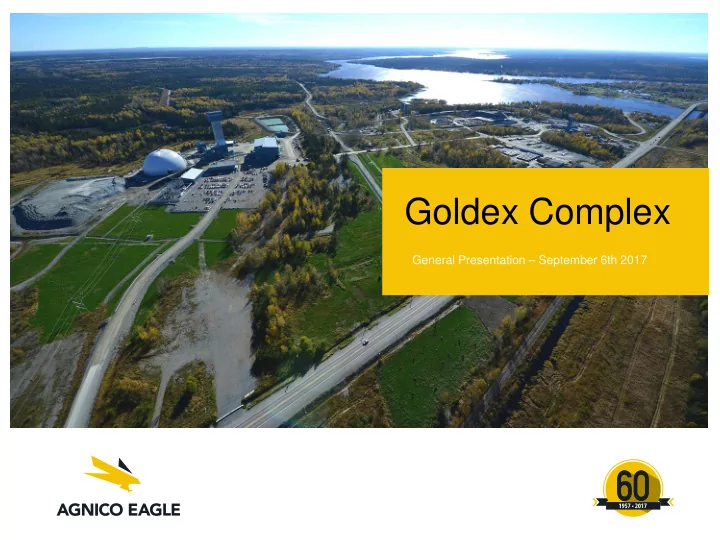
Goldex Complex General Presentation September 6th 2017 Agenda - - PowerPoint PPT Presentation
Goldex Complex General Presentation September 6th 2017 Agenda 7:15 am Goldex presentation 8:15 am Underground tour Maintenance shop Rail veyor dump loop Rail veyor loading system Production area (Deep Zone) 11:00 am
General Presentation – September 6th 2017
7:15 am Goldex presentation 8:15 am Underground tour
11:00 am Mill tour 11:45 am Depart for Canadian Malartic
Ag nic o E a g le | Go ld e x 2
3 Ag nic o E a g le | Go ld e x
The information in this presentation has been prepared as at September 5, 2017. Certain statements contained in this presentation constitute “forward-looking statements” within the meaning of the United States Private Securities Litigation Reform Act of 1995 and “forward-looking information” under the provisions of Canadian provincial securities laws and are referred to herein as “forward-looking statements”. When used in this presentation, the words “anticipate”, “could”, “estimate”, “expect”, “forecast”, “future”, “indicate”, “plan”, “possible”, “potential”, “will” and similar expressions are intended to identify forward-looking statements. Such statements include, without limitation: the Company's forward-looking production guidance, including estimated ore grades, project timelines, drilling results, metal production, life of mine estimates, total cash costs per ounce, all-in sustaining costs per ounce, other expenses and cash flows; the estimated timing and conclusions of technical reports and other studies; the methods by which ore will be extracted or processed; statements concerning expansion projects, recovery rates, mill throughput, optimization and projected exploration expenditures, including costs and other estimates upon which such projections are based; statements regarding timing and amounts of capital expenditures and other assumptions; estimates of future mineral reserves, mineral resources, mineral production,
statements as to the projected development of certain ore deposits, including estimates of exploration, development and production and other capital costs and estimates of the timing of such exploration, development and production or decisions with respect to such exploration, development and production; estimates of mineral reserves and mineral resources; statements regarding the Company’s ability to obtain the necessary permits and authorizations in connection with its exploration, development and mining operations and the anticipated timing thereof; statements regarding anticipated future exploration; the anticipated timing of events with respect to the Company’s mine sites and statements regarding the sufficiency of the Company’s cash resources and other statements regarding anticipated trends with respect to the Company's operations, exploration and the funding thereof. Such statements reflect the Company’s views as at the date of this presentation and are subject to certain risks, uncertainties and assumptions, and undue reliance should not be placed on such statements. Forward-looking statements are necessarily based upon a number of factors and assumptions that, while considered reasonable by Agnico Eagle as of the date of such statements, are inherently subject to significant business, economic and competitive uncertainties and contingencies. The material factors and assumptions used in the preparation of the forward looking statements contained herein, which may prove to be incorrect, include, but are not limited to, the assumptions set forth herein and in management's discussion and analysis (“MD&A”) and the Company's Annual Information Form (“AIF”) for the year ended December 31, 2016 filed with Canadian securities regulators and that are included in its Annual Report on Form 40-F for the year ended December 31, 2016 (“Form 40-F”) filed with the U.S. Securities and Exchange Commission (the "SEC") as well as: that there are no significant disruptions affecting operations; that production, permitting, development and expansion at each of Agnico Eagle's properties proceeds on a basis consistent with current expectations and plans; that the relevant metal prices, foreign exchange rates and prices for key mining and construction supplies will be consistent with Agnico Eagle's expectations; that Agnico Eagle's current estimates of mineral reserves, mineral resources, mineral grades and metal recovery are accurate; that there are no material delays in the timing for completion of ongoing growth projects; that the Company's current plans to optimize production are successful; and that there are no material variations in the current tax and regulatory environment. Many factors, known and unknown, could cause the actual results to be materially different from those expressed or implied by such forward looking statements. Such risks include, but are not limited to: the volatility of prices of gold and other metals; uncertainty of mineral reserves, mineral resources, mineral grades and mineral recovery estimates; uncertainty of future production, project development, capital expenditures and other costs; foreign exchange rate fluctuations; financing of additional capital requirements; cost of exploration and development programs; mining risks; community protests; risks associated with foreign operations; the unfavorable outcome of litigation involving the Partnership; governmental and environmental regulation; the volatility of the Company’s stock price; and risks associated with the Company’s currency, fuel and by-product metal derivative strategies. For a more detailed discussion of such risks and other factors that may affect the Company’s ability to achieve the expectations set forth in the forward-looking statements contained in this presentation, see the AIF and MD&A filed on SEDAR at www.sedar.com and included in the Form 40-F filed on EDGAR at www.sec.gov, as well as the Company’s other filings with the Canadian securities regulators and the SEC. Other than as required by law, the Company does not intend, and does not assume any obligation, to update these forward-looking statements.
4 Ag nic o E a g le | Go ld e x
Note Regarding the Use of Non-GAAP Financial Measures This presentation discloses certain measures, including “total cash costs per ounce” and “minesite costs per tonne” that are not standardized measures under IFRS. These data may not be comparable to data reported by other issuers. For a reconciliation of these measures to the most directly comparable financial information reported in the consolidated financial statements prepared in accordance with IFRS and for an explanation of how management uses these measures, see “Non-GAAP Financial Performance Measures” in the MD&A filed on SEDAR at www.sedar.com and included in the Form 6-K filed on EDGAR at www.sec.gov, as well as the Company’s other filings with the Canadian securities regulators and the SEC. The total cash costs per ounce of gold produced is reported on both a by-product basis (deducting by-product metal revenues from production costs) and co-product basis (without deducting by-product metal revenues). Unless otherwise specified total cash costs per ounce of gold produced is reported on a by-product basis in this presentation. The total cash costs per ounce of gold produced on a by-product basis is calculated by adjusting production costs as recorded in the consolidated statements of income for by-product revenues, unsold concentrate inventory production costs, smelting, refining and marketing charges and other adjustments, and then dividing by the number of ounces of gold produced. The total cash costs per ounce of gold produced on a co-product basis is calculated in the same manner as the total cash costs per ounce of gold produced on a by-product basis except that no adjustment is made for by-product metal revenues. Accordingly, the calculation of total cash costs per ounce of gold produced on a co-product basis does not reflect a reduction in production costs or smelting, refining and marketing charges associated with the production and sale of by-product metals. The total cash costs per ounce of gold produced is intended to provide information about the cash-generating capabilities of the Company’s mining operations. Management also uses these measures to monitor the performance of the Company’s mining operations. As market prices for gold are quoted on a per ounce basis, using the total cash costs per ounce of gold produced on a by-product basis measure allows management to assess a mine’s cash-generating capabilities at various gold prices. Minesite costs per tonne are calculated by adjusting production costs as recorded in the consolidated statements of income for unsold concentrate inventory production costs, and then dividing by tonnes of ore processed. As the total cash costs per ounce of gold produced can be affected by fluctuations in by product metal prices and foreign exchange rates, management believes that minesite costs per tonne provides additional information regarding the performance of mining operations, eliminating the impact of varying production
tonne mined, in order to be economically viable the estimated revenue on a per tonne basis must be in excess of the minesite costs per tonne. Management is aware that this per tonne measure of performance can be impacted by fluctuations in processing levels and compensates for this inherent limitation by using this measure in conjunction with production costs prepared in accordance with IFRS Note Regarding Production Guidance The gold production guidance is based on the Company’s mineral reserves but includes contingencies and assumes metal prices and foreign exchange rates that are different from those used in the mineral reserve estimates. These factors and others mean that the gold production guidance presented in this presentation does not reconcile exactly with the production models used to support these mineral reserves. Currency All amounts in this presentation are expressed in U.S. dollars except as otherwise noted.
5 Ag nic o E a g le | Go ld e x
Cautionary Note to Investors Concerning Estimates of Measured and Indicated Mineral Resources This presentation uses the terms “measured mineral resources” and “indicated mineral resources”. Investors are advised that while those terms are recognized and required by Canadian regulations, the SEC does not recognize them. Investors are cautioned not to assume that any part or all of mineral deposits in these categories will ever be converted into mineral reserves. Cautionary Note to Investors Concerning Estimates of Inferred Mineral Resources This presentation also uses the term “inferred mineral resources”. Investors are advised that while this term is recognized and required by Canadian regulations, the SEC does not recognize it. “Inferred mineral resources” have a great amount of uncertainty as to their existence, and great uncertainty as to their economic and legal feasibility. It cannot be assumed that all or any part of an inferred mineral resource will ever be upgraded to a higher category. Under Canadian rules, estimates of inferred mineral resources may not form the basis of feasibility or pre-feasibility studies, except in rare cases. Investors are cautioned not to assume that any part or all of an inferred mineral resource exists, or is economically or legally mineable. Scientific and Technical Data Cautionary Note To U.S. Investors - The SEC permits U.S. mining companies, in their filings with the SEC, to disclose only those mineral deposits that a company can economically and legally extract or produce. Agnico Eagle reports mineral reserve and mineral resource estimates in accordance with the Canadian Institute of Mining, Metallurgy and Petroleum Best Practice Guidelines for Exploration and Best Practice Guidelines for Estimation of Mineral Resources and Mineral Reserves in accordance with the Canadian securities regulatory authorities' (the "CSA") National Instrument 43-101 Standards of Disclosure for Mineral Projects ("NI 43-101"). These standards are similar to those used by the SEC’s Industry Guide
information contained herein may not be comparable to similar information disclosed by U.S. companies. Under the requirements of the SEC, mineralization may not be classified as a "reserve" unless the determination has been made that the mineralization could be economically and legally produced or extracted at the time the reserve determination is made. A "final" or "bankable" feasibility study is required to meet the requirements to designate mineral reserves under Industry Guide 7. Agnico Eagle uses certain terms in this presentation, such as "measured", "indicated", "inferred" and "resources" that the SEC guidelines strictly prohibit U.S. registered companies from including in their filings with the SEC. In prior periods, mineral reserves for all properties were typically estimated using historic three-year average metals prices and foreign exchange rates in accordance with the SEC
to mean historic three-year average prices. Given the current commodity price environment, Agnico Eagle has decided to use price assumptions that are below the three-year
project, the Canadian Malartic mine and the Upper Beaver project) were $1,150 per ounce gold, $16.50 per ounce silver, $0.95 per pound zinc, $2.15 per pound copper and foreign exchange rates of C$1.20 per $1.00, 16.00 Mexican pesos per $1.00 and $1.15 per €1.00 for all mines and projects other than the Lapa and Meadowbank mines in Canada, and the Creston Mascota mine and Santo Niño pit at the Pinos Altos mine in Mexico; due to the shorter remaining mine life for the Lapa and Meadowbank mines in Canada, and the Creston Mascota mine and Santo Niño pit at the Pinos Altos mine in Mexico, the foreign exchange rates used were C$1.30 per $1.00 and 16.00 Mexican pesos per $1.00 (other assumptions unchanged). At the Meliadine project, the same assumptions at December 2015 were used to estimate the December 2016 mineral reserves, which were $1,100 per ounce gold and an foreign exchange rate of C$1.16 per $1.00. The mineral resources at all properties are estimated using 75% of the cut-off grades used to estimate the mineral reserves. The Canadian Malartic General Partnership, owned by Agnico Eagle (50%) and Yamana Gold Inc. (50%), which owns and operates the Canadian Malartic mine, and Canadian Malartic Corporation, owned by Agnico Eagle (50%) and Yamana (50%), which owns and manages the Upper Beaver project in Kirkland Lake, have estimated the December 2016 mineral reserves of the Canadian Malartic mine and the Upper Beaver project using the following assumptions: $1,200 per ounce gold; a cut-off grade at the Canadian Malartic mine between 0.33 g/t and 0.37 g/t gold (depending on the deposit); a C$125/tonne net smelter return (NSR) for the Upper Beaver project; and an foreign exchange rate of C$1.25 per $1.00. NI 43-101 requires mining companies to disclose mineral reserves and mineral resources using the subcategories of "proven mineral reserves”, "probable mineral reserves”, "measured mineral resources”, "indicated mineral resources” and "inferred mineral resources”. Mineral resources that are not mineral reserves do not have demonstrated economic viability.
6 Ag nic o E a g le | Go ld e x
A mineral reserve is the economically mineable part of a measured and/or indicated mineral resource. It includes diluting materials and allowances for losses, which may occur when the material is mined or extracted and is defined by studies at pre-feasibility or feasibility level as appropriate that include application of modifying factors. Such studies demonstrate that, at the time of reporting, extraction could reasonably be justified. Modifying factors are considerations used to convert mineral resources to mineral reserves. These include, but are not restricted to, mining, processing, metallurgical, infrastructure, economic, marketing, legal, environmental, social and governmental factors. A proven mineral reserve is the economically mineable part of a measured mineral resource. A proven mineral reserve implies a high degree of confidence in the modifying factors. A probable mineral reserve is the economically mineable part of an indicated and, in some circumstances, a measured mineral resource. The confidence in the modifying factors applying to a probable mineral reserve is lower than that applying to a proven mineral reserve. A mineral resource is a concentration or occurrence of solid material of economic interest in or on the Earth's crust in such form, grade or quality and quantity that there are reasonable prospects for eventual economic extraction. The location, quantity, grade or quality, continuity and other geological characteristics of a mineral resource are known, estimated or interpreted from specific geological evidence and knowledge, including sampling. A measured mineral resource is that part of a mineral resource for which quantity, grade or quality, densities, shape and physical characteristics are estimated with confidence sufficient to allow the application of modifying factors to support detailed mine planning and final evaluation of the economic viability of the deposit. Geological evidence is derived from detailed and reliable exploration, sampling and testing and is sufficient to confirm geological and grade or quality continuity between points of observation. An indicated mineral resource is that part of a mineral resource for which quantity, grade or quality, densities, shape and physical characteristics are estimated with sufficient confidence to allow the application of modifying factors in sufficient detail to support mine planning and evaluation of the economic viability of the deposit. Geological evidence is derived from adequately detailed and reliable exploration, sampling and testing and is sufficient to assume geological and grade or quality continuity between points of observation. An inferred mineral resource is that part of a mineral resource for which quantity and grade or quality are estimated on the basis of limited geological evidence and sampling. Geological evidence is sufficient to imply but not verify geological and grade or quality continuity. Investors are cautioned not to assume that part or all of an inferred mineral resource exists, or is economically or legally mineable. A feasibility study is a comprehensive technical and economic study of the selected development option for a mineral project that includes appropriately detailed assessments of applicable modifying factors together with any other relevant operational factors and detailed financial analysis that are necessary to demonstrate, at the time of reporting, that extraction is reasonably justified (economically mineable). The results of the study may reasonably serve as the basis for a final decision by a proponent or financial institution to proceed with, or finance, the development of the project. The confidence level of the study will be higher than that of a Pre-Feasibility Study. The effective date for all of the Company's mineral resource and mineral reserve estimates in this presentation is December 31, 2016. Additional information about each of the mineral projects that is required by NI 43-101, sections 3.2 and 3.3 and paragraphs 3.4 (a), (c) and (d) can be found in the Technical Reports filed by Agnico Eagle, which may be found at www.sedar.com. Other important operating information can be found in the Company's AIF and Form 40-F. The scientific and technical information relating to Agnico Eagle’s mineral reserves and mineral resources contained herein has been approved by Daniel Doucet, Eng., Senior Corporate Director, Reserve Development.
Ag nic o E a g le | Go ld e x 7
CSD Lapa
Ag nic o E a g le | Go ld e x 8
Paste backfill plant Mill Shaft #1 (exploration) Parking lot Shaft #2 Administration
1963
1990
(shaft #1 extended up to 760m)
2004
mineralization confirmation
2005
2008
2011 (October)
Ag nic o E a g le | Go ld e x 9
2012 (July)
stoping with cemented pastefill)
costs per tonne: C$40)
increase resources and improve on the base plan
2013 (September)
2013 (October)
2013-2016 results:
Ag nic o E a g le | Go ld e x 10
Approved for production in July 2015 Upper D Zone (850m-1200m)
Project cost = $135-140M Unlocks significant upside potential
accessible via Deep 1 infrastructure)
Ag nic o E a g le | Go ld e x 11
December 2016 Mineral Reserves
Production rate
Mine Life
December 2016 Mineral Resources
30.3M tonnes @ 1.82g/t - 1.8Moz
21.9M tonnes @ 1.60g/t - 1.1Moz
Ag nic o E a g le | Go ld e x 12
See AEM February 15, 2017 press release for detailed breakdown of mineral reserves and mineral resources
Ag nic o E a g le | Go ld e x 14
M & Mx Zones
E & Deep Zones
Ag nic o E a g le | Go ld e x 15
Ground support
Drilling
Mucking Equipment
Paste Backfill
Development in Ore Cablebolting Initial Opening (V30) Production Drilling Mucking
Ag nic o E a g le | Go ld e x 16
Fully mechanised
Over 8,600m of lateral development planned for 2017
Ag nic o E a g le | Go ld e x 17
Drilling – Cubex ITH drills
Blasting
Electronic Detonators
carrier (3000kg capacity) Cubex 6200 with Mechanised Rod Handler
Ag nic o E a g le | Go ld e x 18
Trucks
Scoops
Industrial bulk material handling solution using trains to move material on light track
Ag nic o E a g le | Go ld e x 19
System
Ag nic o E a g le | Go ld e x 20
Ag nic o E a g le | Go ld e x 21
Ag nic o E a g le | Go ld e x 22 Ore Bin (3500 t)
Crusher (66x84 BB) Rock Breakers (level 76)
Ag nic o E a g le | Go ld e x 24
Ag nic o E a g le | Go ld e x 25
8,000+ tpd capacity Simple mineralogy
Sulphide concentrate trucked to LaRonde for Leaching Average combined recovery 93%
Ag nic o E a g le | Go ld e x 26
Dome (30K Tm cap) Grinding circuit SAG & BALL MILL Gravity 3 Knelson Refinery (70% rec.) Pyrite/Gold Flotation & Column Laronde cyanidation circuit (30% rec.) Pastefill plant Tailings Storage Facility
Ag nic o E a g le | Go ld e x 27
AEM Contractor Total
Maintenance
98 36 134
Underground
146 178 324
Mill
34 17 51
Administration
56 52 108
TOTAL
334 283 617
Ag nic o E a g le | Go ld e x 29
Ag nic o E a g le | Go ld e x 30
Ventilation installation for exhaust air is underground to reduce noise Dome for dust control on ore transfer Ventilation for air supply is East oriented and is installed inside a building for noise reduction No cyanide use, ore recovery uses gravity and flotation Deslauriers brook has been protected Small footprint of the installations,
Ag nic o E a g le | Go ld e x 31
production blast is scheduled
deployed around the property and in
Ag nic o E a g le | Go ld e x 32
Abandoned acid-generating minesite
AEM and the Quebec Government established in 2006
new tailings management facility
construction, deposition facilities, etc.)
reclamation (lower burden for Quebec Taxpayers)
Ag nic o E a g le | Go ld e x 33
Auxiliary tailings pond
Ag nic o E a g le | Go ld e x 34
50% completed
2016 2004
Ag nic o E a g le | Go ld e x 36
2016 2017E 2018E 2019E Gold Production (oz) 120,704 105,000 115,000 120,000 Daily throughput (tpd) 6,954 6,800
tonne (CAD$) $33 $35-37
per ounce $532 $667
Ag nic o E a g le | Go ld e x 37
Probable Mineral Reserves
4.8 Mt @ 0.92 g/t Au (141 000 oz) and 0.52% Cu (24 500 t)
Indicated Mineral Resources
2.8 Mt @ 0.60 g/t Au (54 000 oz) and 0.33% Cu (9 285 t) 2014 Acquisition Synergy with Goldex Deep (uses extra mill capacity) Open pit operation Metallurgy compatible with current mill configuration Copper recovery in LaRonde circuit Permitting process is ongoing Production start up in late 2018
See AEM February 15, 2017 press release for detailed breakdown of mineral reserves and mineral resources
Ag nic o E a g le | Go ld e x 38
Indicated Mineral Resources 3.0 Mt @ 2.09g/t Au (199 000oz) Inferred Mineral Resources 4.2 Mt @ 1.43g/t Au (193 000oz)
Potential to extend mine life by 2-4 years
Level 073 Level 120
DEEP 2 ZONE
See AEM February 15, 2017 press release for detailed breakdown of mineral reserves and mineral resources
Ag nic o E a g le | Go ld e x 39
Inferred Mineral Resources 305 kt @ 5.45 g/t Au (53 000 oz)
Plan View Level 100 Cross Section Looking West
See AEM February 15, 2017 press release for detailed breakdown of mineral reserves and mineral resources
Ag nic o E a g le | Go ld e x 40
Exploration targets
Ag nic o E a g le | Go ld e x 41
Access to some areas might be limited for pacemaker users No smoking is allowed underground or inside any building onsite Always remain at a minimum distance of 3m from the shaft Be mindful of signs, safety barricades and ribbons Mind your step for uneven and slippery floors Do not blind vehicle operators with your head lamp Do not stray away from the group. Remain with your guides at all times Never place yourself between 2 vehicles Move into a safety bay if a vehicle is approaching Make sure that the vehicle is stationary before getting in or out of it Keep your hands inside the vehicle at all times when it is moving Always use 3 points of contact while getting in or out of vehicles Should you feel ill or uncomfortable please let your guide know immediately
Trading Symbol: AEM on TSX & NYSE Investor Relations: 416-947-1212 info@agnicoeagle.com
agnicoeagle.com