Golden LEAF Biomanufacturing Training & Education Center - - PowerPoint PPT Presentation

golden leaf biomanufacturing training amp education center
SMART_READER_LITE
LIVE PREVIEW

Golden LEAF Biomanufacturing Training & Education Center - - PowerPoint PPT Presentation

Golden LEAF Biomanufacturing Training & Education Center Presented by: Gary Gilleskie, Acting Director 1 BTEC Mission Contribute to the social and economic well-being of the state of North Carolina by providing a wide variety of high


slide-1
SLIDE 1

1

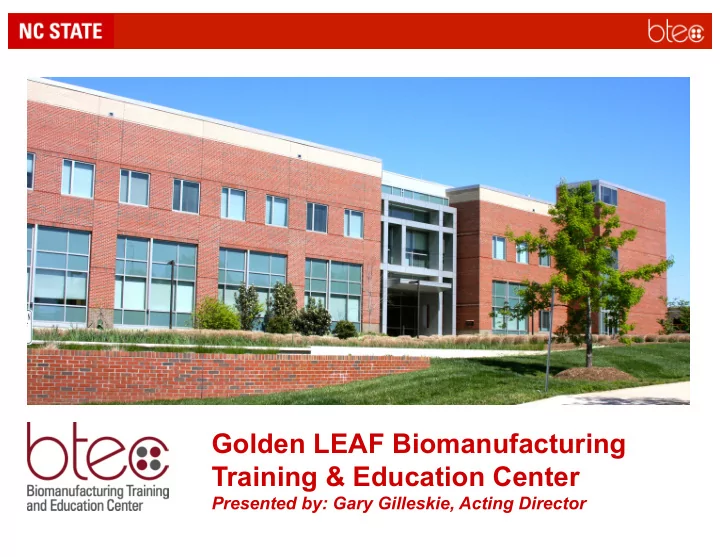
Golden LEAF Biomanufacturing Training & Education Center

Presented by: Gary Gilleskie, Acting Director

slide-2
SLIDE 2

BTEC Mission

Contribute to the social and economic well-being of the state of North Carolina by providing a wide variety of high quality educational and training opportunities to develop skilled professionals for the biomanufacturing industry and by providing services to industry, government and academia

2

slide-3
SLIDE 3

What is BTEC?

Training/education for NC State students Training/education for professionals Contract services

3

Focus on biological products for treatment

  • r prevention of human disease, produced

using cells

Economic development

slide-4
SLIDE 4

BTEC Organization

4

Report to the Dean, College of Engineering, NC State University Organized into 3 main areas: operations, strategic programs, and academic programs reporting into the director

‒ 46 full-time staff (> 50% from industry)

Part of NCBioImpact Have an Industrial Advisory Board to provide an interface between industry, NCSU and other stakeholders BTEC Industrial Advisory Board

slide-5
SLIDE 5

Key Features

Main facility

‒ 63,000 gsf labs, including a simulated cGMP mfg area ‒ 9,000 gsf classrooms ‒ $39 MM infrastructure ‒ $15 MM equipment

BTEC Annex – 4,000 gsf labs $5 MM/year state funding

5

NCCCS BioNetwork Capstone Center

  • perates labs within BTEC
slide-6
SLIDE 6

BTEC’s Unique Educational Programs

Minimize training done by industry Industry-focused curriculum, with significant investment in lecture / laboratory content and model process Hands-on experiences Instructors with industry experience

6

Involve wide-ranging audiences and topics Multi-disciplinary Undergraduate, graduate, industry Upstream, downstream, analytical, regulatory Bench, intermediate, large scales

slide-7
SLIDE 7

Academic Programs

7

Chemical & Biomolecular Engineering

(Biomanufacturing Concentration)

Food, Bioprocessing & Nutrition Sciences

Bioprocessing Science (BBS)

Biotechnology (BIT) Other COE, CALS, COS Students BTEC Programs

Minor (Undergraduate & Graduate) Certificate (Undergraduate & Graduate) Post-Baccalaureate Studies Certificate Professional Science Masters (BIOM)

slide-8
SLIDE 8

Enrollment by Academic Year

17 52 53 128 213 273 314 325 322 326 167 308 391 445 391 491 545 606 520 505

100 200 300 400 500 600 700 800 900 1000

07-08 08-09 09-10 10-11 11-12 12-13 13-14 14-15 15-16 16-17

Graduate Undergrad

Enrollment (Seats Filled)

8

slide-9
SLIDE 9

2016-2017

‒ Enrollment = 505 ‒ 54 minors + 13 certificates

376 minors or certificates since 2008 >95% employment within 6 months

9

NC State undergraduates NC State graduate students

BTEC’s NC State Students

2016–17

‒ Enrollment = 326 ‒ 9 masters + 3 certificates

64 masters or certificates since 2012 >98% employed within 6 months

slide-10
SLIDE 10

Impact of Academic Programs on NC

10

“…the number of people I recognize here [Biogen] from BTEC is just

  • verwhelming! It is a great feeling running into someone you have seen

before in class, even if I never spoke or interacted with them before. It has really helped me meet a lot of different people here and I love it!” — 2017 masters graduate

Master’s students who work in state after graduation: 91% Undergraduate minors who work in state after graduation: 86%

slide-11
SLIDE 11

Short Courses for Industry

Open-enrollment tracks Analytical Technologies Biomanufacturing Bioprocess Development Bioprocess Engineering

Professional Development Program

Customized courses

11

“Some of the best aspects of this course: there were a lot of hands-on activities, not

  • nly having us look at single-use equipment

but also being able to process actual media through the equipment…” — Short course participant, 2016

slide-12
SLIDE 12

Enrollment: Professional Development Courses

Trained > 2,200

12 36 53 69 70 137 156 119 138

20

75 363 266 131 98 193 119 236

100 200 300 400 500 08-09 09-10 10-11 11-12 12-13 13-14 14-15 15-16 16-17

Open Custom

Enrollment

slide-13
SLIDE 13

Impact of Professional Development Program on NC

1125 participants from NC 87 companies represented with NC participants – includes numerous vendor reps residing in state

13

Has attracted students from various regions throughout NC – Research Triangle, Piedmont Triad, Charlotte, Southeast

slide-14
SLIDE 14

Other Notable Training Programs

FDA (since 2007)

– Courses: Upstream Bioprocessing, Downstream Bioprocessing, QC/Analytical, Aseptic Processing

BARDA (2011–2015)

– Courses: Influenza Vaccine Manufacturing (Fundamentals, Advanced, Regulators)

BioNetwork Capstone Bootcamps (since 2010)

Trained 155 FDA Investigators to date Trained 150 vaccine specialists from 14 different countries

14

Numerous educators and community college students involved

All programs involve collaboration with the BioNetwork Capstone Center

slide-15
SLIDE 15

Bioprocess and Analytical Services

BTEC offers: Faculty with expertise in biomanufacturing topics Staff with hands-on biomanufacturing experience Facilities and equipment ideal for this type of work Multiple contract options Flexibility in the types of projects – “Risk-free environment”

15

137 projects, 57 companies since 2009

– Smaller projects that CMOs not likely to take on

slide-16
SLIDE 16

Examples of Projects

Bioprocess Services

Development of bacteriophage process Fermentation optimization Production of cell culture broth Testing production conditions for human fusion proteins Ultracentrifugation of VLPs Low-endotoxin purification Optimization of thyroglobulin purification Videos for training video

Analytical Services

Water analysis – TOC, LAL, bioburden, Micro ID, conductivity AA analysis – Spent media AA analysis – Tobacco leaf Polyamine detection Quantitative PCR Autoclave – Material structural integrity H2O2 analysis LAL analysis

slide-17
SLIDE 17

Economic Development Activities

Partner with university and state economic development professionals (NC Dept. of Commerce) Sponsor NC Pavilion at BIO International Present at national and international meetings Host local, national, international visitors Conduct tours for companies considering NC Help university researchers and local companies Provide facilities for workshops, demos, meetings

17

slide-18
SLIDE 18

Continue to provide state-of-the-art, hands-on educational and professional development opportunities Incorporate content related to manufacturing next-generation biopharmaceuticals (e.g., gene therapy, cell therapy) into academic and training programs Enhance our process technologies in areas such as single use and advanced process control/analytics Grow capacity of Bioprocess and Analytical Services to assist small, mid-size and large companies Implement GMP production for Phase I clinical trials Integrate BTEC more directly with the research mission of NC State by playing a major role in National Institute for Manufacturing of Biopharmaceuticals (NIIMBL)

BTEC’s Strategic Plan

18

slide-19
SLIDE 19

Additional Nonrecurring Funds 2017–2018

To keep undergraduate, graduate enrollment high and labs functioning, BTEC will use additional nonrecurring funds for the following: Enhanced marketing of BTEC’s academic programs

– Because we are not a department with a bachelor’s degree, getting word out to students is important to maintain/expand enrollment

New equipment capabilities

– Fills a need to expose students to the new technologies that are rapidly being adopted by industry

Maintenance and upgrades on frequently used equipment

– Maintenance/upgrades on equipment to ensure reliable performance leading to positive student experiences

19

slide-20
SLIDE 20

20