R-Tree An R-tree is a depth-balanced tree Each node corresponds - - PowerPoint PPT Presentation

r tree
SMART_READER_LITE
LIVE PREVIEW

R-Tree An R-tree is a depth-balanced tree Each node corresponds - - PowerPoint PPT Presentation

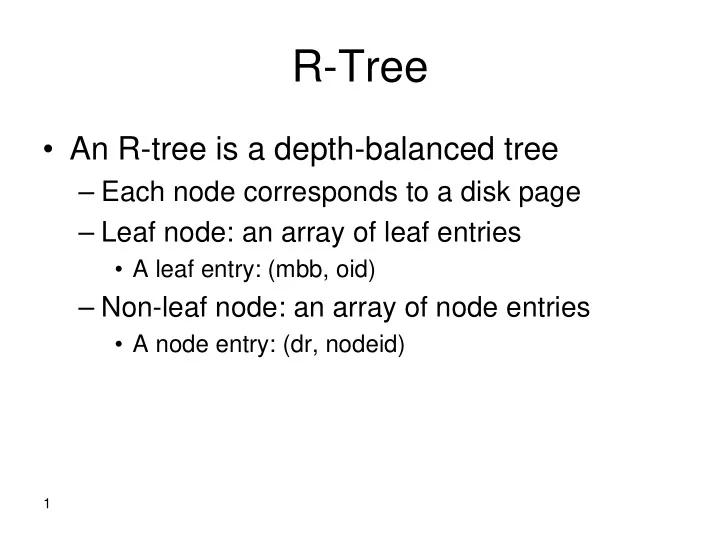
R-Tree An R-tree is a depth-balanced tree Each node corresponds to a disk page Leaf node: an array of leaf entries A leaf entry: (mbb, oid) Non-leaf node: an array of node entries A node entry: (dr, nodeid) 1 1 5 11


slide-1
SLIDE 1

R-Tree

  • An R-tree is a depth-balanced tree

– Each node corresponds to a disk page – Leaf node: an array of leaf entries

  • A leaf entry: (mbb, oid)

– Non-leaf node: an array of node entries

  • A node entry: (dr, nodeid)

1

slide-2
SLIDE 2

1 5 2 6 14 8 9 13 11 12 3 4 7 10

a c b d R a b c d m=2, M=4 [1,2,5,6] [3,4,7,10] [8.9.14] [11,12,13]

2

slide-3
SLIDE 3

Properties

  • The number of entries of a node (except for

the root) in the tree is between m and M where m∈[0, M/2]

– M: the maximum number of entries in a node, may differ for leaf and non-leaf nodes P: disk page E: entry – The root has at least 2 entries unless it is a leaf

  • All leaf nodes are at the same level
  • An R-tree of depth d indexes at least md+1
  • bjects and at most Md+1 objects, in other

words,

⎣ ⎦

) ( / ) ( E size P size M =

⎣ ⎦ ⎣ ⎦

1 log 1 log − ≤ ≤ − N d N

m M

3

slide-4
SLIDE 4

Search with R-tree

  • Given a point q, find all mbbs containing q
  • A recursive process starting from the root

result = ∅ For a node N if N is a leaf node, then result = result ∪ {N} else // N is a non-leaf node for each child N’ of N if the rectangle of N’ contains q then recursively search N’

4

slide-5
SLIDE 5

Time complexity of search

  • If mbbs do not overlap on q, the

complexity is O(logmN).

  • If mbbs overlap on q, it may not be

logarithmic, in the worst case when all mbbs overlap on q, it is O(N).

5

slide-6
SLIDE 6

Insertion – choose a leaf node

  • Traverse the R-tree top-down, starting

from the root, at each level

– If there is a node whose directory rectangle contains the mbb to be inserted, then search the subtree – Else choose a node such that the enlargement of its directory rectangle is minimal, then search the subtree – If more than one node satisfy this, choose the

  • ne with smallest area,
  • Repeat until a leaf node is reached

6

slide-7
SLIDE 7

Insertion – insert into the leaf node

  • If the leaf node is not full, an entry

[mbb, oid] is inserted

  • Else

// the leaf node is full

– Split the leaf node – Update the directory rectangles of the ancestor nodes if necessary

7

slide-8
SLIDE 8

1 5 2 6 14 8 9 13 11 12 3 4 7 10

a c b d R a b c d

15

Insert object 15 m=2, M=4 [1,2,5,6] [3,4,7,10] [8.9.14] [11,12,13,15]

8

slide-9
SLIDE 9

1 5 2 6 14 8 9 13 11 12 3 4 7 10

a c b d m=2, M=4

15

Insert object 16

9

16

e [1,2,5,6] R a b c d [3,4,7] [8.9.14][11,12,13,15] e [10,16] f R’ R’ f

slide-10
SLIDE 10

Split - goal

  • The leaf node has M entries, and one new

entry to be inserted, how to partition the M+1 mbbs into two nodes, such that

– 1. The total area of the two nodes is minimized – 2. The overlapping of the two nodes is minimized

  • Sometimes the two goals are conflicting

– Using 1 as the primary goal

10

slide-11
SLIDE 11

11

slide-12
SLIDE 12

Split - solution

  • Optimal solution: check every possible

partition, complexity O(2M+1)

  • A quadratic algorithm:

– Pick two “seed” entries e1 and e2 far from each other, that is to maximize area(mbb(e1,e2)) – area(e1) – area(e2) here mbb(e1,e2) is the mbb containing both e1 and e2, complexity O((M+1)2) – Insert the remaining (M-1) entries into the two groups

12

slide-13
SLIDE 13

Quadratic split cont.

  • A greedy method
  • At each time, find an entry e such that e

expands a group with the minimum area, if tie

– Choose the group of small area – Choose the group of fewer elements

  • Repeat until no entry left or one group has

(M-m+1) entries, all remaining entries go to another group

  • If the parent is also full, split the parent too. The

recursive adjustment happens bottom-up until the tree satisfies the properties required. This can be up to the root.

13