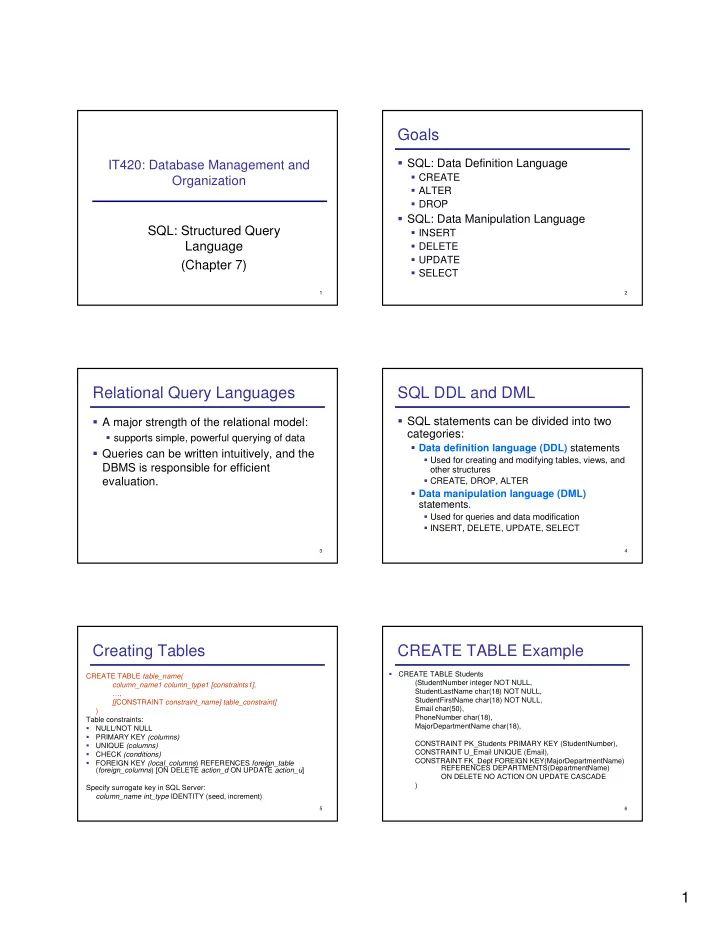

SLIDE 1
1
1
IT420: Database Management and Organization SQL: Structured Query Language (Chapter 7)
2
Goals
SQL: Data Definition Language
CREATE ALTER DROP
SQL: Data Manipulation Language
INSERT DELETE UPDATE SELECT
3
Relational Query Languages
A major strength of the relational model:
supports simple, powerful querying of data
Queries can be written intuitively, and the DBMS is responsible for efficient evaluation.
4
SQL DDL and DML
SQL statements can be divided into two categories:
Data definition language (DDL) statements
Used for creating and modifying tables, views, and
- ther structures
CREATE, DROP, ALTER
Data manipulation language (DML) statements.
Used for queries and data modification INSERT, DELETE, UPDATE, SELECT
5
Creating Tables
CREATE TABLE table_name( column_name1 column_type1 [constraints1], …, [[CONSTRAINT constraint_name] table_constraint] ) Table constraints:
- NULL/NOT NULL
- PRIMARY KEY (columns)
- UNIQUE (columns)
- CHECK (conditions)
- FOREIGN KEY (local_columns) REFERENCES foreign_table
(foreign_columns) [ON DELETE action_d ON UPDATE action_u] Specify surrogate key in SQL Server: column_name int_type IDENTITY (seed, increment)
6
CREATE TABLE Example
- CREATE TABLE Students
(StudentNumber integer NOT NULL, StudentLastName char(18) NOT NULL, StudentFirstName char(18) NOT NULL, Email char(50), PhoneNumber char(18), MajorDepartmentName char(18), CONSTRAINT PK_Students PRIMARY KEY (StudentNumber), CONSTRAINT U_Email UNIQUE (Email), CONSTRAINT FK_Dept FOREIGN KEY(MajorDepartmentName) REFERENCES DEPARTMENTS(DepartmentName) ON DELETE NO ACTION ON UPDATE CASCADE )