Glyphosate herbicide: background, issues, and discussion Brad - - PDF document

glyphosate herbicide background issues and discussion
SMART_READER_LITE
LIVE PREVIEW

Glyphosate herbicide: background, issues, and discussion Brad - - PDF document

7/20/2017 Glyphosate herbicide: background, issues, and discussion Brad Hanson Weed Science Program University of California, Davis Contra Costa IPM Concord, CA 7/20/17 My program at UC Davis 100% Cooperative Extension Appt. Weed


slide-1
SLIDE 1

7/20/2017 1

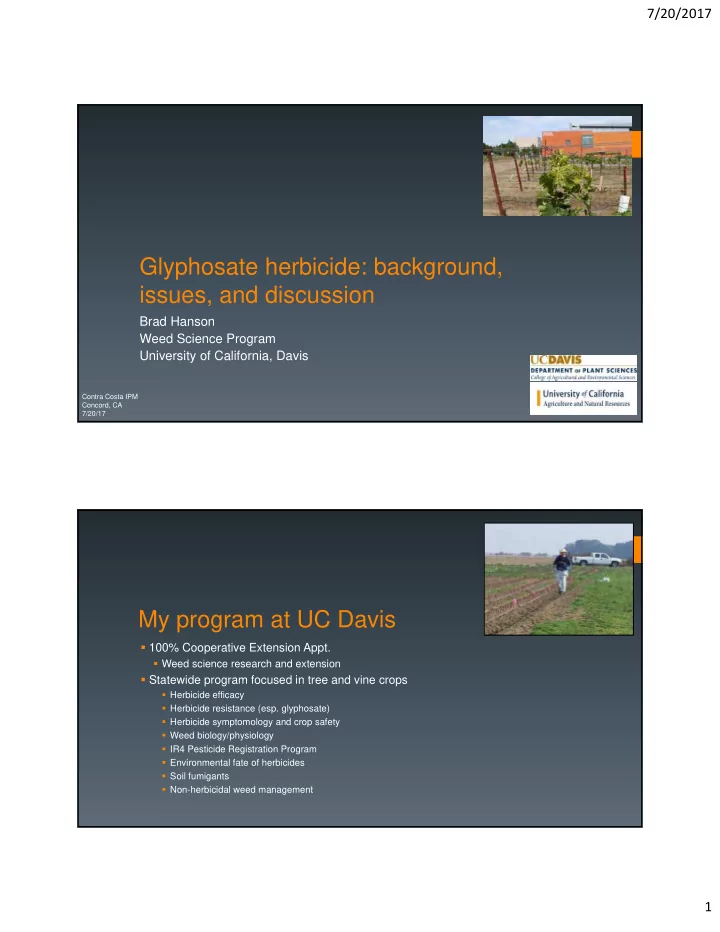
Glyphosate herbicide: background, issues, and discussion

Brad Hanson Weed Science Program University of California, Davis

Contra Costa IPM Concord, CA 7/20/17

My program at UC Davis

  • 100% Cooperative Extension Appt.
  • Weed science research and extension
  • Statewide program focused in tree and vine crops
  • Herbicide efficacy
  • Herbicide resistance (esp. glyphosate)
  • Herbicide symptomology and crop safety
  • Weed biology/physiology
  • IR4 Pesticide Registration Program
  • Environmental fate of herbicides
  • Soil fumigants
  • Non-herbicidal weed management
slide-2
SLIDE 2

7/20/2017 2

Outline

  • How do herbicides work?
  • Herbicide chemistry
  • How do we apply herbicides?
  • Fate of herbicides in the environment
  • Routes and risks of off-site movement
  • Toxicology
  • Hazards vs risks
  • Glyphosate issues
  • Integrated weed management
  • Questions and discussion

Herbicides

  • Incredibly powerful and effective weed control tools
  • Latin: “Herbi” – relating to plants, “cide” – killer
  • Many different mechanisms of action and target sites within plants
  • Chemical properties affect herbicide behavior in plants, soil, water, and air
  • Varies widely among herbicides and, sometimes, in different environmental conditions
slide-3
SLIDE 3

7/20/2017 3

Herbicide chemistry

  • The chemistry of the herbicide molecule drives how it works, potential for off-site

movement, and longevity in the environment

  • Structure affects availability, stability, and phase equilibrium
  • Can vary among environmental conditions
  • Soil type, pH, moisture, OM content, etc

glyphosate Metsulfuron-methyl imazaquin

How do herbicides kill plants?

  • Mode of action:
  • The overall manner in which a herbicide affects a plant at the tissue or cellular level
  • Usually defined by a specific enzymatic pathway affected (can be broad or narrow)
  • eg. photosystem II inhibitors, amino acid inhibitors, carotinoid biosynthesis inhibitors
  • Mechanism of action:
  • The specific molecular site of the herbicide
  • eg. inhibitors of acetolactate synthase (ALS) or acetyl coenzymeA carboxylase (ACCase) enzyme
slide-4
SLIDE 4

7/20/2017 4

Enzyme 1

Precursor Intermediate Final Product

Enzyme 2

Generalized biosynthesis pathway How do we apply herbicides?

  • Herbicides almost always diluted in water or other liquid

carrier for control of terrestrial plants

  • Easier to make uniform applications of relatively low use rate materials
  • Example:
  • Application of 1 lb of glyphosate per acre as a broadcast application
  • Roundup PowerMax has 4.5 lb ae per gallon. So 1 lb ae per acre = 28 fl oz of this product per acre)
  • Acre has 43,560 sq ft. So 28 fl oz spread over one acre is 0.00064 fl oz per square foot. (about 10 uL or

0.01 cc)

  • If diluted in 20 gallons of water to spray, 20 gal of herbicide plus carrier = 0.06 fl oz (1.8 mL or cc) per square

foot

  • Still pretty low, but more manageable!
slide-5
SLIDE 5

7/20/2017 5

Herbicide placement

  • “Preemergence” (PRE) herbicides are applied to soil to kill newly germinating

seedlings before they become established.

  • Sometimes called: preventative, residual, soil-applied treatments.
  • Also sometimes inaccurately called “soil sterilants”.
  • “Postemergence” (POST) herbicides are applied to the leaves (or sometimes

stems or stumps) of existing plants

  • Can be mobile in the plant (“translocated” or “systemic”)
  • Or not very mobile (“contact”)

Selective herbicide use

  • Non-selective herbicide affect most plants
  • Selective herbicides (or selective use patterns) control only some plants while

sparing others

  • Selectivity is typically achieved through:
  • Differential sensitivity of target plant vs non-target plants
  • Herbicide chemistry or plant biochemistry
  • Placement (spot applications, spray below tree canopy, etc)
  • Timing (treat before emergence or after dormancy, etc)
slide-6
SLIDE 6

7/20/2017 6

What happens to herbicides in the environment?

  • Transfer processes
  • Change in location or availability of the herbicide – NO change in chemical structure or

properties

  • Degradation processes
  • Changes in the chemical structure of the compound which alters the potency of the

herbicide

Major transfer processes

  • Volatilization
  • Physical drift
  • Spray droplets
  • Dust
  • Water
  • Leaching
  • Surface runoff
  • Soil erosion
  • Plant or animal uptake and removal

*Change in location or availability of the herbicide

slide-7
SLIDE 7

7/20/2017 7

Degradation

  • Begins immediately after application and continues until broken down into

molecules like CO2 and H2O

  • ALL herbicides degrade in the environment
  • Degradation RATE can vary among herbicides or environments

Time Amount

1/2 gone

A B C

Degradation processes

  • Photochemical
  • Chemical (in soil or water)
  • Microbial (in soil or water)
  • Plant/animal metabolism

*Changes in the chemical structure

  • f the compound

O C H2 OH O C Cl Cl Cl 2,4,5-T 4 CO2, Cells, & 3Cl OH Cl Cl Cl C H3 OH O C Ideal C C Cl Cl Cl O O H O H O

+

Oxidase Biomass

slide-8
SLIDE 8

7/20/2017 8

Degradation reactions

  • Numerous types of reactions
  • Dehalogenation
  • Dealkylation
  • Decarboxylation
  • Oxidation
  • Hydrolysis
  • Conjugation
  • Ring cleavage
  • etc

O C H2 C OH C H3 Cl MCPA OH C H3 Cl OH C H3 Cl OH C C OH C H3 Cl OH O O C C OH C H3 OH OH O O

Dehalogenase?

Chemical degradation

  • Change in structure due to non-biological factors in soil or water
  • Ex. Hydrolysis: molecule reacts with water
  • Factors affecting:
  • Soil or water pH
  • Temperature
  • Clay and organic matter content
  • Water content of soil
  • Chemical structure
  • Rings vs chains, functional groups
slide-9
SLIDE 9

7/20/2017 9

Microbial degradation

  • Change in structure due to activity of microorganisms
  • Microbes produce enzymes that degrade the compounds
  • Organisms use the molecule as food source
  • Usually not specific, but sometimes can be
  • Enhanced degradation
  • Overall, the most important degradation process for herbicides

Herbicide dissipation

Soil Adsorption Volatilization and Drift Leaching Microbial Breakdown Photolysis Chemical Breakdown Plant Uptake and Removal Surface Runoff

Transfer Processes Degradation Processes

Plant and animal uptake and metabolism

slide-10
SLIDE 10

7/20/2017 10

Herbicide toxicology

  • Acute toxicity
  • Often described with LD50 values (lethal dose for 50% of the experimental subjects)
  • Subchronic toxicity
  • Often described with NOEL values (no observable effect level) over the course of study
  • Chronic toxicity
  • Often develop NOEL for various long-term measures: teratogenicity, reproductive effects,

gene and chromosome aberrations, etc

  • Herbicide data focused on active ingredients with validation information for some

formulated products

Toxicity comparisons

Glyphosate acid Triclopyr acid Caffeine Ethanol Oral LD50 (rat) 5,600 mg/kg bw 712 mg/kg bw/d 300 mg/kg bw/d 8300 mg/kg bw/d (mouse) 90d dietary (rat) NOEL 2,300 mg/kg bw/d 5 mg/kg bw/d 1500 mg/kg bw/d 2400 mg/kg bw/d 21d dermal (rabbit) ~5000mg/kg bw/d 24 mo dietary (rat) NOEL 4500 mg/kg bw/d NOEL 3 mg/kg bw/d Teratogenicity (rat) NOEL 1000 mg/kg bw/d NOEL 50 mg/kg bw/d NOEL 3600 mg/kg bw/d Reproductive (rat) NOEL 700 mg/kg bw/d NOEL 25 mg/kg bw/d NOEL 22 mg/kg bw/d (mouse) NOEL 2000 mg/kg bw/d Mutagenicity (rat) negative negative negative

Caffeine and ethanol values from INCHEM.org Glyphosate and triclopyr from WSSA Herbicide Handbook

slide-11
SLIDE 11

7/20/2017 11

Hazard vs risk (what’s the difference?)

  • Hazard – anything that can cause harm
  • Risk – the potential for a hazard to cause harm
  • Hazard x Exposure = RISK
  • Risk management or mitigation can be addressed through steps focused on the

hazard and/or on the exposure

Paraphrased from The Toxicology Education Foundation

Minimizing risks related to herbicide use

  • Select lowest risk material for the job
  • Use appropriate rates
  • Apply product at appropriate time
  • Maximize performance on the target species
  • Minimize exposure to non-target species and reduce chance for off-site movement
  • Minimize the treated area (based on site scouting)
  • Use appropriate application techniques
  • Broadcast, small areas, spot treatments, individual plants, etc
  • Applicator training
slide-12
SLIDE 12

7/20/2017 12

In the news…

  • Glyphosate as “probable carcinogen”
  • IARC evaluation
  • New interpretation of existing data
  • Other agencies (USEPA, EU) previously interpreted these data differently
  • What does this mean for CA ag?
  • Added to CA Prop 65 list (7/7/17) – based on IARC designation
  • I anticipate relatively little near term impact (ag)
  • Likely to cause challenges for some non-ag users

Glyphosate: what is it?

  • N-(phosphonomethyl)glycine
  • First tested and patented ~1970
  • IPA salt formulation released in 1974
  • Foliar activity only, no residual activity in soil
  • Translocated to growing points
  • Works by blocking EPSPS enzyme important in synthesis of aromatic amino acids
  • Growing points of plants have the greatest need for these, growth stops quickly but plant death is

relatively slow

  • Very low acute mammalian toxicity because mammals do not synthesize aromatic amino acids (we get them from

plant-based foods)

  • Broad weed control spectrum
  • Grasses, broadleaves, annuals, perennials, woody, aquatics
  • Roundup and many other branded products
slide-13
SLIDE 13

7/20/2017 13

How important is glyphosate?

  • Most widely used herbicide in the world
  • Hundreds of labels
  • Preplanting in many annual crops
  • Post harvest or harvest aid
  • In-crop use in RR crops
  • Directed applications in annuals

and perennials

  • Non-crop areas
  • Aquatic weeds (no surfactants)
  • Homeowner products
  • Vegetation suppression

Issues (real and perceived)

  • Increasing use and resistance
  • GMO issue
  • Chelation of micronutrients, impacts on soil biota (Huber)
  • Mammalian toxicity?
  • Carcinogenicity (IARC)
  • Alleged cause of most human ailments (internet and media)
slide-14
SLIDE 14

7/20/2017 14

GMOs and glyphosate

  • GE varieties first available for a major crop in 1996
  • By 2003 herbicide tolerant (mostly RR) varieties planted on 82-93% of soybean,

corn, and cotton acreage

Concerns about GMO technology are entwined with concerns about glyphosate in many minds

Micronutrient

  • In 2011, there was a great deal of noise about a “confidential and urgent” letter

written by a Purdue pathologist to Sec. of Ag. Vilsack.

  • Later followed up with a letter to European officials
  • New “micro-fungal-like” pathogen
  • Linked to plant disease and animal reproductive issues
  • Related to “glyphosate chelation of vital nutrients”
  • “reaching epidemic proportions”, “seeing an unprecedented trend of increasing plant and

animal diseases and disorders” “…highly sensitive information that could result in a collapse of US soy and corn export markets and significant disruption of domestic food and feed supplies.”

http://fhrfarms1.com/docs/HotTopic/Huber%20second%20letter.pdf

slide-15
SLIDE 15

7/20/2017 15

Toxicity

  • Humans don’t have the same target site as plants
  • (we get our aromatic amino acids from food rather than via a shikimate pathway)
  • Very low mammalian toxicity
  • LD50 (rats) is 5 g / kg body weight
  • ~175 lb person would have to ingest ~1 lb of glyphosate
  • 7.5-fold less toxic than aspirin
  • 14-fold less toxic than nicotine
  • In most formulations, the surfactants are more toxic than the ai.
  • Not a typically considered a carcinogen or reproductive hazard (prior to 2015)

Toxicity – IARC designation

  • March 2015. WHO International Agency for Research on Cancer (IARC)

reclassified glyphosate as “2A. Probably carcinogenic to humans”

  • Previously, most other national regulatory bodies (USEPA, EU, etc) used the same

data to classify it as noncarcinogenic

  • No new data were evaluated by IARC
slide-16
SLIDE 16

7/20/2017 16

Info: IARC has only 4 classes:

  • 1. Is carcinogenic
  • 2a. Probably carcinogenic
  • 2b. Possibly carcinogenic.
  • 3. Not classifiable either way.
  • 4. Not carcinogenic

A few other (selected) IARC designations

  • Coffee (drinking)

3 (not classifiable) in prep

  • Processed meat (consumption)

1 (carcinogenic) in prep

  • Red meat (consumption)

2a (probably carcinogenic) in prep

  • DDT

2a (probably carcinogenic) 2016

  • Ginko biloba extract

2b (possibly carcinogenic) 2016

  • Aloe vera, whole leaf extract

2b (possibly carcinogenic) 2016

  • Outdoor air pollution

1 (carcinogenic) 2016

  • Glyphosate

2a (probably carcinogenic) 2015

  • Diazinon

2a (probably carcinogenic) 2015

  • Radiofrequency magnetic fields

2b (possibly carcinogenic) 2013

http://monographs.iarc.fr/ENG/Classification/latest_classif.php

slide-17
SLIDE 17

7/20/2017 17

FAO/WHO

  • May 2016 Joint FAO/WHA Meeting on Pesticide Residues

“In view of the absence of carcinogenic potential in rodents at human-relevant doses and the absence of genotoxicity by the oral route in mammals, and considering the epidemiological evidence from occupational exposures, the Meeting concluded that glyphosate is unlikely to pose a carcinogenic risk to humans from exposure through the diet.”

US-EPA Office of Pesticide Programs

  • September 2016 “Glyphosate Issue Paper: Evaluation of Carcinogenetic Potential”

(227 pg)

  • https://www.epa.gov/sites/production/files/2016-

09/documents/glyphosate_issue_paper_evaluation_of_carcincogenic_potential.pdf

“The strongest support is for “not likely to be carcinogenic to humans” at the doses relevant to human health risk assessment for glyphosate”

slide-18
SLIDE 18

7/20/2017 18

Prop 65 listing

  • July 7, 2017
  • CDFA-OEHHA (Office of Environmental Health Hazard Assessment) added glyphosate to

California “Prop 65” list

  • IARC designation is one way that OEHHA adds chemicals to the list. CDFA did not re-review

evidence.

  • This ruling has been challenged but currently stands

https://oehha.ca.gov/proposition-65/crnr/glyphosate-listed-effective-july-7-2017-known-state-california-cause-cancer

Controversy continues

  • Controversy continued this spring when Reuters reported that IARC did not include

data from a large survey of ag workers and families (~89,000 individuals)

  • http://www.reuters.com/investigates/special-report/glyphosate-cancer-data/
  • One of the 17 IARC scientists was a co-author of this (unpublished) research, yet it was

not considered

  • Suggestions that these data may have changed the IARC designation
  • Claims of bias since this new study showed no cancer link (specifically NHL)
  • IARC has responded suggesting author conflict and that non-published data are not

included in reviews

slide-19
SLIDE 19

7/20/2017 19

Conclusion / opinions

  • Resistance. Will be a continuing challenge, especially for agron crops
  • No new herbicides coming with as broad of a weed spectrum, low toxicity,

favorable environmental profile; especially for the cost

  • GMO. Much of the glyphosate controversy seems to actually be

controversy about GM crops and big ag

  • Micronutrients. This has not been well documented and I remain a bit

skeptical based on my limited research. Seems to sell a lot of micronutrients though so it will continue to have supporters

  • Toxicity. The risk of this herbicide seems low at likely exposures
  • Most data and toxicologists seems to support that opinion
  • IARC classification very broad and not based on new data
  • Much of this fight may be similar to the GMO points above

Integrated Weed Management (IWM)

  • All weed management choices, including doing nothing, have consequences
  • Herbicides are tools that can provide efficient and effective weed control
  • However, should not be the only tool considered.
  • Instead be part of an integrated management plan that fully considers the specific

situation and recognizes the tradeoffs and opportunities of the available options

slide-20
SLIDE 20

7/20/2017 20

Correlation is not causation

  • Take two examples related to autism

https://gmo.geneticliteracyproject.org/FAQ/is-glyphosate-roundup-dangerous/

“Weight of evidence” vs limited sample size evaluations

  • Simplified graphic of major studies on glyphosate

and cancer (A. Kniss, U Wyoming)

  • https://gmo.geneticliteracyproject.org/FAQ/is-

glyphosate-roundup-dangerous/

  • Some statistical increases and some decreases in

cancers

“Regulatory scientists, reviewing this contradictory evidence, have concluded that glyphosate has no predictive impact as to whether human exposure at normal levels would result in cancer.”

slide-21
SLIDE 21

7/20/2017 21

So, where does that leave us?

  • IARC designation seems to focus on “hazard”
  • Most other reviews focus on “risk” or addressed both hazard and risk
  • Our focus as consumers and applicators should be on risks
  • The hazard appear to be low (or controversial) and most

people’s potential exposure is extremely low.

  • Particularly from most municipal use patterns
  • I see this herbicide as fairly low in the list of risks I am

exposed to (either by my choice or by circumstance)

  • Your mileage may vary…

Questions and discussion?

slide-22
SLIDE 22

7/20/2017 22

UC Davis Weed Research and Information Center http://wric.ucdavis.edu/ http://ucanr.org/blogs/UCDWeedScience/

Brad Hanson

bhanson@ucdavis.edu 530 752 8115 http://ucanr.org/brad.hanson @UCWeedScience UC Davis Statewide Integrated Pest Management Program http://www.ipm.ucdavis.edu/