Global Causes of Death 2011 The inescapable conclusion is that an - - PowerPoint PPT Presentation

global causes of death
SMART_READER_LITE
LIVE PREVIEW

Global Causes of Death 2011 The inescapable conclusion is that an - - PowerPoint PPT Presentation

Global Causes of Death 2011 The inescapable conclusion is that an epidemic of NCDs cause 64% (35 million) of global deaths 80% (28 million) are in LMICs premature CV disease is developing, the brunt of NCDs will cost the world $47


slide-1
SLIDE 1

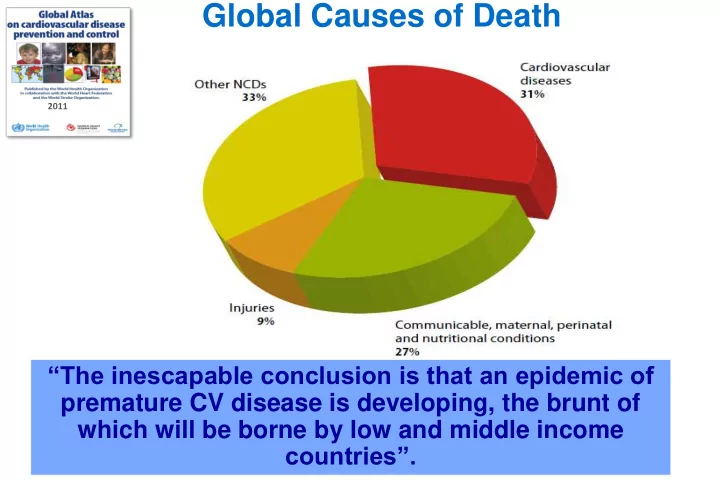
Global Causes of Death

  • NCDs cause 64% (35 million) of global deaths
  • 80% (28 million) are in LMICs
  • NCDs will cost the world $47 trillion over the next 20 years
  • CVD is responsible for around one third of all deaths worldwide

2011

“The inescapable conclusion is that an epidemic of premature CV disease is developing, the brunt of which will be borne by low and middle income countries”.

slide-2
SLIDE 2

20 40 60 Age (yrs)

Clinical Events

Genetic Environmental

Fetus

CVD Prevention Opportunity!

slide-3
SLIDE 3

Forecasting Future CVD in USA

Heidenreich Circ 2011; 123: 933-944

900 700 600 500 400 300 200 100

Billions $

2010 2011 2012 2013 2014 2015 2016 2017 2018 2019 2020 2021 2022 2023 2024 2025 2026 2027 2028 2029 2030

800

Indirect Direct

>20% of cost of car from staff health insurance

slide-4
SLIDE 4

Tuzcu Circ 2001 103:2075-10

32 Year Old Female

100

Atherosclerosis (%)

17% 37% 60% 85% 71% 20 40 60 80 <20 20-29 30-39 40-49 ≥50

Age (years)

Most of us have Arterial Disease!

slide-5
SLIDE 5

CV Risk Factors in Childhood and Carotid IMT in Adults

Raitakari et al JAMA 2003;290;2277-2283 Mean maximum carotid IMT (mm) Risk factors measured at ages 12-18yrs

  • No. of risk factors

Men Women P<0.001 P<0.001 0.88 0.80 0.72 0.64 0.56 0.48 1 2 3 or 4

slide-6
SLIDE 6

Framingham Heart Study :Lifetime Risk

Adjusted Cumulative Incidence 50% 39% 27%

Attained Age

0.7 0.6 0.5 0.4 0.3 0.2 0.1 50 60 70 80 90

69% 50% 46% 36% 5%

0.7 0.6 0.5 0.4 0.3 0.2 0.1 50 60 70 80 90

8%

≥2 Major RFs 1 Major RF ≥ Elevated RF ≥ Not Elevated RF All Optimal RFs

Men Women

Lloyd-Jones Circ. 2006; 113: 791-798

slide-7
SLIDE 7

LDL Cholesterol and Coronary Heart Disease among Black Subjects by PCSK9142X or PCSK9679X Allele

LDL Cholesterol in Black Subjects (mg/dl)

PCSK9142X or PCSK9679X

300 30 20 10 0 0 50 100 150 200 250 300 No Nonsense Mutation (n=3278)

50th Percentile

Frequency (%)

PCSK9142X

  • r PCSK9679X

(N=85) 30 20 10 0 0 50 100 150 200 250

Cohen NEJM 2006; 354:1264-72

28%

Coronary Heart Disease (%)

No Yes

P=0.008

12 8 4

88%

 Use Genetics to evaluate long term exposure  Compound interest from early management

slide-8
SLIDE 8

Effect of Lifetime CV RF Exposure

 Study sample: 102,773 persons (age 27 - 100 years)

 enrolled in one of 14 prospective cohort or case-control studies

 LDL-C genetic score: 46 polymorphisms associated

primarily with lower LDL-C at genome-wide level of significance

 SBP genetic score: 33 polymorphisms associated

with lower SBP at genome-wide level of significance

 Genetic scores used as both the instrument of

randomization and the instrument of exposure

  • B. Ference (Plymouth, US), FP 3163 ESC 2016
slide-9
SLIDE 9

Combined Effect of LDL-C and SBP

  • n Cardiovascular Events
  • B. Ference (Plymouth, US), FP 3163

N = 14,368 Major Vascular Events

slide-10
SLIDE 10
  • B. Ference (Plymouth, US), FP 3163

Effect of 1 mmol/L lower LDL-C & 10 mmHg lower SBP on Major Cardiovascular Events

SBP and LDL-C have independent, multiplicative and cumulative effects on CVD risk

0.25 0.50 0.75 1.00

slide-11
SLIDE 11

Jha N Engl J Med 2013; 368: 341-50

Hazards of Smoking and Benefits of Smoking Cessation 113,752 w and 88,496 m aged ≥25y in US NHIS

slide-12
SLIDE 12

Lifetime Atherosclerosis Management

Treat to Lower Levels

Treat multiple Risk Factors

Start Earlier

slide-13
SLIDE 13

Knowledge Communication

CVD Prediction and Prevention

Empowerment

slide-14
SLIDE 14

European Heart Journal 2012; 33: 1635-1701

ESC CV Prevention Guidelines 2012

Disenfranchises the Young, especially Women!

slide-15
SLIDE 15

Non-smoking men <45yrs All women <65yrs <10% 10yr CHD Risk 56% of US adults (87,000,000) have low (<10%) 10yr and high lifetime (≥39%) risk

Marma Circ Cardiothoracic Qual Outcomes 2010;3:8-14 Marma Circ 2009;120:384-390

Short Term v. Lifetime Risk in USA

slide-16
SLIDE 16

New Cholesterol Guidelines to a Population-Based Sample

Pencina NEJM 2014; 370: 1422-31

56 million people Mostly Elderly Men!

slide-17
SLIDE 17

JBS3 Lifetime Risk Calculator

Heart March 2014 and www.jbs3risk.com

  • Understandable measures of risk
  • Personalised opportunities to benefit
slide-18
SLIDE 18

Systolic Blood Pressure (mmHg)

P<0.001

2 1

  • 1
  • 2
  • 3
  • 4
  • 5

Weight (kg)

P<0.001

1.0 0.8 0.6 0.2

  • 0.2
  • 0.4
  • 0.8
  • 1.0

0.4 0.0

  • 0.6

Glucose (mg/dl)

P<0.001

4 3 2 1

  • 2
  • 3
  • 4
  • 1

Total cholesterol (mg/dl)

P<0.001

8 6 4 2

  • 4
  • 6
  • 8
  • 2

Current smoking (%^)

P<0.001

2.0 1.5 1.0 0.5 0.0

  • 1.0
  • 1.5
  • 2.0
  • 0.5

Heart Age (yrs)

P<0.001

2.0 1.5 1.0 0.5 0.0

  • 1.0
  • 1.5
  • 2.0
  • 0.5

Impact of Heart Age Tool on Modifiable CVRFs

3153 subjects (47% male), Mean Age 46yrs, 12m FU

Lopez-Gonzalez European Journal of Preventive Cardiology 2015: 22; 389–396

Control FR HA

slide-19
SLIDE 19

Years Total Mortality CV Events 7447 persons with High CV Risk (55-80yrs) 57% women

Primary Prevention of CVD with Mediteranean Diet

Years

Estruch N Engl J Med 2013; 368: 1279-90

slide-20
SLIDE 20

Changes in Fruit, Vegetable and Whole Grains Intake

Jenkins J Am Coll Cardiol. 2017; 69(9): 1103-12

* Significantly different from control group (p<0.05)

Healthy shifts in diet among generally well populations is likely to require a range of sustained approaches and multiple forms of communication in a process measured in decades rather than months”.

slide-21
SLIDE 21

Lifetime CVD Risk Management

Launched on Feb 14th 2015

Starts 2,115,568 Completes 882,260

Total starts: 2,115,568 Total completes: 882,260

slide-22
SLIDE 22

Heart Age 2 - Starts: 449,289 / Completes: 232,262

Age W e i g h t Features TC

From 26.09.2016 – 10.02.2017

slide-23
SLIDE 23

Digital Health: Empowerment ?

slide-24
SLIDE 24

What’s Good for the Heart is Good for the Brain!

CV RF lowering and Dementia Risk?

slide-25
SLIDE 25

Whitmer Neurology 2005; 64: 277-281

Mid LifeCV RFs and Dementia

2.5 2.0 1.5 1.0 0.5

1 2 3 4

Hazard Factor

Risk Factors CV composite Score

8845 HMO patients Age 40-43 yrs

slide-26
SLIDE 26

Multidomain Treatment and Cognitive Decline: FINGER Trial

Ngandu Lancet 2015; 385: 2255-2263

slide-27
SLIDE 27

Statins and IMT in FH Children

Weigman JACC 2004

208 FH children (8-18 yrs) 2 yrs with Pravastatin 20-40mg

  • 15
  • 10
  • 5

5 10 15

CCA P=0.06 Bulb P=0.3 CA P=0.2 Mean carotid P=0.019 Mean D IMT (mm) Pravastatin (n=104) Placebo (n=104)

slide-28
SLIDE 28

ALSPAC: Vascular Risk Factors at 9-11 yrs v. BMI

5 4 3 2 1

Cholesterol (mmol/L)

15 20 25 30 BMI (Kg/m2) HDL Cholesterol Non-HDL Cholesterol 120 100 80 60

Blood pressure (mm Hg)

15 20 25 30 BMI (Kg/m2) Diastolic Systolic

slide-29
SLIDE 29

BMI during adolescence and CV mortality

Twig G et al, NEJM 2016;374:2430-40

slide-30
SLIDE 30

Early Management / Digital Systems Wellness Illness Ageing

Revolution in the Delivery of Medicine

slide-31
SLIDE 31

McConachie et al July 2013

slide-32
SLIDE 32

Trends in Calories from Beverages

 National tax of 1% per oz of drink

$14.9 billion

 State tax

Florida $928 million Alabama $221 million

 72% approval for health promotion 2008 NYC poll

Brownell NEJM 2009;361:1599-1605

slide-33
SLIDE 33
slide-34
SLIDE 34

CVD Prevention: Never too early!

 Early intervention for lifetime gain.  Novel treatment approaches  Better communication, especially with the young  Empowerment including use of innovative technology  Political / legislative interventions

 Doctors need to play a major role in all of these!

slide-35
SLIDE 35

“It should be the function of medicine to have people die young as late as possible”

Ernest L. Wynder M.D.

Final Thought…