Global Causes of Death 2011 The inescapable conclusion is that an - - PowerPoint PPT Presentation

global causes of death
SMART_READER_LITE
LIVE PREVIEW

Global Causes of Death 2011 The inescapable conclusion is that an - - PowerPoint PPT Presentation

Global Causes of Death 2011 The inescapable conclusion is that an epidemic of NCDs cause 64% (35 million) of global deaths premature CV disease is developing, the brunt of 80% (28 million) are in LMICs NCDs will cost the world $47


slide-1
SLIDE 1

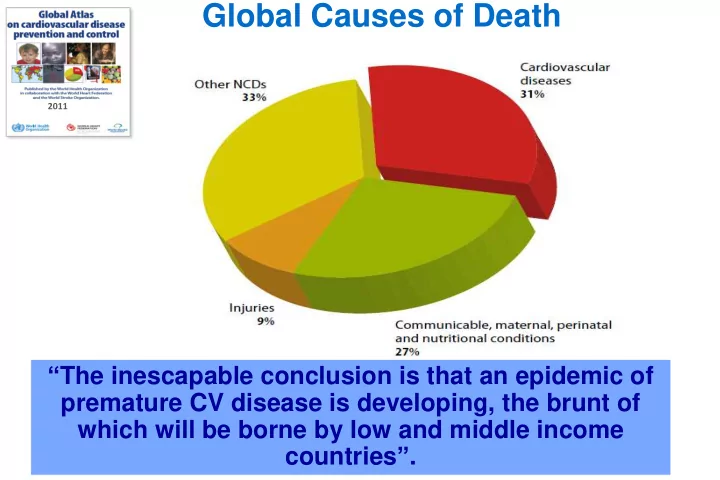
Global Causes of Death

  • NCDs cause 64% (35 million) of global deaths
  • 80% (28 million) are in LMICs
  • NCDs will cost the world $47 trillion over the next 20 years
  • CVD is responsible for around one third of all deaths worldwide

2011

“The inescapable conclusion is that an epidemic of premature CV disease is developing, the brunt of which will be borne by low and middle income countries”.

slide-2
SLIDE 2

“The human race has had long experience and a fine tradition in surviving adversity; we now face a task for which we have little experience, the task of surviving prosperity”

Alan Gregg (1890-1957) Rockefeller Foundation

CVD Prevention: Challenge!

slide-3
SLIDE 3

20 40 60 Age (yrs)

Clinical Events

Genetic Environmental

Fetus

CVD Prevention Opportunity!

slide-4
SLIDE 4

Coronary Heart Disease Mortality in Beijing 1984-1999

Critchley J. Circulation, 2004;110:1236-1244 2500 2000 1000 500

  • 500
  • 1000

1984 1999

Cholesterol 77%

1822 Extra deaths Attributable to Risk Factor Changes

Diabetes 19% BMI 4% Smoking 1%

642 fewer deaths by treatments

AMI treatments 41% Hypertension treatment 24% Secondary prevetion 11% Heart failure 10% Aspirin for Angina 10% Angina: CABG & PTCA 2%

slide-5
SLIDE 5

Forecasting Future CVD Costs in USA

Heidenreich Circ 2011; 123: 933-944

900

Billions 2008 $

2010 2011 2012 2013 2014 2015 2016 2017 2018 2019 2020 2021 2022 2023 2024 2025 2026 2027 2028 2029 2030

700 600 500 400 300 200 100 800

Indirect Direct

>20% of cost of car from staff health insurance

slide-6
SLIDE 6

Modifiable Risk Factors: Prevention Opportunity

INTERHEART Lancet 2004

1 2 3

Odds Ratio

9 RFs accounted for 90% of MI in men and 94% in women

Age Gender Smoking Cholesterol BP Diabetes 15152 MI patients in 52 countries

slide-7
SLIDE 7

Lifetime Atherosclerosis Management

 Treat to Lower Levels

 Treat multiple Risk Factors  Start Earlier

slide-8
SLIDE 8

New Lancet Statin Efficacy and Safety Study

Mean 1-year LDLC difference Between treatment groups (mmol/L) 30 20 10 0.5 1.0 1.5 Proportional reduction in major CV event rate (95% CI)

5 trials with LDL reduction at 1year >1.1 mmol/L (average: 1.4 mmol/L) 17 trials with LDL reduction at 1year <1.1 mmol/L (average: 0.9 mmol/L) 5 trials with further LDl reduction (average: 0.5 mmol/L)

Lancet September 2016

slide-9
SLIDE 9

Matthijs Boekholdt J Am Coll Cardiol 2014; 64: 485–94

Very Low Levels of Atherogenic Lipoproteins and the Risk for CV Events

A Meta-Analysis of Statin Trials

slide-10
SLIDE 10

Evolocumab in Hyperlipidemia as Add-On Therapy (DESCARTES Study)

Blom NEJM 2014; 370: 1809-1819

slide-11
SLIDE 11

Residual Risk in TNT Study

Mora Circ 2012; 125: 1979-1987

Increased Risk

RR Range Older age 1.13 1.04-1.23 Increased BMI 1.09 1.02-1.17 Male Sex 1.33 1.07-1.65 Increased BP 1.38 1.17-1.63 DM 1.33 1.11-1.60 Baseline ApoB 1.19 1.11-1.28 BUN 1.10 1.03-1.17 + Current smoking, CVD and CCB use

Decreased Risk

RR Range High dose statin 0.82 0.70-0.94 Aspirin 0.67 0.56-0.81 Baseline ApoA-1 0.91 0.84-0.99

slide-12
SLIDE 12

640M also have other uncontrolled CV risk factors

80%

800 million people (1 in 8) have a BP ≥140/90 mmHg

Coexistence of Multiple CV Risk Factors

slide-13
SLIDE 13

Pathophysiology: Additive Effect of Cholesterol and BP on CHD Risk

Neaton et al. Arch Intern Med. 1992;152:56-64. 142+ 125-131 <182 182-202 203-220 221-244 <118 118-124 132-141

34 21 13 6 23 12 10 6 18 11 9 6 4 17 8 8 6 3

Deaths /10,000 Patient-years

245+

14 5 6 3 12 17

N=316,099

slide-14
SLIDE 14

ASCOT-LLA: non-fatal MI and fatal CHD

Sever PS, et al. Lancet 2003;361:1149–58

slide-15
SLIDE 15

Tuzcu Circ 2001 103:2075-10

32 Year Old Female

100

Atherosclerosis (%)

17% 37% 60% 85% 71% 20 40 60 80 <20 20-29 30-39 40-49 ≥50

Age (years)

Most of us have Arterial Disease!

slide-16
SLIDE 16

Framingham Heart Study :Lifetime Risk

Adjusted Cumulative Incidence 50% 39% 27%

Attained Age

0.7 0.6 0.5 0.4 0.3 0.2 0.1 50 60 70 80 90

69% 50% 46% 36% 5%

0.7 0.6 0.5 0.4 0.3 0.2 0.1 50 60 70 80 90

8%

≥2 Major RFs 1 Major RF ≥ Elevated RF ≥ Not Elevated RF All Optimal RFs

Men Women

Lloyd-Jones Circ. 2006; 113: 791-798

slide-17
SLIDE 17

LDL Cholesterol and Coronary Heart Disease among Black Subjects by PCSK9142X or PCSK9679X Allele

LDL Cholesterol in Black Subjects (mg/dl)

PCSK9142X or PCSK9679X

300 30 20 10 0 0 50 100 150 200 250 300 No Nonsense Mutation (n=3278)

50th Percentile

Frequency (%)

PCSK9142X

  • r PCSK9679X

(N=85) 30 20 10 0 0 50 100 150 200 250

Cohen NEJM 2006; 354:1264-72

28%

Coronary Heart Disease (%)

No Yes

P=0.008

12 8 4

88%

 Exposure to CV RFs over time is key  Compound interest from early management

slide-18
SLIDE 18

Ference J Am Coll Cardiol. 2015; 65: 1552–61

Benefit from Lifetime Lower LDLc

slide-19
SLIDE 19

Ference J Am Coll Cardiol 2015; 65: 1552–61

LDL EXposure is Key!

Effect of Lower LDL-C Mediated by Polymorphisms in NPC1L1, HMGCR, or Both

slide-20
SLIDE 20

Silverman JAMA 2016; 316: 1289-1297

Trial Support for Lower LDLc Irrespective of Approach

slide-21
SLIDE 21

HOPE-3 Studies: NEJM April 2016

“Because of the short follow up of trial the probable life time benefit of continuous treatment is much larger than the benefit observed during trials” “The size of the intermediate risk population eligible for primary prevention is

  • enormous. Three quarters of

men over 55 and women over 60 would be eligible based on HOPE-3 criteria”

Salim Yusuf

slide-22
SLIDE 22

Heart Protection Study Collaborative Group Lancet 2011; 378: 2013–20

HPS: Effects on 11-year Mortality and Morbidity Of Lowering LDL Cholesterol With Simvastatin for About 5 Years in 20,536 High-risk Individuals: A Randomised Controlled Trial

slide-23
SLIDE 23

Ford Circ 2016; 133: 1073-1080

Long Term Benefits From LDLc Lowering Past Trial Duration

slide-24
SLIDE 24

Jha N Engl J Med 2013; 368: 341-50

Hazards of Smoking and Benefits of Smoking Cessation 113,752 w and 88,496 m aged ≥25y in US NHIS

slide-25
SLIDE 25

Study Population and Exposures

 Study sample: 102,773 persons (age 27 - 100 years)

 enrolled in one of 14 prospective cohort or case-control studies

 LDL-C genetic score: 46 polymorphisms associated

primarily with lower LDL-C at genome-wide level of significance

 SBP genetic score: 33 polymorphisms associated

with lower SBP at genome-wide level of significance

 Genetic scores used as both the instrument of

randomization and the instrument of exposure

  • B. Ference (Plymouth, US), FP 3163 ESC 2016
slide-26
SLIDE 26

Combined Effect of LDL-C and SBP

  • n Cardiovascular Events
  • B. Ference (Plymouth, US), FP 3163

N = 14,368 Major Vascular Events

slide-27
SLIDE 27
  • B. Ference (Plymouth, US), FP 3163

Effect of 1 mmol/L lower LDL-C & 10 mmHg lower SBP on Major Cardiovascular Events

SBP and LDL-C have independent, multiplicative and cumulative effects on CVD risk

0.25 0.50 0.75 1.00

slide-28
SLIDE 28

Conclusions

LDL-C and SBP have independent, multiplicative

and cumulative causal effects on risk of CV events

 Because their effects are multiplicative and cumulative

  • ver time, long-term exposure to combination of

modestly lower LDL-C and SBP has the potential to dramatically reduce the lifetime risk of CVD

 CV events are largely preventable and CVD prevention

can be substantially improved and simplified by designing programs that promote long-term exposure to combination of lower LDL-C and lower SBP beginning in early adulthood

slide-29
SLIDE 29

CV disease is preventable

“Life-long Rx likely to be cost-effective and

  • ften cost saving”

Circulation 2011;124:967-990

slide-30
SLIDE 30

Knowledge Communication

CVD Prediction and Prevention

Empowerment

slide-31
SLIDE 31

JBS3 Lifetime Risk Calculator

Heart March 2014 and www.jbs3risk.com

slide-32
SLIDE 32

Systolic Blood Pressure (mmHg)

P<0.001

2 1

  • 1
  • 2
  • 3
  • 4
  • 5

Weight (kg)

P<0.001

1.0 0.8 0.6 0.2

  • 0.2
  • 0.4
  • 0.8
  • 1.0

0.4 0.0

  • 0.6

Glucose (mg/dl)

P<0.001

4 3 2 1

  • 2
  • 3
  • 4
  • 1

Total cholesterol (mg/dl)

P<0.001

8 6 4 2

  • 4
  • 6
  • 8
  • 2

Current smoking (%^)

P<0.001

2.0 1.5 1.0 0.5 0.0

  • 1.0
  • 1.5
  • 2.0
  • 0.5

Heart Age (yrs)

P<0.001

2.0 1.5 1.0 0.5 0.0

  • 1.0
  • 1.5
  • 2.0
  • 0.5

Impact of Heart Age Tool on Modifiable CVRFs

3153 subjects (47% male), Mean Age 46yrs, 12m FU

Lopez-Gonzalez European Journal of Preventive Cardiology 2015: 22; 389–396

Control FR HA

slide-33
SLIDE 33

Familial Hypercholesterolaemia

IMT difference between FH and sibs against age

  • 0.04
  • 0.02

0.02 0.04 0.06 0.08

Δ IMT (mm) FH v. siblings Age (years)

8 10 12 14 16 18

slide-34
SLIDE 34

Statins and IMT in FH Children

Weigman JACC 2004

208 FH children (8-18 yrs) 2 yrs with Pravastatin 20-40mg

  • 15
  • 10
  • 5

5 10 15

CCA P=0.06 Bulb P=0.3 CA P=0.2 Mean carotid P=0.019

Mean D IMT (mm) Pravastatin (n=104) Placebo (n=104)

slide-35
SLIDE 35

atorvastatin placebo quinapril quinapril 125 125 atorvastatin placebo placebo placebo 125 125

Statin Arm

ACE Inhibitor Arm

AdDIT: Intervention in Adolescent Diabetes

slide-36
SLIDE 36

Independent and graded association between GFR and CVD

Go et al; NEJM 2004

2 4 6 8 10 12 14 ≥60 45-59 30-44 15-29 <15 Estimated GFR (ml/min/1.73m2) Age-standardized rate of death from any cause (per 100 person-yr)

0.76 1.08 4.76 11.36 14.14

5 10 15 20 25 35 40 ≥60 45-59 30-44 15-29 <15 Estimated GFR (ml/min/1.73m2) Age-standardized rate of CV events (per 100 person-yr)

2.11 3.65 11.29 21.80 36.60

35

slide-37
SLIDE 37

Proportion of Patients With Decline

  • r Improvement From Baseline eGFR

P<0.0001 P<0.0001 (n=3324) (n=3225) (n=1505) (n=1602)

eGFR decline from eGFR improvement from ≥60 mL/min/1.73 m2 <60 mL/min/1.73 m2 9.2% 6.6% 37.8% 45.6%

slide-38
SLIDE 38

ALSPAC: Vascular Risk Factors at 9-11 yrs v. BMI

5 4 3 2 1

Cholesterol (mmol/L)

15 20 25 30 BMI (Kg/m2) HDL Cholesterol Non-HDL Cholesterol 120 100 80 60

Blood pressure (mm Hg)

15 20 25 30 BMI (Kg/m2) Diastolic Systolic

slide-39
SLIDE 39

Juonala NEJM 2011; 365: 1876-1885

slide-40
SLIDE 40

Potential Benefit of CV RF treatment in Obesity

2021 2023 2025 2027 2029 2031 2033 2035

Year

  • No. of excess events

Excess Total CHD Events

Average projection Treatment for DBP and LDL Treatment for DBP, LDL and HDL 1 10 1000 10000 100000

2021 2023 2025 2027 2029 2031 2033 2035

Year

  • No. of excess events

Excess Deaths from CHD

Average projection Treatment for DBP and LDL Treatment for DBP, LDL and HDL 100 1 10 1000 10000 100000 100

Bibbins-Domingo NEJM 2007; 357: 2371-2379

slide-41
SLIDE 41

CVD Prevention: Delivery Who is Responsible for our Health?

 Child?  Parents?  Government?  Doctors?

slide-42
SLIDE 42

Responsibility for Childhood Obesity?

76 48 22 12

20 40 60 80

Parents Food and drink manufacturers The individual The state Who is at fault for obesity? 31

40

30 69 Who is reponsible for addressing it? Henley Centre (2007)

‘Sell Health as a Valued Commodity’

slide-43
SLIDE 43

Digital Health: Empowerment ?

slide-44
SLIDE 44

Personalized Nutrition by Prediction of Glycemic Responses

Zeevi Cell 2015; 163: 1079-1094

slide-45
SLIDE 45

Price and Cigarette Consumption France

Sales Cigarettes (billions) Yearly price increase of Marlboro (%)

90 80 70 60 50 40 30 20 10 1999 2000 2001 2002 2003 5 10 15 20 25 30 Year

slide-46
SLIDE 46
slide-47
SLIDE 47

Early Management / Digital Systems Wellness Illness Ageing

Revolution in the Delivery of Medicine

slide-48
SLIDE 48

CVD Prevention: Some Thoughts…

 Early intervention for lifetime gain.  Novel treatment approaches  Better communication especially with the young  Empowerment including use of innovative technology  Political / legislative interventions

 Doctors need to play a major role in all of these!