glasser and dagenbach glasser and dagenbach landscape architects - - PowerPoint PPT Presentation

glasser and dagenbach
SMART_READER_LITE
LIVE PREVIEW

glasser and dagenbach glasser and dagenbach landscape architects - - PowerPoint PPT Presentation

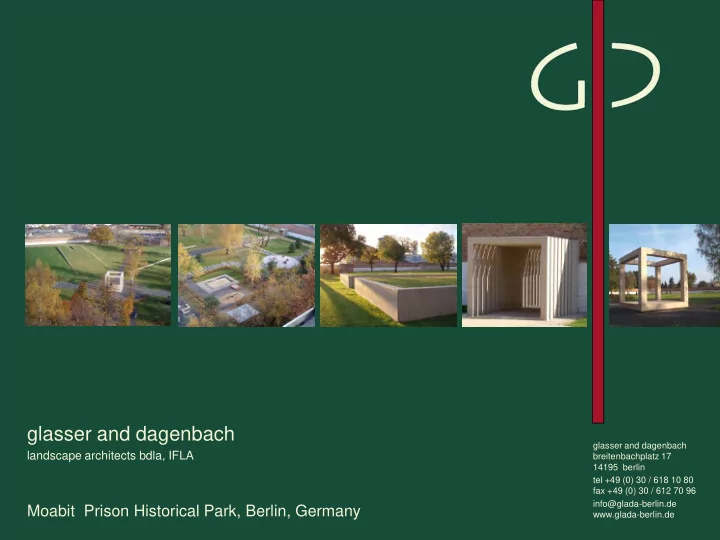
glasser and dagenbach glasser and dagenbach landscape architects bdla, IFLA breitenbachplatz 17 14195 berlin tel +49 (0) 30 / 618 10 80 fax +49 (0) 30 / 612 70 96 info@glada-berlin.de Moabit Prison Historical Park, Berlin, Germany


slide-1
SLIDE 1

glasser and dagenbach

landscape architects bdla, IFLA

Moabit Prison Historical Park, Berlin, Germany

glasser and dagenbach breitenbachplatz 17 14195 berlin tel +49 (0) 30 / 618 10 80 fax +49 (0) 30 / 612 70 96 info@glada-berlin.de www.glada-berlin.de

slide-2
SLIDE 2

glasser & dagenbach landscape architects

slide-3
SLIDE 3

glasser & dagenbach landscape architects The park's them e and urban planning and its architectural and political history are unique to Berlin’s urban landscape. The task of creating both a m em orial and an area for people to relax and learn has been accomplished in an exemplary

  • manner. Historical landmarks have been preserved, restored

and enhanced using contemporary styling. The dramaturgical approach of minimalist sculptural design principles once again anchors the structural remains permanently in the disordered urban space of the neighbouring Central Station. Local people and visitors to Berlin can rediscover the site’s historical significance after m ore than 50 years

  • f

inaccessibility and enjoy its recreational resources. The prison was erected 150 years ago following a penal reform as a pentagonal, panoptic brick building modelled on Pentonville Prison in London. The cellular prison, which once dominated the cityscape, no longer exists. Most of the prison buildings were dem olished between 1956 and 1958. The remaining five-metre-high prison walls were m eticulously restored. Like two angled arm s, they protect the large, open interior grounds from intrusion. The space inside the high prison walls now constitutes a hortulus conclusus – which would hardly have been the case had the park been designed using “conventional” planning methods. Creating a protected interior space was a conscious attem pt to reverse the form er use of the site. Following a well-defined dramaturgical concept, fram ework landscaping on the park surface conveys the symm etrical layout of the prison com pound, giving visitors a notion of the complex’s dimensions and strict

  • rganization. The star-shaped facility is mirrored in various

concrete-enclosed tectonic indentations and elevations in the interior lawn. The eastern wings are depicted in their full width and length as rising and falling grassy slopes creating a mega-sculpture in the spacious park. The northern cell block is set in an existing grove. This sector has therefore been reshaped less dramatically. Hedgerows made of red beech trees recast the cells in various alignments. Concrete walls recreate one cell as a visitor-accessible sculpture in its

  • riginal dimensions. A uniformly sunken lawn outlines the

south wing. The former central surveillance sector is interpreted as a circular space with a fram e-like concrete cube in the middle. To the west, towards a six-to-ten-storey building barrier in Lehrter Straße, a sparse wood-like vegetation screen acts as a type of woods, shielding the park

  • ptically from adjoining residences. The new pines, birches

and acacias extend the existing grove to the south. In the middle of this “woodsy structure”, three rows of cubed red beeches indicate where the form er location

  • f

the administration wing once stood. The three form er walking sheds for yard exercise were situated between the cell wings.

slide-4
SLIDE 4

glasser & dagenbach landscape architects They are now portrayed using various interpretations of their earlier function. In the southeast section of the landscape

  • ne of these triangular boxes is strikingly visualized by two
  • bliquely aligned concrete discs. “Jumping in a triangle” is a

slang expression for inmates’ confined outdoor exercise in the three-corner enclosures. To the east, a circular indentation in the lawn dem onstrates the size of the entire exercise facility. In its centre, enclosed in a concrete wall, stands an old walnut tree – a relic of the transformation of the walkways into decorative greenery at the beginning of the 20th century. All concrete components are the colour of sand, similar to the mortar of the brick walls. The sandblasted, damaged surface

  • f the concrete conveys a sense of affliction and oppression

and attests to the area’s legacy as a place of injury and

  • infliction. In the north, the exercise yard’s form er central

surveillance area is em phasized by a centrally positioned red maple in a dark cinder bed. Arranged in a radial form, imbedded concrete circles portray the separation of the walking sheds. A columnar juniper has been planted in each pen, creating a surreal gathering of “yardbirds”. Inside the high prison walls, the proposed m easures divide the park into two zones. In the east, the spacious, empty lawn with the clear depiction of the prison buildings is contrasted and complem ented by the sparse wooded arrangement opposite the adjoining housing. The strict layout of the segm ented lawn collides with the melancholy, romantic backdrop of the lightly vegetated margin of the woods edge. This division makes it possible to integrate necessary park features such as play and rest areas without harming the dignity of the

  • site. The sparse woods are accessible on a trail-like network
  • f paths. Parallel granite curbs cross the trails at irregular

intervals, creating a stripe pattern throughout. Large quantities of the curbing were stored on the property. Play facilities are inconspiciously arranged along the woodland

  • paths. In the central portion of the wooded area we find the
  • nly remaining building in the form er prison complex – the
  • ld weighing house. A sand play area has been constructed

here for small children. The restoration of the weighing house facilitates temporary use by supervised play parties (storage

  • f recreational equipment, etc.) and storage of irrigation and

sprinkling control components. The earlier use of the property as the Tiergarten Civil Engineering Departm ent depot made widespread sedimentation a part of the history

  • f the site. This chapter is “recounted” in the wooded
  • periphery. Special materials such as the slate block remains
  • f the fountains in front of the zoo and the remainder of the

Moltkebrücke sandstone are arranged with the remnants of natural stone paving in the circular installation of a Japanese rock garden made of archaeological artefacts. The Moabit Ratschlag Club organized a cooperative project between children, teenagers and four artists to landscape three sides
slide-5
SLIDE 5

glasser & dagenbach landscape architects

  • f the western section of the park as foreseen by the Borough
  • f Mitte.The concrete sculpture which represents the prison

cell was enhanced by a sound installation based on an idea proposed and coordinated by the lyricist and filmmaker Christiane Keppler. It is composed of code-like “knocking signals” and recitations of passages from Albrecht Haushofer’s “Moabit Sonnets” which can be heard upon entering the cell. This work was accompanied by schoolchildren. The western wooded sector was enhanced with a climbing wall and a sitting wall, based on the them e of a key. Sculptor Bärbel Rothhaar, children from Moabit schools and local residents engraved key signs and fragm ents of poem s in bricks, which they then fired and subsequently arranged into a wall for

  • relaxation. The key theme is also found in a wooden climbing

wall designed by Rothhaar and local youths.At the form er weighing house, sculptors Gabriele Rosskamp and Serge Petit devised a star labyrinth. They used granite curbs left on the site and surplus stones from the storage yard to create a labyrinthine installation. Stars were the only shapes prisoners could decipher from their cells at night. Under the guidance of the sculptors, neighbourhood children chiselled constellations into the stone remnants.A passage of the Haushofer sonnet “In Fetters” was inscribed in the northeast section of the form er prison wall. Christiane Keppler selected the passage and the lettering: “From all the sorrow that perm eates the masonry and iron bars, stirs a breath of life and clandestine shivers…” The inner part of the park is traversed by asphalt and gravel paths which follow the preserved prison walls, leading to the three park entrances. A north-south axis of asphalt paving, similar to the original surface of the ground floor, connects the western Cell Wings A and D .The three entrances to the interior of the park are designed in very different ways. In the south, one gains admittance through a breach in the wall from Invalidenstraße. The arrangem ent and style of the breach express a dramaturgical concept. Direct views from the street and from the park are blocked by a concrete disc positioned in front of the prison wall. A series of fram e-like concrete arches runs along the wall and leads into the inner park area on the axis of form er Cell Wings A and B. The play of light and shadow on the arches and the reduced vision into and out of the park gradually opens into a total view of the central sector and of the park. In the east, visitors can get a glimpse of the park from a square form ed according to the layout of the former “insanity ward”. This was once the prison’s places of execution. A folded entrance structure, shaped like a rectangular origami, creates an opening in the fence and copper beech hedge. In the west, the park can be accessed from a square on Lehrter Straße adorned by nine newly planted lindens. All three sides have information boards designed and worded in conjunction with the Tiergarten History Workshop. When the park is closed at night, the locked entrance gates display the layout of the prison.

slide-6
SLIDE 6

glasser & dagenbach landscape architects

slide-7
SLIDE 7

glasser & dagenbach landscape architects

slide-8
SLIDE 8

glasser & dagenbach landscape architects

slide-9
SLIDE 9

glasser & dagenbach landscape architects

slide-10
SLIDE 10

glasser & dagenbach landscape architects

slide-11
SLIDE 11

glasser & dagenbach landscape architects

slide-12
SLIDE 12

glasser & dagenbach landscape architects

slide-13
SLIDE 13

glasser & dagenbach landscape architects

slide-14
SLIDE 14

glasser & dagenbach landscape architects

slide-15
SLIDE 15

glasser & dagenbach landscape architects

slide-16
SLIDE 16

glasser & dagenbach landscape architects

slide-17
SLIDE 17

glasser & dagenbach landscape architects

slide-18
SLIDE 18

glasser & dagenbach landscape architects

slide-19
SLIDE 19

glasser & dagenbach landscape architects

slide-20
SLIDE 20

glasser & dagenbach landscape architects

slide-21
SLIDE 21

glasser & dagenbach landscape architects

slide-22
SLIDE 22

glasser & dagenbach landscape architects

slide-23
SLIDE 23

glasser & dagenbach landscape architects

slide-24
SLIDE 24

glasser & dagenbach landscape architects

slide-25
SLIDE 25

glasser & dagenbach landscape architects

slide-26
SLIDE 26

glasser & dagenbach landscape architects

slide-27
SLIDE 27

glasser & dagenbach landscape architects

slide-28
SLIDE 28

glasser & dagenbach landscape architects

slide-29
SLIDE 29

glasser & dagenbach landscape architects

slide-30
SLIDE 30

glasser & dagenbach landscape architects

slide-31
SLIDE 31

glasser & dagenbach landscape architects

slide-32
SLIDE 32

glasser & dagenbach landscape architects

slide-33
SLIDE 33

glasser & dagenbach landscape architects

slide-34
SLIDE 34

glasser & dagenbach landscape architects

slide-35
SLIDE 35

glasser & dagenbach landscape architects

slide-36
SLIDE 36

glasser & dagenbach landscape architects

slide-37
SLIDE 37

glasser & dagenbach landscape architects

slide-38
SLIDE 38

glasser & dagenbach landscape architects