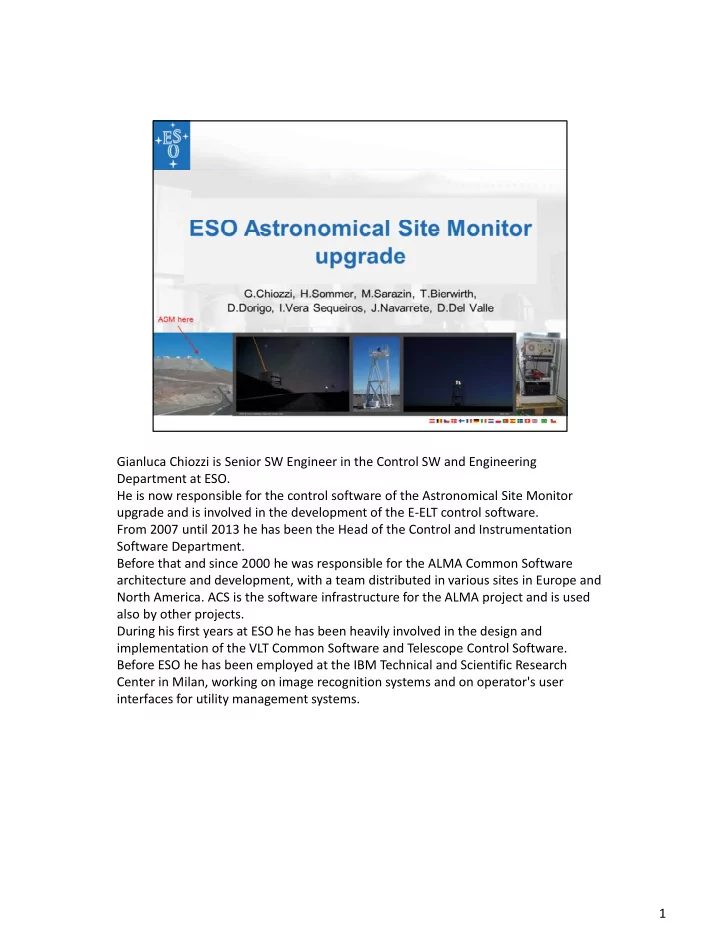
SLIDE 1
Gianluca Chiozzi is Senior SW Engineer in the Control SW and Engineering Department at ESO. He is now responsible for the control software of the Astronomical Site Monitor upgrade and is involved in the development of the E‐ELT control software. From 2007 until 2013 he has been the Head of the Control and Instrumentation Software Department. Before that and since 2000 he was responsible for the ALMA Common Software architecture and development, with a team distributed in various sites in Europe and North America. ACS is the software infrastructure for the ALMA project and is used also by other projects. During his first years at ESO he has been heavily involved in the design and implementation of the VLT Common Software and Telescope Control Software. Before ESO he has been employed at the IBM Technical and Scientific Research Center in Milan, working on image recognition systems and on operator's user interfaces for utility management systems. 1
SLIDE 2
2
SLIDE 3 The weather and environmental parameters provided by the Astronomical Site Monitors at all ESO observatories are indispensable during the whole lifecycle of
- bservations, from the scheduling to the final analysis of the data.
The improvement in the science image quality brought by the new VLT AOF (under commissioning) will be strongly dependent on the vertical distribution of the atmospheric turbulence. At the moment the system is not providing an official prediction for the seeing, but personnel at the observatory use the available data to make their own short term predictions regarding the seeing/wind/transparency to schedule the observations. Official predictions will be made available in the future. 3
SLIDE 4 New features:
- Multi Aperture Scintillation Sensor (MASS)[4] to measure the vertical distribution
- f turbulence in the high atmosphere and its characteristic velocity by analyzing
the scintillation of bright stars;
- SLOpe Detection And Ranging (SLODAR)[5] telescope, for measuring the altitude
and intensity of turbulent layers in the low atmosphere by means of a triangulation method, in which the turbulence profile is recovered from
- bservations of bright binary stars using a Shack‐Hartmann wavefront sensor.
- Integrate Paranal Water Vapour Monitor:
- Measure of the water vapour content of the atmosphere with high
precision and time resolution, allowing the execution of infrared observations in periods of low precipitable water vapour.
- Measure of infrared sky brightness
- … and other data.
- About x5 more data items with respect to the old system
4
SLIDE 5
5
SLIDE 6 Instruments distributed in convenient positions on the platform. MASS‐DIMM and SLODAR instruments on identical commercial mounts (Astelco NTM500) and enclosures (Halfmann). MASS‐DIMM developed jointly at Sternberg Institute (Moscow, Russia) and Cerro Tololo Observatory. More than 30 devices are in use around the world. SLODAR developed at the center for Advanced Instrumentation (CFAI, Durham University, UK) SLODAR systems, based on small telescopes (typically 50cm aperture), have been employed for characterization of the optical turbulence at Paranal, ORM (La Palma), Mauna Kea and SAAO observatories. MASS‐DIMM and SLODAR subsystems are operational during night time, as they rely
- n the observation of stars
Meteo tower and water vapour radiometer are in operation 24/7. 6
SLIDE 7 OLD control system was responsible both for
- collecting data
- providing display of the weather conditions in the control room.
Once a day, during day‐time, part of the data archived in a relational database for
Data available in the control room was limited to the last 12 or 24 hours. The NEW system decouples data display, retrieval and analysis from data collection:
- The control system
- collects the data
- sends it to a relational database.
- provides real time data access to telescopes and instruments, using
backward compatible interfaces.
- Any application, including the display in the control room, gets the data from the
relational database.
- Data replication allows access both in Paranal and in near real time also at ESO
HQ in Garching with appropriate quality of service characteristics.
- We integrate into the database forecast data provided by external services
(European Center for Medium Range Forecasts’ (ECMWF)) 7
SLIDE 8 The OLD control system was fully built on the classical VLT architecture:
- devices connected to IO boards on VME‐based Local Control Units (LCUs), with
the code primarily developed in ANSI C;
- DIMM using a VLT Technical CCD camera, developed in‐house by ESO;
- the mount of the telescope was controlled by the same tracking software as used
- n the VLT Unit Telescopes, modified to support the specific hardware;
- an HP Unix workstation (obsolete since years) was running the supervisory
software, written primarily in C++ 8
SLIDE 9 NEW control system:
- Latest VLT SW, with Java and Python replacing C/C++ (with exception for C++
external interfaces)
- Integrate off‐the‐shelves devices and their control systems (MASS‐DIMM and
SLODAR). Do not re‐implement what available:
- Synergies with other users
- We own the code
- Drawback: MASS uses TCL
- No LCUs (no devices connected to IO boards, no strict real time control
requirements)
- MASS‐DIMM and SLODAR have Linux workstations for the control
- Central supervisory Linux workstation to coordinate the operation of all
instruments:
- Meteo station is now connected through a serial‐to‐Ethernet adapter:
- No cable length limitations
- Simple socket interface
- Mounts are driven by the vendor commercial controller (linux based)
- TCCD replaced by GigE Prosilica commercial camera
- MASS still requires a USB connection for a RS485‐to‐USB converter
9
SLIDE 10 The ASM subsystems deliver their proprietary data at different levels of complexity:
- SLODAR produces ready‐to‐use PAF data files in the black‐box vendor's software;
- METEO publishes custom ASCII datagrams that we read from a socket connection;
- LHATPRO publishes custom data files for us to poll from an FTP server;
- MASS‐DIMM uses for each detector a two‐staged pipeline: data supervisors
follow data as it gets appended to files, mix output, and identify new data blocks in the continuous streams of new data lines. Independent Data Supervisors:
- Collect, reformat and aggregate device data
- Perform data scaling to different units
- Compute derived data items
- Ingest into the archive in Paranal
- Write in the CCS Online database for TCS/INS usage (backward compatible)
Attention placed on robust data flow:
- Any stage can be restarted independently, or will wait if started too early.
- No data can ever be lost, thanks to buffering in the file system or the online
database.
- Re‐processing of old data after restart is recognized and suppressed.
- Data files get deleted only after the ingestion in the relational database has been
verified independently 10
SLIDE 11 All data flow applications are implemented in Java because of better support
- Multithreading
- database connection pooling (c3p0)
- Parsing .. and many other tasks of data flow.
Wrapped the C API of VLT common software using generated Java bindings: jnaerator using the BridJ Java‐C binding target. The JNA binding is more widely used, but BridJ appeared clearer in the mapping of complex pointer constructs. We also use BridJ to wrap the slalib astronomical routines for Java. 10
SLIDE 12 The database has been created in the existing ESO operational data flow system:
- local database server in the observatories
- central database server at ESO Headquarters.
- synchronization of the databases by means of database replication technology
The distributed architecture is a major step forward, since:
- It provides fast and reliable access to the data from the observatory,
- It protects from connectivity outages from headquarters.
- Allows real time access from the database in headquarters of the full history of
the observatories
- The database in the observatories can be kept small, therefore improving the
recovery time of the local database if needed. The process that ingests data uses configuration tables in the database itself to identify the data destination table and column. In this way, any new parameter can be easily added by introducing a new database table or database column and adding the proper configuration in the database. These configuration tables are used as well by the web display to decide which parameters can be plotted in the tool. 11
SLIDE 13 Therefore, making a new instrument or parameter available for plotting does not require any code change. Forecast data retrieved from external services are inserted at ESO headquarters. They can be used in the ASM web display. Such data are replicated from headquarters to Paranal to be available at the
In order to allow the display of large historical time ranges, database tables are down‐sampled into hourly, daily or weekly averages, populated periodically by an external process. The ASM data is accessible also directly using standardized query forms, common to all ESO observatories. 11
SLIDE 14
This screenshot shows the old ASM display in the Paranal control room. This was implemented heavily using the RTAP plotting features. Our first requirement was to provide exactly the same user feel with the new application. 12
SLIDE 15
And this is the new ASM Display as seen in the Paranal control room. Our second driver was to make the live updating plots easily accessible also from stakeholders worldwide. Consequently we decided for a web‐based solution using modern browsers (Chrome, Firefox, Safari) as visualization platform driven by JavaScript. This allows to offload the CPU needed for generating the graphs to the web browsers running on the clients, while the data is retrieved from the database and not any more from the control workstation. In this way we do not have any more the constraints of the old system on the number of consoles that are allowed to display weather data. Moreover, if very complex graphs, with a lot of historical data, are requested by users, only the client web browser will struggle and the rest of the system will not be affected. Visualization requirements were demanding. We initially considered using the flexible JavaScript library d3.js. 13
SLIDE 16
After prototyping we realized that it was too low‐level and we were spending too much time reinventing the wheel. We decided to go for highcharts.js and its companion library highstock.js. We found these libraries to be extremely feature‐rich, well‐documented and supported, highly customizable and to have a large user base. 13
SLIDE 17
A personal profile with an active warning indication: a wind speed threshold was crossed 14
SLIDE 18
‐ Configuration: ‐ Profiles ‐ Page ‐ Plot Offering a rich and dynamic configuration user interface in a web browser ‐ similar to a desktop GUI application ‐ is not trivial. Over the last couple of years, browser programming in JavaScript has undergone a major paradigm change: ‐ Before dynamic browser behavior was primarily using asynchronous server calls (AJAX) triggering callbacks that would directly modify the browser's DOM tree. This often led to hard to the callback hell, a codebase that was difficult to understand and maintain and a tight coupling of data and view. ‐ More recently, browser programming moved away from this imperative programming paradigm to a declarative one using a client‐side model‐view‐ controller pattern. While the controller fetches and maintains the model data, the view declares its dynamic dependencies on model changes. The DOM is never directly modified. For the web display, we chose Google's angular.js, one of the most widespread frameworks supporting this declarative paradigm 15
SLIDE 19
Separation of concerns: data access and visualization ‐ Some browser‐based user interface libraries use a server‐centric approach ‐ Complete separation between data access and visualization was very important since various stakeholders have increasing demand to access live or historic data programmatically. ‐ As a general strategic trend, we strive for web‐based solutions, exposing services through RESTful APIs to be consumed by independent GUIs as well as by programmatic clients. ‐ For ASM, a simple REST API consumes an HTTP GET call with from ..to parameters to specify the time interval for which data points are requested and a fields parameter that lists the required physical measurement values. ‐ Results are returned in the lightweight JSON format that is easily consumable by JavaScript clients ‐ In order to prevent excessive DB queries, different restrictions apply depending on whether the query is made anonymously or by an authenticated user ‐ We implemented the back‐end of the ASM web display using the Grails framework ‐ The exchanged information is minimal, performance is very good ‐ Additional APIs allow storage and retrieval of configuration profiles and other actions 16
SLIDE 20 Despite additional devices and much wider set of parameters, the switch to a modern hardware architecture and programming languages has allowed us to implement a robust, maintainable and extensible system. Running the new system in parallel to the old one for more than one year has been extremely valuable. This has allowed us to compare the operational behavior of the two systems and tune our new software. An interesting example is the discovery and investigation of a Ghost manipulating data. On the control system side we have already received requests for improvements and for adding further data. The next big testbed will be when the new AOF, being integrated, will use the atmospheric profile data from the ASM. As far as the web display is concerned, using highcharts.js for visualization is highly
- recommended. The usage of the "declarative" client‐side web framework angular.js
was essential for building a desktop‐like dynamic user experience and is also highly recommended. 17
SLIDE 21
The upgrade of the La Silla ASM and the installation of a new system at the E‐ELT site are now being planned. Already now La Silla data, coming from the old ASM, has been integrated in the new ASM Database and Display applications. This makes it already possible to compare the weather conditions at the two sites. 17
SLIDE 22
18