
SLIDE 1
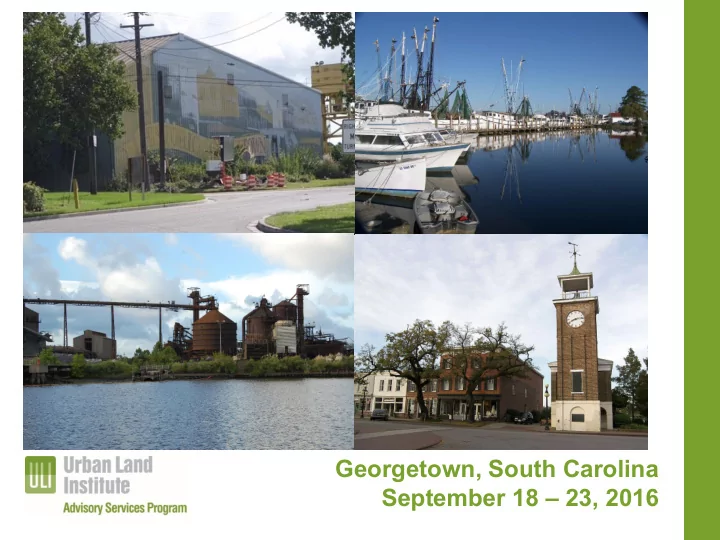
Georgetown, South Carolina September 18 23, 2016 University of - - PowerPoint PPT Presentation
Georgetown, South Carolina September 18 23, 2016 University of Denver Denver, CO June 12 - 17, 2016 About the Urban Land Institute The mission of the Urban Land Institute is to provide leadership in the responsible use of land
2
University of Denver – Denver, CO – June 12 - 17, 2016
2
Georgetown, South Carolina September 18 - 23, 2016
The mission of the Urban Land Institute is to
land and in creating and sustaining thriving communities worldwide. ULI is a membership organization with nearly
spectrum of real estate development, land use planning and financial disciplines, working in private enterprise and public service. What the Urban Land Institute does:
– Provides a forum for sharing of best – practices Writes, edits and publishes books and – magazines Organizes and conducts meetings – Directs outreach programs – Conducts Advisory Services Panels –
3
University of Denver – Denver, CO – June 12 - 17, 2016
3
Georgetown, South Carolina September 18 - 23, 2016
candid advice on important land use and real estate issues
materials
presentation & tour
interviews
and write recommendations
4
University of Denver – Denver, CO – June 12 - 17, 2016
4
Georgetown, South Carolina September 18 - 23, 2016
5
University of Denver – Denver, CO – June 12 - 17, 2016
5
Georgetown, South Carolina September 18 - 23, 2016
Alex J. Rose, Chair Senior Vice President, Development Continental Development Corporation El Segundo, CA John Banka Partners & Director Colliers International Warsaw, Poland Don Edwards CEO & Principal Justice & Sustainability Associates Washington, DC Antonio Fiol-Silva Founding Principal SITIO architecture + urbanism Philadelphia, PA Juanita Hardy Senior Visiting Fellow for Creative Placemaking ULI – the Urban Land Institute Washington, DC Ken Kay Founder & President Ken Kay Associates San Francisco, CA Geoff Koski Senior Consultant Bleakly Advisory Group Atlanta, GA Kathleen Rose President & CEO Rose & Associates, Southeast,, Inc. Davidson, NC Sarah Sieloff Executive Director The Center for Creative Land Recycling Oakland, CA Ross Tilghman President Tilghman Group Seattle, WA
6
University of Denver – Denver, CO – June 12 - 17, 2016
6
Georgetown, South Carolina September 18 - 23, 2016
7
University of Denver – Denver, CO – June 12 - 17, 2016
7
Georgetown, South Carolina September 18 - 23, 2016
Economic and Jobs Crisis
8
University of Denver – Denver, CO – June 12 - 17, 2016
8
Georgetown, South Carolina September 18 - 23, 2016
9
University of Denver – Denver, CO – June 12 - 17, 2016
9
Georgetown, South Carolina September 18 - 23, 2016
10
University of Denver – Denver, CO – June 12 - 17, 2016
10
Georgetown, South Carolina September 18 - 23, 2016
Process
11
University of Denver – Denver, CO – June 12 - 17, 2016
11
Georgetown, South Carolina September 18 - 23, 2016
Historic Context
Public Control
Quo Historic Opportunity
12
University of Denver – Denver, CO – June 12 - 17, 2016
12
Georgetown, South Carolina September 18 - 23, 2016
Entrepreneurial Risk
Jobs Recreational and Cultural Assets
13
University of Denver – Denver, CO – June 12 - 17, 2016
13
Georgetown, South Carolina September 18 - 23, 2016
14
University of Denver – Denver, CO – June 12 - 17, 2016
14
Georgetown, South Carolina September 18 - 23, 2016
City of Georgetown 1.10% Georgetown County 1.90% Horry County 14.80% Charleston County 11.20% State of South Carolina 5.90%
0% 2% 4% 6% 8% 10% 12% 14% 16%
15
University of Denver – Denver, CO – June 12 - 17, 2016
15
Georgetown, South Carolina September 18 - 23, 2016
City of Georgetown $29,711 Georgetown County $42,666 Horry County $43,142 Charleston County $48,433 State of South Carolina $43,939
$0 $10,000 $20,000 $30,000 $40,000 $50,000 $60,000
16
University of Denver – Denver, CO – June 12 - 17, 2016
16
Georgetown, South Carolina September 18 - 23, 2016
Attract:
– – local consumers new – businesses – tourists This combination
target markets can be characterized as: – “from yunh” (from here) – “come yunh” (come here)
17
University of Denver – Denver, CO – June 12 - 17, 2016
17
Georgetown, South Carolina September 18 - 23, 2016
1
90-minute drive of downtown Georgetown. Spends $ – 14 billion annually on retail goods and food and drink South Carolina is one of the
5.9 – % population growth from 2010-2015
Successful
upon growing the currently limited real estate demand. 90 minute drive time
18
University of Denver – Denver, CO – June 12 - 17, 2016
18
Georgetown, South Carolina September 18 - 23, 2016
Bachelor
17 – % City of Georgetown 24 – % Georgetown County
19
University of Denver – Denver, CO – June 12 - 17, 2016
19
Georgetown, South Carolina September 18 - 23, 2016
Retirees
20
University of Denver – Denver, CO – June 12 - 17, 2016
20
Georgetown, South Carolina September 18 - 23, 2016
Economic Development Land Use Plan Real Estate Market
21
University of Denver – Denver, CO – June 12 - 17, 2016
21
Georgetown, South Carolina September 18 - 23, 2016
% of Employment – Georgetown County
Accommodation & Food Service Retail Trade Manufacturing
22
University of Denver – Denver, CO – June 12 - 17, 2016
22
Georgetown, South Carolina September 18 - 23, 2016
Location Quotients – Top Ranked Industries State County County
Primary Industry Annual Average (2015) SC Georgetown Horry NAICS 71 - Arts, entertainment, & recreation 0.98 3.11 2.56 NAICS 11 – Agriculture, forestry, fishing and hunting 0.64 2.92 0.19 NAICS 72 - Accommodation and food services 1.19 1.75 2.63 NAICS 23 - Construction 1.00 1.35 1.05 NAICS 53 - Real estate rental & leasing 0.99 1.28 2.50 NAICS 44-45 – Retail Trade 1.14 1.21 1.63 Primary Industry Sub-Sector (2015) SC Georgetown Horry NAICS 712 – Museums, historical sites, zoos & parks 0.83 7.19 2.27 NAICS 713 – Amusements, gambling, & recreation 1.08 3.60 2.63 NAICS 487 – Scenic and sightseeing transportation 1.28 2.66 3.58 NAICS 722 - Food services and drinking places 1.21 1.77 2.15 NAICS 332 – Fabrication/product manufacturing 1.43 1.76 0.66 NAICS 721 – Accommodation 1.12 1.66 5.38 NAICS 448 – Clothing and clothing accessories stores 1.07 0.64 3.24 NAICS 531 – Real Estate 0.97 1.56 3.04 Source: Bureau of Labor Statistics; Rose & Associates SE, Inc.
23
University of Denver – Denver, CO – June 12 - 17, 2016
23
Georgetown, South Carolina September 18 - 23, 2016
24
University of Denver – Denver, CO – June 12 - 17, 2016
24
Georgetown, South Carolina September 18 - 23, 2016
25
University of Denver – Denver, CO – June 12 - 17, 2016
25
Georgetown, South Carolina September 18 - 23, 2016
www.whoi.edu
26
University of Denver – Denver, CO – June 12 - 17, 2016
26
Georgetown, South Carolina September 18 - 23, 2016
www.mysticseaport.org
27
University of Denver – Denver, CO – June 12 - 17, 2016
27
Georgetown, South Carolina September 18 - 23, 2016
http://pikeplacemarket.org
28
Georgetown, South Carolina September 18 - 23, 2016
STEAM incorporates
Art and Culture is an economic driver*
Area
Impact Organizations Audiences Total Total Direct Expenditures (in Billions) $61.12 $74.08 $135.20 Full-Time Equivalent Jobs (in Millions) 2.24 1.89 4.13
Source: Art and Economic Prosperity IV Study, Americans for the Arts, 2010
29
Georgetown, South Carolina September 18 - 23, 2016
Georgetown County
Cultural Expenditures 313.6 – Million Employs – 5.42%
Impact of Tourism on South Carolina Counties (2014) Expenditures Rank County % of State $ millions 1 Horry 31.30% $3,894 2 Charleston 17.70% $2,147.31 3 Beaufort 9.90% $1,205.88 4 Greenville 9.10% $1,110.16 5 Richland 5.10% $621.07 6 Lexington 4.30% $517.76 7 Spartanburg 3.20% $385.37 8 Georgetown 2.60% $313.36 9 Florence 2.40% $293.41 10 York 1.70% $206.93 38 Williamsburg 0.10% $9.22 State Totals $12,155.01
30
Georgetown, South Carolina September 18 - 23, 2016
31
Georgetown, South Carolina September 18 - 23, 2016
and vacant for 7 years prior to being purchased
temporary retail space while developers are seeking entitlement for redevelopment
community
former food truck vendors how to manager a restaurant business and develop their customer base
3 1
32
Georgetown, South Carolina September 18 - 23, 2016
The neighborhood is disconnected from economic drivers around it
Through a community based approach, a discovery was made that
Through this process, the goal is to reduce the chance of
place.
33
Georgetown, South Carolina September 18 - 23, 2016
Former steel mill has been restored, adapted, and transformed into an arts and cultural
This is a massive project that involved many partners to pull off including needing to
34
Georgetown, South Carolina September 18 - 23, 2016
35
University of Denver – Denver, CO – June 12 - 17, 2016
35
Georgetown, South Carolina September 18 - 23, 2016
36
University of Denver – Denver, CO – June 12 - 17, 2016
36
Georgetown, South Carolina September 18 - 23, 2016
37
University of Denver – Denver, CO – June 12 - 17, 2016
37
Georgetown, South Carolina September 18 - 23, 2016
38
University of Denver – Denver, CO – June 12 - 17, 2016
38
Georgetown, South Carolina September 18 - 23, 2016
Occupies a strategic location within the City of Georgetown: – Dominates the waterfront – Abuts Front Steet, the city’s prime commercial street – Runs parallel to S. Fraser Street/US 17 – Perhaps most critically, it constitutes an extensive border with the West End district, separating it from the waterfront
39
University of Denver – Denver, CO – June 12 - 17, 2016
39
Georgetown, South Carolina September 18 - 23, 2016
40
University of Denver – Denver, CO – June 12 - 17, 2016
40
Georgetown, South Carolina September 18 - 23, 2016
41
University of Denver – Denver, CO – June 12 - 17, 2016
41
Georgetown, South Carolina September 18 - 23, 2016
Does the site want to be: – Industrial ? – Commercial ? – Residential ? – Recreational ? What should be accomplished by the new site functions ? These questions can be answered by examining the physical and market context & by considering your apirations
42
University of Denver – Denver, CO – June 12 - 17, 2016
42
Georgetown, South Carolina September 18 - 23, 2016
What we know: To serve as a commercial port, the harbor needs
Funds required to dredge the harbor are not on hand
not so apparent.
43
University of Denver – Denver, CO – June 12 - 17, 2016
43
Georgetown, South Carolina September 18 - 23, 2016
What we’ve learned & observed:
drivers approaching from the south on US 17
recreational and commercial
public art
Georgetonians, especially for West End residents
44
University of Denver – Denver, CO – June 12 - 17, 2016
44
Georgetown, South Carolina September 18 - 23, 2016
Provide opportunities for establishing high-value job creating activities from the following sectors:
45
University of Denver – Denver, CO – June 12 - 17, 2016
45
Georgetown, South Carolina September 18 - 23, 2016
Our panel has based its recommendations on the following:
provided by city and state officials
survey responses—together we reached over 800 community stakeholders
demographic info
46
University of Denver – Denver, CO – June 12 - 17, 2016
46
Georgetown, South Carolina September 18 - 23, 2016
It is important to note that we are not presenting
The time frame for full realization of the Vision is
be possible much sooner. We will discuss phasing shortly.
47
University of Denver – Denver, CO – June 12 - 17, 2016
47
Georgetown, South Carolina September 18 - 23, 2016
and
48
University of Denver – Denver, CO – June 12 - 17, 2016
48
Georgetown, South Carolina September 18 - 23, 2016
Education, Entrepreneurship, Recreation
49
University of Denver – Denver, CO – June 12 - 17, 2016
49
Georgetown, South Carolina September 18 - 23, 2016
50
University of Denver – Denver, CO – June 12 - 17, 2016
50
Georgetown, South Carolina September 18 - 23, 2016
On-Site Open site to pedestrians, bikes, cars,
Establish public right –
Streets and walkways define size –
Extend Georgetown
across site, where possible Compatible with city – ’s existing blocks Creates multiple ownership –
51
University of Denver – Denver, CO – June 12 - 17, 2016
51
Georgetown, South Carolina September 18 - 23, 2016
Off-Site
feel: – Landscape, develop both sides – Signalize intersections and mark crosswalks – Reduce speed limit to 30 mph – Shorten crossing distances, as possible – Investigate an Alternate 17
52
University of Denver – Denver, CO – June 12 - 17, 2016
52
Georgetown, South Carolina September 18 - 23, 2016
53
University of Denver – Denver, CO – June 12 - 17, 2016
53
Georgetown, South Carolina September 18 - 23, 2016
54
University of Denver – Denver, CO – June 12 - 17, 2016
54
Georgetown, South Carolina September 18 - 23, 2016
55
University of Denver – Denver, CO – June 12 - 17, 2016
55
Georgetown, South Carolina September 18 - 23, 2016
56
University of Denver – Denver, CO – June 12 - 17, 2016
56
Georgetown, South Carolina September 18 - 23, 2016
57
University of Denver – Denver, CO – June 12 - 17, 2016
57
Georgetown, South Carolina September 18 - 23, 2016
58
University of Denver – Denver, CO – June 12 - 17, 2016
58
Georgetown, South Carolina September 18 - 23, 2016
59
University of Denver – Denver, CO – June 12 - 17, 2016
59
Georgetown, South Carolina September 18 - 23, 2016
60
University of Denver – Denver, CO – June 12 - 17, 2016
60
Georgetown, South Carolina September 18 - 23, 2016
61
University of Denver – Denver, CO – June 12 - 17, 2016
61
Georgetown, South Carolina September 18 - 23, 2016
62
University of Denver – Denver, CO – June 12 - 17, 2016
62
Georgetown, South Carolina September 18 - 23, 2016
Launch task forces to create a broad base for participation and engagement
63
University of Denver – Denver, CO – June 12 - 17, 2016
63
Georgetown, South Carolina September 18 - 23, 2016
64
University of Denver – Denver, CO – June 12 - 17, 2016
64
Georgetown, South Carolina September 18 - 23, 2016
Approaches to Site Control – Sale to private entities – Special purpose public agency – Holding the land in trust – Public-Private Partnership – Public Acquisition
65
University of Denver – Denver, CO – June 12 - 17, 2016
65
Georgetown, South Carolina September 18 - 23, 2016
community
66
University of Denver – Denver, CO – June 12 - 17, 2016
66
Georgetown, South Carolina September 18 - 23, 2016
“Real property, the expansion, redevelopment, or reuse of which may be complicated by the presence or potential presence of a hazardous substance, pollutant, or contaminant.” U.S. Environmental Protection Agency
Photo: Center for Creative Land Recycling
67
University of Denver – Denver, CO – June 12 - 17, 2016
67
Georgetown, South Carolina September 18 - 23, 2016
Art: Flaticon.com
68
University of Denver – Denver, CO – June 12 - 17, 2016
68
Georgetown, South Carolina September 18 - 23, 2016
69
University of Denver – Denver, CO – June 12 - 17, 2016
69
Georgetown, South Carolina September 18 - 23, 2016
70
University of Denver – Denver, CO – June 12 - 17, 2016
70
Georgetown, South Carolina September 18 - 23, 2016
Photo: Smart Growth America
71
University of Denver – Denver, CO – June 12 - 17, 2016
71
Georgetown, South Carolina September 18 - 23, 2016
Spring 2017 (6 mos.)
planning for an instituting a community educational program.
Fall 2017 (1 yr.)
Establish a Redevelopment Corporation, as well as expectations and norms for the Corporation
communication with the community.
Fall 2018 (2 yrs.)
Secure access to the Site, hire Corporation staff (e.g. a project manager and key support staff), secure
priorities), develop a technical understanding of the sinkhole and drainage issue, grow an understanding
assessment and remediation. Develop plans for initial public development and investment, e.g. parks, etc.
2021 (5 yrs.)
2036 (20 yrs.)
72
University of Denver – Denver, CO – June 12 - 17, 2016
72
Georgetown, South Carolina September 18 - 23, 2016
Photos: East Macon Arts Village, The Hall
73
University of Denver – Denver, CO – June 12 - 17, 2016
73
Georgetown, South Carolina September 18 - 23, 2016
74
University of Denver – Denver, CO – June 12 - 17, 2016
74
Georgetown, South Carolina September 18 - 23, 2016