Geometry of Flat Origami Triangulations 4 3 4 3 4 3 4 3 6 - - PowerPoint PPT Presentation

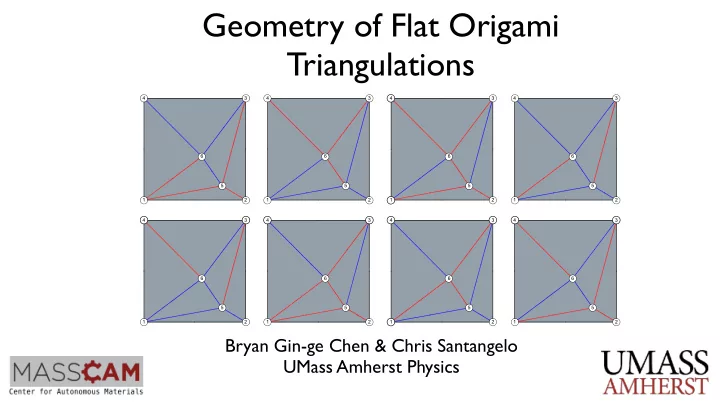
geometry of flat origami triangulations
SMART_READER_LITE
LIVE PREVIEW

Geometry of Flat Origami Triangulations 4 3 4 3 4 3 4 3 6 - - PowerPoint PPT Presentation

Geometry of Flat Origami Triangulations 4 3 4 3 4 3 4 3 6 6 6 6 5 5 5 5 1 2 1 2 1 2 1 2 4 3 4 3 4 3 4 3 6 6 6 6 5 5 5 5 1 2 1 2 1 2 1 2 Bryan Gin-ge Chen & Chris


slide-1
SLIDE 1

Geometry of Flat Origami Triangulations

Bryan Gin-ge Chen & Chris Santangelo UMass Amherst Physics

  • 1

2 3 4 5 6 1 2 3 4 5 6 1 2 3 4 5 6 1 2 3 4 5 6 1 2 3 4 5 6 1 2 3 4 5 6 1 2 3 4 5 6 1 2 3 4 5 6
slide-2
SLIDE 2

Origami in nature and engineering

Andresen et al, PRE 2007 Saito et al, PNAS 2017 Wood et al, Science 2015 J.-H. Na et al., Adv. Mat. 2015

slide-3
SLIDE 3

Robert Lang Daniel Piker, after Ron Resch, Ben Parker and John Mckeeve

http://spacesymmetrystructure.wordpress.com/2009/03/24/origami-electromagnetism/

slide-4
SLIDE 4

Robert Lang Daniel Piker, after Ron Resch, Ben Parker and John Mckeeve

http://spacesymmetrystructure.wordpress.com/2009/03/24/origami-electromagnetism/

slide-5
SLIDE 5

Robert Lang Daniel Piker, after Ron Resch, Ben Parker and John Mckeeve

http://spacesymmetrystructure.wordpress.com/2009/03/24/origami-electromagnetism/

slide-6
SLIDE 6

Robert Lang Daniel Piker, after Ron Resch, Ben Parker and John Mckeeve

http://spacesymmetrystructure.wordpress.com/2009/03/24/origami-electromagnetism/

But how much does a crease pattern really tell us?

slide-7
SLIDE 7

Robert Lang Daniel Piker, after Ron Resch, Ben Parker and John Mckeeve

http://spacesymmetrystructure.wordpress.com/2009/03/24/origami-electromagnetism/

But how much does a crease pattern really tell us? What does it tell us near the flat state?

slide-8
SLIDE 8

Triangulated Vb-gon : Vb boundary vertices

Rigid origami as bond-node structure

slide-9
SLIDE 9

“bird base”

Triangulated Vb-gon : Vb boundary vertices

Rigid origami as bond-node structure

slide-10
SLIDE 10

“bird base”

Demaine et al, Graphs and Combinatorics, 2011

Triangulated Vb-gon : Vb boundary vertices

Rigid origami as bond-node structure

slide-11
SLIDE 11

“bird base”

Demaine et al, Graphs and Combinatorics, 2011

Triangulated Vb-gon : Vb boundary vertices Vint : # of internal vertices

Rigid origami as bond-node structure

slide-12
SLIDE 12

“bird base”

Demaine et al, Graphs and Combinatorics, 2011

Triangulated Vb-gon : Vb boundary vertices Vint : # of internal vertices 3Vint+Vb-3: # of folds

Rigid origami as bond-node structure

slide-13
SLIDE 13

“bird base”

Demaine et al, Graphs and Combinatorics, 2011

Triangulated Vb-gon : Vb boundary vertices Vint : # of internal vertices 3Vint+Vb-3: # of folds

Rigid origami as bond-node structure

slide-14
SLIDE 14

“bird base”

Demaine et al, Graphs and Combinatorics, 2011

Triangulated Vb-gon : Vb boundary vertices Vint : # of internal vertices 3Vint+Vb-3: # of folds # of degrees of freedom?

Rigid origami as bond-node structure

slide-15
SLIDE 15

“bird base”

Demaine et al, Graphs and Combinatorics, 2011

Triangulated Vb-gon : Vb boundary vertices Vint : # of internal vertices 3Vint+Vb-3: # of folds # of degrees of freedom?

Rigid origami as bond-node structure

N0 = 3(Vint + Vb) − (3Vint + Vb − 3 + Vb)

slide-16
SLIDE 16

“bird base”

Demaine et al, Graphs and Combinatorics, 2011

Triangulated Vb-gon : Vb boundary vertices Vint : # of internal vertices 3Vint+Vb-3: # of folds # of degrees of freedom?

Rigid origami as bond-node structure

N0 = 3(Vint + Vb) − (3Vint + Vb − 3 + Vb)

=Vb + 3 =6 + (Vb − 3)

slide-17
SLIDE 17

“bird base”

Demaine et al, Graphs and Combinatorics, 2011

Triangulated Vb-gon : Vb boundary vertices Vint : # of internal vertices 3Vint+Vb-3: # of folds

rigid body motions

# of degrees of freedom?

Rigid origami as bond-node structure

N0 = 3(Vint + Vb) − (3Vint + Vb − 3 + Vb)

=Vb + 3 =6 + (Vb − 3)

slide-18
SLIDE 18

“bird base”

Demaine et al, Graphs and Combinatorics, 2011

Triangulated Vb-gon : Vb boundary vertices Vint : # of internal vertices 3Vint+Vb-3: # of folds generically Vb-3 dof

rigid body motions

# of degrees of freedom?

Rigid origami as bond-node structure

N0 = 3(Vint + Vb) − (3Vint + Vb − 3 + Vb)

=Vb + 3 =6 + (Vb − 3)

slide-19
SLIDE 19

1 2 3 4 5 6

1 2 3 4 5 6

BGC and Santangelo, 2017

Configuration space near the flat state

slide-20
SLIDE 20

1 2 3 4 5 6

1 2 3 4 5 6

BGC and Santangelo, 2017

Configuration space near the flat state

slide-21
SLIDE 21

1 2 3 4 5 6

1 2 3 4 5 6

BGC and Santangelo, 2017

Configuration space near the flat state

4 branches

slide-22
SLIDE 22

BGC and Santangelo, 2017

slide-23
SLIDE 23

BGC and Santangelo, 2017

slide-24
SLIDE 24

Flat is not generic!

slide-25
SLIDE 25

Vint+1 linear motions!

Flat is not generic!

slide-26
SLIDE 26

Vint+1 linear motions!

Flat is not generic!

generically 1dof vs ??

slide-27
SLIDE 27

Vint+1 linear motions!

Flat is not generic!

generically 1dof vs ?? Toy example:

slide-28
SLIDE 28

linear motion Vint+1 linear motions!

Flat is not generic!

generically 1dof vs ?? Toy example:

slide-29
SLIDE 29

linear motion Vint+1 linear motions! redundant constraints = ‘self stress’

Flat is not generic!

generically 1dof vs ?? Toy example:

slide-30
SLIDE 30

linear motion compression tension Vint+1 linear motions! redundant constraints = ‘self stress’

Flat is not generic!

generically 1dof vs ?? Toy example:

slide-31
SLIDE 31

Self stresses and second-order constraints

compression tension linear motion

slide-32
SLIDE 32

Self stresses and second-order constraints

compression tension linear motion

The second-order constraints are in 1 to 1 correspondence with self stresses!

Connelly and Whiteley, SIAM J Discrete Math 1996

slide-33
SLIDE 33

Self stresses and second-order constraints

compression tension linear motion

The second-order constraints are in 1 to 1 correspondence with self stresses!

Connelly and Whiteley, SIAM J Discrete Math 1996

uT Ωu = 0

symmetric “stress matrix”

slide-34
SLIDE 34

Self stresses and second-order constraints

compression tension linear motion

The second-order constraints are in 1 to 1 correspondence with self stresses!

Connelly and Whiteley, SIAM J Discrete Math 1996

uT Ωu = 0

symmetric “stress matrix”

u

slide-35
SLIDE 35

Self stresses in flat triangulations

BGC and Santangelo, 2017

slide-36
SLIDE 36

Self stresses in flat triangulations

“wheel stress”

BGC and Santangelo, 2017

slide-37
SLIDE 37

Self stresses in flat triangulations

“wheel stress”

BGC and Santangelo, 2017

slide-38
SLIDE 38

Self stresses in flat triangulations

“wheel stress”

BGC and Santangelo, 2017

u

vertical displacements

slide-39
SLIDE 39

Self stresses in flat triangulations

“wheel stress”

BGC and Santangelo, 2017

uT Ωu = 0

symmetric stress matrix

u

vertical displacements

slide-40
SLIDE 40

Self stresses in flat triangulations

“wheel stress”

BGC and Santangelo, 2017

uT Ωu = 0

symmetric stress matrix

α1,2 α2,3 α4,1

β1,2

β2,3

β4,1

ψ1 ψ2

ψ3

ψ4

Gaussian curvature vanishes at each vertex

u

vertical displacements

slide-41
SLIDE 41

Self stresses in flat triangulations

“wheel stress”

BGC and Santangelo, 2017

uT Ωu = 0

symmetric stress matrix

α1,2 α2,3 α4,1

β1,2

β2,3

β4,1

ψ1 ψ2

ψ3

ψ4

Gaussian curvature vanishes at each vertex

⇐ ⇒

u

vertical displacements !!

slide-42
SLIDE 42
  • rigami n-vertex configuration space

BGC and Santangelo, 2017

1 2 3 4 5 6

uT Ωu = 0

(n+1)x(n+1) symmetric stress matrix

u

(n+1)-vector of vertical displacements

3-dim kernel from isometries

slide-43
SLIDE 43
  • rigami n-vertex configuration space

Kapovich and Millson, Publ. RIMS Kyoto Univ, 1997 BGC and Santangelo, 2017

1 2 3 4 5 6

uT Ωu = 0

(n+1)x(n+1) symmetric stress matrix

u

(n+1)-vector of vertical displacements

Always exactly one negative eigenvalue! 3-dim kernel from isometries

slide-44
SLIDE 44
  • rigami n-vertex configuration space

Kapovich and Millson, Publ. RIMS Kyoto Univ, 1997 BGC and Santangelo, 2017

1 2 3 4 5 6

uT Ωu = 0

(n+1)x(n+1) symmetric stress matrix

u

(n+1)-vector of vertical displacements

Always exactly one negative eigenvalue! 3-dim kernel from isometries

BGC, Theran and Nixon, 2017

slide-45
SLIDE 45
  • rigami n-vertex configuration space

Kapovich and Millson, Publ. RIMS Kyoto Univ, 1997 BGC and Santangelo, 2017

1 2 3 4 5 6

uT Ωu = 0

(n+1)x(n+1) symmetric stress matrix

u

(n+1)-vector of vertical displacements

Always exactly one negative eigenvalue! 3-dim kernel from isometries

BGC, Theran and Nixon, 2017

slide-46
SLIDE 46

What are the two nappes?

1 2 3 4 5 6

BGC and Santangelo, 2017

slide-47
SLIDE 47

What are the two nappes?

1 2 3 4 5 6

BGC and Santangelo, 2017

slide-48
SLIDE 48

What are the two nappes?

1 2 3 4 5 6

BGC and Santangelo, 2017

slide-49
SLIDE 49

What are the two nappes?

1 2 3 4 5 6

Demaine et al, Proceedings of the IASS, 2016 BGC and Santangelo, 2017

slide-50
SLIDE 50

What are the two nappes?

1 2 3 4 5 6

Demaine et al, Proceedings of the IASS, 2016

Negative eigenvector maximizes Gaussian curvature

BGC and Santangelo, 2017

slide-51
SLIDE 51

What are the two nappes?

1 2 3 4 5 6

Demaine et al, Proceedings of the IASS, 2016 BGC and Santangelo, 2017

slide-52
SLIDE 52

What are the two nappes?

1 2 3 4 5 6

Demaine et al, Proceedings of the IASS, 2016 BGC and Santangelo, 2017

slide-53
SLIDE 53

What are the two nappes?

1 2 3 4 5 6

Demaine et al, Proceedings of the IASS, 2016 BGC and Santangelo, 2017

slide-54
SLIDE 54

What are the two nappes?

1 2 3 4 5 6

Demaine et al, Proceedings of the IASS, 2016

+ –

BGC and Santangelo, 2017

slide-55
SLIDE 55

What are the two nappes?

1 2 3 4 5 6

The two nappes correspond to popped up and popped down configurations!

Demaine et al, Proceedings of the IASS, 2016

+ –

Abel et al, JoCG, 2016; Streinu and Whiteley, 2005

+ –

BGC and Santangelo, 2017

slide-56
SLIDE 56

1 2 3 4 5 6

1 2 3 4 5 6

BGC and Santangelo, 2017

Multiple vertex configuration space

slide-57
SLIDE 57

1 2 3 4 5 6

1 2 3 4 5 6

BGC and Santangelo, 2017

Multiple vertex configuration space

slide-58
SLIDE 58

1 2 3 4 5 6

1 2 3 4 5 6

Vint = 2 ⇒ 2 wheel stresses

BGC and Santangelo, 2017

Multiple vertex configuration space

slide-59
SLIDE 59

1 2 3 4 5 6

1 2 3 4 5 6

Vint = 2 ⇒ 2 wheel stresses

BGC and Santangelo, 2017

2 homogeneous quadratic equations in 3 unknowns

Multiple vertex configuration space

slide-60
SLIDE 60

1 2 3 4 5 6

1 2 3 4 5 6

Vint = 2 ⇒ 2 wheel stresses

BGC and Santangelo, 2017

2 homogeneous quadratic equations in 3 unknowns Bézout’s theorem: at most 2^2 solutions

Multiple vertex configuration space

slide-61
SLIDE 61

1 2 3 4 5 6

1 2 3 4 5 6

BGC and Santangelo, 2017

Multiple vertex configuration space

slide-62
SLIDE 62

1 2 3 4 5 6

BGC and Santangelo, 2017

Exactly 2^Vint solutions ???

slide-63
SLIDE 63

1 2 3 4 5 6

BGC and Santangelo, 2017

Exactly 2^Vint solutions ???

slide-64
SLIDE 64

1 2 3 4 5 6

BGC and Santangelo, 2017

Exactly 2^Vint solutions ???

slide-65
SLIDE 65

1 2 3 4 5 6

BGC and Santangelo, 2017

Exactly 2^Vint solutions ???

2^Vint*

slide-66
SLIDE 66

+ –

1 2 3 4 5 6

BGC and Santangelo, 2017

Exactly 2^Vint solutions ???

2^Vint*

slide-67
SLIDE 67

+ –

1 2 3 4 5 6

BGC and Santangelo, 2017

Exactly 2^Vint solutions ???

2^Vint*

+ –

slide-68
SLIDE 68

+ –

1 2 3 4 5 6

BGC and Santangelo, 2017

Exactly 2^Vint solutions ???

vertex sign patterns seem to uniquely label pairs of branches!

2^Vint*

+ –

slide-69
SLIDE 69

1 2 3 4 5 6

BGC and Santangelo, 2017

Exactly 2^Vint solutions ???

2^Vint*

slide-70
SLIDE 70

1 2 3 4 5 6

BGC and Santangelo, 2017

Exactly 2^Vint solutions ???

2^Vint*

slide-71
SLIDE 71

1 2 3 4 5 6

BGC and Santangelo, 2017

Exactly 2^Vint solutions ???

2^Vint*

slide-72
SLIDE 72

1 2 3 4 5 6

BGC and Santangelo, 2017

Exactly 2^Vint solutions ???

2^Vint*

Yes, if the crease pattern is constructed with Henneberg-I moves from a pair of triangles!

slide-73
SLIDE 73

1 2 3 4 5 6

BGC and Santangelo, 2017

Exactly 2^Vint solutions ???

2^Vint*

Yes, if the crease pattern is constructed with Henneberg-I moves from a pair of triangles!

Demaine et al, Graphs and Combinatorics, 2011

slide-74
SLIDE 74

1 2 3 4 5 6

BGC and Santangelo, 2017

Exactly 2^Vint solutions ???

2^Vint*

Yes, if the crease pattern is constructed with Henneberg-I moves from a pair of triangles!

Demaine et al, Graphs and Combinatorics, 2011

How to show that all vertex sign patterns are realized twice?

slide-75
SLIDE 75

Robert Lang Daniel Piker, after Ron Resch, Ben Parker and John Mckeeve

http://spacesymmetrystructure.wordpress.com/2009/03/24/origami-electromagnetism/

But how much does a crease pattern really tell us?

slide-76
SLIDE 76

Robert Lang Daniel Piker, after Ron Resch, Ben Parker and John Mckeeve

http://spacesymmetrystructure.wordpress.com/2009/03/24/origami-electromagnetism/

But how much does a crease pattern really tell us? # of branches ≤ 2^(Vint)

slide-77
SLIDE 77

Robert Lang Daniel Piker, after Ron Resch, Ben Parker and John Mckeeve

http://spacesymmetrystructure.wordpress.com/2009/03/24/origami-electromagnetism/

But how much does a crease pattern really tell us? # of Mountain-Valley choices = 2#creases = 2^(3Vint+1) # of branches ≤ 2^(Vint)

slide-78
SLIDE 78

Robert Lang Daniel Piker, after Ron Resch, Ben Parker and John Mckeeve

http://spacesymmetrystructure.wordpress.com/2009/03/24/origami-electromagnetism/

But how much does a crease pattern really tell us? # of Mountain-Valley choices = 2#creases = 2^(3Vint+1) Only a tiny fraction of MV’s can be realized! # of branches ≤ 2^(Vint)

slide-79
SLIDE 79

Robert Lang Daniel Piker, after Ron Resch, Ben Parker and John Mckeeve

http://spacesymmetrystructure.wordpress.com/2009/03/24/origami-electromagnetism/

But how much does a crease pattern really tell us? # of Mountain-Valley choices = 2#creases = 2^(3Vint+1) Maybe we’re in good shape… Only a tiny fraction of MV’s can be realized! # of branches ≤ 2^(Vint)

slide-80
SLIDE 80

1 2 3 4 5 6 7 8 9

3 2 1 4 5 6 7 8 9

BGC and Santangelo, 2017 Hull and Tachi, J Mechanisms Robotics, 2017 Abel et al, JoCG, 2016 Brunck et al, PRE, 2016

One crease pattern with fixed M-V labels : two branches!

slide-81
SLIDE 81

1 2 3 4 5 6 7 8 9

3 2 1 4 5 6 7 8 9

BGC and Santangelo, 2017 Hull and Tachi, J Mechanisms Robotics, 2017 Abel et al, JoCG, 2016 Brunck et al, PRE, 2016

One crease pattern with fixed M-V labels : two branches!

slide-82
SLIDE 82

1 2 3 4 5 6 7 8 9

3 2 1 4 5 6 7 8 9

BGC and Santangelo, 2017 Hull and Tachi, J Mechanisms Robotics, 2017 Abel et al, JoCG, 2016 Brunck et al, PRE, 2016

One crease pattern with fixed M-V labels : two branches!

slide-83
SLIDE 83

1 2 3 4 5 6 7 8 9

3 2 1 4 5 6 7 8 9

BGC and Santangelo, 2017 Hull and Tachi, J Mechanisms Robotics, 2017 Abel et al, JoCG, 2016 Brunck et al, PRE, 2016

One crease pattern with fixed M-V labels : two branches!

slide-84
SLIDE 84

BGC and Santangelo, 2017

(a)

1 2 3 4 5 6 7 8 9

1 2 3 4 5 6 7 8 9

Same M-V labels, same vertex sign pattern : two branches!

slide-85
SLIDE 85

BGC and Santangelo, 2017

(a)

1 2 3 4 5 6 7 8 9

1 2 3 4 5 6 7 8 9

Same M-V labels, same vertex sign pattern : two branches!

slide-86
SLIDE 86

BGC and Santangelo, 2017

(a)

1 2 3 4 5 6 7 8 9

1 2 3 4 5 6 7 8 9

Same M-V labels, same vertex sign pattern : two branches!

slide-87
SLIDE 87

+ –

Thanks!

NSF PHY-1125915 EFRI ODISSEI-1240441

Tom Hull, Louis Theran 2^Vint branches from popping vertices up / down? The flat state is singular, but self stresses help us navigate…

1 2 3 4 5 6 7 8 9

Summary:

Do these second-order motions generically extend to continuous motions?