SLIDE 1
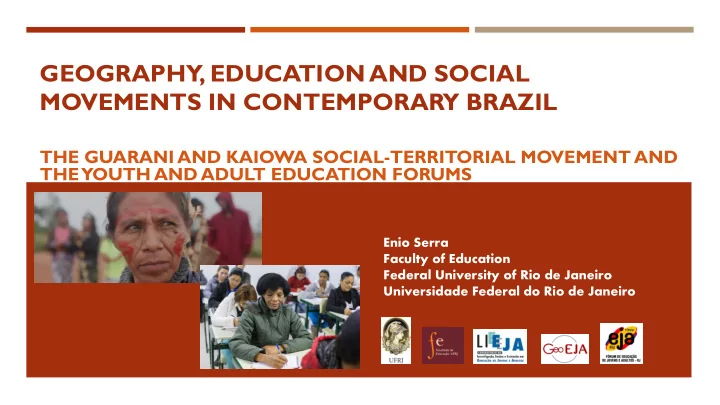
GEOGRAPHY , EDUCATION AND SOCIAL MOVEMENTS IN CONTEMPORARY BRAZIL
THE GUARANI AND KAIOWA SOCIAL-TERRITORIAL MOVEMENT AND THE YOUTH AND ADULT EDUCATION FORUMS
Enio Serra Faculty of Education Federal University of Rio de Janeiro Universidade Federal do Rio de Janeiro
SLIDE 2
Brazil! Show your face. I want to see who pays for you to be like this. Brazil! What is your business? Your partner’s name? Trust me. (Cazuza)
SLIDE 3
Colonization and territory The Bandeirantes and the
massacre of the indigenous people
The conquest of the
territory
BRAZILIAN SOCIAL-SPATIAL FORMATION: BRIEF CONSIDERATIONS
SLIDE 4
Economic
archipelago
The
concentrated region
BRAZILIAN SOCIAL-SPATIAL FORMATION: BRIEF CONSIDERATIONS
SLIDE 5
Myth of the three races Myth of foundation of Brazil and
authoritarian society
BRAZILIAN SOCIAL-SPATIAL FORMATION: BRIEF CONSIDERATIONS
SLIDE 6
Slavery heritage
BRAZILIAN SOCIAL-SPATIAL FORMATION: BRIEF CONSIDERATIONS
SLIDE 7
SLIDE 8 Social classes in contemporary
Brazil:
- Former slaves “scum” (base
- f the social pyramid),
- Low-income workers,
- Middle class and its strata,
- Elite.
BRAZILIAN SOCIAL-SPATIAL FORMATION: BRIEF CONSIDERATIONS
SLIDE 9 Elite pact with the middle class
- Moralism
- Authoritarianism
- Economic privileges
Governments of the Workers Party
(PT) and the 2016 coup d'état
BRAZILIAN SOCIAL-SPATIAL FORMATION: BRIEF CONSIDERATIONS
SLIDE 10 According to Zibechi (2013), the contemporary social movements have the following
aspects:
- Territory as a basis
- Requirement for autonomy
- Enhancement of their own cultural status and defense of an identity ownership
GEOGRAPHY AND CONTEMPORARY SOCIAL MOVEMENTS
SLIDE 11 According to Pedon (2013), the social-territorial movements:
- Introduce new forms of land ownership and use
- Entail changes in social relations and in the configuration of territories
- Bound to exempted working classes
- Demand of land takeover
- Have territory takeover defining identities
- Have Indigenous Movements, MST and MTST like instances of social-territorial
movements
GEOGRAPHY AND CONTEMPORARY SOCIAL MOVEMENTS
SLIDE 12
Guarani e Kaiowa peoples are the second largest Brazilian indigenous ethnic groups with
43.000 people in 2012
Original Territory: Brazil, Paraguay, Argentina Currently living in indigenous reservations across the state of Mato Grosso do Sul (MS) Dourados Indigenous Reserves (MS): 3,500 ha (35 km2) to 15,000 people – lock-down
feeling
Lack of conditions to farm for trade – they get food supplies from the federal government Lack of land is the main factor concerning the current precarious situation lived by Guarani
and Kaiowa peoples
THE SOCIAL-TERRITORIAL MOVEMENT OF GUARANI AND KAIOWA PEOPLES
SLIDE 13 Location of Guarani and Kaiowa lands in Mato Grosso do Sul
Location of Dourados Indigenous Reserve and Tekoha settlements in Dourados and Itaporã – MS
SLIDE 14
SLIDE 15
The Guarani and Kaiowa group as an ethnical social-territorial movement in order to
demarcate the boundaries of their lands
To them, the territorial struggle means retaking Tekoha Tekoha: lands of traditional occupation, a place where it is possible to reproduce the
Guarani and Kaiowa lifestyle
Course of action: land occupation in neighboring farms (sugar cane, soy) – with
settlements
Agrobusiness dominance in the region Conflicts with land owners – discrimination, violence and murder Support from the CIMI – Missionary Indigenous Council
THE SOCIAL-TERRITORIAL MOVEMENT OF GUARANI AND KAIOWA PEOPLES
SLIDE 16
SLIDE 17 SOCIAL MOVEMENTS AND EDUCATION
According to Gohn (2011):
- Educational demands entail the fight for civil rights
- The issues concerning civil rights make the social and economical matters and the
government policies a universal theme
SLIDE 18 YOUTH AND ADULT EDUCATION FORUMS
Youth and adult education
(EJA) as a right to those who did not finish Elementary school as children or teenagers
In Brazil, there are 65 million
people in this situation (2010 Census Figures)
PROSPECTIVE DEMAND FOR YOUTH AND ADULT EDUCATION – ELEMENTARY SCHOOL
SLIDE 19
Illiteracy in Brazil
SLIDE 20
YOUTH AND ADULT EDUCATION FORUMS
There are EJA forums in
every Brazilian state
It is a social movement
bound to discussing, strengthening and proposition of alternatives to Youth and Adult Education
SLIDE 21
YOUTH AND ADULT EDUCATION FORUMS
Articulate partnerships and aliances
to face the grave issue of illiteracy and under-schooling among youth and adults
Work through monitoring public
policies, financing EJA actions and demanding that the government work to tend to the people’s right to education
Teachers, students, government
representatives, universities, NGOs and other social movements take part
SLIDE 22
CONCLUSIONS
The role of social movements in the struggle against social inequality Portray of old movement (syndicates, professional entities, students) Growth of identity movements and social-territorial movements Criminalization of social movements as conservative reaction New challenges in the current political scene in Brazil
SLIDE 23 REFERENCES
GOHN, M. G. Movimentos sociais na contemporaneidade. Revista Brasileira de Educação, v. 16 n. 47 maio-ago. 2011. MIZUSAKI, M. Movimentos indígenas, geografia e marxismo na questão agrária brasileira: quando “novos” personagens entram em cena. Revista NERA, Presidente Prudente, ano 20, nº. 39, pp. 39-59, 2017. MOTA, J.; PEREIRA, L. O movimento étnico-socioterritorial Guarani e Kaiowa em mato grosso do sul: atuação do estado, impasses e dilemas para demarcação de terras indígenas. Boletim DATALUTA, outubro de 2012. PEDON, N. Geografia e movimentos sociais: dos primeiros estudos à abordagem socioterritorial. São Paulo: Editora Unesp, 2013. SOUZA, J. A elite do atraso: da escravidão à lava jato. Rio de Janeiro: Leya, 2017. ZIBECHI, R. Palestra: Los movimientos sociales en la crisis del sistema mundo. Popayán: Maestría en Estudios Interdisciplinarios del
- Desarrollo. Universidad del Cauca. Colombia, 2013. Disponível em:
<https://www.youtube.com/results?search_query=zibechi+movimientos+sociales>. Acesso em: 26 out. 2018.
SLIDE 24
Σας ευχαριστώ THANK YOU OBRIGADO