Genesis 21 THE PROMISE, THE PROBLEM, THE PA TRIARCH Opening - - PowerPoint PPT Presentation

genesis 21
SMART_READER_LITE
LIVE PREVIEW

Genesis 21 THE PROMISE, THE PROBLEM, THE PA TRIARCH Opening - - PowerPoint PPT Presentation

Genesis 21 THE PROMISE, THE PROBLEM, THE PA TRIARCH Opening Observations Chapter 21 is a short trilogy Each vignette (episode) deals with closure The seed promise is realized The contender problem is banished The patriarchs power is


slide-1
SLIDE 1

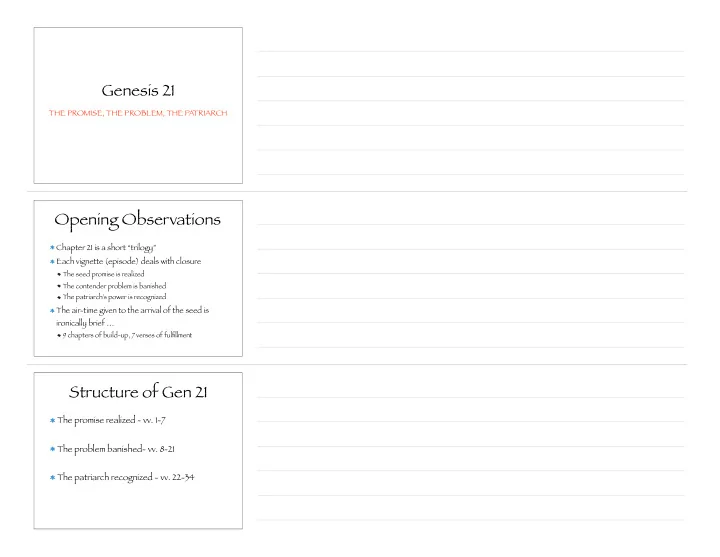
Genesis 21

THE PROMISE, THE PROBLEM, THE PA TRIARCH

Opening Observations

Chapter 21 is a short “trilogy” Each vignette (episode) deals with closure

The seed promise is realized The contender problem is banished The patriarch’s power is recognized

The air-time given to the arrival of the seed is ironically brief …

9 chapters of build-up, 7 verses of fulfillment

Structure of Gen 21

The promise realized - vv. 1-7
 The problem banished- vv. 8-21
 The patriarch recognized - vv. 22-34

slide-2
SLIDE 2

The Promise Realized

What two themes are stressed in vv. 1-7?

Everything happened JUST AS God said it would

This reminds me of 1 Cor 15:3-4 (“according to the Scriptures)

It was a physical miracle

How are these two themes expressed?

By repetition … note the 3-fold repetition of God’s “agency”

  • v. 1a - “

As He has said”

  • v. 1b - “

As He had spoken”

  • v. 2 - “

At the time … God had spoken”

Realized .. Continued

Note the 3-fold repetition of Abraham’s age

  • v. 2: “in his old age”
  • v. 5: “

Abraham was 100 years old”

  • v. 7: “in his old age”

So while the birth narrative is short after all the build-up it is emphatic in its presentation

Realized .. Continued

God “visited” Sarah - v. 1

NASB “took note” is unfortunate

The Hebrew verb dqp is more “active” and better translated “attended to,” or “visited” It is a common verb (occurs over 300x’s), often in contexts where God intervenes to accomplish something

So used in Gen 50:24-25; Exod 13:19 (reflecting Gen 50)

Yahweh did far more than take note of her condition — He miraculously intervened and restored Sarah’s ability to bear children despite “barrenness” and “old-age”
slide-3
SLIDE 3

Realized .. Continued

As a result, she conceived and bore a son … Who was named Isaac as commanded - Gen 17:19

Derived from the Hebrew root qxc Which means “to laugh”

And was dutifully circumcised by Abraham

  • n the 8th day as commanded Gen 17:10-12

Realized .. Continued

After which Sarah .. and others .. rejoiced

Note laughter 2x’s in v. 6 This is the laughter of joy And uses the same Hebrew root as Isaac’s name in verbal forms

What does v. 7 reinforce?

Sarah’s complete restoration (nursing, bearing a child); Abraham’s old-age — in other words the miraculous nature of what has occurred

Closing Thought

“Principalizing” the forgoing, We are never too old for God to do 
 a new thing in us or through us!

slide-4
SLIDE 4

The Problem Banished

What is/are the purpose(s) of Ishmael’s banishment?

T

  • wean Abraham “of his affections”

No fall back position for Abraham … particularly in light of what is coming in Gen 22

Remove potential challenges to Isaac A means to fulfill Gen 17:4-5 (turn and read)

Banished .. Continued

Just as Isaac was weaned from nursing, Abraham is being weaned from “attachments”

His natural love for Ishmael must be subordinated to his love for God and His purposes Reminding us that the cost of true discipleship is high - turn to Luke 9:57-62

The occasion of the events of vv. 8-21 arise from a party Abraham throws for Isaac

Banished .. Continued

Sarah observes Ishmael “mocking” Isaac

“Mocking” is translated from the same root for Isaac’s name It is in the “intensive” form .. so the idea of excessively laughing or making fun of

Sarah properly discerns Ishmael’s nature, the threat, and moves to protect Isaac But she goes further in my mind by heaping contempt on him in v. 10

slide-5
SLIDE 5

Banished .. Continued

How is Sarah’s contempt manifested?

She never address Hagar or Ishmael by name

Note the downward progression of address - vv. 9-10

Son of Hagar the Egyptian … ethnic slight Hagar as “this maid” … hierarchical slight And Ishmael as “the son of this maid” … familial slight (he’s still Abraham’s son!)

Can’t you almost picture Sarah “snarling” these epithets at Abraham

Banished .. Continued

How do we know Sarah’s demand arises from proper discernment even though “nasty?”

Because God affirms her demand in v. 12 And because she properly discerned Abraham’s conflicted feelings — and perhaps even divided loyalty between the two boys …

Which is born out for us, the readers, in v. 11

Banished .. Continued

God affirms Sarah’s demand and also provides the reason in v. 12 What does the explanation tell us?

First we encounter this Hebrew word [rz again Anyone remember the meaning and significance?

Means seed or seeds It is a collective, so context has to help us decide

slide-6
SLIDE 6

Banished .. Continued

What do you like .. sg. or plural and why?

I like singular Because God is emphasizing a particular seed Ishmael will also bear offspring to Abraham as v. 13 will affirm

Therefor, since God is the speaker — I think he is demonstrating the skeletal form of an important doctrine … What is it?

Banished .. Continued

Election!!

We see the skeletal form of God conscious and deliberate “choosing” of particular individuals … Sarah was God’s “unknowing agent” to bring this to light

All of which Paul fully develops in Gal 4:21ff specifically citing Gen 21 in 4:30

The “true” descendants of Abraham will be found in the line of Isaac … and God wants there to be no confusion

Banished .. Continued

God mollifies Abraham in v. 13, affirming there will be another line that will proceed through Ishmael

The boy will survive and flourish Ishmael will be the channel to fulfill the “nations” promise of the Abrahamic Covenant

As is his custom Abraham obeys .. immediately Provisions and sends the 2 off the next morning

slide-7
SLIDE 7

Banished .. Continued

Does Abraham’s provision seem miserly?

Certainly does to me

Do you think this is all Abraham gave them?

T ext doesn’t say, but I suspect NO

Why don’t we hear more?

Because how much, or little, Abraham gave them is not the author’s focus

Banished .. Continued

Rather the author is setting up the final point of this vignette What is it?

God’s love and continued care for Hagar and Ishmael

Which plays out in vv. 15-21

Banished .. Continued

The events remind us of Hagar’s first flight in Gen 16:7ff Here, God hears the boy’s cries and the angel of God speaks to Hagar

Affirms that Ishmael will head a great nation Directs Hagar to a water supply

slide-8
SLIDE 8

Banished .. Continued

  • Vv. 20-21 record God’s favor toward Ishmael …

God was “with him” He grew and became a skilled archer He dwelt in the the Wilderness of Paran He took a wife from Egypt … “the nations” line

This is the last we hear of Hagar .. other than in a genealogy And virtually the last we hear of Ishmael

He will resurface briefly in Gen 25: burying Abraham, then his genealogical record and his death

Closing Thoughts

God requires us to separate from conflicting affections in our christian walk .. we cannot serve two masters — Matt 6:24

Closing Thoughts

What makes this hard is that we might be asked to separate from good things to receive God’s best In other words … something good may have to go, because God has something better He wants to give us. God is always “pruning”

slide-9
SLIDE 9

The Patriarch Recognized

This final section shows us the status that Abraham has attained in the land He still “possesses” none of it, but will make his first land acquisition in this final vignette

  • Vv. 22-34 close the saga with Abimelech, but

what is its primary focus?

Recognized .. Continued

T

  • show how prominent a personage

Abraham has become under God’s blessing

God’s favor to Abraham has become so manifest that people all around can recognize it!

What principle can we draw from this?

God works through the testimony of our day-to-day life to witness for Christ and draw people to Him!

Recognized .. Continued

The great irony in these final verses is the complete role reversal from Gen 20

Previously Abimelech gave protection, now he wants protection Previously Abimelech reproved Abraham, now Abraham reproves Abimelech Previoulsy Abimelech enriches Abraham with flocks, now it is the other way around

slide-10
SLIDE 10

Recognized .. Continued

Abraham seems to have assumed the position of power .. Which is not all that remarkable when we remember the source of Abraham’s power In vv. 22-23, Abimelech and his “military commander” seek a treaty … note the sequence

They acknowledge Abraham’s source of blessing They invoke God as source for the oath

Abraham readily agrees .. with no haggling

Recognized .. Continued

The order of events in vv. 24-26 probably seemed reversed to our Western mind Why would he unconditionally agree, then bring up apparent “bargaining chips later?

The answer is — you have to understand the eastern mind … which is HIGH CONTEXT Had Abraham led with the conflict over the wells, “high context” would think he did not want to agree to a treaty

Recognized .. Continued

But Abraham wanted, and saw the value of, peaceful coexistence and readily agrees …

So, his quick agreement signals his desire to “reach a deal”

Only then did he raise an issue that might derail the treaty, wishing to remove future obstacles up front

In arid climates, water is at a premium Wells would have been a source of constant contention among the shepherds if ownership was not resolved

slide-11
SLIDE 11

Recognized .. Continued

We should also note that Abraham had not yet ratified the agreement .. so perhaps there was still some wiggle room Now in v. 25, Abraham takes Abimelech to the woodshed

T ext says that he “reproved” Abimelech Similar pattern as Gen 20:11 .. where Abraham assumed the worst about Abimelech

Apparently following the “guilty until proven innocent” model of law

Recognized .. Continued

Just as with God, Abimelech defends himself in

  • v. 26 by …

Pleading complete innocence — which was probably true!

Does Abraham accept his response?

Yes — look at v. 27 Animals given to Abimelech A bi-lateral (“the two of them”) covenant is cut

Recognized .. Continued

At this point, the peace treaty is ratified But there is more .. What is going on in vv. 28-30?

Abraham is adding an “addendum” to the contract Whereby he wants to affirm ownership of the well

What is significant about this “addendum?”

By this Abraham comes into “official” possession of his first “property” in the land

As customary, Abraham then memorializes the place with a name …

slide-12
SLIDE 12

Recognized .. Continued

Beersheba means “Well of the Seven”

Or … it could mean “Well of the Oath” because the Hebrew root for “to swear” and the number “seven” is the same [bv Based on the context I prefer “the seven” … pointing to the “7” additional lambs that “ratify” the addendum Either way, it is a Hebrew word play

Satisfied … Abimelech heads home to Philistine

Recognized .. Continued

Abraham marks the site with an additional symbol … A tamarisk tree And Abraham worships

Giving us another name for God — Everlasting God (~l'wO[ lae)

The chapter ends with Abraham enjoying the fruits of his treaty … “staying” in the Philistine’s land many days

Closing Thoughts

Gen 21 seems like it is devoted to “tying up” loose ends before the story turns to Isaac Abraham & Sarah have the promised seed Any threat of “palace revolt” has been removed And Abraham has secured peace with the “king

  • f the land”

In other words — ALL IS WELL IN DODGE

slide-13
SLIDE 13

Closing Thoughts

So … the next logical scene would seem to be events that wind-down Abraham’s life in Gen 23-25

Namely … Sarah’s death, Isaac’s bride (securing the promised line), and Abraham’s death

But … God has one more monster test to affirm Abraham’s loyalty before the story moves on to Isaac as we might have expected! We will pick up with this famous test next week …