SLIDE 1 Generic attacks and index calculus
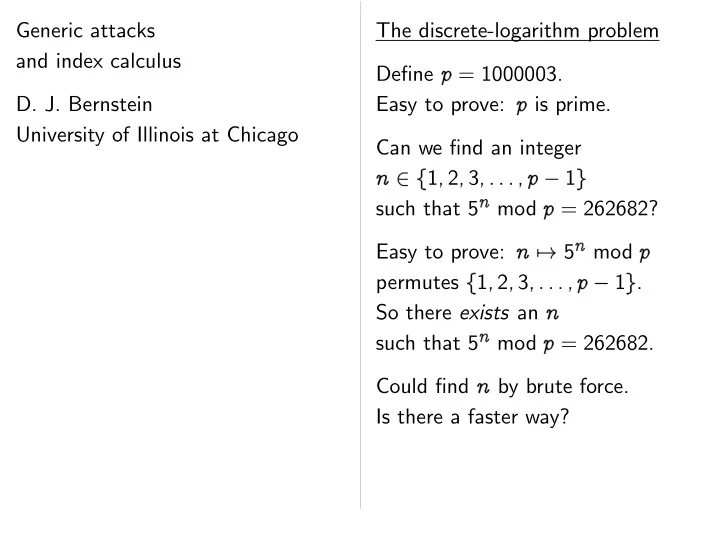
University of Illinois at Chicago The discrete-logarithm problem Define ♣ = 1000003. Easy to prove: ♣ is prime. Can we find an integer ♥ ✷ ❢1❀ 2❀ 3❀ ✿ ✿ ✿ ❀ ♣ 1❣ such that 5♥ mod ♣ = 262682? Easy to prove: ♥ ✼✦ 5♥ mod ♣ permutes ❢1❀ 2❀ 3❀ ✿ ✿ ✿ ❀ ♣ 1❣. So there exists an ♥ such that 5♥ mod ♣ = 262682. Could find ♥ by brute force. Is there a faster way?
SLIDE 2
Generic attacks index calculus Bernstein University of Illinois at Chicago The discrete-logarithm problem Define ♣ = 1000003. Easy to prove: ♣ is prime. Can we find an integer ♥ ✷ ❢1❀ 2❀ 3❀ ✿ ✿ ✿ ❀ ♣ 1❣ such that 5♥ mod ♣ = 262682? Easy to prove: ♥ ✼✦ 5♥ mod ♣ permutes ❢1❀ 2❀ 3❀ ✿ ✿ ✿ ❀ ♣ 1❣. So there exists an ♥ such that 5♥ mod ♣ = 262682. Could find ♥ by brute force. Is there a faster way? Typical cryptanalytic Imagine ♣ in the Diffie-Hellman User cho ♥ publishes
♥
♣ Can attack the discrete- Given public
♥
♣ quickly find ♥ (Warning: to attack Maybe there
SLIDE 3
calculus Illinois at Chicago The discrete-logarithm problem Define ♣ = 1000003. Easy to prove: ♣ is prime. Can we find an integer ♥ ✷ ❢1❀ 2❀ 3❀ ✿ ✿ ✿ ❀ ♣ 1❣ such that 5♥ mod ♣ = 262682? Easy to prove: ♥ ✼✦ 5♥ mod ♣ permutes ❢1❀ 2❀ 3❀ ✿ ✿ ✿ ❀ ♣ 1❣. So there exists an ♥ such that 5♥ mod ♣ = 262682. Could find ♥ by brute force. Is there a faster way? Typical cryptanalytic Imagine standard ♣ in the Diffie-Hellman User chooses secret ♥ publishes 5♥ mod ♣ Can attacker quickly the discrete-logarithm Given public key 5♥ ♣ quickly find secret ♥ (Warning: This is to attack the proto Maybe there are b
SLIDE 4
Chicago The discrete-logarithm problem Define ♣ = 1000003. Easy to prove: ♣ is prime. Can we find an integer ♥ ✷ ❢1❀ 2❀ 3❀ ✿ ✿ ✿ ❀ ♣ 1❣ such that 5♥ mod ♣ = 262682? Easy to prove: ♥ ✼✦ 5♥ mod ♣ permutes ❢1❀ 2❀ 3❀ ✿ ✿ ✿ ❀ ♣ 1❣. So there exists an ♥ such that 5♥ mod ♣ = 262682. Could find ♥ by brute force. Is there a faster way? Typical cryptanalytic application: Imagine standard ♣ = 1000003 in the Diffie-Hellman protocol. User chooses secret key ♥, publishes 5♥ mod ♣ = 262682. Can attacker quickly solve the discrete-logarithm problem? Given public key 5♥ mod ♣, quickly find secret key ♥? (Warning: This is one way to attack the protocol. Maybe there are better ways.)
SLIDE 5
The discrete-logarithm problem Define ♣ = 1000003. Easy to prove: ♣ is prime. Can we find an integer ♥ ✷ ❢1❀ 2❀ 3❀ ✿ ✿ ✿ ❀ ♣ 1❣ such that 5♥ mod ♣ = 262682? Easy to prove: ♥ ✼✦ 5♥ mod ♣ permutes ❢1❀ 2❀ 3❀ ✿ ✿ ✿ ❀ ♣ 1❣. So there exists an ♥ such that 5♥ mod ♣ = 262682. Could find ♥ by brute force. Is there a faster way? Typical cryptanalytic application: Imagine standard ♣ = 1000003 in the Diffie-Hellman protocol. User chooses secret key ♥, publishes 5♥ mod ♣ = 262682. Can attacker quickly solve the discrete-logarithm problem? Given public key 5♥ mod ♣, quickly find secret key ♥? (Warning: This is one way to attack the protocol. Maybe there are better ways.)
SLIDE 6 discrete-logarithm problem ♣ = 1000003. to prove: ♣ is prime. e find an integer ♥ ✷ ❢ ❀ 2❀ 3❀ ✿ ✿ ✿ ❀ ♣ 1❣ that 5♥ mod ♣ = 262682? to prove: ♥ ✼✦ 5♥ mod ♣ ermutes ❢1❀ 2❀ 3❀ ✿ ✿ ✿ ❀ ♣ 1❣. there exists an ♥ that 5♥ mod ♣ = 262682. find ♥ by brute force. there a faster way? Typical cryptanalytic application: Imagine standard ♣ = 1000003 in the Diffie-Hellman protocol. User chooses secret key ♥, publishes 5♥ mod ♣ = 262682. Can attacker quickly solve the discrete-logarithm problem? Given public key 5♥ mod ♣, quickly find secret key ♥? (Warning: This is one way to attack the protocol. Maybe there are better ways.) Relations
to elliptic-curve Use in evaluating security
Use in evaluating advantages compared
extra applications See Tanja
SLIDE 7 discrete-logarithm problem ♣ 1000003. ♣ is prime. integer ♥ ✷ ❢ ❀ ❀ ❀ ✿ ✿ ✿ ❀ ♣ 1❣
♥
d ♣ = 262682? ♥ ✼✦ 5♥ mod ♣ ❢ ❀ ❀ ❀ ✿ ✿ ✿ ❀ ♣ 1❣. an ♥
♥
d ♣ = 262682. ♥ brute force. way? Typical cryptanalytic application: Imagine standard ♣ = 1000003 in the Diffie-Hellman protocol. User chooses secret key ♥, publishes 5♥ mod ♣ = 262682. Can attacker quickly solve the discrete-logarithm problem? Given public key 5♥ mod ♣, quickly find secret key ♥? (Warning: This is one way to attack the protocol. Maybe there are better ways.) Relations to ECC:
to elliptic-curve DL Use in evaluating security of an elliptic
Use in evaluating advantages of elliptic compared to multiplication.
- 3. Tricky: Some techniques
extra applications See Tanja Lange’s
SLIDE 8 roblem ♣ ♣ ♥ ✷ ❢ ❀ ❀ ❀ ✿ ✿ ✿ ❀ ♣ ❣
♥
♣ 262682? ♥ ✼✦
♥ mod ♣
❢ ❀ ❀ ❀ ✿ ✿ ✿ ❀ ♣ 1❣. ♥
♥
♣ 262682. ♥ rce. Typical cryptanalytic application: Imagine standard ♣ = 1000003 in the Diffie-Hellman protocol. User chooses secret key ♥, publishes 5♥ mod ♣ = 262682. Can attacker quickly solve the discrete-logarithm problem? Given public key 5♥ mod ♣, quickly find secret key ♥? (Warning: This is one way to attack the protocol. Maybe there are better ways.) Relations to ECC:
- 1. Some DL techniques also
to elliptic-curve DL problems. Use in evaluating security of an elliptic curve.
- 2. Some techniques don’t apply
Use in evaluating advantages of elliptic curves compared to multiplication.
- 3. Tricky: Some techniques
extra applications to some curves. See Tanja Lange’s talk
SLIDE 9 Typical cryptanalytic application: Imagine standard ♣ = 1000003 in the Diffie-Hellman protocol. User chooses secret key ♥, publishes 5♥ mod ♣ = 262682. Can attacker quickly solve the discrete-logarithm problem? Given public key 5♥ mod ♣, quickly find secret key ♥? (Warning: This is one way to attack the protocol. Maybe there are better ways.) Relations to ECC:
- 1. Some DL techniques also apply
to elliptic-curve DL problems. Use in evaluating security of an elliptic curve.
- 2. Some techniques don’t apply.
Use in evaluating advantages of elliptic curves compared to multiplication.
- 3. Tricky: Some techniques have
extra applications to some curves. See Tanja Lange’s talk
SLIDE 10 ypical cryptanalytic application: Imagine standard ♣ = 1000003 Diffie-Hellman protocol. chooses secret key ♥, publishes 5♥ mod ♣ = 262682. attacker quickly solve discrete-logarithm problem? public key 5♥ mod ♣, quickly find secret key ♥? rning: This is one way attack the protocol. there are better ways.) Relations to ECC:
- 1. Some DL techniques also apply
to elliptic-curve DL problems. Use in evaluating security of an elliptic curve.
- 2. Some techniques don’t apply.
Use in evaluating advantages of elliptic curves compared to multiplication.
- 3. Tricky: Some techniques have
extra applications to some curves. See Tanja Lange’s talk
Understanding Can compute 51 mod ♣ 52 mod ♣ 53 mod ♣ ✿ ✿ ✿ 58 mod ♣ 59 mod ♣ ✿ ✿ ✿ 51000002 ♣ At some ♥ with 5♥ mo ♣ Maximum ✔ ♣ 1 ♣ ✔ ♣ 1 that does
SLIDE 11 cryptanalytic application: rd ♣ = 1000003 Diffie-Hellman protocol. secret key ♥,
♥
d ♣ = 262682. quickly solve rithm problem? 5♥ mod ♣, secret key ♥? is one way rotocol. better ways.) Relations to ECC:
- 1. Some DL techniques also apply
to elliptic-curve DL problems. Use in evaluating security of an elliptic curve.
- 2. Some techniques don’t apply.
Use in evaluating advantages of elliptic curves compared to multiplication.
- 3. Tricky: Some techniques have
extra applications to some curves. See Tanja Lange’s talk
Understanding brute Can compute successively 51 mod ♣ = 5, 52 mod ♣ = 25, 53 mod ♣ = 125, ✿ ✿ ✿ 58 mod ♣ = 390625, 59 mod ♣ = 953122, ✿ ✿ ✿ 51000002 mod ♣ = 1. At some point we’ll ♥ with 5♥ mod ♣ = 262682. Maximum cost of ✔ ♣ 1 mults by 5 ♣ ✔ ♣ 1 nanoseconds that does 1 mult/nanosecond.
SLIDE 12 application: ♣ 1000003 rotocol. ♥,
♥
♣ 262682. roblem?
♥
♣, ♥ y ys.) Relations to ECC:
- 1. Some DL techniques also apply
to elliptic-curve DL problems. Use in evaluating security of an elliptic curve.
- 2. Some techniques don’t apply.
Use in evaluating advantages of elliptic curves compared to multiplication.
- 3. Tricky: Some techniques have
extra applications to some curves. See Tanja Lange’s talk
Understanding brute force Can compute successively 51 mod ♣ = 5, 52 mod ♣ = 25, 53 mod ♣ = 125, ✿ ✿ ✿ , 58 mod ♣ = 390625, 59 mod ♣ = 953122, ✿ ✿ ✿ , 51000002 mod ♣ = 1. At some point we’ll find ♥ with 5♥ mod ♣ = 262682. Maximum cost of computation: ✔ ♣ 1 mults by 5 mod ♣; ✔ ♣ 1 nanoseconds on a CPU that does 1 mult/nanosecond.
SLIDE 13 Relations to ECC:
- 1. Some DL techniques also apply
to elliptic-curve DL problems. Use in evaluating security of an elliptic curve.
- 2. Some techniques don’t apply.
Use in evaluating advantages of elliptic curves compared to multiplication.
- 3. Tricky: Some techniques have
extra applications to some curves. See Tanja Lange’s talk
Understanding brute force Can compute successively 51 mod ♣ = 5, 52 mod ♣ = 25, 53 mod ♣ = 125, ✿ ✿ ✿ , 58 mod ♣ = 390625, 59 mod ♣ = 953122, ✿ ✿ ✿ , 51000002 mod ♣ = 1. At some point we’ll find ♥ with 5♥ mod ♣ = 262682. Maximum cost of computation: ✔ ♣ 1 mults by 5 mod ♣; ✔ ♣ 1 nanoseconds on a CPU that does 1 mult/nanosecond.
SLIDE 14
Relations to ECC: Some DL techniques also apply elliptic-curve DL problems. evaluating y of an elliptic curve. Some techniques don’t apply. evaluating advantages of elliptic curves red to multiplication. ricky: Some techniques have applications to some curves. anja Lange’s talk il descent etc. Understanding brute force Can compute successively 51 mod ♣ = 5, 52 mod ♣ = 25, 53 mod ♣ = 125, ✿ ✿ ✿ , 58 mod ♣ = 390625, 59 mod ♣ = 953122, ✿ ✿ ✿ , 51000002 mod ♣ = 1. At some point we’ll find ♥ with 5♥ mod ♣ = 262682. Maximum cost of computation: ✔ ♣ 1 mults by 5 mod ♣; ✔ ♣ 1 nanoseconds on a CPU that does 1 mult/nanosecond. This is negligible for ♣ ✙ 2 But users standardize ♣ making the Attack cost ✙ 250 mults ♣ ✙ ✙ 2100 mults ♣ ✙ (Not exactly cost of mults ♣ But this
SLIDE 15
ECC: techniques also apply DL problems. evaluating elliptic curve. techniques don’t apply. evaluating elliptic curves multiplication. techniques have applications to some curves. Lange’s talk etc. Understanding brute force Can compute successively 51 mod ♣ = 5, 52 mod ♣ = 25, 53 mod ♣ = 125, ✿ ✿ ✿ , 58 mod ♣ = 390625, 59 mod ♣ = 953122, ✿ ✿ ✿ , 51000002 mod ♣ = 1. At some point we’ll find ♥ with 5♥ mod ♣ = 262682. Maximum cost of computation: ✔ ♣ 1 mults by 5 mod ♣; ✔ ♣ 1 nanoseconds on a CPU that does 1 mult/nanosecond. This is negligible w for ♣ ✙ 220. But users can standardize a larger ♣ making the attack Attack cost scales ✙ 250 mults for ♣ ✙ ✙ 2100 mults for ♣ ✙ (Not exactly linearly: cost of mults grows ♣ But this is a minor
SLIDE 16
also apply roblems. curve. apply. curves multiplication. techniques have curves. Understanding brute force Can compute successively 51 mod ♣ = 5, 52 mod ♣ = 25, 53 mod ♣ = 125, ✿ ✿ ✿ , 58 mod ♣ = 390625, 59 mod ♣ = 953122, ✿ ✿ ✿ , 51000002 mod ♣ = 1. At some point we’ll find ♥ with 5♥ mod ♣ = 262682. Maximum cost of computation: ✔ ♣ 1 mults by 5 mod ♣; ✔ ♣ 1 nanoseconds on a CPU that does 1 mult/nanosecond. This is negligible work for ♣ ✙ 220. But users can standardize a larger ♣, making the attack slower. Attack cost scales linearly: ✙ 250 mults for ♣ ✙ 250, ✙ 2100 mults for ♣ ✙ 2100, etc. (Not exactly linearly: cost of mults grows with ♣. But this is a minor effect.)
SLIDE 17
Understanding brute force Can compute successively 51 mod ♣ = 5, 52 mod ♣ = 25, 53 mod ♣ = 125, ✿ ✿ ✿ , 58 mod ♣ = 390625, 59 mod ♣ = 953122, ✿ ✿ ✿ , 51000002 mod ♣ = 1. At some point we’ll find ♥ with 5♥ mod ♣ = 262682. Maximum cost of computation: ✔ ♣ 1 mults by 5 mod ♣; ✔ ♣ 1 nanoseconds on a CPU that does 1 mult/nanosecond. This is negligible work for ♣ ✙ 220. But users can standardize a larger ♣, making the attack slower. Attack cost scales linearly: ✙ 250 mults for ♣ ✙ 250, ✙ 2100 mults for ♣ ✙ 2100, etc. (Not exactly linearly: cost of mults grows with ♣. But this is a minor effect.)
SLIDE 18 Understanding brute force compute successively d ♣ = 5, d ♣ = 25, d ♣ = 125, ✿ ✿ ✿ , d ♣ = 390625, d ♣ = 953122, ✿ ✿ ✿ ,
1000002 mod ♣ = 1.
some point we’ll find ♥
♥ mod ♣ = 262682.
Maximum cost of computation: ✔ ♣ 1 mults by 5 mod ♣; ✔ ♣ 1 nanoseconds on a CPU does 1 mult/nanosecond. This is negligible work for ♣ ✙ 220. But users can standardize a larger ♣, making the attack slower. Attack cost scales linearly: ✙ 250 mults for ♣ ✙ 250, ✙ 2100 mults for ♣ ✙ 2100, etc. (Not exactly linearly: cost of mults grows with ♣. But this is a minor effect.) Computation
Chance scales 1❂2 chance ❂ 1❂10 chance ❂ “So users ♥ That’s p “random choose random r compute
r
♣ compute
r ♥
♣ (515040 ✁
♥
♣ ♣ compute subtract r ♣ ♥
SLIDE 19 rute force successively ♣ ♣ ♣ 125, ✿ ✿ ✿ , ♣ 390625, ♣ 953122, ✿ ✿ ✿ , ♣ 1. e’ll find ♥
♥
♣ 262682.
✔ ♣ y 5 mod ♣; ✔ ♣ nanoseconds on a CPU mult/nanosecond. This is negligible work for ♣ ✙ 220. But users can standardize a larger ♣, making the attack slower. Attack cost scales linearly: ✙ 250 mults for ♣ ✙ 250, ✙ 2100 mults for ♣ ✙ 2100, etc. (Not exactly linearly: cost of mults grows with ♣. But this is a minor effect.) Computation has a
Chance scales linea 1❂2 chance of 1❂2 1❂10 chance of 1❂ “So users should cho ♥ That’s pointless. W “random self-reduction”: choose random r, compute 5r mod ♣ compute 5r5♥ mod ♣ (515040 ✁ (5♥ mod ♣ ♣ compute discrete log; subtract r mod ♣ ♥
SLIDE 20 ♣ ♣ ♣ ✿ ✿ ✿ ♣ ♣ ✿ ✿ ✿ ♣ ♥
♥
♣ computation: ✔ ♣ ♣; ✔ ♣ CPU mult/nanosecond. This is negligible work for ♣ ✙ 220. But users can standardize a larger ♣, making the attack slower. Attack cost scales linearly: ✙ 250 mults for ♣ ✙ 250, ✙ 2100 mults for ♣ ✙ 2100, etc. (Not exactly linearly: cost of mults grows with ♣. But this is a minor effect.) Computation has a good chance
Chance scales linearly: 1❂2 chance of 1❂2 cost; 1❂10 chance of 1❂10 cost; etc. “So users should choose large ♥ That’s pointless. We can apply “random self-reduction”: choose random r, say 726379; compute 5r mod ♣ = 515040; compute 5r5♥ mod ♣ as (515040 ✁ (5♥ mod ♣)) mod ♣ compute discrete log; subtract r mod ♣ 1; obtain ♥
SLIDE 21 This is negligible work for ♣ ✙ 220. But users can standardize a larger ♣, making the attack slower. Attack cost scales linearly: ✙ 250 mults for ♣ ✙ 250, ✙ 2100 mults for ♣ ✙ 2100, etc. (Not exactly linearly: cost of mults grows with ♣. But this is a minor effect.) Computation has a good chance
Chance scales linearly: 1❂2 chance of 1❂2 cost; 1❂10 chance of 1❂10 cost; etc. “So users should choose large ♥.” That’s pointless. We can apply “random self-reduction”: choose random r, say 726379; compute 5r mod ♣ = 515040; compute 5r5♥ mod ♣ as (515040 ✁ (5♥ mod ♣)) mod ♣; compute discrete log; subtract r mod ♣ 1; obtain ♥.
SLIDE 22 negligible work ♣ ✙ 220. users can rdize a larger ♣, making the attack slower. cost scales linearly: ✙ mults for ♣ ✙ 250, ✙ mults for ♣ ✙ 2100, etc. exactly linearly:
this is a minor effect.) Computation has a good chance
Chance scales linearly: 1❂2 chance of 1❂2 cost; 1❂10 chance of 1❂10 cost; etc. “So users should choose large ♥.” That’s pointless. We can apply “random self-reduction”: choose random r, say 726379; compute 5r mod ♣ = 515040; compute 5r5♥ mod ♣ as (515040 ✁ (5♥ mod ♣)) mod ♣; compute discrete log; subtract r mod ♣ 1; obtain ♥. Computation One low-cost many pa Example, 210 cores each 230 Maybe; see for detaile Attacker many pa Example, so 234 co so 264 mults/second, so 289 mults/y
SLIDE 23 work ♣ ✙ rger ♣, attack slower. scales linearly: ✙ ♣ ✙ 250, ✙ ♣ ✙ 2100, etc. linearly: grows with ♣. minor effect.) Computation has a good chance
Chance scales linearly: 1❂2 chance of 1❂2 cost; 1❂10 chance of 1❂10 cost; etc. “So users should choose large ♥.” That’s pointless. We can apply “random self-reduction”: choose random r, say 726379; compute 5r mod ♣ = 515040; compute 5r5♥ mod ♣ as (515040 ✁ (5♥ mod ♣)) mod ♣; compute discrete log; subtract r mod ♣ 1; obtain ♥. Computation can b One low-cost chip many parallel searches. Example, 26 e: one 210 cores on the chip, each 230 mults/second? Maybe; see SHARCS for detailed cost analyses. Attacker can run many parallel chips. Example, 230 e: 2 so 234 cores, so 264 mults/second, so 289 mults/year.
SLIDE 24 ♣ ✙ ♣ ly: ✙ ♣ ✙ ✙ ♣ ✙ , etc. ♣. effect.) Computation has a good chance
Chance scales linearly: 1❂2 chance of 1❂2 cost; 1❂10 chance of 1❂10 cost; etc. “So users should choose large ♥.” That’s pointless. We can apply “random self-reduction”: choose random r, say 726379; compute 5r mod ♣ = 515040; compute 5r5♥ mod ♣ as (515040 ✁ (5♥ mod ♣)) mod ♣; compute discrete log; subtract r mod ♣ 1; obtain ♥. Computation can be parallelized. One low-cost chip can run many parallel searches. Example, 26 e: one chip, 210 cores on the chip, each 230 mults/second? Maybe; see SHARCS workshops for detailed cost analyses. Attacker can run many parallel chips. Example, 230 e: 224 chips, so 234 cores, so 264 mults/second, so 289 mults/year.
SLIDE 25 Computation has a good chance
Chance scales linearly: 1❂2 chance of 1❂2 cost; 1❂10 chance of 1❂10 cost; etc. “So users should choose large ♥.” That’s pointless. We can apply “random self-reduction”: choose random r, say 726379; compute 5r mod ♣ = 515040; compute 5r5♥ mod ♣ as (515040 ✁ (5♥ mod ♣)) mod ♣; compute discrete log; subtract r mod ♣ 1; obtain ♥. Computation can be parallelized. One low-cost chip can run many parallel searches. Example, 26 e: one chip, 210 cores on the chip, each 230 mults/second? Maybe; see SHARCS workshops for detailed cost analyses. Attacker can run many parallel chips. Example, 230 e: 224 chips, so 234 cores, so 264 mults/second, so 289 mults/year.
SLIDE 26 Computation has a good chance finishing earlier. Chance scales linearly: ❂ chance of 1❂2 cost; ❂ chance of 1❂10 cost; etc. users should choose large ♥.”
“random self-reduction”: random r, say 726379; compute 5r mod ♣ = 515040; compute 5r5♥ mod ♣ as (515040 ✁ (5♥ mod ♣)) mod ♣; compute discrete log; subtract r mod ♣ 1; obtain ♥. Computation can be parallelized. One low-cost chip can run many parallel searches. Example, 26 e: one chip, 210 cores on the chip, each 230 mults/second? Maybe; see SHARCS workshops for detailed cost analyses. Attacker can run many parallel chips. Example, 230 e: 224 chips, so 234 cores, so 264 mults/second, so 289 mults/year. Multiple Computation to many Given 100
♥
♣ 5♥2 mod ♣ ✿ ✿ ✿
♥
♣ Can find ♥ ❀ ♥ ❀ ✿ ✿ ✿ ❀ ♥ with ✔ ♣ ♣ Simplest a sorted 5♥1 mod ♣ ✿ ✿ ✿
♥
♣ Then check 51 mod ♣ ♣
SLIDE 27 has a good chance rlier. linearly: ❂ ❂2 cost; ❂ 1❂10 cost; etc. choose large ♥.”
self-reduction”: r, say 726379;
r
♣ = 515040;
r ♥ mod ♣ as
✁
♥ mod ♣)) mod ♣;
discrete log; r ♣ 1; obtain ♥. Computation can be parallelized. One low-cost chip can run many parallel searches. Example, 26 e: one chip, 210 cores on the chip, each 230 mults/second? Maybe; see SHARCS workshops for detailed cost analyses. Attacker can run many parallel chips. Example, 230 e: 224 chips, so 234 cores, so 264 mults/second, so 289 mults/year. Multiple targets and Computation can b to many targets at Given 100 DL targets
♥
♣ 5♥2 mod ♣, ✿ ✿ ✿ , 5♥ ♣ Can find all of ♥1❀ ♥ ❀ ✿ ✿ ✿ ❀ ♥ with ✔ ♣ 1 mults ♣ Simplest approach: a sorted table containing 5♥1 mod ♣, ✿ ✿ ✿ , 5♥ ♣ Then check table fo 51 mod ♣, 52 mod ♣
SLIDE 28 chance ❂ ❂ ❂ ❂ etc. rge ♥.” apply r 726379;
r
♣ 515040;
r ♥
♣ ✁
♥
♣ d ♣; r ♣
Computation can be parallelized. One low-cost chip can run many parallel searches. Example, 26 e: one chip, 210 cores on the chip, each 230 mults/second? Maybe; see SHARCS workshops for detailed cost analyses. Attacker can run many parallel chips. Example, 230 e: 224 chips, so 234 cores, so 264 mults/second, so 289 mults/year. Multiple targets and giant steps Computation can be applied to many targets at once. Given 100 DL targets 5♥1 mo ♣ 5♥2 mod ♣, ✿ ✿ ✿ , 5♥100 mod ♣ Can find all of ♥1❀ ♥2❀ ✿ ✿ ✿ ❀ ♥ with ✔ ♣ 1 mults mod ♣. Simplest approach: First build a sorted table containing 5♥1 mod ♣, ✿ ✿ ✿ , 5♥100 mod ♣ Then check table for 51 mod ♣, 52 mod ♣, etc.
SLIDE 29
Computation can be parallelized. One low-cost chip can run many parallel searches. Example, 26 e: one chip, 210 cores on the chip, each 230 mults/second? Maybe; see SHARCS workshops for detailed cost analyses. Attacker can run many parallel chips. Example, 230 e: 224 chips, so 234 cores, so 264 mults/second, so 289 mults/year. Multiple targets and giant steps Computation can be applied to many targets at once. Given 100 DL targets 5♥1 mod ♣, 5♥2 mod ♣, ✿ ✿ ✿ , 5♥100 mod ♣: Can find all of ♥1❀ ♥2❀ ✿ ✿ ✿ ❀ ♥100 with ✔ ♣ 1 mults mod ♣. Simplest approach: First build a sorted table containing 5♥1 mod ♣, ✿ ✿ ✿ , 5♥100 mod ♣. Then check table for 51 mod ♣, 52 mod ♣, etc.
SLIDE 30 Computation can be parallelized. w-cost chip can run parallel searches. Example, 26 e: one chip, res on the chip,
30 mults/second?
e; see SHARCS workshops tailed cost analyses. er can run parallel chips. Example, 230 e: 224 chips, cores, mults/second, mults/year. Multiple targets and giant steps Computation can be applied to many targets at once. Given 100 DL targets 5♥1 mod ♣, 5♥2 mod ♣, ✿ ✿ ✿ , 5♥100 mod ♣: Can find all of ♥1❀ ♥2❀ ✿ ✿ ✿ ❀ ♥100 with ✔ ♣ 1 mults mod ♣. Simplest approach: First build a sorted table containing 5♥1 mod ♣, ✿ ✿ ✿ , 5♥100 mod ♣. Then check table for 51 mod ♣, 52 mod ♣, etc. Interesting Solving all isn’t much solving one Interesting Solving at
is much solving one When did find its first ♥✐ Typically ✙ ♣ ❂
SLIDE 31 can be parallelized. chip can run searches.
chip, mults/second? SHARCS workshops analyses. chips. 224 chips, mults/second, r. Multiple targets and giant steps Computation can be applied to many targets at once. Given 100 DL targets 5♥1 mod ♣, 5♥2 mod ♣, ✿ ✿ ✿ , 5♥100 mod ♣: Can find all of ♥1❀ ♥2❀ ✿ ✿ ✿ ❀ ♥100 with ✔ ♣ 1 mults mod ♣. Simplest approach: First build a sorted table containing 5♥1 mod ♣, ✿ ✿ ✿ , 5♥100 mod ♣. Then check table for 51 mod ♣, 52 mod ♣, etc. Interesting consequence Solving all 100 DL isn’t much harder solving one DL problem. Interesting consequence Solving at least one
is much easier than solving one DL problem. When did this computation find its first ♥✐? Typically ✙ (♣ 1)❂
SLIDE 32 rallelized. rkshops chips, Multiple targets and giant steps Computation can be applied to many targets at once. Given 100 DL targets 5♥1 mod ♣, 5♥2 mod ♣, ✿ ✿ ✿ , 5♥100 mod ♣: Can find all of ♥1❀ ♥2❀ ✿ ✿ ✿ ❀ ♥100 with ✔ ♣ 1 mults mod ♣. Simplest approach: First build a sorted table containing 5♥1 mod ♣, ✿ ✿ ✿ , 5♥100 mod ♣. Then check table for 51 mod ♣, 52 mod ♣, etc. Interesting consequence #1: Solving all 100 DL problems isn’t much harder than solving one DL problem. Interesting consequence #2: Solving at least one
is much easier than solving one DL problem. When did this computation find its first ♥✐? Typically ✙ (♣ 1)❂100 mults.
SLIDE 33 Multiple targets and giant steps Computation can be applied to many targets at once. Given 100 DL targets 5♥1 mod ♣, 5♥2 mod ♣, ✿ ✿ ✿ , 5♥100 mod ♣: Can find all of ♥1❀ ♥2❀ ✿ ✿ ✿ ❀ ♥100 with ✔ ♣ 1 mults mod ♣. Simplest approach: First build a sorted table containing 5♥1 mod ♣, ✿ ✿ ✿ , 5♥100 mod ♣. Then check table for 51 mod ♣, 52 mod ♣, etc. Interesting consequence #1: Solving all 100 DL problems isn’t much harder than solving one DL problem. Interesting consequence #2: Solving at least one
is much easier than solving one DL problem. When did this computation find its first ♥✐? Typically ✙ (♣ 1)❂100 mults.
SLIDE 34 Multiple targets and giant steps Computation can be applied many targets at once. 100 DL targets 5♥1 mod ♣,
♥ mod ♣, ✿ ✿ ✿ , 5♥100 mod ♣:
find all of ♥1❀ ♥2❀ ✿ ✿ ✿ ❀ ♥100 ✔ ♣ 1 mults mod ♣. Simplest approach: First build rted table containing
♥ mod ♣, ✿ ✿ ✿ , 5♥100 mod ♣.
check table for d ♣, 52 mod ♣, etc. Interesting consequence #1: Solving all 100 DL problems isn’t much harder than solving one DL problem. Interesting consequence #2: Solving at least one
is much easier than solving one DL problem. When did this computation find its first ♥✐? Typically ✙ (♣ 1)❂100 mults. Can use to turn a into multiple Given 5♥ ♣ Choose random r ❀ r ❀ ✿ ✿ ✿ ❀ r Compute
r ♥
♣ 5r25♥ mo ♣ Solve these Typically ✙ ♣ ❂ to find at r✐ + ♥ mo ♣ immediately ♥
SLIDE 35 and giant steps can be applied at once. rgets 5♥1 mod ♣,
♥
♣ ✿ ✿ ✿ 5♥100 mod ♣: ♥1❀ ♥2❀ ✿ ✿ ✿ ❀ ♥100 ✔ ♣ mults mod ♣.
containing
♥
♣ ✿ ✿ ✿ 5♥100 mod ♣. table for ♣ d ♣, etc. Interesting consequence #1: Solving all 100 DL problems isn’t much harder than solving one DL problem. Interesting consequence #2: Solving at least one
is much easier than solving one DL problem. When did this computation find its first ♥✐? Typically ✙ (♣ 1)❂100 mults. Can use random self-reduction to turn a single target into multiple targets. Given 5♥ mod ♣: Choose random r1❀ r ❀ ✿ ✿ ✿ ❀ r Compute 5r15♥ mo ♣ 5r25♥ mod ♣, etc. Solve these 100 DL Typically ✙ (♣ 1)❂ to find at least one r✐ + ♥ mod ♣ 1, immediately revealing ♥
SLIDE 36 steps applied
♥ mod ♣, ♥
♣ ✿ ✿ ✿
♥
♣: ♥ ❀ ♥ ❀ ✿ ✿ ✿ ❀ ♥100 ✔ ♣ ♣. build
♥
♣ ✿ ✿ ✿
♥
♣. ♣ ♣ Interesting consequence #1: Solving all 100 DL problems isn’t much harder than solving one DL problem. Interesting consequence #2: Solving at least one
is much easier than solving one DL problem. When did this computation find its first ♥✐? Typically ✙ (♣ 1)❂100 mults. Can use random self-reduction to turn a single target into multiple targets. Given 5♥ mod ♣: Choose random r1❀ r2❀ ✿ ✿ ✿ ❀ r Compute 5r15♥ mod ♣, 5r25♥ mod ♣, etc. Solve these 100 DL problems. Typically ✙ (♣ 1)❂100 mults to find at least one r✐ + ♥ mod ♣ 1, immediately revealing ♥.
SLIDE 37 Interesting consequence #1: Solving all 100 DL problems isn’t much harder than solving one DL problem. Interesting consequence #2: Solving at least one
is much easier than solving one DL problem. When did this computation find its first ♥✐? Typically ✙ (♣ 1)❂100 mults. Can use random self-reduction to turn a single target into multiple targets. Given 5♥ mod ♣: Choose random r1❀ r2❀ ✿ ✿ ✿ ❀ r100. Compute 5r15♥ mod ♣, 5r25♥ mod ♣, etc. Solve these 100 DL problems. Typically ✙ (♣ 1)❂100 mults to find at least one r✐ + ♥ mod ♣ 1, immediately revealing ♥.
SLIDE 38 Interesting consequence #1: Solving all 100 DL problems much harder than
Interesting consequence #2: Solving at least one 100 DL problems much easier than
did this computation its first ♥✐? ypically ✙ (♣ 1)❂100 mults. Can use random self-reduction to turn a single target into multiple targets. Given 5♥ mod ♣: Choose random r1❀ r2❀ ✿ ✿ ✿ ❀ r100. Compute 5r15♥ mod ♣, 5r25♥ mod ♣, etc. Solve these 100 DL problems. Typically ✙ (♣ 1)❂100 mults to find at least one r✐ + ♥ mod ♣ 1, immediately revealing ♥. Also spent to compute
r✐
♣ ✙ lg ♣ mults ✐ Faster: Cho r✐ ✐r with r1 ✙ ♣ ❂ Compute
r
♣ 5r15♥ mo ♣ 52r15♥ mo ♣ 53r15♥ mo ♣ Just 1 mult ✐ ✙ 100 + ♣ ♣ ❂ to find ♥
♥
♣
SLIDE 39 consequence #1: DL problems rder than roblem. consequence #2:
roblems than roblem. computation ♥✐ ✙ ♣ 1)❂100 mults. Can use random self-reduction to turn a single target into multiple targets. Given 5♥ mod ♣: Choose random r1❀ r2❀ ✿ ✿ ✿ ❀ r100. Compute 5r15♥ mod ♣, 5r25♥ mod ♣, etc. Solve these 100 DL problems. Typically ✙ (♣ 1)❂100 mults to find at least one r✐ + ♥ mod ♣ 1, immediately revealing ♥. Also spent some mults to compute each 5r✐ ♣ ✙ lg ♣ mults for each ✐ Faster: Choose r✐ ✐r with r1 ✙ (♣ 1)❂ Compute 5r1 mod ♣ 5r15♥ mod ♣; 52r15♥ mod ♣; 53r15♥ mod ♣; etc. Just 1 mult for each ✐ ✙ 100 + lg ♣ + (♣ ❂ to find ♥ given 5♥ ♣
SLIDE 40
#1: roblems #2: computation ♥✐ ✙ ♣ ❂ mults. Can use random self-reduction to turn a single target into multiple targets. Given 5♥ mod ♣: Choose random r1❀ r2❀ ✿ ✿ ✿ ❀ r100. Compute 5r15♥ mod ♣, 5r25♥ mod ♣, etc. Solve these 100 DL problems. Typically ✙ (♣ 1)❂100 mults to find at least one r✐ + ♥ mod ♣ 1, immediately revealing ♥. Also spent some mults to compute each 5r✐ mod ♣: ✙ lg ♣ mults for each ✐. Faster: Choose r✐ = ✐r1 with r1 ✙ (♣ 1)❂100. Compute 5r1 mod ♣; 5r15♥ mod ♣; 52r15♥ mod ♣; 53r15♥ mod ♣; etc. Just 1 mult for each new ✐. ✙ 100 + lg ♣ + (♣ 1)❂100 to find ♥ given 5♥ mod ♣.
SLIDE 41
Can use random self-reduction to turn a single target into multiple targets. Given 5♥ mod ♣: Choose random r1❀ r2❀ ✿ ✿ ✿ ❀ r100. Compute 5r15♥ mod ♣, 5r25♥ mod ♣, etc. Solve these 100 DL problems. Typically ✙ (♣ 1)❂100 mults to find at least one r✐ + ♥ mod ♣ 1, immediately revealing ♥. Also spent some mults to compute each 5r✐ mod ♣: ✙ lg ♣ mults for each ✐. Faster: Choose r✐ = ✐r1 with r1 ✙ (♣ 1)❂100. Compute 5r1 mod ♣; 5r15♥ mod ♣; 52r15♥ mod ♣; 53r15♥ mod ♣; etc. Just 1 mult for each new ✐. ✙ 100 + lg ♣ + (♣ 1)❂100 mults to find ♥ given 5♥ mod ♣.
SLIDE 42 use random self-reduction a single target multiple targets. 5♥ mod ♣:
- se random r1❀ r2❀ ✿ ✿ ✿ ❀ r100.
Compute 5r15♥ mod ♣,
r ♥ mod ♣, etc.
these 100 DL problems. ypically ✙ (♣ 1)❂100 mults at least one r✐ ♥ mod ♣ 1, immediately revealing ♥. Also spent some mults to compute each 5r✐ mod ♣: ✙ lg ♣ mults for each ✐. Faster: Choose r✐ = ✐r1 with r1 ✙ (♣ 1)❂100. Compute 5r1 mod ♣; 5r15♥ mod ♣; 52r15♥ mod ♣; 53r15♥ mod ♣; etc. Just 1 mult for each new ✐. ✙ 100 + lg ♣ + (♣ 1)❂100 mults to find ♥ given 5♥ mod ♣. Faster: Increase ✙ ♣♣ Only ✙ 2♣♣ to solve “Shanks discrete-loga Example: ♣ 5♥ mod ♣ Compute ♣ Then compute 510245♥ ♣ 52✁10245♥ ♣ 53✁10245♥ ♣ ✿ ✿ ✿ 51000✁1024 ♥ ♣
SLIDE 43 self-reduction target rgets.
♥
♣: r1❀ r2❀ ✿ ✿ ✿ ❀ r100.
r ♥ mod ♣, r ♥
♣ etc. DL problems. ✙ ♣ 1)❂100 mults
r✐ ♥ ♣ 1, revealing ♥. Also spent some mults to compute each 5r✐ mod ♣: ✙ lg ♣ mults for each ✐. Faster: Choose r✐ = ✐r1 with r1 ✙ (♣ 1)❂100. Compute 5r1 mod ♣; 5r15♥ mod ♣; 52r15♥ mod ♣; 53r15♥ mod ♣; etc. Just 1 mult for each new ✐. ✙ 100 + lg ♣ + (♣ 1)❂100 mults to find ♥ given 5♥ mod ♣. Faster: Increase 100 ✙ ♣♣ Only ✙ 2♣♣ mults to solve one DL prob “Shanks baby-step-giant-st discrete-logarithm Example: ♣ = 1000003, 5♥ mod ♣ = 262682. Compute 51024 mo ♣ Then compute 1000 510245♥ mod ♣ = 966849, 52✁10245♥ mod ♣ = 53✁10245♥ mod ♣ = ✿ ✿ ✿ 51000✁10245♥ mod ♣
SLIDE 44
self-reduction
♥
♣ r ❀ r ❀ ✿ ✿ ✿ ❀ r100.
r ♥
♣
r ♥
♣ ms. ✙ ♣ ❂ mults r✐ ♥ ♣ ♥ Also spent some mults to compute each 5r✐ mod ♣: ✙ lg ♣ mults for each ✐. Faster: Choose r✐ = ✐r1 with r1 ✙ (♣ 1)❂100. Compute 5r1 mod ♣; 5r15♥ mod ♣; 52r15♥ mod ♣; 53r15♥ mod ♣; etc. Just 1 mult for each new ✐. ✙ 100 + lg ♣ + (♣ 1)❂100 mults to find ♥ given 5♥ mod ♣. Faster: Increase 100 to ✙ ♣♣ Only ✙ 2♣♣ mults to solve one DL problem! “Shanks baby-step-giant-step discrete-logarithm algorithm.” Example: ♣ = 1000003, 5♥ mod ♣ = 262682. Compute 51024 mod ♣ = 58588. Then compute 1000 targets: 510245♥ mod ♣ = 966849, 52✁10245♥ mod ♣ = 579277, 53✁10245♥ mod ♣ = 579062, ✿ ✿ ✿ 51000✁10245♥ mod ♣ = 321705.
SLIDE 45
Also spent some mults to compute each 5r✐ mod ♣: ✙ lg ♣ mults for each ✐. Faster: Choose r✐ = ✐r1 with r1 ✙ (♣ 1)❂100. Compute 5r1 mod ♣; 5r15♥ mod ♣; 52r15♥ mod ♣; 53r15♥ mod ♣; etc. Just 1 mult for each new ✐. ✙ 100 + lg ♣ + (♣ 1)❂100 mults to find ♥ given 5♥ mod ♣. Faster: Increase 100 to ✙ ♣♣. Only ✙ 2♣♣ mults to solve one DL problem! “Shanks baby-step-giant-step discrete-logarithm algorithm.” Example: ♣ = 1000003, 5♥ mod ♣ = 262682. Compute 51024 mod ♣ = 58588. Then compute 1000 targets: 510245♥ mod ♣ = 966849, 52✁10245♥ mod ♣ = 579277, 53✁10245♥ mod ♣ = 579062, ✿ ✿ ✿ , 51000✁10245♥ mod ♣ = 321705.
SLIDE 46
spent some mults compute each 5r✐ mod ♣: ✙ ♣ mults for each ✐. aster: Choose r✐ = ✐r1 r ✙ (♣ 1)❂100. Compute 5r1 mod ♣;
r ♥ mod ♣; r ♥ mod ♣; r ♥ mod ♣; etc.
mult for each new ✐. ✙ + lg ♣ + (♣ 1)❂100 mults ♥ given 5♥ mod ♣. Faster: Increase 100 to ✙ ♣♣. Only ✙ 2♣♣ mults to solve one DL problem! “Shanks baby-step-giant-step discrete-logarithm algorithm.” Example: ♣ = 1000003, 5♥ mod ♣ = 262682. Compute 51024 mod ♣ = 58588. Then compute 1000 targets: 510245♥ mod ♣ = 966849, 52✁10245♥ mod ♣ = 579277, 53✁10245♥ mod ♣ = 579062, ✿ ✿ ✿ , 51000✁10245♥ mod ♣ = 321705. Build a s 2573 = 5
✁ ♥
♣ 3371 = 5
✁ ♥
♣ 3593 = 5
✁ ♥
♣ 4960 = 5
✁ ♥
♣ 5218 = 5
✁ ♥
♣ ✿ ✿ ✿ 999675 =
✁ ♥
♣ Look up ♣ ♣ 53 mod ♣ 5755 mod ♣ 966603 =
✁ ♥
♣ in the tab so 755 = ✁ ♥ ♣ deduce ♥
SLIDE 47
mults 5r✐ mod ♣: ✙ ♣ each ✐. r✐ = ✐r1 r ✙ ♣ 1)❂100.
r
d ♣;
r ♥
♣
r ♥
♣
r ♥
♣ etc. each new ✐. ✙ ♣ ♣ 1)❂100 mults ♥
♥ mod ♣.
Faster: Increase 100 to ✙ ♣♣. Only ✙ 2♣♣ mults to solve one DL problem! “Shanks baby-step-giant-step discrete-logarithm algorithm.” Example: ♣ = 1000003, 5♥ mod ♣ = 262682. Compute 51024 mod ♣ = 58588. Then compute 1000 targets: 510245♥ mod ♣ = 966849, 52✁10245♥ mod ♣ = 579277, 53✁10245♥ mod ♣ = 579062, ✿ ✿ ✿ , 51000✁10245♥ mod ♣ = 321705. Build a sorted table 2573 = 5430✁10245♥ ♣ 3371 = 5192✁10245♥ ♣ 3593 = 5626✁10245♥ ♣ 4960 = 5663✁10245♥ ♣ 5218 = 5376✁10245♥ ♣ ✿ ✿ ✿ 999675 = 5344✁1024 ♥ ♣ Look up 51 mod ♣, ♣ 53 mod ♣, etc. in this 5755 mod ♣ = 966603; 966603 = 5332✁1024 ♥ ♣ in the table of targets; so 755 = 332✁1024 ♥ ♣ deduce ♥ = 660789.
SLIDE 48
r✐
♣: ✙ ♣ ✐ r✐ ✐r r ✙ ♣ ❂
r
♣
r ♥
♣
r ♥
♣
r ♥
♣ ✐. ✙ ♣ ♣ ❂100 mults ♥
♥
♣ Faster: Increase 100 to ✙ ♣♣. Only ✙ 2♣♣ mults to solve one DL problem! “Shanks baby-step-giant-step discrete-logarithm algorithm.” Example: ♣ = 1000003, 5♥ mod ♣ = 262682. Compute 51024 mod ♣ = 58588. Then compute 1000 targets: 510245♥ mod ♣ = 966849, 52✁10245♥ mod ♣ = 579277, 53✁10245♥ mod ♣ = 579062, ✿ ✿ ✿ , 51000✁10245♥ mod ♣ = 321705. Build a sorted table of targets: 2573 = 5430✁10245♥ mod ♣, 3371 = 5192✁10245♥ mod ♣, 3593 = 5626✁10245♥ mod ♣, 4960 = 5663✁10245♥ mod ♣, 5218 = 5376✁10245♥ mod ♣, ✿ ✿ ✿ 999675 = 5344✁10245♥ mod ♣ Look up 51 mod ♣, 52 mod ♣ 53 mod ♣, etc. in this table. 5755 mod ♣ = 966603; find 966603 = 5332✁10245♥ mod ♣ in the table of targets; so 755 = 332✁1024+♥ mod ♣ deduce ♥ = 660789.
SLIDE 49
Faster: Increase 100 to ✙ ♣♣. Only ✙ 2♣♣ mults to solve one DL problem! “Shanks baby-step-giant-step discrete-logarithm algorithm.” Example: ♣ = 1000003, 5♥ mod ♣ = 262682. Compute 51024 mod ♣ = 58588. Then compute 1000 targets: 510245♥ mod ♣ = 966849, 52✁10245♥ mod ♣ = 579277, 53✁10245♥ mod ♣ = 579062, ✿ ✿ ✿ , 51000✁10245♥ mod ♣ = 321705. Build a sorted table of targets: 2573 = 5430✁10245♥ mod ♣, 3371 = 5192✁10245♥ mod ♣, 3593 = 5626✁10245♥ mod ♣, 4960 = 5663✁10245♥ mod ♣, 5218 = 5376✁10245♥ mod ♣, ✿ ✿ ✿ , 999675 = 5344✁10245♥ mod ♣. Look up 51 mod ♣, 52 mod ♣, 53 mod ♣, etc. in this table. 5755 mod ♣ = 966603; find 966603 = 5332✁10245♥ mod ♣ in the table of targets; so 755 = 332✁1024+♥ mod ♣1; deduce ♥ = 660789.
SLIDE 50
aster: Increase 100 to ✙ ♣♣. ✙ 2♣♣ mults solve one DL problem! “Shanks baby-step-giant-step discrete-logarithm algorithm.” Example: ♣ = 1000003,
♥
d ♣ = 262682. Compute 51024 mod ♣ = 58588. compute 1000 targets:
♥ mod ♣ = 966849, ✁
5♥ mod ♣ = 579277,
✁
5♥ mod ♣ = 579062, ✿ ✿ ✿ ,
✁10245♥ mod ♣ = 321705.
Build a sorted table of targets: 2573 = 5430✁10245♥ mod ♣, 3371 = 5192✁10245♥ mod ♣, 3593 = 5626✁10245♥ mod ♣, 4960 = 5663✁10245♥ mod ♣, 5218 = 5376✁10245♥ mod ♣, ✿ ✿ ✿ , 999675 = 5344✁10245♥ mod ♣. Look up 51 mod ♣, 52 mod ♣, 53 mod ♣, etc. in this table. 5755 mod ♣ = 966603; find 966603 = 5332✁10245♥ mod ♣ in the table of targets; so 755 = 332✁1024+♥ mod ♣1; deduce ♥ = 660789. Eliminating Improved ① ①✐+1 = 5①✐ ♣ ①✐ ✷ ①✐+1 = ①✐ ♣ ①✐ ✷ ①✐+1 = 5♥①✐ ♣ Then ①✐
❛✐♥ ❜✐
♣ where (❛ ❀ ❜ ❀ (❛✐+1❀ ❜✐ ❛✐❀ ❜✐ (❛✐+1❀ ❜✐ ❛✐❀ ❜✐ (❛✐+1❀ ❜✐ ❛✐ ❀ ❜✐ Search fo ①✐ ①1 = ①2? ① ① ① ① ①4 = ①8? ① ① Deduce linea ♥
SLIDE 51
100 to ✙ ♣♣. ✙ ♣♣ mults problem! y-step-giant-step rithm algorithm.” ♣ 1000003,
♥
♣ 262682. mod ♣ = 58588. 1000 targets:
♥
♣ 966849,
✁ ♥
♣ = 579277,
✁ ♥
♣ = 579062, ✿ ✿ ✿ ,
✁ ♥
d ♣ = 321705. Build a sorted table of targets: 2573 = 5430✁10245♥ mod ♣, 3371 = 5192✁10245♥ mod ♣, 3593 = 5626✁10245♥ mod ♣, 4960 = 5663✁10245♥ mod ♣, 5218 = 5376✁10245♥ mod ♣, ✿ ✿ ✿ , 999675 = 5344✁10245♥ mod ♣. Look up 51 mod ♣, 52 mod ♣, 53 mod ♣, etc. in this table. 5755 mod ♣ = 966603; find 966603 = 5332✁10245♥ mod ♣ in the table of targets; so 755 = 332✁1024+♥ mod ♣1; deduce ♥ = 660789. Eliminating storage Improved method: ① ①✐+1 = 5①✐ mod ♣ ①✐ ✷ ①✐+1 = ①2
✐ mod ♣ if ①✐ ✷
①✐+1 = 5♥①✐ mod ♣ Then ①✐ = 5❛✐♥+❜✐ ♣ where (❛0❀ ❜0) = (0❀ (❛✐+1❀ ❜✐+1) = (❛✐❀ ❜✐ (❛✐+1❀ ❜✐+1) = (2❛✐❀ ❜✐ (❛✐+1❀ ❜✐+1) = (❛✐ ❀ ❜✐ Search for a collision ①✐ ①1 = ①2? ①2 = ①4 ① ① ①4 = ①8? ①5 = ①10 Deduce linear equation ♥
SLIDE 52
✙ ♣♣. ✙ ♣♣ y-step-giant-step rithm.” ♣
♥
♣ ♣ 58588. rgets:
♥
♣
✁ ♥
♣ 579277,
✁ ♥
♣ 579062, ✿ ✿ ✿ ,
✁ ♥
♣ 321705. Build a sorted table of targets: 2573 = 5430✁10245♥ mod ♣, 3371 = 5192✁10245♥ mod ♣, 3593 = 5626✁10245♥ mod ♣, 4960 = 5663✁10245♥ mod ♣, 5218 = 5376✁10245♥ mod ♣, ✿ ✿ ✿ , 999675 = 5344✁10245♥ mod ♣. Look up 51 mod ♣, 52 mod ♣, 53 mod ♣, etc. in this table. 5755 mod ♣ = 966603; find 966603 = 5332✁10245♥ mod ♣ in the table of targets; so 755 = 332✁1024+♥ mod ♣1; deduce ♥ = 660789. Eliminating storage Improved method: Define ①0 ①✐+1 = 5①✐ mod ♣ if ①✐ ✷ 3Z ①✐+1 = ①2
✐ mod ♣ if ①✐ ✷ 2 +
①✐+1 = 5♥①✐ mod ♣ otherwise. Then ①✐ = 5❛✐♥+❜✐ mod ♣ where (❛0❀ ❜0) = (0❀ 0) and (❛✐+1❀ ❜✐+1) = (❛✐❀ ❜✐ + 1), o (❛✐+1❀ ❜✐+1) = (2❛✐❀ 2❜✐), or (❛✐+1❀ ❜✐+1) = (❛✐ + 1❀ ❜✐). Search for a collision in ①✐: ①1 = ①2? ①2 = ①4? ①3 = ①6 ①4 = ①8? ①5 = ①10? etc. Deduce linear equation for ♥
SLIDE 53
Build a sorted table of targets: 2573 = 5430✁10245♥ mod ♣, 3371 = 5192✁10245♥ mod ♣, 3593 = 5626✁10245♥ mod ♣, 4960 = 5663✁10245♥ mod ♣, 5218 = 5376✁10245♥ mod ♣, ✿ ✿ ✿ , 999675 = 5344✁10245♥ mod ♣. Look up 51 mod ♣, 52 mod ♣, 53 mod ♣, etc. in this table. 5755 mod ♣ = 966603; find 966603 = 5332✁10245♥ mod ♣ in the table of targets; so 755 = 332✁1024+♥ mod ♣1; deduce ♥ = 660789. Eliminating storage Improved method: Define ①0 = 1; ①✐+1 = 5①✐ mod ♣ if ①✐ ✷ 3Z; ①✐+1 = ①2
✐ mod ♣ if ①✐ ✷ 2 + 3Z;
①✐+1 = 5♥①✐ mod ♣ otherwise. Then ①✐ = 5❛✐♥+❜✐ mod ♣ where (❛0❀ ❜0) = (0❀ 0) and (❛✐+1❀ ❜✐+1) = (❛✐❀ ❜✐ + 1), or (❛✐+1❀ ❜✐+1) = (2❛✐❀ 2❜✐), or (❛✐+1❀ ❜✐+1) = (❛✐ + 1❀ ❜✐). Search for a collision in ①✐: ①1 = ①2? ①2 = ①4? ①3 = ①6? ①4 = ①8? ①5 = ①10? etc. Deduce linear equation for ♥.
SLIDE 54
a sorted table of targets: 5430✁10245♥ mod ♣, 5192✁10245♥ mod ♣, 5626✁10245♥ mod ♣, 5663✁10245♥ mod ♣, 5376✁10245♥ mod ♣, ✿ ✿ ✿ , 999675 = 5344✁10245♥ mod ♣. up 51 mod ♣, 52 mod ♣, d ♣, etc. in this table. mod ♣ = 966603; find 966603 = 5332✁10245♥ mod ♣ table of targets; = 332✁1024+♥ mod ♣1; deduce ♥ = 660789. Eliminating storage Improved method: Define ①0 = 1; ①✐+1 = 5①✐ mod ♣ if ①✐ ✷ 3Z; ①✐+1 = ①2
✐ mod ♣ if ①✐ ✷ 2 + 3Z;
①✐+1 = 5♥①✐ mod ♣ otherwise. Then ①✐ = 5❛✐♥+❜✐ mod ♣ where (❛0❀ ❜0) = (0❀ 0) and (❛✐+1❀ ❜✐+1) = (❛✐❀ ❜✐ + 1), or (❛✐+1❀ ❜✐+1) = (2❛✐❀ 2❜✐), or (❛✐+1❀ ❜✐+1) = (❛✐ + 1❀ ❜✐). Search for a collision in ①✐: ①1 = ①2? ①2 = ①4? ①3 = ①6? ①4 = ①8? ①5 = ①10? etc. Deduce linear equation for ♥. The ①✐’s typically ✙ ♣♣ Example: Modulo ①1 = 5♥ ①2 = 52♥ ①3 = 52♥ ✁ ①4 = 52♥ ✁ ①5 = 52♥ ✁ ①6 = 52♥ ✁ ①7 = 54♥ ①8 = 54♥ ✁ etc.
SLIDE 55
table of targets:
✁
5♥ mod ♣,
✁
5♥ mod ♣,
✁
5♥ mod ♣,
✁
5♥ mod ♣,
✁
5♥ mod ♣, ✿ ✿ ✿ ,
✁10245♥ mod ♣.
♣, 52 mod ♣, ♣ in this table. ♣ 966603; find
✁10245♥ mod ♣
targets; ✁1024+♥ mod ♣1; ♥ 660789. Eliminating storage Improved method: Define ①0 = 1; ①✐+1 = 5①✐ mod ♣ if ①✐ ✷ 3Z; ①✐+1 = ①2
✐ mod ♣ if ①✐ ✷ 2 + 3Z;
①✐+1 = 5♥①✐ mod ♣ otherwise. Then ①✐ = 5❛✐♥+❜✐ mod ♣ where (❛0❀ ❜0) = (0❀ 0) and (❛✐+1❀ ❜✐+1) = (❛✐❀ ❜✐ + 1), or (❛✐+1❀ ❜✐+1) = (2❛✐❀ 2❜✐), or (❛✐+1❀ ❜✐+1) = (❛✐ + 1❀ ❜✐). Search for a collision in ①✐: ①1 = ①2? ①2 = ①4? ①3 = ①6? ①4 = ①8? ①5 = ①10? etc. Deduce linear equation for ♥. The ①✐’s enter a cycle, typically within ✙ ♣♣ Example: 1000003, Modulo 1000003: ①1 = 5♥ = 262682. ①2 = 52♥ = 262682 ①3 = 52♥+1 = 5✁626121 ①4 = 52♥+2 = 5✁130596 ①5 = 52♥+3 = 5✁652980 ①6 = 52♥+4 = 5✁264891 ①7 = 54♥+8 = 324452 ①8 = 54♥+9 = 5✁784500 etc.
SLIDE 56
rgets:
✁ ♥
♣,
✁ ♥
♣,
✁ ♥
♣,
✁ ♥
♣,
✁ ♥
♣, ✿ ✿ ✿ ,
✁ ♥
♣. ♣ d ♣, ♣ table. ♣
✁ ♥
♣ ✁ ♥ mod ♣1; ♥ Eliminating storage Improved method: Define ①0 = 1; ①✐+1 = 5①✐ mod ♣ if ①✐ ✷ 3Z; ①✐+1 = ①2
✐ mod ♣ if ①✐ ✷ 2 + 3Z;
①✐+1 = 5♥①✐ mod ♣ otherwise. Then ①✐ = 5❛✐♥+❜✐ mod ♣ where (❛0❀ ❜0) = (0❀ 0) and (❛✐+1❀ ❜✐+1) = (❛✐❀ ❜✐ + 1), or (❛✐+1❀ ❜✐+1) = (2❛✐❀ 2❜✐), or (❛✐+1❀ ❜✐+1) = (❛✐ + 1❀ ❜✐). Search for a collision in ①✐: ①1 = ①2? ①2 = ①4? ①3 = ①6? ①4 = ①8? ①5 = ①10? etc. Deduce linear equation for ♥. The ①✐’s enter a cycle, typically within ✙ ♣♣ steps. Example: 1000003, 262682. Modulo 1000003: ①1 = 5♥ = 262682. ①2 = 52♥ = 2626822 = 626121. ①3 = 52♥+1 = 5✁626121 = 130596. ①4 = 52♥+2 = 5✁130596 = 652980. ①5 = 52♥+3 = 5✁652980 = 264891. ①6 = 52♥+4 = 5✁264891 = 324452. ①7 = 54♥+8 = 3244522 = 784500. ①8 = 54♥+9 = 5✁784500 = 922491. etc.
SLIDE 57
Eliminating storage Improved method: Define ①0 = 1; ①✐+1 = 5①✐ mod ♣ if ①✐ ✷ 3Z; ①✐+1 = ①2
✐ mod ♣ if ①✐ ✷ 2 + 3Z;
①✐+1 = 5♥①✐ mod ♣ otherwise. Then ①✐ = 5❛✐♥+❜✐ mod ♣ where (❛0❀ ❜0) = (0❀ 0) and (❛✐+1❀ ❜✐+1) = (❛✐❀ ❜✐ + 1), or (❛✐+1❀ ❜✐+1) = (2❛✐❀ 2❜✐), or (❛✐+1❀ ❜✐+1) = (❛✐ + 1❀ ❜✐). Search for a collision in ①✐: ①1 = ①2? ①2 = ①4? ①3 = ①6? ①4 = ①8? ①5 = ①10? etc. Deduce linear equation for ♥. The ①✐’s enter a cycle, typically within ✙ ♣♣ steps. Example: 1000003, 262682. Modulo 1000003: ①1 = 5♥ = 262682. ①2 = 52♥ = 2626822 = 626121. ①3 = 52♥+1 = 5✁626121 = 130596. ①4 = 52♥+2 = 5✁130596 = 652980. ①5 = 52♥+3 = 5✁652980 = 264891. ①6 = 52♥+4 = 5✁264891 = 324452. ①7 = 54♥+8 = 3244522 = 784500. ①8 = 54♥+9 = 5✁784500 = 922491. etc.
SLIDE 58
Eliminating storage roved method: Define ①0 = 1; ①✐ 5①✐ mod ♣ if ①✐ ✷ 3Z; ①✐ ①2
✐ mod ♣ if ①✐ ✷ 2 + 3Z;
①✐ 5♥①✐ mod ♣ otherwise. ①✐ = 5❛✐♥+❜✐ mod ♣ (❛0❀ ❜0) = (0❀ 0) and ❛✐ ❀ ❜✐+1) = (❛✐❀ ❜✐ + 1), or ❛✐ ❀ ❜✐+1) = (2❛✐❀ 2❜✐), or ❛✐ ❀ ❜✐+1) = (❛✐ + 1❀ ❜✐). for a collision in ①✐: ① ①2? ①2 = ①4? ①3 = ①6? ① ①8? ①5 = ①10? etc. Deduce linear equation for ♥. The ①✐’s enter a cycle, typically within ✙ ♣♣ steps. Example: 1000003, 262682. Modulo 1000003: ①1 = 5♥ = 262682. ①2 = 52♥ = 2626822 = 626121. ①3 = 52♥+1 = 5✁626121 = 130596. ①4 = 52♥+2 = 5✁130596 = 652980. ①5 = 52♥+3 = 5✁652980 = 264891. ①6 = 52♥+4 = 5✁264891 = 324452. ①7 = 54♥+8 = 3244522 = 784500. ①8 = 54♥+9 = 5✁784500 = 922491. etc. ①1785 =
♥
①3570 =
♥
(Cycle length Conclude 249847♥ ✑ 388795♥ ♣ so ♥ ✑ 160788 ♣ ❂ Only 6 p ♥ Try each Find that
♥
♣ for ♥ = 160788 ♣ ❂ for ♥ = 660789.
SLIDE 59
rage d: Define ①0 = 1; ①✐ ①✐ ♣ if ①✐ ✷ 3Z; ①✐ ①✐ ♣ if ①✐ ✷ 2 + 3Z; ①✐
♥①✐
d ♣ otherwise. ①✐
❛✐♥ ❜✐ mod ♣
❛ ❀ ❜ (0❀ 0) and ❛✐ ❀ ❜✐ ❛✐❀ ❜✐ + 1), or ❛✐ ❀ ❜✐ (2❛✐❀ 2❜✐), or ❛✐ ❀ ❜✐ ❛✐ + 1❀ ❜✐). collision in ①✐: ① ① ① ①4? ①3 = ①6? ① ① ① ①10? etc. equation for ♥. The ①✐’s enter a cycle, typically within ✙ ♣♣ steps. Example: 1000003, 262682. Modulo 1000003: ①1 = 5♥ = 262682. ①2 = 52♥ = 2626822 = 626121. ①3 = 52♥+1 = 5✁626121 = 130596. ①4 = 52♥+2 = 5✁130596 = 652980. ①5 = 52♥+3 = 5✁652980 = 264891. ①6 = 52♥+4 = 5✁264891 = 324452. ①7 = 54♥+8 = 3244522 = 784500. ①8 = 54♥+9 = 5✁784500 = 922491. etc. ①1785 = 5249847♥+759123 ①3570 = 5388795♥+632781 (Cycle length is 357.) Conclude that 249847♥ + 759123 ✑ 388795♥ + 632781 ♣ so ♥ ✑ 160788 (mo ♣ ❂ Only 6 possible ♥’s. Try each of them. Find that 5♥ mod ♣ for ♥ = 160788 + ♣ ❂ for ♥ = 660789.
SLIDE 60 ①0 = 1; ①✐ ①✐ ♣ ①✐ ✷ 3Z; ①✐ ①✐ ♣ ①✐ ✷ + 3Z; ①✐
♥①✐
♣ otherwise. ①✐
❛✐♥ ❜✐
♣ ❛ ❀ ❜ ❀ and ❛✐ ❀ ❜✐ ❛✐❀ ❜✐ 1), or ❛✐ ❀ ❜✐ ❛✐❀ ❜✐
❛✐ ❀ ❜✐ ❛✐ ❀ ❜✐). ①✐: ① ① ① ① ① ①6? ① ① ① ① ♥. The ①✐’s enter a cycle, typically within ✙ ♣♣ steps. Example: 1000003, 262682. Modulo 1000003: ①1 = 5♥ = 262682. ①2 = 52♥ = 2626822 = 626121. ①3 = 52♥+1 = 5✁626121 = 130596. ①4 = 52♥+2 = 5✁130596 = 652980. ①5 = 52♥+3 = 5✁652980 = 264891. ①6 = 52♥+4 = 5✁264891 = 324452. ①7 = 54♥+8 = 3244522 = 784500. ①8 = 54♥+9 = 5✁784500 = 922491. etc. ①1785 = 5249847♥+759123 = 555013. ①3570 = 5388795♥+632781 = 555013. (Cycle length is 357.) Conclude that 249847♥ + 759123 ✑ 388795♥ + 632781 (mod ♣ so ♥ ✑ 160788 (mod (♣ ❂ Only 6 possible ♥’s. Try each of them. Find that 5♥ mod ♣ = 262682 for ♥ = 160788 + 3(♣ 1)❂6, for ♥ = 660789.
SLIDE 61
The ①✐’s enter a cycle, typically within ✙ ♣♣ steps. Example: 1000003, 262682. Modulo 1000003: ①1 = 5♥ = 262682. ①2 = 52♥ = 2626822 = 626121. ①3 = 52♥+1 = 5✁626121 = 130596. ①4 = 52♥+2 = 5✁130596 = 652980. ①5 = 52♥+3 = 5✁652980 = 264891. ①6 = 52♥+4 = 5✁264891 = 324452. ①7 = 54♥+8 = 3244522 = 784500. ①8 = 54♥+9 = 5✁784500 = 922491. etc. ①1785 = 5249847♥+759123 = 555013. ①3570 = 5388795♥+632781 = 555013. (Cycle length is 357.) Conclude that 249847♥ + 759123 ✑ 388795♥ + 632781 (mod ♣ 1), so ♥ ✑ 160788 (mod (♣ 1)❂6). Only 6 possible ♥’s. Try each of them. Find that 5♥ mod ♣ = 262682 for ♥ = 160788 + 3(♣ 1)❂6, i.e., for ♥ = 660789.
SLIDE 62 ①✐’s enter a cycle, ypically within ✙ ♣♣ steps. Example: 1000003, 262682. dulo 1000003: ①
♥ = 262682.
①
2♥ = 2626822 = 626121.
①
2♥+1 = 5✁626121 = 130596.
①
2♥+2 = 5✁130596 = 652980.
①
2♥+3 = 5✁652980 = 264891.
①
2♥+4 = 5✁264891 = 324452.
①
4♥+8 = 3244522 = 784500.
①
4♥+9 = 5✁784500 = 922491.
①1785 = 5249847♥+759123 = 555013. ①3570 = 5388795♥+632781 = 555013. (Cycle length is 357.) Conclude that 249847♥ + 759123 ✑ 388795♥ + 632781 (mod ♣ 1), so ♥ ✑ 160788 (mod (♣ 1)❂6). Only 6 possible ♥’s. Try each of them. Find that 5♥ mod ♣ = 262682 for ♥ = 160788 + 3(♣ 1)❂6, i.e., for ♥ = 660789. This is “P Optimized: ✙ ♣♣ Another “Pollard’s Can parallelize “van Oo DL using Bottom ❝ distributed have chance ✙ ❝ ❂♣
♥
♣ With 290 have chance ✙ ❂♣ Negligible ♣ ✙
SLIDE 63 ①✐ cycle, ✙ ♣♣ steps. 1000003, 262682. 1000003: ①
♥
262682. ①
♥
2626822 = 626121. ①
♥
✁626121 = 130596. ①
♥
✁130596 = 652980. ①
♥
✁652980 = 264891. ①
♥
✁264891 = 324452. ①
♥
3244522 = 784500. ①
♥
✁784500 = 922491. ①1785 = 5249847♥+759123 = 555013. ①3570 = 5388795♥+632781 = 555013. (Cycle length is 357.) Conclude that 249847♥ + 759123 ✑ 388795♥ + 632781 (mod ♣ 1), so ♥ ✑ 160788 (mod (♣ 1)❂6). Only 6 possible ♥’s. Try each of them. Find that 5♥ mod ♣ = 262682 for ♥ = 160788 + 3(♣ 1)❂6, i.e., for ♥ = 660789. This is “Pollard’s rho Optimized: ✙ ♣♣ Another method, simila “Pollard’s kangaro Can parallelize both “van Oorschot/Wi DL using distinguished Bottom line: With ❝ distributed across many have chance ✙ ❝2❂♣
♣ With 290 mults (a have chance ✙ 2180❂♣ Negligible if, e.g., ♣ ✙
SLIDE 64 ①✐ ✙ ♣♣ steps. 262682. ①
♥
①
♥
626121. ①
♥
✁ 130596. ①
♥
✁ 652980. ①
♥
✁ 264891. ①
♥
✁ 324452. ①
♥
784500. ①
♥
✁ 922491. ①1785 = 5249847♥+759123 = 555013. ①3570 = 5388795♥+632781 = 555013. (Cycle length is 357.) Conclude that 249847♥ + 759123 ✑ 388795♥ + 632781 (mod ♣ 1), so ♥ ✑ 160788 (mod (♣ 1)❂6). Only 6 possible ♥’s. Try each of them. Find that 5♥ mod ♣ = 262682 for ♥ = 160788 + 3(♣ 1)❂6, i.e., for ♥ = 660789. This is “Pollard’s rho metho Optimized: ✙ ♣♣ mults. Another method, similar speed: “Pollard’s kangaroo method.” Can parallelize both methods. “van Oorschot/Wiener parallel DL using distinguished points.” Bottom line: With ❝ mults, distributed across many cores, have chance ✙ ❝2❂♣
- f finding ♥ from 5♥ mod ♣.
With 290 mults (a few years?), have chance ✙ 2180❂♣. Negligible if, e.g., ♣ ✙ 2256.
SLIDE 65 ①1785 = 5249847♥+759123 = 555013. ①3570 = 5388795♥+632781 = 555013. (Cycle length is 357.) Conclude that 249847♥ + 759123 ✑ 388795♥ + 632781 (mod ♣ 1), so ♥ ✑ 160788 (mod (♣ 1)❂6). Only 6 possible ♥’s. Try each of them. Find that 5♥ mod ♣ = 262682 for ♥ = 160788 + 3(♣ 1)❂6, i.e., for ♥ = 660789. This is “Pollard’s rho method.” Optimized: ✙ ♣♣ mults. Another method, similar speed: “Pollard’s kangaroo method.” Can parallelize both methods. “van Oorschot/Wiener parallel DL using distinguished points.” Bottom line: With ❝ mults, distributed across many cores, have chance ✙ ❝2❂♣
- f finding ♥ from 5♥ mod ♣.
With 290 mults (a few years?), have chance ✙ 2180❂♣. Negligible if, e.g., ♣ ✙ 2256.
SLIDE 66 ① = 5249847♥+759123 = 555013. ① = 5388795♥+632781 = 555013. length is 357.) Conclude that 249847♥ + 759123 ✑ 388795♥ + 632781 (mod ♣ 1), ♥ ✑ 160788 (mod (♣ 1)❂6). possible ♥’s. each of them. that 5♥ mod ♣ = 262682 ♥ 160788 + 3(♣ 1)❂6, i.e., ♥ 660789. This is “Pollard’s rho method.” Optimized: ✙ ♣♣ mults. Another method, similar speed: “Pollard’s kangaroo method.” Can parallelize both methods. “van Oorschot/Wiener parallel DL using distinguished points.” Bottom line: With ❝ mults, distributed across many cores, have chance ✙ ❝2❂♣
- f finding ♥ from 5♥ mod ♣.
With 290 mults (a few years?), have chance ✙ 2180❂♣. Negligible if, e.g., ♣ ✙ 2256. Factors of Assume ❛❜ Given ①, 5❛ has o ❜ ①❛ is a p
❛
Compute ❵
❛ ①❛
5❜ has order ❛ ①❂5❵ is a
❜
Compute ♠
❜ ①❂ ❵
Then ① =
❵ ♠❜
SLIDE 67 ①
♥+759123 = 555013.
①
♥+632781 = 555013.
357.) ♥ 759123 ✑ ♥ 632781 (mod ♣ 1), ♥ ✑ (mod (♣ 1)❂6). ♥’s. them.
♥
d ♣ = 262682 ♥ + 3(♣ 1)❂6, i.e., ♥ This is “Pollard’s rho method.” Optimized: ✙ ♣♣ mults. Another method, similar speed: “Pollard’s kangaroo method.” Can parallelize both methods. “van Oorschot/Wiener parallel DL using distinguished points.” Bottom line: With ❝ mults, distributed across many cores, have chance ✙ ❝2❂♣
- f finding ♥ from 5♥ mod ♣.
With 290 mults (a few years?), have chance ✙ 2180❂♣. Negligible if, e.g., ♣ ✙ 2256. Factors of the group Assume 5 has order ❛❜ Given ①, a power of 5❛ has order ❜, and ①❛ is a power of 5❛ Compute ❵ = log5❛ ①❛ 5❜ has order ❛, and ①❂5❵ is a power of
❜
Compute ♠ = log5❜ ①❂ ❵ Then ① = 5❵+♠❜.
SLIDE 68 ①
♥
555013. ①
♥
555013. ♥ ✑ ♥ ♣ 1), ♥ ✑ ♣ 1)❂6). ♥
♥
♣ 262682 ♥ ♣ 1)❂6, i.e., ♥ This is “Pollard’s rho method.” Optimized: ✙ ♣♣ mults. Another method, similar speed: “Pollard’s kangaroo method.” Can parallelize both methods. “van Oorschot/Wiener parallel DL using distinguished points.” Bottom line: With ❝ mults, distributed across many cores, have chance ✙ ❝2❂♣
- f finding ♥ from 5♥ mod ♣.
With 290 mults (a few years?), have chance ✙ 2180❂♣. Negligible if, e.g., ♣ ✙ 2256. Factors of the group order Assume 5 has order ❛❜. Given ①, a power of 5: 5❛ has order ❜, and ①❛ is a power of 5❛. Compute ❵ = log5❛ ①❛. 5❜ has order ❛, and ①❂5❵ is a power of 5❜. Compute ♠ = log5❜(①❂5❵). Then ① = 5❵+♠❜.
SLIDE 69 This is “Pollard’s rho method.” Optimized: ✙ ♣♣ mults. Another method, similar speed: “Pollard’s kangaroo method.” Can parallelize both methods. “van Oorschot/Wiener parallel DL using distinguished points.” Bottom line: With ❝ mults, distributed across many cores, have chance ✙ ❝2❂♣
- f finding ♥ from 5♥ mod ♣.
With 290 mults (a few years?), have chance ✙ 2180❂♣. Negligible if, e.g., ♣ ✙ 2256. Factors of the group order Assume 5 has order ❛❜. Given ①, a power of 5: 5❛ has order ❜, and ①❛ is a power of 5❛. Compute ❵ = log5❛ ①❛. 5❜ has order ❛, and ①❂5❵ is a power of 5❜. Compute ♠ = log5❜(①❂5❵). Then ① = 5❵+♠❜.
SLIDE 70
“Pollard’s rho method.” Optimized: ✙ ♣♣ mults. Another method, similar speed: rd’s kangaroo method.” parallelize both methods. Oorschot/Wiener parallel using distinguished points.” line: With ❝ mults, distributed across many cores, chance ✙ ❝2❂♣ finding ♥ from 5♥ mod ♣.
90 mults (a few years?),
chance ✙ 2180❂♣. Negligible if, e.g., ♣ ✙ 2256. Factors of the group order Assume 5 has order ❛❜. Given ①, a power of 5: 5❛ has order ❜, and ①❛ is a power of 5❛. Compute ❵ = log5❛ ①❛. 5❜ has order ❛, and ①❂5❵ is a power of 5❜. Compute ♠ = log5❜(①❂5❵). Then ① = 5❵+♠❜. This “Poh converts ❛❜ an order-❛ ❜ and a few e.g. ♣ = ① ♣ 1 = ❜ ❜ Compute ① Compute ①❂ Compute
❜
Then ① =
❜
Use rho: ✙ ♣❛ ♣ ❜ Better if ❛❜ apply Pohlig-He
SLIDE 71 rd’s rho method.” ✙ ♣♣ mults. d, similar speed: roo method.”
chot/Wiener parallel distinguished points.” With ❝ mults, across many cores, ✙ ❝2❂♣ ♥ 5♥ mod ♣. (a few years?), ✙
180❂♣.
e.g., ♣ ✙ 2256. Factors of the group order Assume 5 has order ❛❜. Given ①, a power of 5: 5❛ has order ❜, and ①❛ is a power of 5❛. Compute ❵ = log5❛ ①❛. 5❜ has order ❛, and ①❂5❵ is a power of 5❜. Compute ♠ = log5❜(①❂5❵). Then ① = 5❵+♠❜. This “Pohlig-Hellman converts an order-❛❜ an order-❛ DL, an ❜ and a few exponentiations. e.g. ♣ = 1000003, ① ♣ 1 = 6❜ where ❜ Compute log56(①6) Compute ①❂5160788 Compute log5❜ 1000002 Then ① = 5160788+3❜ Use rho: ✙ ♣❛ + ♣ ❜ Better if ❛❜ factors apply Pohlig-Hellman
SLIDE 72 ethod.” ✙ ♣♣ speed: d.” methods. rallel
❝ mults, res, ✙ ❝ ❂♣ ♥
♥
♣. rs?), ✙ ❂♣ ♣ ✙ . Factors of the group order Assume 5 has order ❛❜. Given ①, a power of 5: 5❛ has order ❜, and ①❛ is a power of 5❛. Compute ❵ = log5❛ ①❛. 5❜ has order ❛, and ①❂5❵ is a power of 5❜. Compute ♠ = log5❜(①❂5❵). Then ① = 5❵+♠❜. This “Pohlig-Hellman metho converts an order-❛❜ DL into an order-❛ DL, an order-❜ DL, and a few exponentiations. e.g. ♣ = 1000003, ① = 262682: ♣ 1 = 6❜ where ❜ = 166667. Compute log56(①6) = 160788. Compute ①❂5160788 = 1000002. Compute log5❜ 1000002 = 3. Then ① = 5160788+3❜ = 5660789 Use rho: ✙ ♣❛ + ♣ ❜ mults. Better if ❛❜ factors further: apply Pohlig-Hellman recursively
SLIDE 73
Factors of the group order Assume 5 has order ❛❜. Given ①, a power of 5: 5❛ has order ❜, and ①❛ is a power of 5❛. Compute ❵ = log5❛ ①❛. 5❜ has order ❛, and ①❂5❵ is a power of 5❜. Compute ♠ = log5❜(①❂5❵). Then ① = 5❵+♠❜. This “Pohlig-Hellman method” converts an order-❛❜ DL into an order-❛ DL, an order-❜ DL, and a few exponentiations. e.g. ♣ = 1000003, ① = 262682: ♣ 1 = 6❜ where ❜ = 166667. Compute log56(①6) = 160788. Compute ①❂5160788 = 1000002. Compute log5❜ 1000002 = 3. Then ① = 5160788+3❜ = 5660789. Use rho: ✙ ♣❛ + ♣ ❜ mults. Better if ❛❜ factors further: apply Pohlig-Hellman recursively.
SLIDE 74 rs of the group order Assume 5 has order ❛❜. ①, a power of 5:
❛
①❛ power of 5❛. Compute ❵ = log5❛ ①❛.
❜
①❂ ❵ is a power of 5❜. Compute ♠ = log5❜(①❂5❵). ① = 5❵+♠❜. This “Pohlig-Hellman method” converts an order-❛❜ DL into an order-❛ DL, an order-❜ DL, and a few exponentiations. e.g. ♣ = 1000003, ① = 262682: ♣ 1 = 6❜ where ❜ = 166667. Compute log56(①6) = 160788. Compute ①❂5160788 = 1000002. Compute log5❜ 1000002 = 3. Then ① = 5160788+3❜ = 5660789. Use rho: ✙ ♣❛ + ♣ ❜ mults. Better if ❛❜ factors further: apply Pohlig-Hellman recursively. All of the apply to An elliptic
q
has ✙ q + so can compute ✙ ♣q elliptic-curve Need quite q If largest
is much q then Pohlig-Hellman computes Need larger q
SLIDE 75 group order rder ❛❜. ① er of 5:
❛
❜ and ①❛ 5❛. ❵ log5❛ ①❛.
❜
❛ and ①❂ ❵
♠ log5❜(①❂5❵). ①
❵ ♠❜.
This “Pohlig-Hellman method” converts an order-❛❜ DL into an order-❛ DL, an order-❜ DL, and a few exponentiations. e.g. ♣ = 1000003, ① = 262682: ♣ 1 = 6❜ where ❜ = 166667. Compute log56(①6) = 160788. Compute ①❂5160788 = 1000002. Compute log5❜ 1000002 = 3. Then ① = 5160788+3❜ = 5660789. Use rho: ✙ ♣❛ + ♣ ❜ mults. Better if ❛❜ factors further: apply Pohlig-Hellman recursively. All of the techniques apply to elliptic curves. An elliptic curve over
q
has ✙ q + 1 points so can compute ECDL ✙ ♣q elliptic-curve Need quite large q If largest prime diviso
is much smaller than q then Pohlig-Hellman computes ECDL mo Need larger q;
SLIDE 76 ❛❜ ①
❛
❜ ①❛
❛
❵
❛ ①❛
❜
❛ ①❂ ❵
❜
♠
❜ ①❂ ❵).
①
❵ ♠❜
This “Pohlig-Hellman method” converts an order-❛❜ DL into an order-❛ DL, an order-❜ DL, and a few exponentiations. e.g. ♣ = 1000003, ① = 262682: ♣ 1 = 6❜ where ❜ = 166667. Compute log56(①6) = 160788. Compute ①❂5160788 = 1000002. Compute log5❜ 1000002 = 3. Then ① = 5160788+3❜ = 5660789. Use rho: ✙ ♣❛ + ♣ ❜ mults. Better if ❛❜ factors further: apply Pohlig-Hellman recursively. All of the techniques so far apply to elliptic curves. An elliptic curve over Fq has ✙ q + 1 points so can compute ECDL using ✙ ♣q elliptic-curve adds. Need quite large q. If largest prime divisor
is much smaller than q then Pohlig-Hellman method computes ECDL more quickly Need larger q;
- r change choice of curve.
SLIDE 77 This “Pohlig-Hellman method” converts an order-❛❜ DL into an order-❛ DL, an order-❜ DL, and a few exponentiations. e.g. ♣ = 1000003, ① = 262682: ♣ 1 = 6❜ where ❜ = 166667. Compute log56(①6) = 160788. Compute ①❂5160788 = 1000002. Compute log5❜ 1000002 = 3. Then ① = 5160788+3❜ = 5660789. Use rho: ✙ ♣❛ + ♣ ❜ mults. Better if ❛❜ factors further: apply Pohlig-Hellman recursively. All of the techniques so far apply to elliptic curves. An elliptic curve over Fq has ✙ q + 1 points so can compute ECDL using ✙ ♣q elliptic-curve adds. Need quite large q. If largest prime divisor
is much smaller than q then Pohlig-Hellman method computes ECDL more quickly. Need larger q;
- r change choice of curve.
SLIDE 78 “Pohlig-Hellman method” converts an order-❛❜ DL into rder-❛ DL, an order-❜ DL, few exponentiations. ♣ = 1000003, ① = 262682: ♣ = 6❜ where ❜ = 166667. Compute log56(①6) = 160788. Compute ①❂5160788 = 1000002. Compute log5❜ 1000002 = 3. ① = 5160788+3❜ = 5660789. rho: ✙ ♣❛ + ♣ ❜ mults. if ❛❜ factors further: Pohlig-Hellman recursively. All of the techniques so far apply to elliptic curves. An elliptic curve over Fq has ✙ q + 1 points so can compute ECDL using ✙ ♣q elliptic-curve adds. Need quite large q. If largest prime divisor
is much smaller than q then Pohlig-Hellman method computes ECDL more quickly. Need larger q;
- r change choice of curve.
Index calculus Have generated group elements
❛♥ ❜
♣ Deduced ♥ from random Index calculus discrete-loga in a different Example ♣ Can completely 3❂(♣
so 31 ✑ ♣ so log5( ✑ 6 log5 2 + ♣
SLIDE 79 ellman method” rder-❛❜ DL into ❛ an order-❜ DL,
♣ 1000003, ① = 262682: ♣ ❜ where ❜ = 166667. ①6) = 160788. ①❂ 160788 = 1000002.
❜ 1000002 = 3.
①
160788+3❜ = 5660789.
✙ ♣❛ + ♣ ❜ mults. ❛❜ factors further: llman recursively. All of the techniques so far apply to elliptic curves. An elliptic curve over Fq has ✙ q + 1 points so can compute ECDL using ✙ ♣q elliptic-curve adds. Need quite large q. If largest prime divisor
is much smaller than q then Pohlig-Hellman method computes ECDL more quickly. Need larger q;
- r change choice of curve.
Index calculus Have generated many group elements 5❛♥ ❜ ♣ Deduced equations ♥ from random collisions. Index calculus obtains discrete-logarithm in a different way. Example for ♣ = 1000003: Can completely facto 3❂(♣ 3) as 31❂ so 31 ✑ 2656 (mo ♣ so log5(1) + log5 ✑ 6 log5 2 + 6 log5 5 ♣
SLIDE 80 method” ❛❜ into ❛ ❜ DL,
♣ ① 262682: ♣ ❜ ❜ 166667. ① 160788. ①❂ 1000002.
❜
3. ①
❜ 660789.
✙ ♣❛ ♣ ❜ mults. ❛❜ urther: recursively. All of the techniques so far apply to elliptic curves. An elliptic curve over Fq has ✙ q + 1 points so can compute ECDL using ✙ ♣q elliptic-curve adds. Need quite large q. If largest prime divisor
is much smaller than q then Pohlig-Hellman method computes ECDL more quickly. Need larger q;
- r change choice of curve.
Index calculus Have generated many group elements 5❛♥+❜ mod ♣ Deduced equations for ♥ from random collisions. Index calculus obtains discrete-logarithm equations in a different way. Example for ♣ = 1000003: Can completely factor 3❂(♣ 3) as 31❂2656 in so 31 ✑ 2656 (mod ♣) so log5(1) + log5 3 ✑ 6 log5 2 + 6 log5 5 (mod ♣
SLIDE 81 All of the techniques so far apply to elliptic curves. An elliptic curve over Fq has ✙ q + 1 points so can compute ECDL using ✙ ♣q elliptic-curve adds. Need quite large q. If largest prime divisor
is much smaller than q then Pohlig-Hellman method computes ECDL more quickly. Need larger q;
- r change choice of curve.
Index calculus Have generated many group elements 5❛♥+❜ mod ♣. Deduced equations for ♥ from random collisions. Index calculus obtains discrete-logarithm equations in a different way. Example for ♣ = 1000003: Can completely factor 3❂(♣ 3) as 31❂2656 in Q so 31 ✑ 2656 (mod ♣) so log5(1) + log5 3 ✑ 6 log5 2 + 6 log5 5 (mod ♣ 1).
SLIDE 82 the techniques so far to elliptic curves. elliptic curve over Fq ✙ q + 1 points compute ECDL using ✙ ♣q elliptic-curve adds. quite large q. rgest prime divisor number of points much smaller than q
computes ECDL more quickly. larger q; change choice of curve. Index calculus Have generated many group elements 5❛♥+❜ mod ♣. Deduced equations for ♥ from random collisions. Index calculus obtains discrete-logarithm equations in a different way. Example for ♣ = 1000003: Can completely factor 3❂(♣ 3) as 31❂2656 in Q so 31 ✑ 2656 (mod ♣) so log5(1) + log5 3 ✑ 6 log5 2 + 6 log5 5 (mod ♣ 1). Can completely ❂ ♣ as 21311❂ so log5 2 ✑ log5 3 + log5 19 + ♣ Try to completely 1❂(♣ + 1), ❂ ♣ Find facto ❛❂ ♣ ❛ as product ❀ 2❀ 3❀ 5❀ 7❀ ❀ ❀ ❀ ❀ ❀ ❀ for each ❛ 5100,
SLIDE 83 techniques so far curves.
✙ q
ECDL using ✙ ♣q elliptic-curve adds. q. divisor
than q
more quickly. q
Index calculus Have generated many group elements 5❛♥+❜ mod ♣. Deduced equations for ♥ from random collisions. Index calculus obtains discrete-logarithm equations in a different way. Example for ♣ = 1000003: Can completely factor 3❂(♣ 3) as 31❂2656 in Q so 31 ✑ 2656 (mod ♣) so log5(1) + log5 3 ✑ 6 log5 2 + 6 log5 5 (mod ♣ 1). Can completely facto ❂ ♣ as 21311❂315111219 so log5 2 + log5 31 ✑ log5 3 + log5 5 + 2 log5 19 + log5 29 ♣ Try to completely 1❂(♣ + 1), 2❂(♣ + Find factorization ❛❂ ♣ ❛ as product of powers ❀ 2❀ 3❀ 5❀ 7❀ 11❀ 13❀ 17❀ ❀ ❀ ❀ for each of the follo ❛ 5100, 4675, 3128, 403, 368, 147, 62, 957, 2912, 3857,
SLIDE 84
r
q
✙ q using ✙ ♣q q q method quickly. q Index calculus Have generated many group elements 5❛♥+❜ mod ♣. Deduced equations for ♥ from random collisions. Index calculus obtains discrete-logarithm equations in a different way. Example for ♣ = 1000003: Can completely factor 3❂(♣ 3) as 31❂2656 in Q so 31 ✑ 2656 (mod ♣) so log5(1) + log5 3 ✑ 6 log5 2 + 6 log5 5 (mod ♣ 1). Can completely factor 62❂(♣ as 21311❂3151112191291 so log5 2 + log5 31 ✑ log5 3 + log5 5 + 2 log5 11 + log5 19 + log5 29 (mod ♣ Try to completely factor 1❂(♣ + 1), 2❂(♣ + 2), etc. Find factorization of ❛❂(♣ + ❛ as product of powers of 1❀ 2❀ 3❀ 5❀ 7❀ 11❀ 13❀ 17❀ 19❀ 23❀ 29❀ for each of the following ❛’s: 5100, 4675, 3128, 403, 368, 147, 3, 62, 957, 2912, 3857, 6877.
SLIDE 85
Index calculus Have generated many group elements 5❛♥+❜ mod ♣. Deduced equations for ♥ from random collisions. Index calculus obtains discrete-logarithm equations in a different way. Example for ♣ = 1000003: Can completely factor 3❂(♣ 3) as 31❂2656 in Q so 31 ✑ 2656 (mod ♣) so log5(1) + log5 3 ✑ 6 log5 2 + 6 log5 5 (mod ♣ 1). Can completely factor 62❂(♣ + 62) as 21311❂3151112191291 so log5 2 + log5 31 ✑ log5 3 + log5 5 + 2 log5 11 + log5 19 + log5 29 (mod ♣ 1). Try to completely factor 1❂(♣ + 1), 2❂(♣ + 2), etc. Find factorization of ❛❂(♣ + ❛) as product of powers of 1❀ 2❀ 3❀ 5❀ 7❀ 11❀ 13❀ 17❀ 19❀ 23❀ 29❀ 31 for each of the following ❛’s: 5100, 4675, 3128, 403, 368, 147, 3, 62, 957, 2912, 3857, 6877.
SLIDE 86 calculus generated many elements 5❛♥+❜ mod ♣. Deduced equations for ♥ random collisions. calculus obtains discrete-logarithm equations different way. Example for ♣ = 1000003: completely factor ❂ ♣ 3) as 31❂2656 in Q
(mod ♣) (1) + log5 3 ✑ 2 + 6 log5 5 (mod ♣ 1). Can completely factor 62❂(♣ + 62) as 21311❂3151112191291 so log5 2 + log5 31 ✑ log5 3 + log5 5 + 2 log5 11 + log5 19 + log5 29 (mod ♣ 1). Try to completely factor 1❂(♣ + 1), 2❂(♣ + 2), etc. Find factorization of ❛❂(♣ + ❛) as product of powers of 1❀ 2❀ 3❀ 5❀ 7❀ 11❀ 13❀ 17❀ 19❀ 23❀ 29❀ 31 for each of the following ❛’s: 5100, 4675, 3128, 403, 368, 147, 3, 62, 957, 2912, 3857, 6877. Each complete produces Now have for log5 2❀ ❀ ✿ ✿ ✿ ❀ Free equations: log5(1) ♣ ❂ By linear log5 2❀ log ❀ ✿ ✿ ✿ ❀ (If this ha could have ❛ By simila discrete
SLIDE 87 many 5❛♥+❜ mod ♣. equations for ♥ collisions.
rithm equations y. ♣ 1000003: factor ❂ ♣ 31❂2656 in Q
(mod ♣)
5 (mod ♣ 1). Can completely factor 62❂(♣ + 62) as 21311❂3151112191291 so log5 2 + log5 31 ✑ log5 3 + log5 5 + 2 log5 11 + log5 19 + log5 29 (mod ♣ 1). Try to completely factor 1❂(♣ + 1), 2❂(♣ + 2), etc. Find factorization of ❛❂(♣ + ❛) as product of powers of 1❀ 2❀ 3❀ 5❀ 7❀ 11❀ 13❀ 17❀ 19❀ 23❀ 29❀ 31 for each of the following ❛’s: 5100, 4675, 3128, 403, 368, 147, 3, 62, 957, 2912, 3857, 6877. Each complete facto produces a log equation. Now have 12 linea for log5 2❀ log5 3❀ ✿ ✿ ✿ ❀ Free equations: log log5(1) = (♣ 1)❂ By linear algebra compute log5 2❀ log5 3❀ ✿ ✿ ✿ ❀ log (If this hadn’t been could have searched ❛ By similar technique discrete log of any
SLIDE 88 ❛♥ ❜
d ♣. ♥ equations ♣ ❂ ♣
in Q
♣
♣ 1). Can completely factor 62❂(♣ + 62) as 21311❂3151112191291 so log5 2 + log5 31 ✑ log5 3 + log5 5 + 2 log5 11 + log5 19 + log5 29 (mod ♣ 1). Try to completely factor 1❂(♣ + 1), 2❂(♣ + 2), etc. Find factorization of ❛❂(♣ + ❛) as product of powers of 1❀ 2❀ 3❀ 5❀ 7❀ 11❀ 13❀ 17❀ 19❀ 23❀ 29❀ 31 for each of the following ❛’s: 5100, 4675, 3128, 403, 368, 147, 3, 62, 957, 2912, 3857, 6877. Each complete factorization produces a log equation. Now have 12 linear equations for log5 2❀ log5 3❀ ✿ ✿ ✿ ❀ log5 31. Free equations: log5 5 = 1, log5(1) = (♣ 1)❂2. By linear algebra compute log5 2❀ log5 3❀ ✿ ✿ ✿ ❀ log5 31. (If this hadn’t been enough, could have searched more ❛’s.) By similar technique obtain discrete log of any target.
SLIDE 89
Can completely factor 62❂(♣ + 62) as 21311❂3151112191291 so log5 2 + log5 31 ✑ log5 3 + log5 5 + 2 log5 11 + log5 19 + log5 29 (mod ♣ 1). Try to completely factor 1❂(♣ + 1), 2❂(♣ + 2), etc. Find factorization of ❛❂(♣ + ❛) as product of powers of 1❀ 2❀ 3❀ 5❀ 7❀ 11❀ 13❀ 17❀ 19❀ 23❀ 29❀ 31 for each of the following ❛’s: 5100, 4675, 3128, 403, 368, 147, 3, 62, 957, 2912, 3857, 6877. Each complete factorization produces a log equation. Now have 12 linear equations for log5 2❀ log5 3❀ ✿ ✿ ✿ ❀ log5 31. Free equations: log5 5 = 1, log5(1) = (♣ 1)❂2. By linear algebra compute log5 2❀ log5 3❀ ✿ ✿ ✿ ❀ log5 31. (If this hadn’t been enough, could have searched more ❛’s.) By similar technique obtain discrete log of any target.
SLIDE 90 completely factor 62❂(♣ + 62) 311❂3151112191291 2 + log5 31 ✑ + log5 5 + 2 log5 11 + + log5 29 (mod ♣ 1). completely factor ❂ ♣ 1), 2❂(♣ + 2), etc. factorization of ❛❂(♣ + ❛) duct of powers of 1❀ ❀ ❀ ❀ 7❀ 11❀ 13❀ 17❀ 19❀ 23❀ 29❀ 31 each of the following ❛’s: 5100, 4675, 3128,
957, 2912, 3857, 6877. Each complete factorization produces a log equation. Now have 12 linear equations for log5 2❀ log5 3❀ ✿ ✿ ✿ ❀ log5 31. Free equations: log5 5 = 1, log5(1) = (♣ 1)❂2. By linear algebra compute log5 2❀ log5 3❀ ✿ ✿ ✿ ❀ log5 31. (If this hadn’t been enough, could have searched more ❛’s.) By similar technique obtain discrete log of any target. For ♣ ✦ ✶ scales surp cost ♣✎ where ✎ ✦ Compare ✙ ♣ ❂ Specifically: ❛ ✷ ✟ 1❀ 2❀ ✿ ✿ ✿ ❀ ② ✠ lg ② ✷ ❖(♣ ♣ ♣ finds ② complete into prim ✔ ② and computes (Assuming Have exte
SLIDE 91 factor 62❂(♣ + 62) ❂
2191291
31 ✑ 2 log5 11 + (mod ♣ 1). completely factor ❂ ♣ ❂ ♣ + 2), etc. ization of ❛❂(♣ + ❛) wers of 1❀ ❀ ❀ ❀ ❀ ❀ ❀ 17❀ 19❀ 23❀ 29❀ 31 following ❛’s:
3857, 6877. Each complete factorization produces a log equation. Now have 12 linear equations for log5 2❀ log5 3❀ ✿ ✿ ✿ ❀ log5 31. Free equations: log5 5 = 1, log5(1) = (♣ 1)❂2. By linear algebra compute log5 2❀ log5 3❀ ✿ ✿ ✿ ❀ log5 31. (If this hadn’t been enough, could have searched more ❛’s.) By similar technique obtain discrete log of any target. For ♣ ✦ ✶, index scales surprisingly cost ♣✎ where ✎ ✦ Compare to rho: ✙ ♣ ❂ Specifically: searching ❛ ✷ ✟ 1❀ 2❀ ✿ ✿ ✿ ❀ ②2✠ , lg ② ✷ ❖(♣lg ♣ lg lg ♣ finds ② complete facto into primes ✔ ②, and computes discrete (Assuming standard Have extensive evidence.)
SLIDE 92 ❂(♣ + 62) ❂ ✑ + ♣ 1). ❂ ♣ ❂ ♣ ❛❂ ♣ + ❛) 1❀ ❀ ❀ ❀ ❀ ❀ ❀ ❀ ❀ ❀ 29❀ 31 ❛’s:
Each complete factorization produces a log equation. Now have 12 linear equations for log5 2❀ log5 3❀ ✿ ✿ ✿ ❀ log5 31. Free equations: log5 5 = 1, log5(1) = (♣ 1)❂2. By linear algebra compute log5 2❀ log5 3❀ ✿ ✿ ✿ ❀ log5 31. (If this hadn’t been enough, could have searched more ❛’s.) By similar technique obtain discrete log of any target. For ♣ ✦ ✶, index calculus scales surprisingly well: cost ♣✎ where ✎ ✦ 0. Compare to rho: ✙ ♣1❂2. Specifically: searching ❛ ✷ ✟ 1❀ 2❀ ✿ ✿ ✿ ❀ ②2✠ , with lg ② ✷ ❖(♣lg ♣ lg lg ♣), finds ② complete factorizations into primes ✔ ②, and computes discrete logs. (Assuming standard conjectures. Have extensive evidence.)
SLIDE 93
Each complete factorization produces a log equation. Now have 12 linear equations for log5 2❀ log5 3❀ ✿ ✿ ✿ ❀ log5 31. Free equations: log5 5 = 1, log5(1) = (♣ 1)❂2. By linear algebra compute log5 2❀ log5 3❀ ✿ ✿ ✿ ❀ log5 31. (If this hadn’t been enough, could have searched more ❛’s.) By similar technique obtain discrete log of any target. For ♣ ✦ ✶, index calculus scales surprisingly well: cost ♣✎ where ✎ ✦ 0. Compare to rho: ✙ ♣1❂2. Specifically: searching ❛ ✷ ✟ 1❀ 2❀ ✿ ✿ ✿ ❀ ②2✠ , with lg ② ✷ ❖(♣lg ♣ lg lg ♣), finds ② complete factorizations into primes ✔ ②, and computes discrete logs. (Assuming standard conjectures. Have extensive evidence.)
SLIDE 94
complete factorization duces a log equation. have 12 linear equations
5 2❀ log5 3❀ ✿ ✿ ✿ ❀ log5 31.
equations: log5 5 = 1, 1) = (♣ 1)❂2. linear algebra compute ❀ log5 3❀ ✿ ✿ ✿ ❀ log5 31. hadn’t been enough, have searched more ❛’s.) similar technique obtain discrete log of any target. For ♣ ✦ ✶, index calculus scales surprisingly well: cost ♣✎ where ✎ ✦ 0. Compare to rho: ✙ ♣1❂2. Specifically: searching ❛ ✷ ✟ 1❀ 2❀ ✿ ✿ ✿ ❀ ②2✠ , with lg ② ✷ ❖(♣lg ♣ lg lg ♣), finds ② complete factorizations into primes ✔ ②, and computes discrete logs. (Assuming standard conjectures. Have extensive evidence.) Latest index-calculus use the “numb and the To compute
q
lg cost ✷ ❖((lg q)1❂ q
❂
For securit q ✙ 2256 q ✙ 22048 We don’ index-calculus ✿ ✿ ✿ except
SLIDE 95 factorization equation. linear equations ❀ ❀ ✿ ✿ ✿ ❀ log5 31. log5 5 = 1,
compute ❀ ❀ ✿ ✿ ✿ ❀ log5 31. een enough, rched more ❛’s.) technique obtain any target. For ♣ ✦ ✶, index calculus scales surprisingly well: cost ♣✎ where ✎ ✦ 0. Compare to rho: ✙ ♣1❂2. Specifically: searching ❛ ✷ ✟ 1❀ 2❀ ✿ ✿ ✿ ❀ ②2✠ , with lg ② ✷ ❖(♣lg ♣ lg lg ♣), finds ② complete factorizations into primes ✔ ②, and computes discrete logs. (Assuming standard conjectures. Have extensive evidence.) Latest index-calculus use the “number-fi and the “function- To compute discrete
q
lg cost ✷ ❖((lg q)1❂3(lg lg q) ❂ For security: q ✙ 2256 to stop rho; q ✙ 22048 to stop NFS. We don’t know any index-calculus metho ✿ ✿ ✿ except for some
SLIDE 96 rization equations ❀ ❀ ✿ ✿ ✿ ❀ 31. 1,
❂ ❀ ❀ ✿ ✿ ✿ ❀ enough, ❛’s.)
For ♣ ✦ ✶, index calculus scales surprisingly well: cost ♣✎ where ✎ ✦ 0. Compare to rho: ✙ ♣1❂2. Specifically: searching ❛ ✷ ✟ 1❀ 2❀ ✿ ✿ ✿ ❀ ②2✠ , with lg ② ✷ ❖(♣lg ♣ lg lg ♣), finds ② complete factorizations into primes ✔ ②, and computes discrete logs. (Assuming standard conjectures. Have extensive evidence.) Latest index-calculus variants use the “number-field sieve” and the “function-field sieve.” To compute discrete logs in
q
lg cost ✷ ❖((lg q)1❂3(lg lg q)2❂3). For security: q ✙ 2256 to stop rho; q ✙ 22048 to stop NFS. We don’t know any index-calculus methods for ECDL! ✿ ✿ ✿ except for some curves.
SLIDE 97
For ♣ ✦ ✶, index calculus scales surprisingly well: cost ♣✎ where ✎ ✦ 0. Compare to rho: ✙ ♣1❂2. Specifically: searching ❛ ✷ ✟ 1❀ 2❀ ✿ ✿ ✿ ❀ ②2✠ , with lg ② ✷ ❖(♣lg ♣ lg lg ♣), finds ② complete factorizations into primes ✔ ②, and computes discrete logs. (Assuming standard conjectures. Have extensive evidence.) Latest index-calculus variants use the “number-field sieve” and the “function-field sieve.” To compute discrete logs in Fq: lg cost ✷ ❖((lg q)1❂3(lg lg q)2❂3). For security: q ✙ 2256 to stop rho; q ✙ 22048 to stop NFS. We don’t know any index-calculus methods for ECDL! ✿ ✿ ✿ except for some curves.