SLIDE 1 Generative Linguistics
- Linguistics is a branch of cognitive psychology.
- It is the study of a psychological system—a “mental organ” called the
“language faculty”.
- This is the system that allows us to produce and understand complex
and precise pieces of language.
- It is also the system that allows us to acquire language in the first place.
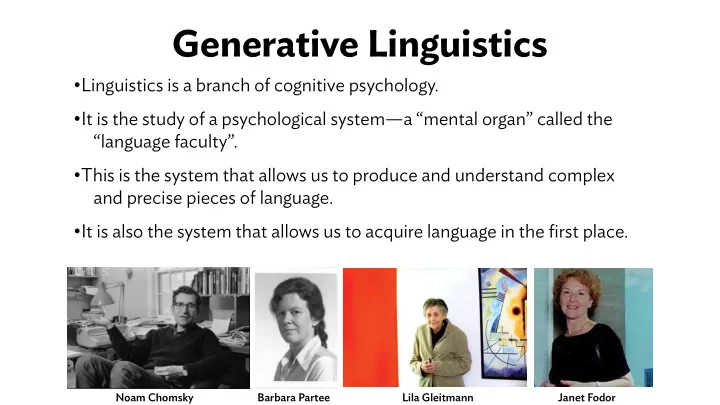
Noam Chomsky Barbara Partee Lila Gleitmann Janet Fodor
SLIDE 2
“…the shift in focus [represented by generative grammar] was from from behavior or the products of behavior to states of the mind/ brain that enter into behavior…” (i)What constitutes knowledge of language? (ii)How is knowledge of language acquired? (iii)How is knowledge of language put to use?
Chomsky, Knowledge of Language (1986)
SLIDE 3
(i)What constitutes knowledge of language? (ii)How is knowledge of language acquired? (iii)How is knowledge of language put to use?
“The answer to the first question is given by a particular generative grammar, a theory concerned with the state of the person who knows a particular language.”
Chomsky, Knowledge of Language (1986)
SLIDE 4 (i)What constitutes knowledge of language? (ii)How is knowledge of language acquired? (iii)How is knowledge of language put to use?
“The answer to the second is given by a specification
- f a UG [Universal Grammar] along with an account
- f the ways in which its principles interact with
experience to yield a particular langauge; UG is a theory of the ‘initial state’ of the language faculty, prior to any linguistic experience.”
Chomsky, Knowledge of Language (1986)
SLIDE 5
(i)What constitutes knowledge of language? (ii)How is knowledge of language acquired? (iii)How is knowledge of language put to use?
“The answer to the third question would be a theory of how the knowledge of language attained enters into the expression of thought and the understanding of presented specimens of language, and derivatively, into communication and other special uses of language.”
Chomsky, Knowledge of Language (1986)
SLIDE 6 Language of Thought vs. Generative Linguistics
- Generative linguistics is a theory of our ability to
acquire and use language of the kind that we speak
- ut loud.
- The language-of-thought hypothesis is a theory
about something else: the language in which we think.
- Important: Don’t confuse the two!
SLIDE 7 String of Words
The Language Faculty
Database of Phonological Rules Database of Syntactic Rules Database of Semantic Rules
Other psychological processes
Syntactic Structure Sentence Meaning
Phonological Processing Syntactic Processing Semantic Processing
Sentence Perception
SLIDE 8 String of Words
The Language Faculty
Database of Phonological Rules Database of Syntactic Rules Database of Semantic Rules
Other psychological processes
Syntactic Structure Sentence Meaning
Phonological Processing Syntactic Processing Semantic Processing
Sentence Perception
SLIDE 9
The big dog chased a cat S(entence)
SLIDE 10
The big dog chased a cat NP VP S
S → NP VP
SLIDE 11
The big dog chased a cat NP VP S NP D
NP → D NP S → NP VP
SLIDE 12
The big dog chased a cat NP VP S NP D A N
NP → A NP NP → D NP S → NP VP
SLIDE 13
The big dog chased a cat NP VP S NP D A N
NP → A NP NP → D NP S → NP VP VP → V NP
NP V
SLIDE 14
The big dog chased a cat NP VP S NP D A N
NP → A NP NP → D NP S → NP VP VP → V NP
NP V
(2)
NP D
SLIDE 15
The big dog chased a cat NP VP S NP D A N
NP → A NP NP → D NP S → NP VP VP → V NP
NP V
(2)
NP D N
NP → N
SLIDE 16
John flew to paris and Mary xEC to Chicago
SLIDE 17 String of Words
The Language Faculty
Database of Phonological Rules Database of Syntactic Rules Database of Semantic Rules
Other psychological processes
Syntactic Structure Sentence Meaning
Phonological Processing Syntactic Processing Semantic Processing
Sentence Perception
SLIDE 18
This is the book that Walter was reading t to his friends and fellow students on Friday. This is the book that Walter was reading to his friends and fellow students about t on Friday.
SLIDE 19
It’s raining x. Everyone x was at the party x last night.
SLIDE 20
As the parents left their child played the guitar nicely.
SLIDE 21
As the parents left their child played the guitar nicely. ??
SLIDE 22
[As the parents left their child] played the guitar nicely. [As the parents left] their child played the guitar nicely.
SLIDE 23
Garden-Path Sentences The teacher told the children the ghost story had frightened that it wasn't true. The old man the boat. The complex houses married and single soldiers and their families. The man who whistles tunes pianos.
SLIDE 24
The rat the cat the dog worried chased the malt.
SLIDE 25
The rat the cat the dog worried chased the malt. The rat [the cat the dog worried] chased ate the malt. The rat Socks chased ate the malt.
SLIDE 26
The rat the cat the dog worried chased the malt.
SLIDE 27
THE INVENTION OF LANGUAGE BY CHILDREN: ENVIRONMENTAL AND BIOLOGICAL INFLUENCES ON THE ACQUISITION OF LANGUAGE
LILA GLEITMAN &
ELISSA NEWPORT
SLIDE 28
GLEITMAN & NEWPORT’S CENTRAL CLAIM
Any given person’s ability to use and understand their native language is not entirely innate. BUT: “…language acquisition in humans seems to involve a type of learning that is heavily constrained, or predisposed to follow certain limited courses, by our biology.” (p.2)
SLIDE 29 UNIVERSAL GRAMMAR
Humans have evolved to have a genetically-coded capacity to learn languages, called ‘universal grammar’. This capacity can be thought of as an algorithm that is programmed into our brains at birth. It is sometimes called a Language Acquisition Device (LAD). Universal grammar constrains the properties of possible human languages. So they share some characteristics that are universal to all possible human languages.
Noam Chomsky
SLIDE 30 SOME TOUGH QUESTIONS
- What is it for a trait to be innate?
- How does the answer to this question differ
depending on whether we’re talking about physical characteristics, abilities, beliefs, desires, or concepts?
- What counts as evidence of whether a trait is innate?
SLIDE 31 RATIONALISM
- Central claim: at least some of our concepts and knowledge
are independent of sense experience to a significant extent.
- Often this involves claims about the innateness of those
concepts and knowledge.
- Plato says we recollect knowledge of mathematics and of the forms
from a previous life, or from the underworld.
- Descartes says that God created us with certain ‘clear and distinct
ideas’ built in, and that we can deduce many important truths from those ideas.
SLIDE 32 EMPIRICISM
- Central claim: sense experience is the ultimate source of all
(or nearly all) of our concepts and knowledge.
- This often comes packaged with the claim that very little is
innate:
- Locke compares the human mind at birth to a blank slate (tabula rasa)
- r an empty cupboard—one with no concepts or knowledge in it yet.
SLIDE 33 NATIVISM–EMPIRICISM DEBATE
- Take some psychological trait or process X
(e.g., the concept RED, or the ability to use language, etc.)
- A nativist about X says that X depends on special-purpose
psychological structures whose existence and development is best explained by facts about our biology.
- An empiricist about X says that X can be explained by
general-purpose learning mechanisms.
- Nativism and empiricism represent end-points on a spectrum.
SLIDE 34 ARGUMENT 1: MILESTONES
Human children learn language at a fixed rate that does not depend on:
- how much their parents engage in “motherese"
- how much their parents talk to them, or whether their parents
talk to them at all
- whether they are learning a spoken or signed language
- whether they are visually impaired in ways that would seem
to make it difficult to understand certain vocabulary
SLIDE 35 ARGUMENT 2: ACQUISITION WITHOUT DATA
Children acquire language in ways that aren’t closely related to the kinds
- f linguistic stimuli to which they’re exposed.
- E.g., children learn at the same rate despite variations in how parents
talk.
- Deaf children “invent” the early stages of a language at about the same
rate as normal children, even if nobody’s teaching them.
- In at least one extreme case, a community of deaf children made up a
whole new language from scratch.
(Nicaraguan sign language.)
SLIDE 36
ARGUMENT 3: THE CRITICAL PERIOD
If children don’t acquire language by a certain age (within a “critical period”), their ability to acquire language is severely degraded. The same is true, to a lesser extent, for second-language learning. This is often taken to show that language-learning depends on special-purpose mechanisms, and not general-purpose learning strategies.
SLIDE 37
SLIDE 38 ARGUMENT 4: PIDGINS AND CREOLES
Pidgens are “rough-and-ready contact language[s]”—less than full languages used by people to deal with each
- ther in inter linguistic contexts.
Creoles are full languages that develop out of pidgens when they acquire native speakers. The way this happens is that children are raised by pidgin speakers, and “fill in the gaps” on their own.
SLIDE 39
ARGUMENT 5: POVERTY OF THE STIMULUS
Arguments 1–4 deal with unusual situations. But L&N argue that all language learning is like these cases in relevant respects. We all acquire essentially the same linguistic abilities, despite highly variable environments and highly impoverished data about how those languages work.
SLIDE 40
HOW TO TURN THESE INTO QUESTIONS? (1)The man who is a fool is amusing. (2)The man is a fool who is amusing. MOVE FIRST ‘IS’? (1)Is the man who a fool is amusing? (2)Is the man a fool who is amusing? MOVE SECOND ‘IS’? (3)Is the man who is a fool amusing. (4)Is the man is a fool who amusing.