Generalized Measurement Invariance Tests for Proposed Proposed - - PowerPoint PPT Presentation

generalized measurement invariance tests for
SMART_READER_LITE
LIVE PREVIEW

Generalized Measurement Invariance Tests for Proposed Proposed - - PowerPoint PPT Presentation

Measurement Measurement Invariance Invariance Ed Merkle, Ed Merkle, Achim Zeileis Achim Zeileis Background Background 1 Background Generalized Measurement Invariance Tests for Proposed Proposed Tests Tests Factor Analysis


slide-1
SLIDE 1

Measurement Invariance Ed Merkle, Achim Zeileis Background Proposed Tests Illustration Conclusions

Generalized Measurement Invariance Tests for Factor Analysis

Ed Merkle1 Achim Zeileis2

1University of Missouri 2Universit¨

at Innsbruck

Supported by grant SES-1061334 from the U.S. National Science Foundation

Measurement Invariance Ed Merkle, Achim Zeileis Background Proposed Tests Illustration Conclusions

1 Background 2 Proposed Tests 3 Illustration 4 Conclusions

Measurement Invariance Ed Merkle, Achim Zeileis Background Proposed Tests Illustration Conclusions

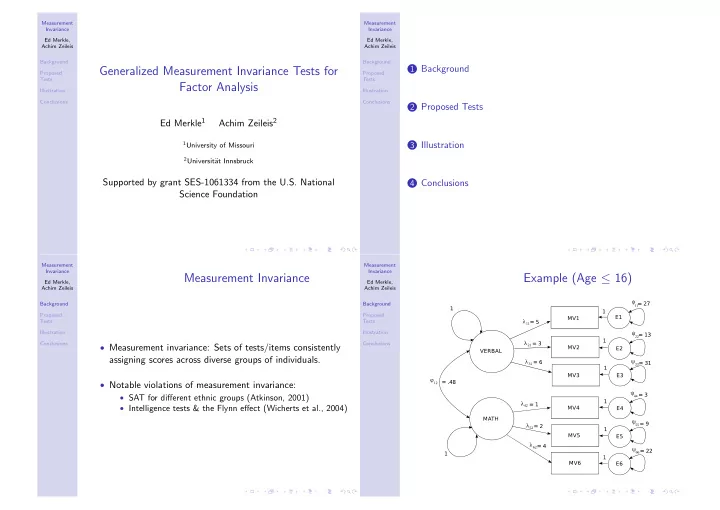
Measurement Invariance

  • Measurement invariance: Sets of tests/items consistently

assigning scores across diverse groups of individuals.

  • Notable violations of measurement invariance:
  • SAT for different ethnic groups (Atkinson, 2001)
  • Intelligence tests & the Flynn effect (Wicherts et al., 2004)

Measurement Invariance Ed Merkle, Achim Zeileis Background Proposed Tests Illustration Conclusions

Example (Age ≤ 16)

slide-2
SLIDE 2

Measurement Invariance Ed Merkle, Achim Zeileis Background Proposed Tests Illustration Conclusions

Example (Age > 16)

Measurement Invariance Ed Merkle, Achim Zeileis Background Proposed Tests Illustration Conclusions

Hypotheses

  • Hypothesis of “full” measurement invariance:

H0 : θi = θ0, i = 1, . . . , n H1 : Not all the θi = θ0 where θi = (λi,1,1, . . . , ψi,1,1, . . . , ϕi,1,2)⊤ is the full p-dimensional parameter vector for individual i.

Measurement Invariance Ed Merkle, Achim Zeileis Background Proposed Tests Illustration Conclusions

Hypotheses

  • H0 from the previous slide is difficult to fully assess due to

all the ways by which individuals may differ.

  • We typically place people into groups based on a

meaningful auxiliary variable, then study measurement invariance across those groups (via Likelihood Ratio tests, Lagrange multiplier tests, Wald tests).

  • If we did not know the groups in advance, we could

conduct a LR or LM test for each possible grouping, then take the maximum. Requires different critical values! (Can be obtained from proposed tests.)

Measurement Invariance Ed Merkle, Achim Zeileis Background Proposed Tests Illustration Conclusions

Lack of Grouping

14 15 16 17 10 20 30 40 50 Age LR and LM statistics (k* = 19) LR LM

slide-3
SLIDE 3

Measurement Invariance Ed Merkle, Achim Zeileis Background Proposed Tests Illustration Conclusions

Proposed Tests

  • In contrast to existing tests of measurement invariance,

the proposed tests offer the abilities to:

  • Test for measurement invariance when groups are

ill-defined (e.g., when the grouping variable is continuous).

  • Test for measurement invariance in any subset of model

parameters.

  • Interpret the nature of measurement invariance violations.

Measurement Invariance Ed Merkle, Achim Zeileis Background Proposed Tests Illustration Conclusions

Proposed Tests

  • The proposed family of tests rely on first derivatives of the

model’s log-likelihood function.

  • We consider individual terms (scores) of the gradient.

These scores tell us how well a particular parameter describes a particular individual.

n

  • i=1

s(ˆ θ; xi) = 0, where s(ˆ θ; xi) = ∂ ∂θ log L(xi, θ)

  • θ=

θ

Measurement Invariance Ed Merkle, Achim Zeileis Background Proposed Tests Illustration Conclusions

Proposed Tests

  • Under measurement invariance, parameter estimates

should roughly describe everyone equally well. So people’s scores should fluctuate around zero.

  • If measurement invariance is violated, the scores should

stray from zero.

Measurement Invariance Ed Merkle, Achim Zeileis Background Proposed Tests Illustration Conclusions

Aggregating Scores

  • We need a way to aggregate scores across people so that

we can draw some general conclusions.

  • Order individuals by an auxiliary variable.
  • Define t ∈ (1/n, n). The empirical cumulative score

process is defined by: B(ˆ θ; t) = 1 √n

⌊nt⌋

  • i=1

s(ˆ θ; xi). where ⌊nt⌋ is the integer part of nt.

slide-4
SLIDE 4

Measurement Invariance Ed Merkle, Achim Zeileis Background Proposed Tests Illustration Conclusions

Tests

  • Under the hypothesis of measurement invariance, a

functional central limit theorem holds: I( θ)−1/2B( θ; ·) d → B0(·), where I( θ) is the observed information matrix and B0(·) is a p-dimensional Brownian bridge.

  • Testing procedure: Compute an aggregated statistic of the

empirical score process and compare with corresponding quantile of aggregated Brownian motion.

  • Test statistics: Special cases include double maximum

(DM), Cram´ er-von Mises (CvM), maximum of LM statistics.

Measurement Invariance Ed Merkle, Achim Zeileis Background Proposed Tests Illustration Conclusions

Simulation

  • Simulation: What is the power of the proposed tests?
  • Two-factor model, with three indicators each.
  • Measurement invariance violation in three factor loading

parameters, with magnitude from 0–4 standard errors.

  • Sample size in {100, 200, 500}.
  • Model parameters tested in {3, 19}.
  • Three test statistics.

Measurement Invariance Ed Merkle, Achim Zeileis Background Proposed Tests Illustration Conclusions

Simulation

Violation Magnitude Power

0.2 0.4 0.6 0.8 1 2 3 4

k* = 3 n = 100 k* = 19 n = 100 k* = 3 n = 200

0.2 0.4 0.6 0.8

k* = 19 n = 200

0.2 0.4 0.6 0.8

k* = 3 n = 500

1 2 3 4

k* = 19 n = 500 CvM max LM DM

Measurement Invariance Ed Merkle, Achim Zeileis Background Proposed Tests Illustration Conclusions

Example

  • Example: Studying stereotype threat via factor analysis

(Wicherts et al., 2005)

  • Stereotype threat: Knowledge of stereotypes about one’s

social group might cause one to fulfill the stereotypes.

  • Wicherts et al. study: 295 students were administered

three intelligence tests. Stereotypes were primed for half of the students.

  • Groups defined by: Ethnicity (majority/minority) and

whether or not stereotypes were primed.

slide-5
SLIDE 5

Measurement Invariance Ed Merkle, Achim Zeileis Background Proposed Tests Illustration Conclusions

Model

  • To study the data, Wicherts et al. employed a series of

four-group, one-factor models.

  • General finding: Minorities with stereotype primes have

different measurement parameters than other groups.

  • Current example: Is measurement further impacted by

academic performance (as measured by student GPA)?

Measurement Invariance Ed Merkle, Achim Zeileis Background Proposed Tests Illustration Conclusions

Model

  • We utilize a model employed by Wicherts et al., where

four model parameters are specific to the “minority, stereotype prime” group.

  • Test for measurement invariance in these parameters wrt

the student GPA variable (either all four together or individually).

  • Violations of measurement invariance imply that stereotype

threat is more problematic for students of low or high GPA.

Measurement Invariance Ed Merkle, Achim Zeileis Background Proposed Tests Illustration Conclusions

Model

Numerical Abstract Verbal

1 μnum

Intelligence

η λnum ψnum

Measurement Invariance Ed Merkle, Achim Zeileis Background Proposed Tests Illustration Conclusions

Results for Single Parameters

4.5 5.5 6.5 7.5 −2 −1 1 2 GPA λn 4.5 5.5 6.5 7.5 −2 −1 1 2 GPA η 4.5 5.5 6.5 7.5 −2 −1 1 2 GPA µn 4.5 5.5 6.5 7.5 −2 −1 1 2 GPA ψn

slide-6
SLIDE 6

Measurement Invariance Ed Merkle, Achim Zeileis Background Proposed Tests Illustration Conclusions

Aggregated Results

4.5 5.5 6.5 7.5 0.0 1.0 2.0 GPA Empirical fluctuation process

Aggregated Process, Double Max

4.5 5.5 6.5 7.5 1 2 3 4 5 6 GPA Empirical fluctuation process

Aggregated Process, CvM

5.5 6.0 6.5 7.0 5 10 20 30 GPA Empirical fluctuation process

Aggregated Process, max LM Measurement Invariance Ed Merkle, Achim Zeileis Background Proposed Tests Illustration Conclusions

Conclusions

  • Measurement invariance tests utilizing stochastic processes

have important advantages over existing tests:

  • Isolating specific parameters that violate measurement

invariance, allowing the researcher to define specific types

  • f measurement invariance “post hoc” instead of “a

priori”.

  • Isolating groups of individuals whose parameter values

differ.

  • Studying the impact of continuous variables on model

estimates, without “ruining” the rest of the model.

  • Power is reasonable, with specific tests being better in

specific circumstances.

Measurement Invariance Ed Merkle, Achim Zeileis Background Proposed Tests Illustration Conclusions

Software

  • To carry out the tests, we utilize
  • lavaan for model estimation.
  • estfun() for score extraction, which is currently a

combination of our own code and lavaan code.

  • strucchange for carrying out the proposed tests with the

scores.

  • Required input: Fitted model, function for score

extraction, and information matrix (optional).

  • gefp() constructs the process.
  • sctest() and plot() calculate and visualize test

statistics.

Measurement Invariance Ed Merkle, Achim Zeileis Background Proposed Tests Illustration Conclusions

Current Work

  • Continued test implementation via strucchange and

lavaan (and possibly OpenMx).

  • Detailed examination of test properties.
  • Extension to related psychometric issues.
  • Working paper:

http://econpapers.repec.org/RePEc:inn:wpaper: 2011-09

slide-7
SLIDE 7

Measurement Invariance Ed Merkle, Achim Zeileis Background Proposed Tests Illustration Conclusions

  • Questions?