SLIDE 1 Page 1 on 32 General presentation Challenger6
General presentation of Challenger6
Release: V1.01 – 24/02/2012
http://www.skynam.com
Machine management
General presentation of Challenger6
Skynam reserves the right to make changes, corrections, modifications, improvements, to this document, to products and to the services which he describes, at any time and without notice preliminary. No part of the documents may be reproduced or transferred, whatever the reason or the means used, whether mechanical or electronic, without prior authorisation from Skynam. Skynam’s general sales conditions are fully applicable. WINDOWS is a Microsoft Corporation registered trademark The WINDOWS logo is a™ Microsoft Corporation trade mark.
SLIDE 2 Page 2 on 32 General presentation Challenger6 TECHNICAL CHARACTERISTICS
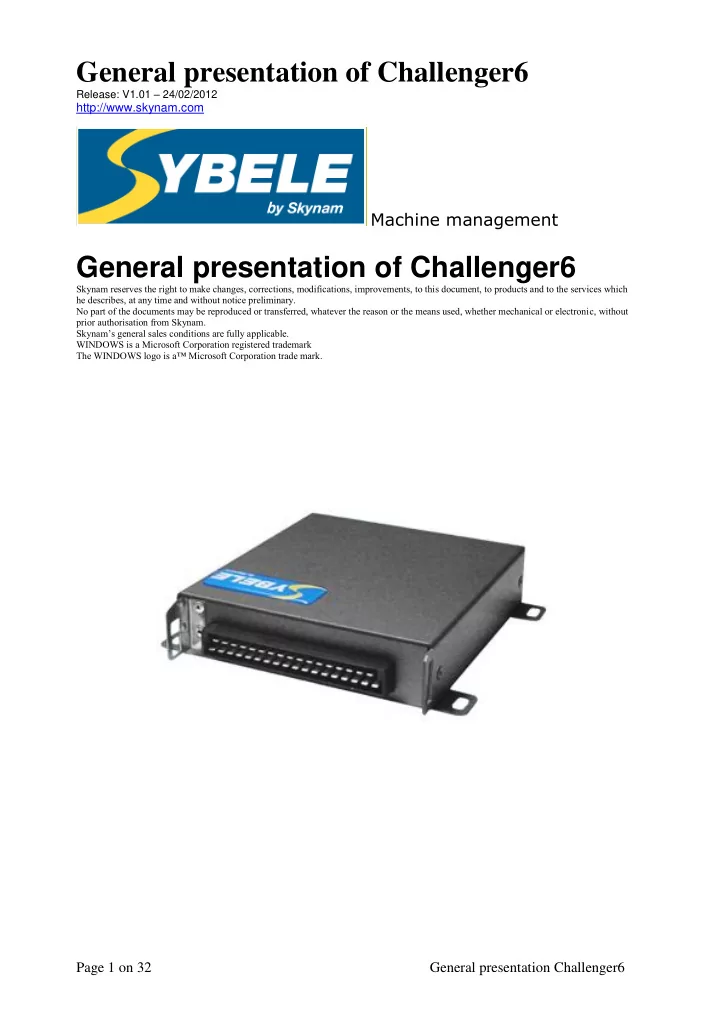
The Challenger6 is an engine management ECU and has a very high computing power, configurable inputs and outputs, allowing a very flexible and effective use. It is specifically made for racing atmospheric and turbocharged engines 1, 2, 3, 4, 6 or 8-cylinder engines.
ELECTRICAL CHARACTERISTICS
Power supply from 5,5 volts to 18 volts DC. Power supply and power grounds separated Consumption minimum while operating at 13 volts: 460 milliamperes, Consumption on stop: 0 milliampere, 5volts sensors power supply: 50 milliamperes maximum,
TEMPERATURE CHARACTERISTICS
In operation, -40°C to 85°C.
COMMUNICATIONS
High speed serial interface (1 Mbits) on USB base for the engines tuning. Auxiliary CAN-BUS 2.0B standard, speed of transmission 1 Mbits, for dashboard or third party data recording information.
HACKER PROTECTION
Tunings protected by selectable locking. Unlocking only possible by the owner of the ECU or in factory at Skynam. Total deletion of the data if attempt of violation.
MANAGEMENT OF ENGINE CYLINDERS
The number of engine cylinders is configurable by the motorist. The number of cylinders can be 1, 2, 3, 4, 6, 8. The angular distribution of cylinders must be regular (for example 180° for a 4-cylinder).
ANALOG CONVERTIONS INPUTS
- internal input measure of power supply tension.
- rotator of race configuration (selection of launch limiter type or inhibits it),
- switch of multimapping (switching on engine modified tuning while engine is running),
- switch of gear shifting configurable logical or analog,
- gear position measurement potentiometer,
- calibrable throttle position,
- calibrable pedal position,
- intake pressure,
- atmospheric or dynamic pressure,
- engine temperature,
- intake temperature,
- wideband Lambda meter (or 0-1 volt differential Lambda sensor),
FREQUENCIAL INPUT
Frequencial inputs are self adaptive in level and shape of signal to limit the impact of the possible parasites (starter, injectors). To do it, a specific microprocessor is allocated to each input to handle and shape its analog signal.
SLIDE 3 Page 3 on 32 General presentation Challenger6
- 1 measure of rpm on flywheel, programmable inductive – Hall,
- 1 measure of phase on camshaft programmable inductive – Hall,
When a sensor is in Hall effect mode, it is necessary to put in the loom a 1KOhm to 10KOhm pull-up resistor between the sensor signal and 12 volts after key or 5 volts, following the type of sensor Hall.
INPUTS DIGITAL FILTERING
Every measure of the ECU has a programmable digital filtering.
FAULTS STRATEGIES
For every measure of the ECU (pressure, throttle, …), it is possible to define a strategy of fault detection, a strategy of value replacement in case of defect, or to use the standard strategies supplied by the ECU. See chapter advanced operation, configuration of inputs.
DIAGNOSTIC
The ECU remembers the faults on the measures, the blackout or the short circuit, occasional or repeated, and allows the deletion of these defects under order of the motorist. More, it remembers the system defects, miss of 30, loss of power supply, watch dog reset, …These systems defects ask for a particular attention and indicate an important problem of assembly or manipulation.
MONITORING
Programmable recording of values overshoots on the measures or the calculations selected by the motorist:
- in extreme value,
- in duration on the extreme value,
- in total duration,
- in number of overshoots.
The trigger of recording maybe made on an advanced strategy defined by the motorist. Erasure by software (with possible protection). Alarm light programmable ( LED):
- immediate or with programmable delay,
- cumulative (on the total duration) with programmable switch on and off.
LOAD CALCULATIONS
- throttle / rpm,
- pressure / rpm (with or without turbo),
INJECTION
4 channels with type of selectable command
- ON-OFF,
- for the Peak and Hold commands, or direct injection commands, it is necessary to add a Skynam
specific device (example: Peak and Hold programmable in duration and intensity of the peak, and intensity of the hold). Selectable types of injection:
- Sequential phased (phase sensor needed),
- Sequential not phased (phase sensor not needed),
- semi sequential (phase sensor not needed).
INJECTION RAILS
Injectors can be grouped in one or two rails. Each injection rail possesses its own accelerating pump and its own injection phase.
SLIDE 4 Page 4 on 32 General presentation Challenger6 Two types of double rail working are possible:
- rail 1 to 2: allows to move gradually from a rail to the other one. When we increase the rail 2,
the rail 1 is decreased in the same way to compensate. Both rails can have different type of injectors, and thanks to the fuel flow coefficient between the two rails, the fuel quantity remains stable when moving from one to the other.
- rail 1 to 1+2: allows to add gradually the rail 2 to the rail 1. Configuration used to inject more
fuel in the engine when we engage the rail 2. Both rails can have different types of injectors.
IGNITION
4 channels to command ignition power modules (the Challenger6 does not directly command the coils). Types of selectable ignition
- twin spark (phase sensor not needed),
- static (phase sensor needed).
FUEL PUMP
Managed in the standards FISA regulation:
- runs 5 seconds at ECU switch on and stops if the engine does not run,
- runs as soon as the engine starts,
- Stops as soon as the engine stops.
AUXILIARY COMMANDS
5 programmable auxiliary commands
- ON-OFF,
- PWM from 10 Hz to 10 KHz,
- PWM software from 10 Hz to 1 KHz,
- angular (square signal the period of which is the engine cycle and the cyclical ratio of which is
adjustable) Types of piloting:
- 2 programmable push-pull or open drain commands,
- 3 open drain commands,
- for the Peak and Hold auxiliary commands, it is needed to add a specific Skynam device
(example: Peak and Hold programmable in duration and intensity of the peak, and intensity of the hold). According to the selected type of application, the outputs commands are used for:
- turbo pressure management,
- fly by wire,
- camshaft proportional shifting by PWM command,
- proportional electrovalve two wires (standard closed by spring) or three wires (opening and
closure electrically piloted).
- shift light,
- alarm defects,
- rpm relay,
- temperature relay,
- 3-state rpm relay,
- programmable type by the motorist.
TURBO
The command is normally made by the command of a pneumatic leak electrovalve or a variable geometry. The management maybe made according to the intake pressure. Supplementary management of back-pressure waste gates, Post combustion (bang-bang).
CAMSHAFTS
SLIDE 5 Page 5 on 32 General presentation Challenger6 The Challenger6 ECU can manage the proportional positioning of one camshafts. The command of the camshaft is done by the management of a unique pneumatic leak electrovalve.
RPM LIMITER
On injection, ignition or both. 3 Configurable launch limiters, selectable by a rotary switch on the vehicle board, Configurable race limiter. Cutoff made on turning cylinder (always begin with a different cylinder).
DECELERATION CUTOFF
On injection, ignition or both, or no cutoff.
SEQUENTIAL GEARBOX
Up to 10 gears the organization of which is selectable (in automotive or motorcycle or special mode). Gearshift switch can be logical (by grounding) or analog (by programmable tension level) The time of intervention is adjustable by map, for each gear and according to the engine rpm. The type of intervention on gearshift is programmable:
- ignition cutoff
- modification of the ignition with slope on go back to normal (by maps with selectable inputs)
These types of intervention can be combined.
ENGINE MULTIMAPPING
A group of modification allow modifying the engine tuning to have two tunings according to a switch. The tuning switch is allowed while engine is running. This modification is constituted of a map of modification of ignition advance, of a map of modification injection time, of a map of modification of richness target and a map of modification of turbo pressure target.
SELF LEARNING: ADVANCED HELP TO ENGINE TUNING
- The injection time base map is pre filled with values allowing an easy engine starting up. Furthermore,
a complete function of self learning was added to it to boost and facilitate the tuning of the engine, based on the richness target map and the reading of the Lambda sensor.
- The base ignition advance map has values allowing an easy engine starting up, but must be specifically
adapted to the engine by the motorist.
- All other maps of the ECU are pre filled with values allowing a good engine working in the majority
- f the cases, notably the maps of starting up enrichment and rising in temperature, of altimetric
adaptation, …
- The PID of fly by wire management, the PID of turbo management and the PID of camshafts
positioning management are also pre filled and most of the time require no or little supplementary adaptation.
AVANCED FUNCTIONS
The Challenger6 offers the motorist the possibility to refine the functioning of the ECU. 1) Parameterization of the inputs of measures: Each ECU measurement (pressure, throttle, temperature,...) can be calibrated to fit the sensor which is connected:
- Throttle potentiometer calibration is used to indicate the to ECU mini and maxi throttle
potentiometer positions and allows to work in angles (graduated from 0 to 1000), not tension.
- Inputs pressure and temperature have a linearization map that transforms the voltage measured
in physical value (°C, millibars,...) The ECU can therefore use any sensor, it is sufficient to provide appropriate transformation maps. 2) Filtering of the measures:
SLIDE 6
Page 6 on 32 General presentation Challenger6 Every measure of the ECU (pressure, throttle, temperature, …) has a calculation of filtering by weighted average, the weight being given by a map an input of which depends on the difference between the measured value and the average, and of which the other input is selectable. An adaptive filtering is so realized, allowing shorter response times in case of real movement of the measure. 3) Strategies of defect of the measures: For every measure of the ECU (pressure, throttle, temperature, …), it is possible to define a strategy of fault detection, a strategy of value replacement in case of fault, or to use the standard strategies supplied by the ECU. 4) Auxiliary commands: The auxiliary outputs of the ECU not used by the selected type of application are left at the disposal of the strategies of the motorist and can command any device in ON-OFF or PWM.
SLIDE 7 Page 7 on 32 General presentation Challenger6 ECU LOOM
J35 FUNCTION COMMENTARIES 1 OUT INJECTION A Open drain ground command - 1st injected channel 2 OUT INJECTION C Open drain ground command - 3rd injected channel 3 OUT AUXILIARY COMMAND 1 Open drain ground command 4 OUT AUXILIARY COMMAND 3 Open drain ground command 5 OUT AUXILIARY COMMAND 4B Programmable push-pull command 6 OUT IGNITION A Vbat push-pull command - 1st ignited channel 7 OUT IGNITION C Vbat push-pull command - 3rd ignited channel 8 GROUND ENGINE POWER GROUND Ground input for power commands 9 GROUND ENGINE SUPPLY GROUND Supply ground of the ECU 10 GROUND SENSORS GROUND Supply ground for sensors 11 IN LAMBDA + MEASUREMENT 0-5 volts differential input + 12 IN LAMBDA - MEASUREMENT 0-5 volts differential input - 13 IN POWER SHIFT SWITCH analog - resistive selectionnable input 14 IN ENGINE TEMPERATURE MEASUREMENT 0-5 volts resistive output 15 IN INTAKE TEMPERATURE MEASUREMENT 0-5 volts resistive output 16 IN RACE CONFIG SWITCH 0-5 volts resistive output 17 IN RPM + rpm sensor input on crankshaft 18 CAN CAN2_L auxiliary CAN (external) 19 OUT INJECTION B Open drain ground command - 2nd injected channel 20 OUT INJECTION D Open drain ground command - 4th injected channel 21 OUT AUXILIARY COMMAND 2 Open drain ground command 22 OUT AUXILIARY COMMAND 4A Programmable push-pull command 23 OUT LOW PRESSURE FUEL PUMP Open drain ground command 24 OUT IGNITION B Vbat push-pull command - 2nd ignited channel 25 OUT IGNITION D Vbat push-pull command - 4th ignited channel 26 SU¨PPLY PERMANENT SUPLLY +30 Permanent 12 volts power supply 27 SUPPLY AFTER KEY SUPPLY +15 After key 12 volts power supply 28 OUT 5V SENSORS SUPPLY 5 volts output for sensors supply 29 IN THROTTLE POSITION MEASUREMENT 0-5 volts analog input 30 IN ATMO OR INTAKE PRESSURE MEASUREMENT 0-5 volts analog input 31 IN GEARBOX POSITION MEASUREMENT 0-5 volts analog input 32 IN PEDAL POSITION MEASUREMENT 0-5 volts analog input 33 IN MULTIMAPPING SWITCH 0-5 volts resistive output 34 IN PHASE+ Phase sensor on camshaft 35 CAN CAN2_H auxiliary CAN (external)
SLIDE 8 Page 8 on 32 General presentation Challenger6 MODULES OF STANDARD CALCULATIONS
According to the chosen type of application, Challenger6 ECU uses or not the various modules of calculation. Standard maps: For the majority of the calculations, Skynam supplies preset maps, which do not need to be retouched. These maps are noted 'standard map' in the list of the calculations below. In some cases, Skynam supplies a sets of standard maps to choose by the motorist, as for example for the sensors conversions (tension/physical value) or the various PID of command of regulation (motorized throttle, tick over electrovalve, overboost pressure). Specific maps: The motorist does not have more than to make the calibration of the engine really specific (injection time, ignition advance, the cylinders corrections, turbo pressure target). Calculation of load: The engine can be equipped with an intake pressure sensor, in that case, the calculations of loads will be made from the intake pressure measurement. If the engine is only equipped with a throttle potentiometer, the calculations of loads will be made from the measure of throttle position.
IGNITION ADVANCE
Basic advance: map, on rpm / load, in 1/100 crankshaft degree relative to the TDC. Multimapping modifications: map of advance modification with programmable activation, allowing a supplementary engine tunings. Cylinders correction: 1 map by cylinder, on rpm / load, in 1/100 degree, applied to basic advance. Dynamics tick over advance: standard map, on engine temperature / rpm, in 5 decimals coefficient of advance modification by the difference between the average engine rpm and the immediate engine rpm. Calculation used to stabilize the tick over. Engine temperature correction: simplified 3D standard map, on engine temperature / rpm / load, in 1/100 degree. Intake temperature correction: simplified 3D standard map, on intake temperature / rpm / load, in 1/100 degree. Atmospheric pressure or dynamic pressure correction: simplified 3D standard map, on atmospheric pressure / rpm / load, in 1/100 degree. Cutoff advances smoothing: standard map, on engine rpm / throttle speed, in coefficient 5 decimals to smooth the advance modification in input and output of deceleration cutoff to limit jolts.
INGNITION COIL LOAD
Angle of coil load: map, on rpm / battery tension, in 1/100 degree. This map can be automatically calculated by Winjall by supplying load times according to the various battery power supply.
INJECTION
Basic injection time: map, on rpm / load, in microseconds (possibility display in crankshaft degrees) Multimapping modifications: map of modification of injection time with programmable activation, allowing a supplementary engine tuning. Phase injection rail 1: map, on rpm / load in 1/100 degree relative to the TDC Phase injection rail 2: map, on rpm / load in 1/100 degree relative to the TDC Cylinders correction: 1 map by cylinder, on rpm / load, in 5 decimals coefficient, applied to the basic time
SLIDE 9 Page 9 on 32 General presentation Challenger6 Engine temperature correction: simplified 3D standard map, on engine temperature / rpm / load, in 5 decimals coefficient. Intake temperature correction: simplified 3D standard map, on intake temperature / rpm / load, in 5 decimals coefficient. Atmospheric pressure or dynamic pressure correction: simplified 3D standard map, on atmospheric pressure / rpm / load, in 5 decimals coefficient. Permission of deceleration cutoff (inhibited during bang-bang if turbo): parameter, value: injection, ignition or both, or no cutoff.
INJECTORS CORRECTION
Injectors correction time: map, on battery tension, in microseconds. Allows to integrate into the electric command of injectors the fuel loss due to the (relative) slowness of injectors reaction.
INJECTION RAILS
Progressive distribution between rails: map with programmable inputs (choice by the motorist), in coefficient on the basic I.T. in 5 decimals. Working dependent on the type of 2nd rail, 1 to 2 or 1 to 1+2.
ENGINE ROTATION START
Engine start rpm limit: standard map, on engine temperature, giving the rpm from which the engine is considered as running by itself (end of cranking). Modification of injection time: simplified 3D standard map, on engine temperature / rpm / number of round since rotation start, in 5 decimals coefficient on basic I.T.
ENGINE START (STARTER)
Post start enrichment: standard map, on engine temperature, applied to the basic I.T. in 5 decimals
- coefficient. This coefficient is fixed at the end of cranking phase and linearly decreased according to
elapsed time at the speed of 100 % in 30 seconds.
ACCELERATING PUMP
Rise: simplified 3D standard map, on load position / load speed / regime, in 5 decimals coefficient.
- In load calculation by throttle angle, the calculation of accelerating pump is made on the throttle
movements
- In load calculation of intake pressure or airflow meter, two calculations of accelerating pump are
available simultaneously.one on the load movements (intake pressure or airflow), and one on the throttle position movements. The pump used by the ECU is the biggest of both. Decay: standard map, engine acceleration / rpm, in 5 decimals coefficient. Correction level of accelerating pumps: parameter, 5 decimals coefficient of fast tuning of accelerating pump: the standard maps supplied by Skynam must almost never be modified, we use this coefficient to enrich or to lean accelerating pumps. A coefficient by injection rail is available. In load calculation of intake pressure or airflow, a coefficient for the accelerating pumps on pressure or airflow movement and a coefficient for the accelerating pumps of throttle movement, what gives four coefficients in two rail injection.
TICK OVER AND DECELERATION CUTOFF
Accelerator pedal tick over limit: parameter, in thousandth (give the pedal position under which the pedal is in tick over zone). Tick over rpm target: parameter, rpm (give the basic value of tick over). Offset deceleration cutoff: parameter, rpm (give the offset of rpm above the tick over rpm target for which we enter in deceleration cutoff zone). Cutoff smoothing: map, on rpm / pedal speed, gives the slope of advance smoothing to enter and go out
- f deceleration cutoff from and to the load.
SLIDE 10 Page 10 on 32 General presentation Challenger6 Tick over smoothing: map, on engine acceleration / difference engine rpm –tick over rpm target, gives the slope of advance smoothing to enter and go out of deceleration cutoff from and to the tick over.
RPM LIMITER
Limiters targets (three launch limiters and one race limiter): parameter, rpm. Channels cutoff: parameter. Gives cutoff slope of channels of the selected limiter target (injection, ignition or both). Rolling cylinder cutoff (always begin with a different cylinder).
RICHNESS CORRECTION
Target: map of richness target, on rpm / load, expressed in richness. Multimapping modifications: map of modification of richness target with programmable activation, allowing a supplementary engine tunings. Permission richness correction: parameter, ON-OFF. Looping start wait: standard map, on rpm / load, expressed in milliseconds giving the maximum waiting time before use of the Lambda sensor. Re-looping wait: standard map, on rpm / load, expressed in milliseconds giving the waiting time before re-looping when the conditions of looping are correct. Speed of richness regulation: simplified 3D standard map, on rpm / load / relative distance richness- target richness.
MOTORIZED THROTTLE
Target: map of motorized throttle position target, on engine rpm / pedal. Standard maps of PID of regulation of motorized throttle command.
TICK OVER PROPORTIONAL ELECTROVALVE
Target: map of proportional electrovalve position target, on rpm / throttle. Electrovalve positioning: standard map, electrovalve target / battery tension, giving the RCO of command of the electrovalve.
TURBO PRESSURE
Target: map of overboost pressure target, on rpm / throttle position. Multimapping modifications: map of modification of pressure target with programmable activation, allowing a supplementary engine tunings. Standard maps of PID of regulation of turbo command by electrovalve of leak. Throttle minimum position of Integral correction: parameter, value of throttle below which the Integral correction of PID is maintained in 0. Maximum pressure target speed of Integral correction: parameter, value of overboost pressure target speed above which the Integral correction is maintained to 0.
BANG-BANG
Maximum time of bang-bang: parameter, bang-bang time after which it is cutoff. If this value is set to 0, there will be no bang-bang. Bang-bang command state: map based on the rpm / load of the engine, with hysteresis of throttle position or pedal position (in motorized throttle) of output of bang-bang in the re-acceleration and rpm hysteresis of output of bang-bang in the rpm drop.
CAMSHAFT POSITIONING (FOR EACH CAMSHAFT)
Target: map of camshaft position target, on rpm / load. Standard maps of PID of regulation of the camshaft position command.
FILTERINGS
Weighted average of measures: each input of measure has a filtering by weighted average (previous average + current measure) / (weight coefficient + 1).
SLIDE 11
Page 11 on 32 General presentation Challenger6 For each measure, the coefficient of weight is given by a map to allow an adaptive filtering. For the static measurements (pressures, throttle, …), one of the inputs of this map depends on the signed difference between the measured value and the average value (value-average), and the other input is selectable by the motorist.
SLIDE 12 Page 12 on 32 General presentation Challenger6 GENERAL TECHNICAL CHARACTERISTICS
AN ECU VERY POWERFUL AND VERY FLEXIBLE
The heart of the Challenger6 is a fast microcontroller with a DSP calculation coprocessor (Digital Signal Processing), with very strong computing power. The calculations are performed as often it is necessary for instant management of events and of the state
The Challenger6 has inputs and outputs configurable, allowing a very flexible and efficient use. It also owns diagnostic functions of defects of the sensors and sophisticated functions of recording of
- vershoots completely configurable (monitoring of the engine and its devices).
COMMUNICATION, TUNING
The Challenger6 can communicate and be configured by means of the PC software Winjall (™ Skynam), and this communication is made by means of a high speed serial interface USB based. The Challenger6 owns an auxiliary CAN-BUS with 125 kBits to 1Mbits speed by which it can send data to a dashboard and/or external data recording. It uses this auxiliary CAN-BUS in the standard 2.0B (11 bits or 29 bits identifiers, selected for every frame).
POWER SUPPLY
The Challenger6 is capable to work in a range of tension of power supply battery going from 7 volts to 18 volts, although the nominal power supply tension is 13,5 volts. It allows to work perfectly on vehicles without alternator, and generally, the other devices of the vehicle stop working well before itself. If the battery tension falls in the neighborhood of 5 volts during the activation of the starter, as by cold time and damaged battery, the problem on starter is remembered in diagnostic system for control. If the battery tension falls in the neighborhood of 5 volts during the working, the loss of power supply is remembered in diagnostic system for control.
TEMPERATURE
The Challenger6 it is capable to work in a range of temperature going of-40°C in +85°C. It must not however be too much near the sources of heat of the engine (exhaust, cylinders cooled by air). It is necessary to take into account the internal temperature of the electronics which borders 70°C at ambient temperature.
WATCH DOG
The Challenger6 has an electronic watch-dog which allows it to make a complete reset (reset hardware) in case of not recoverable internal defect. The complete ECU, and not only the microprocessor, restarts then completely, not generating notorious dysfunction more important than an impression of miss fire. This type of event should occur only exceptionally rarely, and denotes generally of a serious problem of assembly of the ECU loom and\or a ground connection, or an overshoot of the characteristics of
- peration (example: internal temperature, internal presence of water).
The reset is then remembered in diagnostic system for control. If several resets are made, the repetition is also noted in diagnostic system.
SLIDE 13 Page 13 on 32 General presentation Challenger6
MEMORY CHARACTERISTIC
The permanent memory of Challenger6 is a FLASH EPROM, allowing the update of the softwares (and data) by transmission since the PC. The internal memorization of the data of tuning and recording is also made in this permanent memory: no inside battery is necessary. To make this memorization, the Challenger6 needs a permanent power supply that it uses only some fractions of a second to some seconds after the contact is switched off. While it uses this permanent power supply, it makes its diagnostic LED flash. It is imperative not to switch off the permanent power supply (it is a 'permanent' power supply) during this lapse of time. It is the same strongly disadvised to disconnect the ECU of its loom directly without having switched
- ff the contact at first and since the diagnostic LED goes out.
The problems of loss of permanent power supply were minimized, and in normal working, the miss of this power supply will simply prevent the ECU from remembering the last data to be recorded. The miss of permanent power supply is then remembered in diagnostic system for control.
SLIDE 14 Page 14 on 32 General presentation Challenger6 BASIC ENGINE CONFIGURATION I) CALCULATIONS OF LOAD: The Challenger6 knows how to make various types of calculations of load:
- throttle / rpm,
- pressure / rpm (with or without turbo),
II) NUMBER OF CYLINDERS AND ANGLE BETWEEN CYLINDERS: The number of engine cylinders is configurable by the motorist. The angle between cylinders is regularly distributed on the engine cycle. For a 4-cylinder, it is 180°, for a 6-cylinder, it is 120°... III) ENGINE MEASURE OF RPM AND PHASE: To measure its rpm and calculate and set the events phased with the engine, the Challenger6 needs two devices:
- a flywheel target on the crankshaft with its sensor,
- a flywheel target on a camshaft with its sensor,
FLYWHEEL
The flywheel sensor can be inductive or Hall effect. The number of teeth is programmable, from 8 to 60 teeth. Although the computing power of Challenger6 is sufficient to support an engine rpm far beyond the mechanical possibilities of an engine, the flywheel should be chosen with a number of teeth all the more minimized as the foreseen maximum rpm must be raised, for quality questions of sensor's signal rpm. A good balance precision of the low rpm - quality of the high rpm is reached around 500 000 teeth / minute. On the contrary, if the engine must be able to start from very low rpm, it is necessary to increase the number of teeth of the flywheel. The engine can start only when the biggest tooth (see typical of mark) becomes lower than 100 milliseconds. The type of mark is programmable too:
- a supplementary tooth,
- a missing tooth,
- two consecutive missing teeth,
- regular teeth (in that case, the camshaft sensor is imperative, and it is necessary to ensure that
the tolerances of camshaft are small enough so that the mark of cam always passes on the same tooth of the crankshaft).
MINIMUM RPM OF SYNCHRONIZATION CONTROL
A test of loss of synchronization is made in every engine round by the ECU, allowing it to control that the flywheel is correctly read. If a tooth was missed or if an excess tooth is seen (a strong parasite), or if the rpm is too much disrupted, the injection is stopped and the search for the flywheel mark is restarted. We can indicate the rpm below which the test of loss of synchronization of the flywheel will not be made. This rpm is normally 0, and the test of synchronization is made as soon as the engine runs.
SLIDE 15 Page 15 on 32 General presentation Challenger6 For certain engines with a very light flywheel or with few cylinders, it is better not to make this test before certain rpm is reached because the engine turns too irregularly at low rpm, preventing the ECU from letting start the engine.
CAMSHAFT MARK
The camshaft sensor is optional. If it is not present, the sequential injection and the static ignition are not phased. The ignition will produce a spark each 360 crankshaft degree. The camshaft sensor can be inductive or Hall effect. It is used to find the 1st cylinder TDC The type of camshaft target can be:
- mark on position: all the teeth of the target camshaft have to be in the same half round of
- camshaft. It means that the other half round of camshaft must be empty.
- one missing tooth: on the regular teeth of the camshaft target, one tooth has been removed.
- one supplementary tooth: on the regular teeth of the camshaft target, one tooth has been removed
every two teeth, except on one place, where we so have 3 consecutive half teeth.
- mark on state: on the flywheel mark of one of both rounds of the engine cycle, there has to have
a camshaft tooth, and on the other engine round, it does not have to have it. This configuration is often used for gasoline direct injection or common rail diesel engines. For this configuration, the camshaft sensor has to be a Hall effect one.
TOP DEAD CENTER MARK
A calibration allows adapting the angular distance between the mechanical Top Dead Center and the Top Dead Center Mark on the flywheel seen by the sensor. It allows to give the real phase in degrees in the maps of engine phase (the phase injection). Furthermore, if the flywheel must be changed or angularly repositioned, it would be enough to redo this calibration without having to modify the maps to find back the engine tunings. A calibration also allows to set the measure of the camshaft phase to top dead center 0°.
SLIDE 16 Page 16 on 32 General presentation Challenger6 ENGINE COMMAND I) INJECTION: The precision of the calculation of injection of Challenger6 is 1µs, what is about 0,05% at tick over and 0,005% in full load. Challenger6 has 4 injection channels.
ELECTRICAL COMMANDS
The electrical commands of these channels are ON-OFF. For the Peak and Hold commands or the commands of direct injections, it is necessary to add a specific Skynam device (example: programmable Peak and Hold in duration and level of the peak, and level of the hold).
INJECTION RAILS
Injectors can be grouped in one rail, or two rails. If they are grouped in two rails, a map allows to gradually choose the injected quantity for each rail according to the rpm en the load of the engine. Each injection rail owns its own accelerating pump and its own injection phase: the 2nd rail being generally further from valves than the first one, the wetting of the intake must be more intense and the injection phase more early. Two types of double rails working are possible: 1) Rail 1 to 2: This configuration allows to move gradually from a rail to the other one: when we increase the rail 2, the rail 1 is decreased in the same way to compensate. Both rails can have different type of injectors, and thanks to the fuel flow coefficient between the two rails, the fuel quantity remains stable when moving from one to the other. Each rail has its maps of correction and delay of injectors opening. 2) Rail 1 to 1+2: This configuration allows to add gradually the rail 2 to the rail 1: we use this configuration to give more
- f fuel to the engine when we engage the rail 2. Both rails can have injectors of different types and each
rail has its maps of correction and delay of injectors opening.
TYPES OF INJECTION
The injection can be: 1) Sequential phased: (needs phase sensor) This injection is phased on the end of the injection. Injectors are normally connected 1 by 1 to the outputs of the ECU by respecting the order of ignition of the cylinders. The phase management is done by the injection phase map, in function of rpm and load. Each cylinder owns a correction map of injection time allowing the balancing of the combustion between cylinders. 2) Sequential not phased: (no phase sensor) This injection is positioned on the end of the injection. Injectors are normally connected 1 by 1 to the outputs of the ECU by respecting the order of cylinders. The phase management is done by the injection phase map, function of rpm and load, but the cycle round is selected randomly at the engine start. Each cylinder owns a correction map of injection time allowing the balancing of the combustion between cylinders. 3) Semi sequential: (phase sensor not needed) Engines with an even number of cylinders. Injectors are opened by groups: 2 (or more than 2) injectors are commanded by each injection output of the ECU.
SLIDE 17 Page 17 on 32 General presentation Challenger6 This type of injection is not phased.
CORRECTION OF CYLINDERS
For the sequential injection (phase or not) and the direct injection, each cylinder has a map rpm / load of correction to balance the richness in case of disparity of filling. II) IGNITION: The precision of the ignition calculation of Challenger6 is 1µs that is 1/10° at 16000 rpm. Challenger6 has 4 ignition channels.
ELECTRICAL COMMANDS
The electrical commands of these channels are signals of command of external power modules, which can be or not integrated into ignition coils: The Challenger6 does not directly command the primary of ignition coils.
TYPES OF IGNITIONS
1) Static ignition: (necessary phase sensor) It is the ignition with a coil by cylinder. Modules are normally connected 1 by 1 to the outputs of the ECU by respecting the order of ignition of cylinders. 2) Static ignition not phased: (no phase sensor) It is the ignition with a coil by cylinder. Modules are normally connected 1 by 1 to the outputs of the ECU by respecting the order of ignition of cylinders, but the ECU could not determine the good engine round in the engine cycle, it executes a spark every 360° 3) Twin spark ignition: For engines with an even number of cylinders, 360° opposed two by two. Cylinders are lit 2 by 2: it is necessary to use a double coil by ignition module, and a module by ignition
- utput of the ECU. We can also use coils with integrated module.
CORRECTION OF CYLINDERS
- For the static ignition (phased or not phased), each cylinder has a correction map rpm/load to
compensate for an unbalanced combustion.
- For the lost spark ignition, no correction per ignition channel.
TIME OF IGNITION DELAY
A calibration allows to inform the ECU of the time of execution of the ignition command. Indeed, between the order given by the ECU to the coils through the modules, and the real peak of spark, there is a delay time characteristic of the power modules and the coils. This time is typically of about 15 microseconds, inconspicuous at low rpm, but which borders 1 advance degree at 11000 rpm. III) RICHNESS CORRECTION: The Challenger6 can be configured to measure the richness with its Lambda sensor, and correct it. To drive this correction, we use a map of target to indicate the desired richness according to the load and to the rpm. We also have two programmable limits of correction, forbidding the Challenger6 to enrich or to lean too much during this correction. When the richness correction is allowed, we can also define the load, the rpm and the engine temperature below which the richness correction must not be made.
SLIDE 18 Page 18 on 32 General presentation Challenger6 It is advised to use a wideband Lambda sensor (with electronic interface). It is also possible to use 0-1 volts 4 wires Lambda sensors by connecting them to the differential input of the ECU. IV) ENGINE MULTIMAPPING: A group of modification allow to modify the engine tuning to have two tunings according to a switch. The tuning change is allowed while the engine is running. The group of modification is constituted
- of a map of modification ignition advance,
- of a map of modification of injection time,
- of a map of modification of richness target,
- of a map of modification of turbo pressure target (if turbo exists).
SLIDE 19 Page 19 on 32 General presentation Challenger6 VARIOUS FUNCTIONS I) RPM LIMITER:
ACTION OF THE LIMITER
The limiter can be chosen to act on the injection, the ignition, or both. A slope parameter allows to gradually cutoff the cylinders as we approach the limiter instead of cutting
- ff them all at the same time.
To protect the engine, the limiter begins every time with a different cylinder.
TYPES OF LIMITER
The Challenger6 ECU has four rpm limiters. It allows to give different rpm limits, as well as the conditions to switch from one limiter to another. 1) the three launch limiters : They allow by setting a rather low limit rpm to reduce the power of the engine at the takeoff of the vehicle, to avoid the wheels skating: the two rpm limits allow to have a better adaptation to the road
- grip. The limiter 1, 2 or 3 will be selected following the position of the race rotary switch at the vehicle
board. 2) the race limiter: It is used for the full power of the engine.
SHIFT LIGHT
It is the light which we switch on when the engine rpm is to reach the rpm limiter. This light is commanded by an auxiliary output. It is possible to make very precise commands of this light, for example by modifying its ignition according to the gearbox position. II) THROTTLE POSITION AND PEDAL POSITION: The ECU supplies a calibration of throttle position and accelerator pedal position. This calibration allows the ECU to record the minimum and the maximum of the potentiometers values (or of calculation if double potentiometer) and will allocate them the angular position 0 and the angular position 1000, with a linear interpolation between these two values for the intermediate angles. III) TICK OVER AND CUTOFF POSITION: The ECU supplies a function of calibration of tick over, which allows to define three parameters:
- The angular opening of the throttle (or pedal in motorized throttle) until which the ECU has to
consider that it is in tick over. The ECU calculates automatically a small hysteresis on this tick over position to avoid the oscillations of calculation.
- the basic tick over rpm value, which is originally only an information for the ECU, and not a
real target.
- The offset of rpm above the tick over rpm for the deceleration cutoff zone. This adjustable offset
is normally 800 rpm, that is for a tick over rpm 1000 rpm, the limit of cutoff zone will be 1800 rpm. The ECU adds a not adjustable hysteresis of 100 rpm to avoid the oscillations of calculation. IV) DECELERATION CUTOFF:
SLIDE 20
Page 20 on 32 General presentation Challenger6 The cutoff can be chosen to act on the injection, the ignition, or both, or no cut. It is made when the throttle (or the pedal in mode electric throttle) is in the tick over zone and when the rpm is in the cutoff zone (normally throttle closed or pedal released and rpm above 1800 rpm).
SLIDE 21 Page 21 on 32 General presentation Challenger6 SEQUENTIAL GEARBOXES The Challenger6 manages directly the sequential gearboxes. I) NUMBER OF GEARS: The number of gears can be chosen (up to 10 gears). We can also indicate if the gearbox is organized in automotive (Back, neutral, 1st) or motorcycle (1st, neutral, 2nd) or special by choosing the name of the gears in function of the information of the potentiometer of gearbox position. The name of gear is important because it is it which is used in the calculations of gearbox and the advanced calculations. II) GEARSHIFT SWITCH: The gear shift switch can be or
- logic: when it is put grounded, the ECU is informed about the gear shift, but only in the upshift
direction.
- analog: of constraint gauge type, the switch gives a tension centered around 2.5 volts. If this tension
passes below a minimum limit, or above a maximum limit, programmable by the motorist, the ECU is informed about the gear shifting and about the direction of the shift. III) COMMON TUNING TO ALL THE GEARS: We configure three common values to all the gears:
- Minimum engine rpm: it is the rpm below which the ECU does not intervene on the engine
management.
- Minimum pedal position: as for the rpm, the ECU does not agree to intervene on the engine
management below a certain programmable throttle position.
- Wait before new gear: after a gearshift, the ECU refuses a new gearshift during a programmable time.
It avoids intervening involuntarily a second time if the pilot keeps the hand on the gear lever. IV) SPECIFIC TUNINGS FOR EACH GEAR:
CALIBRATION OF THE GEAR POSITIONS
We indicate to the ECU the position of the various gears according to the tension of the potentiometer of measure of position of the gearbox: for each gear, we give the ECU a range of tension surrounding the value supplied by this potentiometer. The tensions of the potentiometer must be rising. The ECU supplies a function of automatic calibration of gears. Once this function launched, it is enough to shift all the gears. The ECU calculates then the range of tensions of potentiometer corresponding to every gear.
INTERVENTIONS DURING THE GEARSHIFT
A map allows for gear to adjust differently the time of intervention. The second input of this map is the engine rpm, allowing to modify the time of intervention of gear position according to the engine rpm.
SLIDE 22 Page 22 on 32 General presentation Challenger6 The intervention is launched as soon as the ECU receives from the switch the signal of gearshift, if the rpm and the throttle are above the programmed limits and if the waiting time before a new gear is elapsed, and lasts as long as the time of intervention defined for this gear is not reached. The type of intervention on gearshift is selectable. It can be
- ignition cutoff
- modification of the ignition with slope on go back to the normal (by maps with selectable
inputs) These types of intervention are combinable. For example, we can choose to cut off and to modify the ignition: The motorist will define in the parameter of modification of ignition the number of degrees of advance degradation. He will also define the slope (the speed) with which we go back to normal at the end of intervention in the parameter of slope of ignition. As we declared that we cut off the ignition at the gearshift, the ignition will be cutoff during all the defined time of intervention. At the end of gearshift, the ignition is degraded before being restarted: it thus restarts from a value lower than normal, and goes back up gradually to the normal value, at the speed defined by the slope parameter. This allows to limit jolts during the gearshift. V) ROBOTIZED BOXES: The wait before new gear also serves for programming the robotized boxes, that is the boxes for which it is needed to maintain the intervention all the time when the switch is pushed (the time of programmable intervention does not then serve). To inform the Challenger6 that the gearbox is of this type, the wait before new gear must be simply set to 0. The ECU adds systematically a 10 milliseconds time of blanking to avoid bounces on the switch of the robotized gearbox.
SLIDE 23 Page 23 on 32 General presentation Challenger6 CONTROL OF OPERATION I) BREAKDOWNS DIAGNOSTIC: The Challenger6 makes a permanent analysis of the operation of the system and the sensors, and remembers their defects, even past.
SYSTEM DIAGNOSTIC
System diagnostic is permanently displayed by the Winjall software below the name of the ECU. It gives the defects such as watch-dog resets, problems of risks or losses of data application on heavy loss of power supply (or not of 30), … A function of Winjall allows to set back to zero diagnostic system.
APPLICATION DIAGNOSTIC
Two functions coexist: a function of display of application diagnostic, and a function of reset to zero of this diagnostic. Application diagnostic consists essentially in the recording of the defects of the sensors and\or the channels of measures of these sensors in the ECU. The recorded defects can be
- black out: permanent,
- short circuit: permanent,
- occasional black out: black out appeared once then disappeared,
- occasional short circuit: short circuit appeared once then disappeared,
- hardware cut: when the input of the measure is not a physical input of the ECU, for example
received from the CAN-BUS, and when this measure is not received. Furthermore, the ECU indicates if the breakdown is in progress, and thus the function is invalidated. II) OVERSHOOTS RECORDING: This function allows to record and to show values overshoots by recording exceeded values, overshoots number, durations of the extreme overshoot, and total times of overshoots. The ECU Challenger6 has 4 identical channels of recording of overshoot. For every canal:
VALUE TO WATCH
The value to be watched is chosen in the list of the dozens measures and results of calculations known by the ECU (for example the engine rpm, the engine temperature, …). A second condition to launch the recording can be added to obtain more elaborated recordings: for example, record the engine temperature overshoots only when the engine is running. One chosen the limits level that the value has to exceed to launch the recording by adjusting the map of piloting of recording. This map with hysteresis (see advanced operation) allows to define the start up and the stop of the recording according to the value of the variable to be watched and of the 2nd condition variable (if desired). With this map, it is possible to make logical combinations of type ' and ', 'now', 'nor', ' nand ', …
RESULT OF RECORDING
A function of the Winjall software gives the results of the overshoot recording:
- the extreme value reached by the variable to be watched, and the direction of the monitoring
(overshoot downward, or overshoot upward),
- the number of times when the variable exceeded the limit,
SLIDE 24 Page 24 on 32 General presentation Challenger6
- the duration of the overshoot for the reached extreme value,
- the total duration of the value overshoots.
VISUAL ALARMS
It is possible to switch on alarms on the condition of overshoot. The functions of visual alarm 'Light of immediate alarm' and 'Light of cumulative alarm' allow to switch
- n and to switch off the alarm light of the ECU, following different modes.
As there are 4 channels of recording of overshoot for a single alarm, the alarm will remain switched on as long as a canal of recording asks for it, even if the others do not ask for it. 1) Immediate alarm: The immediate alarm lights when the value exceeds the allowed limit, that is when the recording is launched, and goes out as soon as the value returns in the allowed limits, that is when the recording stops. We can add a waiting time before the alarm lights, to prevent for example that the alarm switch on if the defect is very short, or to not perturb the driver for a too temporary defect. 2) Cumulative alarm: The cumulative alarm lights when the value exceeds the allowed limit and when the total time of
- vershoot overtakes the programmed 'time before alarm'.
It goes out when the defect disappeared since much longer that the asked 'time before alarm reset', if the number of defect did not exceed the programmed 'number of overshoots forbidding the extinction of the alarm'. If the number of overshoot reaches this limit, the alarm will not go out any more before we made a reset to zero with the Winjall software.
SLIDE 25 Page 25 on 32 General presentation Challenger6 AUXILIARY COMMANDS 7 auxiliary outputs of Challenger6 are generally power outputs of ground command in open drain (ground or nothing). Two outputs can be programmatically configured in push-pull (ground or 12 volts power supply). Some of the auxiliary outputs can be coupled so that a single command pilots two electric outputs. In that case both outputs are set, that is if the one is active, the other one is passive. In the change of state
- f the double commands in push-pull, a very light phase shift is made. It allows for example to create H
bridges. I) FIXED COMMANDS:
DIAGNOSTIC LED
The Challenger6 uses a special output among 7 to command its LED to specifically manage the state signals of the ECU and its diagnostic.
FUEL PUMP
The Challenger6 uses one of 7 outputs to command the low pressure fuel pump following the FISA regulations: pump running 5 seconds at the start up of the ECU, then pump switch off if the engine does not run. As soon as the engine rotates, restart of the pump. As soon as the engine stops, stop of the pump. II) FIXED COMMANDS FOLLOWING TYPE OF APPLICATION:
MOTORIZED THROTTLE
Is managed by a regulation of type PID on a H bridge PWM command (double push-pull) the command frequency of which we select. For this management we use a map of target to indicate the throttle position according to the accelerator pedal position and the rpm, allowing to slow down or to accelerate the movement of the throttle with regard to that of the pedal. It sometimes allows to win torque at low rpm by not allowing to open completely the throttle. It also allows to bring the necessary air quantity for the good working of the bang-bang on turbo engines.
PROPORTIONAL TICK OVER ELECTROVALVE
For the intakes not having a motorized throttle, The Challenger6 knows how to pilot an intake proportional electrovalve by a direct PWM command the frequency of which we can choose. For this management we use a target map to indicate the opening position of the electrovalve according to the throttle position and to the rpm. It also allows to bring the necessary air quantity for the good working of the bang-bang on turbo engines. The type of electrovalve can be two wires (standard electrovalve with closure by spring) or three wires (electrovalve with opening and closure electrically commanded).
CAMSHAFTS PHASE POSITIONING
The Challenger6 ECU can manage the proportional positioning of one camshaft. The command of the camshaft is done by the management of a unique pneumatic leak electrovalve.
SLIDE 26 Page 26 on 32 General presentation Challenger6 The position management of the camshaft is done by a PID regulation on a PWM command the frequency of which we can choose. The electrical command can be inverted by the configuration of the
A map of target indicates the desire camshaft position according to the load and to the rpm.
TURBO PRESSURE
For overboost engines. See below the details of the management of turbos.
PROPORTIONAL ELECTROVALVE
Allows to manage the gradual opening of electrovalves, by a PWM command with selectable frequency and cyclical ratio. The Challenger6 possesses a particular mode of piloting of electrovalve by making an effect of small hammering to force the precise positioning of electrovalves. If this mode of operation is not desired, we shall rather configure the output in simple tunable PWM. The type of electrovalve can be two wires (standard electrovalve with closure by spring) or three wires (electrovalve with opening and closure electrically commanded). III) PROGRAMMABLE COMMAND: The Challenger6 possesses 5 programmable auxiliary outputs (others than injection and ignition). They are numbered 1, 2, 3, 4Aand 4B. These auxiliary commands, when they are not fixed as for the command of motorized throttle or fuel high pressure or the other options forced by the chosen type of application, possess a possibility of programming: they can be piloted by completely programmable maps.
TWIN OUTPUTS
2 of these outputs can be coupled. We call them twin outputs: they are the outputs 4A and 4B. When they are declared coupled, outputs A and B are piloted by the command A, but the state of the
- utput B is the opposite of the output A.
- If the output A outputs of the ground, the output B is in opened drain (or 12 volts if push-pull).
- If the output A is in opened drain (or 12 volts if push-pull), the output B outputs the ground.
They possess in more an option of electric piloting, by open drain or push-pull. These outputs have to be the outputs used to manage a fly by wire.
PROGRAMMABLE OPERATIONS
To the various types of outputs corresponds various possibilities of working. Four types of programmable outputs are:
- command ON-OFF,
- command PWM (from 10 to 10000 Hz)
- angular command,
1) Command ON-OFF: The output works as a relay piloted by a completely programmable map. The output being ON-OFF, it is very recommended to use the mode hysteresis in the map of piloting of this output. 2) Command PWM: This type is to be selected when we want that the output to be a PWM the cyclic report of which we can choose by a completely programmable map. One chosen also the frequency of the PWM, 10 Hz to 10000 Hz, and if we want that the first part of every cycle is passive or active.
SLIDE 27 Page 27 on 32 General presentation Challenger6 3) Angular command: An angular command is a square signal the period of which is the engine cycle and the cyclical ratio of which is flexible. As the period of the engine cycle varies according to the rpm, the frequency of crenels also varies. The cyclical ratio is piloted by a completely programmable map. We chosen also the number of crenels in the engine cycle, and if we want that the first part of every cycle is passive or active. The engine cycle is divided into equal parts between crenels. That is if we chosen 4 crenellations, each shall make 720°/4 = 180° The start of the angular command is not specially phased: all that we know, it is the number of crenels to be made during the engine cycle, and the cyclical report in the crenel
OPTIONS OF THE OUTPUTS
Outputs Basic electric command Option pin connect. Intensity Max (1 millisecond) 1 open drain (ground) no 3 4A 10A 2 open drain (ground) no 21 4A 10A 3 open drain (ground) no 4 4A 10A 4A open drain (ground) push-pull 22 2.5A 10A 4B open drain (ground) push-pull 5 2.5A 10A
Nonstop acceptable total intensity 15 amperes Note: Skynam can supply
- electronic relays 20 amperes to pilot devices asking for more power than support the outputs or if
the acceptable total power is exceeded.
- relays of transformation of command by the ground in Push-pull command to 12 volts.
- relays of transformation of command by the ground in H Bridge command to 12 volts.
FUNCTIONS OF THE OUTPUTS
OUTPUTS 1 2 3 4A 4B On-Off fixed X X X X X programmable X X X X X positive twin programmable X negatif twin programmable X PWM programmable X X X X X positive twin programmable X negative twin programmable X turbo electrovalve X camshaft positionning X positve motorized throttle (fly by wire) X negative motorized throttle (fly by wire) X positive tick over electrovalve X negative tick over electrovalve X positive proportionnal electrovalve X negative proportionnal electrovalve X Angular programmable X rev counter X
SLIDE 28 Page 28 on 32 General presentation Challenger6 TURBO The Challenger6 uses two means to efficiently manage a turbo engine:
- the dynamic management of the leak electrovalve of waste-gate (with possible management of
back pressure) or variable geometry with elimination of the not desired overboosts,
- the post combustion or bang-bang.
The management of the turbo command (waste-gate or variable geometry) is made in PWM. The electrical command can be inverted by the configuration of the output. The frequency of the PWM can be chosen by the configuration of the output.
COMMAND OF THE OVERBOOST PRESSURE
To manage the overboost pressure, we use a map of basic target to indicate the desired pressure according to the load and to the rpm. This map supports the mode bang-bang, that is we can give a target of specific pressure in bang-bang. The management of overboost pressure is a PID: the Proportional is the map of leak, the Differential is the map of immediate correction, the Integral is the long term correction.
DYNAMIC MANAGEMENT OF OVERBOOST
The dynamic management of the overboost made by the Challenger6 has the advantage to give very reactive engines by forcing the turbo to follow at best the target, notably during the demands of fast rise in pressure: as long as the overboost pressure does not reach the target pressure, the ECU gives a maximum command to force the turbo to rise in pressure as quickly as possible.
MANAGEMENT OF WASTE GATES WITH BACK-PRESSURE
For the high level waste gates needing in more a management of the back-pressure, the Commander ECU allows to use a programmable auxiliary command to manage this back-pressure.
ELIMINATION OF OVERBOOSTS
To avoid not desired overboosts, we cancel the Integral correction which can generate a very important
- vershoot of target if, when the throttle is little opened, the pressure does not manage to rise at the level
- f the target: the ECU increases then the Integral at most to try to generate a higher leak to reach the
impossible target, and when we brutally accelerate, the leak is full opened and the pressure rises very high. It is thus necessary to reset the Integral in these circumstances, letting the Differential correct alone the basic leak. The reset to zero of the Integral of the PID of the turbo can be commanded by two different means at the choice of the motorist (each can be used alone, or in combination): 1) If the throttle position is below a limit value, no calculation of Integral, only the proportional and the
- Differential. It is justified by the fact that as long as we are not enough boosted, the turbo pressure does
not rise whatever is the leak: not need of calculation of Integral. 2) If the speed of the target is above a limit value, no calculation of Integral, only the proportional and the Differential. It allows to let the Integral correct the leak and follow the target as long as this target does not move too fast. If the target quickly moves (generally by fast movement of the throttle), the Integral cannot follow and is not any more adapted. It is then better to reset it to 0.
POST COMBUSTION
Two parameters allow to manage the bang-bang:
- maximum time of bang-bang: the duration maxi of the bang-bang in milliseconds allows to cut it
- ff after a while to avoid a too important heating of the turbo and the exhaust part of the engine. If this
value is set in 0, there will be no bang-bang.
SLIDE 29 Page 29 on 32 General presentation Challenger6
- map of bang-bang state command: allowing to define the strategies of input and of output of
bang-bang. The strategy is based on the rpm / load of the engine, with throttle position or pedal position (in motorized throttle) hysteresis of output of bang-bang on re-acceleration and the rpm hysteresis of
- utput of bang-bang on engine rpm decrease.
The tuning of the bang-bang itself is made by means of three maps:
- The ignition advance,
- the injection time,
- the motorized throttle target or the tick over electrovalve, or an auxiliary output commanding
throttle opening by a pushing device. A special mode of operation of these maps allows to define the values of air, fuel and advance in bang- bang mode separately from the normal mode of working.
SLIDE 30 Page 30 on 32 General presentation Challenger6 ADVANCED OPERATION I) PARAMETERISATION OF INPUTS: Every measure of the ECU (pressure, throttle, speed) can be calibrated to adapt to the sensor to which it is connected.
THROTTLE AND PEDAL CALIBRATION
Throttle and pedal potentiometer calibration are used to indicate to the ECU mini and maxi potentiometer positions. This allows not have maps indexed on the tensions of the potentiometers, which may vary with the life of the potentiometer or change completely if you change or dismounts the potentiometer, but on angles (graduated from 0 to 1000).
STATIC MEASURES
The pressure and temperature inputs have a linearization map that transforms the voltage measured in physical value (°C, millibars,...). The ECU can therefore use any sensor, it is sufficient to provide appropriate transformation map. Skynam provided a large number of these maps of conversions, but if the motorist does not owns the one which corresponds to the sensor that it wishes to use, it can easily create his own. Skynam can also do for him. II) DIGITAL FILTERING OF THE MEASURES: Every measure of the ECU (pressure, throttle, temperatures, …) has a filtering calculation by weighted average, the weight being given by a map. Weighted average = (the previous one average + current measure) / (coefficient of weight + 1). One of the inputs of this map depends on the signed difference between the measured value and the average (value – average), allowing a first adaptation of the average to the movement of the measure. Other input, selectable input by the motorist uses generally advanced calculations for a higher adaptability of the coefficients of weight. The adaptive filtering so realized allows shorter response times in case of real movement of the measure. III) STRATEGIES OF MEASURE BREAKDOWNS: For every measure of the ECU (pressure, throttle, temperature, …), it is possible to define a strategy of detection of defects, a strategy of replacement value in case of breakdown, or to use the standard strategies supplied by the ECU. The strategies of detection of standard breakdown consist in verifying that the value of input of the measure is in a range defined according to the type of input:
- analog sensor 0-5 volts: the value of input does not have to come down below 125 millivolts or
rise above 4950 mv, that is the case of all the standard automotive sensors.
- resistive sensor ( CTN-CTP): the value of input does not have to come down below 25 millivolts
- r rise above 4900 mv, that is the case of all the standard automotive sensors.
The strategies of standard replacement consist in supplying a fixed value dependent on the measure itself:
- The engine temperature takes the value +80°C
- The intake temperature takes the value +20°C
SLIDE 31 Page 31 on 32 General presentation Challenger6
- The richness takes the value 0 (null richness)
- The atmospheric pressure takes the value 1013 mbars
- Throttle position takes the value angle 0
- …
If for one or several inputs the motorist decides to program its own strategies of replacement of error or breakdown detection, it is necessary to:
- indicate for the replacement value which value we wish use
- indicate for the detection of error trigger the tension limits giving the allowed range
IV) MAP COMPLETELY PROGRAMMABLE: The maps used in the advanced functions are completely programmable:
VARIABLES OF INPUT OF THE MAP
We can choose the number of input variables of map and thus the number of axes of calculation: either two, or one, or none. We can choose what will be these variables in the list of the dozens of measures and results of calculations known by the ECU (for example the engine rpm, the used gear position, the speed of rise in engine temperature, the state of error of a measure).
TYPE OF MAP INTERPOLATION
We can also choose the way the calculation of interpolation will be made for every axis of map (the interpolation of lines can be different from that of the columns):
- standard interpolation with stop at the endpoints of scales,
- interpolation with continuation (extrapolation out of the endpoints of scales),
- without interpolation with truncated input (stairs downward),
- without interpolation with raised input (stairs upward),
- without interpolation, in hysteresis, for the maps with calculation of state.
V) AUXILIARY COMMANDS: The Challenger6 has 5 auxiliary outputs (other than injection and ignition) which have a possibility of programming: they can be driven by fully programmable maps, that is, the motorist may choose in a very advanced manner the functioning type of the output in the way to command devices not included in the original operating, like
- shift light in function gearbox of position,
- fan with proportional speed to engine temperature
- injection of water or additives
- …
VI) AUXILIARY CAN-BUS: It is possible to ask the Challenger6 to send data on the auxiliary CAN-BUS. The Commander uses this auxiliary CAN-BUS in the standard 2.0B (11 bits or 29 bits identifiers with the choice for every frame). We select the speed of transmission of this CAN of 125 Kbits in 1 Mbit. A 5th type 'Injall', asks the ECU to generate automatically the frames of information necessary for the compatible dashboards with the previous ECUs Sybele, as for example dashboards AIM. The communication by CAN is made by means of frames. They are the units of transmission, as a sentence in a text.
SLIDE 32 Page 32 on 32 General presentation Challenger6 Frames transport the information to be exchanged between the various devices connected together. This information is the data of the frame, as the words are the constituents of the sentences. For every frame to be sent, we supply its 11 bits or 29 bits identifier. The frames data are constituted of 8 bytes which are grouped in 4 successive 16-bit values (LSB then MSB = little indian) for the standard frames, or distributed at will for the specific frames.
DATA TRANSMISSION
We can supply to the system of external data recording or to the original electronics of the vehicle the information which they need, as for example the engine rpm and other data. 1) Frequency of transmission: For every frame, we select the period of transmission between 10 milliseconds (100 Hz) and 10 seconds. 2) Choice of the data: Each of 8 bytes of data (distributed in 4 16-bit variables for the standard frames) of the frame to be emitted can have a fixed value or be positioned to the value of a variable chosen in the list of the dozens measures and results of calculations known by the ECU.