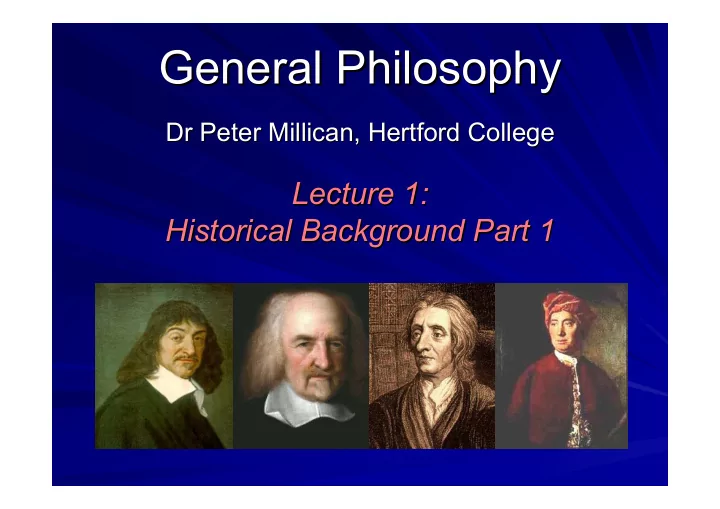
General Philosophy General Philosophy Dr Peter Millican, Hertford - - PowerPoint PPT Presentation

general philosophy general philosophy
SMART_READER_LITE
LIVE PREVIEW

General Philosophy General Philosophy Dr Peter Millican, Hertford - - PowerPoint PPT Presentation

General Philosophy General Philosophy Dr Peter Millican, Hertford College Dr Peter Millican, Hertford College Lecture 1: Lecture 1: Historical Background Part 1 Background Part 1 Historical What is General Philosophy General


slide-1
SLIDE 1

General Philosophy General Philosophy

Dr Peter Millican, Hertford College Dr Peter Millican, Hertford College

Lecture 1: Lecture 1: Historical Historical Background Part 1 Background Part 1

slide-2
SLIDE 2

2 2

What is What is “ “General Philosophy General Philosophy” ”? ?

Some central issues of epistemology Some central issues of epistemology ( (“ “What can we know? What can we know?” ”) and metaphysics ) and metaphysics ( (“ “What is the nature of things? What is the nature of things?” ”). ). Illustrates how philosophy is done: types Illustrates how philosophy is done: types

  • f arguments, methods of enquiry etc.
  • f arguments, methods of enquiry etc.

Historical focus: all but one of the topics Historical focus: all but one of the topics (Knowledge) are introduced through the (Knowledge) are introduced through the writings of writings of “ “Classical Classical” ” philosophers of the philosophers of the 17 17th

th and 18

and 18th

th centuries.

centuries.

slide-3
SLIDE 3

3 3

Why Study Philosophy Historically? Why Study Philosophy Historically?

How the agenda got set: when and why did How the agenda got set: when and why did these problems become important? these problems become important? Learning the labels: Learning the labels: “ “Cartesian dualism Cartesian dualism” ”, , “ “Lockean veil of perception Lockean veil of perception” ”, , “ “Berkeleian Berkeleian idealism idealism” ”, , “ “Berkeleian instrumentalism Berkeleian instrumentalism” ”, , “ “Humean compatibilism Humean compatibilism” ”, , “ “Cartesian Cartesian” ” or

  • r

“ “Humean Humean” ” scepticism etc. scepticism etc. Great original thinkers, writing for a general Great original thinkers, writing for a general audience: so their ideas are profound, and audience: so their ideas are profound, and they don they don’ ’t take too much for granted. t take too much for granted.

slide-4
SLIDE 4

4 4

The Value of Historical Perspective The Value of Historical Perspective

Philosophical ideas tend to have broad and Philosophical ideas tend to have broad and deep interconnections. deep interconnections. Studying classic Studying classic “ “battles of ideas battles of ideas” ” enables enables us to view these interconnections in us to view these interconnections in context and with the perspective of history. context and with the perspective of history. Many classic themes recur throughout the Many classic themes recur throughout the history of thought, sometimes hidden under history of thought, sometimes hidden under the surface of contemporary debate. the surface of contemporary debate. Ignoring the past can make us slaves of Ignoring the past can make us slaves of fashion, and blinker us to other options. fashion, and blinker us to other options.

slide-5
SLIDE 5

5 5

The Topics (1) The Topics (1)

Scepticism Scepticism: Descartes : Descartes’ ’ evil genius, evil genius, Locke Locke’ ’s veil of perception s veil of perception Knowledge: Knowledge: Responding to scepticism Responding to scepticism Perception Perception: Locke : Locke’ ’s representative s representative theory of perception, Berkeley theory of perception, Berkeley’ ’s criticisms s criticisms Primary and secondary qualities Primary and secondary qualities: Boyle : Boyle and Locke and Locke’ ’s theory, Berkeley s theory, Berkeley’ ’s criticisms s criticisms Induction Induction: Hume : Hume’ ’s sceptical argument, s sceptical argument, and his denial that nature is and his denial that nature is “ “intelligible intelligible” ”

slide-6
SLIDE 6

6 6

The Topics (2) The Topics (2)

Free Will Free Will: Hobbes : Hobbes’ ’ and Hume and Hume’ ’s s compatibilism, and their naturalistic view of compatibilism, and their naturalistic view of man as part of nature man as part of nature Mind and Body Mind and Body: Descartes : Descartes’ ’ dualism, dualism, various philosophers on the limited powers various philosophers on the limited powers

  • f matter and their religious implications
  • f matter and their religious implications

Personal Identity Personal Identity: Locke : Locke’ ’s attempt to s attempt to ground this independently of ground this independently of “ “spiritual spiritual substance substance” ”

slide-7
SLIDE 7

7 7

The Birth of Philosophy The Birth of Philosophy

The ancient Greeks, distinctively, The ancient Greeks, distinctively, aimed for rational understanding aimed for rational understanding independent of religious tradition. independent of religious tradition. Many different philosophers and Many different philosophers and “ “schools schools” ”: :

– – Various Various “ “Pre-Socratics Pre-Socratics” ” (c. 600 - 400 BC) (c. 600 - 400 BC) – – Plato and his Plato and his Academy Academy (387 BC -) (387 BC -) – – Aristotle (pictured) and his Aristotle (pictured) and his Lyceum Lyceum (335 BC -) (335 BC -) – – Pyrrhonian sceptics (c. 320 BC -) Pyrrhonian sceptics (c. 320 BC -) – – Epicureans (c. 307 BC -) Epicureans (c. 307 BC -) – – Stoics (c. 300 BC -) Stoics (c. 300 BC -)

slide-8
SLIDE 8

8 8

The Institution of Scholasticism The Institution of Scholasticism

Roman Empire became Christianised: Roman Empire became Christianised:

– – Pagan temples and libraries destroyed 391 AD; Pagan temples and libraries destroyed 391 AD; – – Non-Christian Non-Christian “ “schools schools” ” closed down 529 AD. closed down 529 AD.

Plato and Aristotle adopted: Plato and Aristotle adopted:

– – Christian Platonism (e.g. Augustine 354-430) Christian Platonism (e.g. Augustine 354-430) – – Christian Aristotelianism (e.g. Aquinas 1225-74) Christian Aristotelianism (e.g. Aquinas 1225-74)

The Christian Aristotelian worldview The Christian Aristotelian worldview became dominant in the medieval monastic became dominant in the medieval monastic schools, hence schools, hence “ “Scholasticism Scholasticism” ”. .

slide-9
SLIDE 9

9 9

Mercury Moon Fire Air Water & Earth Venus Sun Mars Saturn Jupiter Fixed Stars

9

Aristotle Aristotle’ ’s Universe s Universe

slide-10
SLIDE 10

10 10

Rediscovery of the Classics Rediscovery of the Classics

Ancient texts survived in the Byzantine Ancient texts survived in the Byzantine Empire, or in the Arabic world. Empire, or in the Arabic world.

– – Manuscripts brought West when the Ottoman Manuscripts brought West when the Ottoman Turks attacked, fostered the development of Turks attacked, fostered the development of Humanism in Renaissance Italy. Humanism in Renaissance Italy.

Printing (invented 1450) gave them much Printing (invented 1450) gave them much wider circulation, e.g.: wider circulation, e.g.:

– – Lucretius Lucretius (rediscovered 1417, printed 1486) (rediscovered 1417, printed 1486) – – Sextus Empiricus Sextus Empiricus (translated into Latin 1562) (translated into Latin 1562)

slide-11
SLIDE 11

11 11

Upheaval and Instability Upheaval and Instability

Many factors contributed to Western Many factors contributed to Western instability in the period 1500-1650, e.g.: instability in the period 1500-1650, e.g.:

– – growth of population and trade; growth of population and trade; – – discovery of the New World (America etc.); discovery of the New World (America etc.); – – consequent economic disruption; consequent economic disruption; – – realisation that ancient maps etc. were wrong; realisation that ancient maps etc. were wrong; – – suggestions of cultural relativity; suggestions of cultural relativity; – – technology of gunpowder and consequent technology of gunpowder and consequent centralisation of power. centralisation of power.

slide-12
SLIDE 12

12 12

The The Hereford Hereford “ “Mappa Mappa Mundi Mundi” ” (c. 1290) (c. 1290)

based on the writings based on the writings

  • f Orosius, a pupil of
  • f Orosius, a pupil of

Saint Augustine, part Saint Augustine, part

  • f a compendium of
  • f a compendium of

knowledge to refute knowledge to refute the pagans the pagans

slide-13
SLIDE 13

13 13

The Reformation The Reformation

The Reformation added to this crisis: The Reformation added to this crisis:

– – Luther rebelled against the Church of Rome, Luther rebelled against the Church of Rome, starting in 1517; starting in 1517; – – Many parts of Europe (especially in the North) Many parts of Europe (especially in the North) became Protestant; became Protestant; – – Savage wars throughout Europe arising from Savage wars throughout Europe arising from religious differences (e.g. Thirty Years religious differences (e.g. Thirty Years’ ’ War War 1618-48, English Civil War 1639-51); 1618-48, English Civil War 1639-51); – – Peace Peace “ “of exhaustion

  • f exhaustion”

” at Westphalia, 1648 led at Westphalia, 1648 led to greater religious toleration. to greater religious toleration.

slide-14
SLIDE 14

14 14

The Problem of the Criterion The Problem of the Criterion

A sceptical problem raised by Sextus A sceptical problem raised by Sextus Empiricus in his Empiricus in his Outlines of Pyrrhonism Outlines of Pyrrhonism: :

How can any criterion of reliable knowledge How can any criterion of reliable knowledge be chosen, unless we already have some be chosen, unless we already have some reliable criterion for making that choice? reliable criterion for making that choice? – – Roman Catholics appeal to tradition (Church, Roman Catholics appeal to tradition (Church, Bible, Aristotle); Protestants appeal to the Bible, Aristotle); Protestants appeal to the believer believer’ ’s personal response to the Bible; s personal response to the Bible; – – How to know who is right? (Maybe neither?!) How to know who is right? (Maybe neither?!)

slide-15
SLIDE 15

15 15

Aristotelian Science Aristotelian Science

Elements and Natural Motions Elements and Natural Motions

– – Four elements: fire, air, water, and earth. Four elements: fire, air, water, and earth. – – Fire/air naturally move upwards, water/earth Fire/air naturally move upwards, water/earth downwards, each seeking its natural place. downwards, each seeking its natural place. – – Heavier things fall faster, in proportion to weight. Heavier things fall faster, in proportion to weight.

A Teleological Physics A Teleological Physics

– – S Strivings, horror of a vacuum etc. trivings, horror of a vacuum etc. – – Everything strives towards the eternal, hence Everything strives towards the eternal, hence heavenly bodies move in circles, and must be heavenly bodies move in circles, and must be made of a fifth element, made of a fifth element, aether aether. .

(Physics, IV 8)

slide-16
SLIDE 16

16 16

Intelligibility, or Empty Intelligibility, or Empty “ “Explanation Explanation” ”? ?

“ “Why does water rise up a siphon pipe? Why does water rise up a siphon pipe?” ”

“ “Because Nature abhors Because Nature abhors a vacuum. a vacuum.” ”

“ “Why does opium Why does opium make one sleep? make one sleep?” ”

“ “Because it contains a Because it contains a dormitive virtue, dormitive virtue, whose whose nature is to make the nature is to make the senses soporific. senses soporific.” ” Moli Moliè ère (1673) re (1673)

slide-17
SLIDE 17

17 17

Galileo Galileo’ ’s Experiments s Experiments

Aristotle couldn Aristotle couldn’ ’t explain: t explain:

– – the flight of a cannonball; the flight of a cannonball; – – a sledge sliding on flat ice; a sledge sliding on flat ice; – – water dripping from a gutter. water dripping from a gutter.

Galileo was reported (by Viviani) to have Galileo was reported (by Viviani) to have performed another critical experiment: performed another critical experiment:

– – dropping a large and a small ball together from dropping a large and a small ball together from the Leaning Tower of Pisa. Contrary to the Leaning Tower of Pisa. Contrary to Aristotle, they fell at similar speeds. Aristotle, they fell at similar speeds.

slide-18
SLIDE 18

18 18

Galileo Galileo’ ’s Telescope s Telescope

The telescope was invented in Holland in The telescope was invented in Holland in 1608, and Galileo made his own in 1609. 1608, and Galileo made his own in 1609. What he saw with it refuted Aristotle What he saw with it refuted Aristotle’ ’s s cosmology: cosmology:

– – Mountains and valleys on the moon; Mountains and valleys on the moon; – – Four moons orbiting around Jupiter; Four moons orbiting around Jupiter; – – Innumerable stars too dim for the naked eye; Innumerable stars too dim for the naked eye; – – Phases of Venus, sometimes Phases of Venus, sometimes “ “full full” ” (implying that (implying that it is then on the opposite side of the Sun). it is then on the opposite side of the Sun).

slide-19
SLIDE 19

Sun Venus Earth

Venus as Venus as considered considered by Ptolemy by Ptolemy

14

slide-20
SLIDE 20

20 20

From Final to Efficient Causes From Final to Efficient Causes

Aristotelian science was based on Aristotelian science was based on purposes, or purposes, or “ “final final” ” causation: causation:

– – Things Things strive strive to reach their natural place, or to to reach their natural place, or to avoid abhorrent situations (e.g. a vacuum); avoid abhorrent situations (e.g. a vacuum);

Galileo preferred Galileo preferred “ “efficient efficient” ” causation: causation:

– – The outcome depends on where the causal The outcome depends on where the causal sequence happens to lead. sequence happens to lead. – – Matter doesn Matter doesn’ ’t t strive strive; it is ; it is inert inert, remaining in , remaining in its state of motion or rest unless acted on. its state of motion or rest unless acted on.

slide-21
SLIDE 21

21 21

The The “ “Mechanical Philosophy Mechanical Philosophy” ”

The paradigm of efficient causation is via The paradigm of efficient causation is via mechanical mechanical contact: contact:

– – Interaction between contiguous particles of Interaction between contiguous particles of matter by pressure and impact. matter by pressure and impact.

Compared with pseudo-explanations Compared with pseudo-explanations involving involving “ “occult

  • ccult”

” qualities (horror of a qualities (horror of a vacuum, dormitive virtue etc.), this seems: vacuum, dormitive virtue etc.), this seems:

– – genuinely genuinely explanatory explanatory; ; – – genuinely genuinely intelligible intelligible. .

slide-22
SLIDE 22

22 22

Inertia and the Orbiting Heavens Inertia and the Orbiting Heavens

Thus Galileo claimed, against Aristotle: Thus Galileo claimed, against Aristotle:

– – Matter does not Matter does not “ “strive strive” ”. . – – Left to itself matter is Left to itself matter is “ “inert inert” ”: it continues in a : it continues in a uniform state of rest or motion until acted uniform state of rest or motion until acted upon by a force (e.g. pushed along). upon by a force (e.g. pushed along). – – The heavenly bodies are not composed of a The heavenly bodies are not composed of a special special “ “aether aether” ”, but of ordinary matter, and , but of ordinary matter, and therefore subject to the same laws. therefore subject to the same laws.

BUT BUT: why then does the Moon orbit the : why then does the Moon orbit the Earth, and the planets orbit the Sun? Earth, and the planets orbit the Sun?

slide-23
SLIDE 23

23 23

The Father of Modern Philosophy The Father of Modern Philosophy

Attacks Aristotlian tradition Attacks Aristotlian tradition

using the sceptical problem using the sceptical problem

  • f the criterion;
  • f the criterion;

Builds on Galileo Builds on Galileo’ ’s s mechanical philosophy mechanical philosophy

grounding it on a theory of grounding it on a theory of matter matter’ ’s s “ “essence essence” ”; ;

Makes room for mind Makes room for mind

as an as an “ “essence essence” ” radically radically distinct from matter. distinct from matter.

slide-24
SLIDE 24

24 24

Descartes Descartes – – Epistemology Epistemology

Seeks reliable anti-sceptical basis for Seeks reliable anti-sceptical basis for knowledge, not appealing to authority: knowledge, not appealing to authority:

– – “ “I think therefore I am I think therefore I am” ”, provides a first , provides a first example of something known, and reveals example of something known, and reveals what is needed: what is needed: clear and distinct perception clear and distinct perception. . – – Then prove clearly and distinctly that the idea Then prove clearly and distinctly that the idea

  • f God implies a perfect cause: i.e. God.
  • f God implies a perfect cause: i.e. God.

– – A perfect God cannot deceive, so our faculties A perfect God cannot deceive, so our faculties must be reliable must be reliable if used properly if used properly. . – – Hence the importance of Descartes Hence the importance of Descartes’ ’ Method Method. .

slide-25
SLIDE 25

25 25

Descartes Descartes – – Science Science

Descartes was a major natural philosopher: Descartes was a major natural philosopher:

– – First to explain the rainbow in detail; First to explain the rainbow in detail; – – Discovered co-ordinate geometry; Discovered co-ordinate geometry; – – Suggested circulation of the blood; Suggested circulation of the blood; – – Concluded that the Earth orbits the Sun. Concluded that the Earth orbits the Sun.

His most important intellectual legacy: His most important intellectual legacy:

The ideal of a mechanistic science of the world, The ideal of a mechanistic science of the world, based on the simple mathematical properties of based on the simple mathematical properties of extended matter. extended matter.

slide-26
SLIDE 26

26 26

Descartes and Essences Descartes and Essences

The real qualities of matter follow from its The real qualities of matter follow from its essence, simple geometrical essence, simple geometrical extension extension. .

– – This essence, known through God-given innate This essence, known through God-given innate ideas, implies mathematical laws of motion. ideas, implies mathematical laws of motion. – – Bodies are Bodies are passive passive, remaining in the same , remaining in the same state state (inertia) (inertia) until a force is applied. until a force is applied. – – Qualities perceived by the senses (Locke Qualities perceived by the senses (Locke’ ’s s “ “secondary qualities secondary qualities” ”) are observer-dependent. ) are observer-dependent.

Mind is a distinct, Mind is a distinct, active active immaterial immaterial substance, whose essence is substance, whose essence is thinking thinking. .

slide-27
SLIDE 27

27 27

Descartes Descartes’ ’ Physics Physics

Since matter Since matter’ ’s essence is s essence is extension extension, non- , non- material extension is impossible. Thus: material extension is impossible. Thus:

– – The physical world is a The physical world is a plenum plenum (no vacuum); (no vacuum); – – All motion must take the form of All motion must take the form of circuits circuits of

  • f

matter within the plenum. matter within the plenum. – – This can be expected to give rise to This can be expected to give rise to vortices vortices, , circular motions like whirlpools. circular motions like whirlpools. – – A vortex can explain why the planets orbit the A vortex can explain why the planets orbit the Sun without shooting off under inertia. Sun without shooting off under inertia.