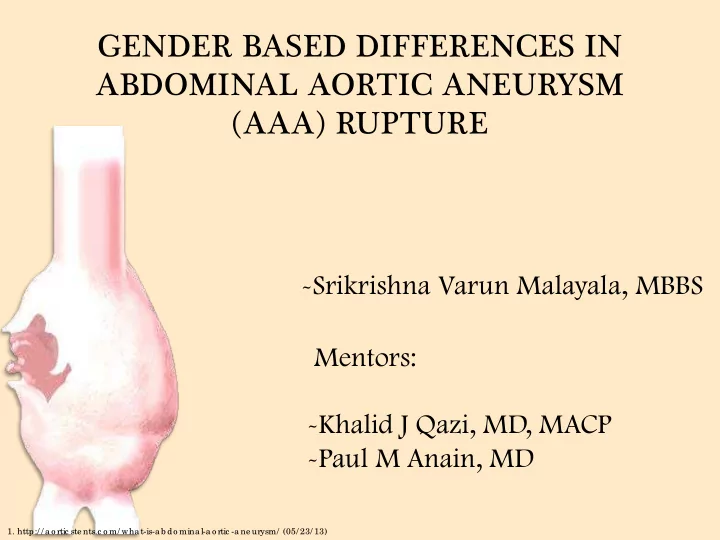
GENDER BASED DIFFERENCES IN ABDOMINAL AORTIC ANEURYSM (AAA) RUPTURE
- Srikrishna Varun Malayala, MBBS
Mentors:
- Khalid J Qazi, MD, MACP
- Paul M Anain, MD
- 1. http:/ / a o rtic ste nts.c o m/ wha t-is-a b do mina l-a o rtic -a ne urysm/ (05/ 23/ 13)
GENDER BASED DIFFERENCES IN ABDOMINAL AORTIC ANEURYSM (AAA) RUPTURE - - PowerPoint PPT Presentation
GENDER BASED DIFFERENCES IN ABDOMINAL AORTIC ANEURYSM (AAA) RUPTURE -Srikrishna Varun Malayala, MBBS Mentors: -Khalid J Qazi, MD, MACP -Paul M Anain, MD 1. http:/ / a o rtic ste nts.c o m/ wha t-is-a b do mina l-a o rtic -a ne urysm/ (05/
Mentors:
U. U.S. Preventi tive Service ces Task For
ce-March h 2009 09
Screening modality Grade
Smoking Counseling on cessation A Hypertension Blood pressure monitoring A Dyslipidemia Lipid profile A Diabetes Mellitus Fasting plasma glucose B Obesity Lifestyle modification B Prevention of Cardiovascular diseases Aspirin B
women in the United States1.
medications owing to the impact of cardiovascular diseases.
Performance Improvement Projects ?? A- Strongly Recommended Benefit>>Risk B-Recommended Benefit>Risk
usually more than 2 standard deviations above the mean diameter1.
1.Ste inb e rg I, Ste in HL . Arte ro sc le ro tic a b do mina l a o rtic a ne urysms. re po rt o f 200 c o nse c utive c a se s dia g no se d b y intra ve no us a o rto g ra phy. JAMA 1966;195:1025.Modifiable
Non modifiable
a ufma n JA, Ca mb ria RP, Ge rtle r JP, L a Mura g lia GM, e t a l. I nitia l e xp e rie nc e with e nd o va sc ula r a ne urysm re p a ir: c o mp a riso n o f e a rly re sults with o utc o me o f c o nve ntio na l o p e n re p a ir. J Va sc Surg 1998;27:992-1003.
Normal CT scan Abdominal Aortic Aneurysm Abdominal Aortic Aneurysm Rupture
diameter4.
i. < 4 cm = 0.5% per year ii. 4.0 – 4.9 cm = 1% per year iii. 5.0 – 5.9 cm = 11% per year iv. 6.0 – 6.9 cm = 26% per year v. 7.0 – 7.9 cm = 40% per year vi. > 8 cm = 50% year year
1 2 3
i. Open repair : conventional method of repair ii. Endovascular repair: faster recovery, reduced length of stay in ICU, reduced hospital stay
be made for a one-time ultrasound screening for AAA for beneficiaries who meet the following criteria2:
enrollment
1. Da vid C. Bre wste r,a MD, Ja c k L . Cro ne nwe tt, MD,b Jo hn W. Ha lle tt, Jr, MD,c K. Wa yne Jo hnsto n, MD,d Willia m C. Krupski, MD,e a nd Jo n S. Ma tsumura , MD,f Bo sto n, Ma ss; L e b a no n, NH; Ba ng o r, Me ; T
Case report on aorto-enteric fistula “Time bomb in the belly”
Introduction
Epidemiological differences:
1.
Ple ume e ke rs HJCM, Ho e s AW, va n de r Do e s E, va n Urk H, Ho fma n A, de Jo ng PT VM, Gro b b e e DE. Ane urysms o f the a b do mina l a o rta in o lde r a dults. Am J E pide mio l. 1995;142:1291–1299.2.
2c o tt RAP, Bridg e wa te r S, Ashto n HA. Ra ndo mise d c linic a l tria l o f sc re e ning fo r a b do mina l a o rtic a ne urysm in wo me n. Br J Surg . 2002;89: 283–285.3.
K a tz DJ, Sta nle y JC, Ze le no c k GB. Ge nde r diffe re nc e s in a b do mina l a o rtic a ne urysm pre va le nc e , tre a tme nt, a nd o utc o me . J Vasc Surg . 1997; 25:561–568.4.
Ma nso n JE, Hsia J, Jo hnso n K C, Ro sso uw JE, Assa f AR, L a sse r NL , T re visa n M, Bla c k HR, He c kb e rt SR, De tra no R, Stric kla nd OL , Wo ng ND, Cro use JR, Ste in E, Cushma n M, fo r the Wo me n’ s He a lth Initia tive Inve stig a to rs. Estro g e n plus pro g e stin a nd the risk o f c o ro na ry he a rt dise a se . N E ng l J Me d. 2003;349:523–534.Biological differences:
e de rle F A, Jo hnso n GR, Wilso n SE , Go rdo n IL , Chute E P, L itto o y F N, Krupski WN, Bra ndyk D, Ba ro ne GW, Gra ha m L M, Hye RJ, Re inke DB, Ane urysm De te c tio n a nd Ma na g e me nt Inve stig a to rs. Re la tio nship o f a g e , g e nde r, ra c e , a nd b o dy size to infra re na l a o rtic dia me te r. J Vasc S urg . 1997;26:595– 601.
, So ldb e rg S. Pre va le nc e o f a nd risk fa c to rs fo r a b do mina l a o rtic a ne urysms in a po pula tio n-b a se d study. Am J E pide mio l. 2001;154:236 –244.
, Sta le H, L a nne T . Co mplia nc e a nd dia me te r in the huma n a b do mina l a o rta : the influe nc e o f se x a nd a g e . E ur J Vasc S urg . 1993;7:690 – 697.
arteries and tortuosity of aortas are different in females3.
N-67,800 All of them=men
Multicentre, randomised controlled trial conducted across 93 UK hospitals 83% males
73451 veterans aged 50 to 79 99% males
1.
T he Unite d K ing do m Sma ll Ane urysm T ria l Pa rtic ipa nts. L
ng l J Me d. 2002;346:1445–1452.
2.
L e de rle F , Wiso n S, Jo hnso n G, Re inke D, L ito o y F , Ac he r C, Ba lla rd D, Me ssina L , Go rdo n I, Chute E , K rupski W, Bra dyk D. Imme dia te re pa ir c o mpa re d with surve illa nc e o f sma ll a b do mina l a o rtic a ne urysms. N E ng l J Me d. 2002;346:1437–1444.
cancer)2.
1. http :/ / www.wo rld -he a rt-fe d e ra tio n.o rg / p re ss/ fa c t-she e ts/ wo me n-a nd -c a rd io va sc ula r-d ise a se / 2. Ame ric a n He a rt Asso c ia tio n. 1997 He a rt a nd Stro ke F a c ts: Sta tistic a l Up d a te . Da lla s, T e x: Ame ric a n He a rt Asso c ia tio n; 1996. 3. Mikha il GW. Co ro na ry he a rt d ise a se in wo me n is und e rd ia g no se d , und e r- tre a te d , a nd und e r-re se a rc he d . BMJ. 2005;331:467–468.
mainly male participants3.
Goals: 1.Emphasize the importance of screening for AAAs in high risk women. 2.Emphasize the importance of “sex-specific” management guidelines of AAA. Objectives: 1.Compare the outcomes of ruptured Abdominal Aortic Aneurysms between men and women. 2.Compare the characters of ruptured AAAs in men and women.
January 1 2007 to September 2012 (6 years).
Records.
co-variance) were used for comparing the means.
Exclusion criteria
Incidence of AAAs
N (% )
Ma le s 79 (67.6%) F e ma le s 38 (32.4%) T
117
67.6 32.4 Males Females
N (% )
Ma le s 1085 (70.6%) F e ma le s 453 (29.4%) T
1538
70.6 29.4 Males Females
Incidence of AAA ruptures
Male s F e male s T
p- value
Site
0.17
SOCH
52(65.8%) 20(52.6%) 72
SBMH
27(34.2%) 18(47.4%) 45
Ra c e
N/ A
Ca uc a sia n
79 (100%) 38(100%) 117
Othe rs
BMI
(n=77)
0.02
No rma l
15(25.8%) 11(58.0%) 26
Ove rwe ig ht
24(41.3%) 6(31.5%) 30
Ob e se
19(32.9%) 2(10.5%) 21
Smo king
0.06
Ye s
66(83.5%) 26(68.4%) 92
No
13(16.5%) 12(31.6%) 25
Ma le s F e ma le s T
p-va lue Hype rte nsio n 0.64 Ye s 66(83.5%) 33(86.8%) 99 No 13(16.5%) 5(13.2%) 18 Ma jo r c o -mo rb iditie s 0.64 Ye s 38 (48.1%) 20(52.6%) 58 No 41(52.9%) 18(47.4%) 59 Sta tin 0.74 Ye s 40(50.6%) 18(47.4%) 68 No 39(49.4%) 20(52.6%) 59 Be ta -Blo c ke r 0.48 Ye s 24(30.4%) 14(36.8%) 38 No 55(69.6%) 24(63.2%) 79 Aspirin 0.10 Ye s 40(50.6%) 18(47.4%) 58 No 39(49.4%) 20(52.6%) 59 Clo pido g re l 0.47 Ye s 7(8.9%) 5(13.1%) 12 No 72 33(86.8%) 105
p=0.005
N Me a n (ye a r s) S.D. (ye a r s) Ra ng e (ye a r s)
Ma le s 79 75.75 10.0 50-97 F e ma le s 38 82.39 8.6 59-103 Ove ra ll 117 77.91 10.1 50-103
aneurysms.
Male s F e male s T
p- value
L
0.28
I nfra -re na l
75 (94.9%) 34 (89.5%) 109
Supra -re na l
1 (2.6%) 1
Bo th
4 (5.1%) 3 (7.9%) 7
I lia c a rte rie s
0.42
L e ft
6 (7.6%) 1(2.6%) 7
Rig ht
9(11.4%) 4(10.5%) 13
Bo th
12(15.2%) 3(7.9%) 15
No ne
52 (65.8%) 30(78.9%) 82 (Pa ra me te rs fro m the CT sc a n a b do me n a t a dmissio n)
Size at rupture
Me a n size (c m) S.D. (c m) Ra ng e (c m) Ma le s 8.23 1.84 4-12
F e ma le s
7.46 2.09 3-14.7
p=0.04
Yes No Males 74 (93.7%) 5 (6.3%) Females 24 (63.2%) 14 (36.8%)
P=0.03
Males Females Total p-value EVAR 57 (72.2%) 16 (42.1%) 73 <0.01 Open 17 (21.5%) 8 (21.1%) 25 None 5 (6.3%) 14 (36.8%) 19
Use of ventilator+ Pressor Support+ LOS ICU (days) Post-op complications*
Males 59.5 % 54.1 % 4.1 48.6% Females 75 % 70.8 % 5.5 58.3%
*Ma jo r c o -mo rb iditie s wa s a sig nific a nt pre dic to r o f
po st-o pe ra tive c o mplic a tio ns, VDRF a nd use o f va so pre sso rs (p<0.001, lo g istic re g re ssio n)
+Ag e wa s a sig nific a nt pre dic to r o f VDRF
a nd use o f va so pre sso rs (p<0.001, lo g istic re g re ssio n)
N=98, Men=74 and Women=24
Overall Mortality
Alive Dead Total Males 54 (68.4%) 25 (31.6%) 79 Females 12 (31.6%) 26 (68.4%) 38 Overall 66 (56.4%) 51 (43.6%) 117
statins, major co-morbidities (logistic regression)
Post-operative mortality
smoking, statins, major co-morbidities (logistic regression)
Alive Dead Total Males 53 (71.6%) 21 (21.4%) 74 Females 12 (50.0%) 12 (50.0%) 24 Overall 65 (66.3%) 33 (33.7%) 98
EVAR OPEN Males 17.5 % 64.7% Females 43.8% 63% P-value 0.02 N/A
Mortality based on type of surgery
statins, major co-morbidities (logistic regression)
Mean size (cm) S.D. (cm) Range (cm) Males 4.0 3.3 4-10 Females 5.0 2.6 3-9.3
Elective surgery could have been performed !!
Size at previous diagnosis
Kaplan-Meier survival curve analysis
Males=11.0 months Females=9.3 months P= 0.41
1.http:/ / www.123rf.c o m/ pho to _18118258_e ld e rly-wo ma n-suffe ring -with-a -b e lly-pa in-in-the -living -ro o m.html-05/ 232013
1
Summary of financials from previous 3 years (SOCH & SBMH)
more for male patients over female patients.
male patients over female patients.
http:/ / www.g e he a lthc a re .c o m/ use n/ c o mmunity/ re imb urse me nt/ do c s/ Va sc ula r_Surg e ry_re imb urse me ntv2.pdf
Conclusions: “Lower AAA prevalence is balanced by a higher rupture rate, mortality and morbidity. So screening is indeed cost-effective.”
at 5.5 cm
history, age at menopause, occupation
(68%) than in females (32%).
from AAA rupture after controlling the effect of hypertension, co-morbidities, smoking, use of statins and previous history of aneurysms; F (1,110)=8, p=0.005.
between females (mean=7.4 cm, SD=2.0) and males (mean=8.2 cm, SD=1.8); t (115)=2.0, p = 0.04.
significantly lower for women as compared to men, even after adjusting for age at admission and major co-morbidities (p=0.03).
(p=0.001) and post-operative mortality after EVAR (p=0.02) from AAA rupture after controlling the effect of hypertension, co-morbidities, smoking, use of statins and previous history of aneurysm.
use of pressors and use of ventilator was more in females.
both males and females might not be appropriate.
to their higher morbidity and mortality.