Gaussian binomial coefficients with negative arguments - - PowerPoint PPT Presentation

gaussian binomial coefficients with negative arguments
SMART_READER_LITE
LIVE PREVIEW

Gaussian binomial coefficients with negative arguments - - PowerPoint PPT Presentation

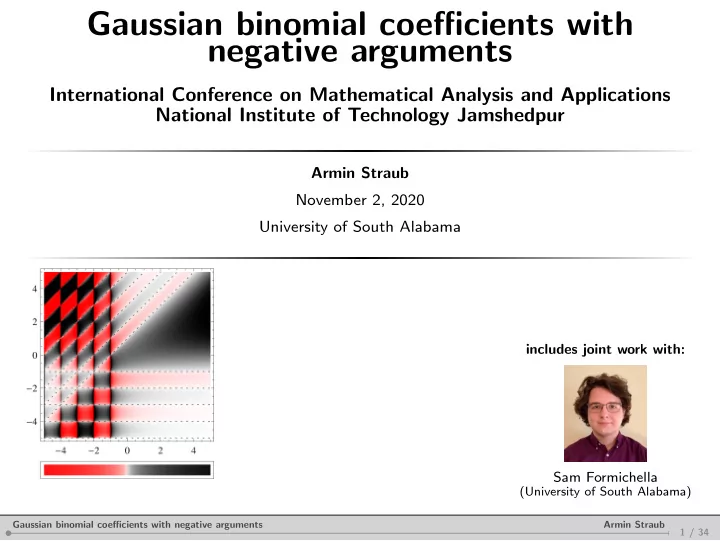
Gaussian binomial coefficients with negative arguments International Conference on Mathematical Analysis and Applications National Institute of Technology Jamshedpur Armin Straub November 2, 2020 University of South Alabama includes joint


slide-1
SLIDE 1

Gaussian binomial coefficients with negative arguments

International Conference on Mathematical Analysis and Applications National Institute of Technology Jamshedpur

Armin Straub November 2, 2020 University of South Alabama

includes joint work with: Sam Formichella

(University of South Alabama)

Gaussian binomial coefficients with negative arguments Armin Straub 1 / 34

slide-2
SLIDE 2

Basic q-analogs

q-binomial coefficients

A q-analog reduces to the classical object in the limit q → 1.

IDEA

  • q-number:

[n]q = qn − 1 q − 1 = 1 + q + . . . qn−1

DEF

Gaussian binomial coefficients with negative arguments Armin Straub 2 / 34

slide-3
SLIDE 3

Basic q-analogs

q-binomial coefficients

A q-analog reduces to the classical object in the limit q → 1.

IDEA

  • q-number:

[n]q = qn − 1 q − 1 = 1 + q + . . . qn−1

  • q-factorial:

[n]q! = [n]q [n − 1]q · · · [1]q =

(q; q)n (1 − q)n

  • q-binomial:

n k

  • q

= [n]q! [k]q! [n − k]q! = (q; q)n (q; q)k(q; q)n−k

For q-series fans:

DEF

D1

Gaussian binomial coefficients with negative arguments Armin Straub 2 / 34

slide-4
SLIDE 4

Basic q-analogs

q-binomial coefficients

A q-analog reduces to the classical object in the limit q → 1.

IDEA

  • q-number:

[n]q = qn − 1 q − 1 = 1 + q + . . . qn−1

  • q-factorial:

[n]q! = [n]q [n − 1]q · · · [1]q =

(q; q)n (1 − q)n

  • q-binomial:

n k

  • q

= [n]q! [k]q! [n − k]q! = (q; q)n (q; q)k(q; q)n−k

For q-series fans:

DEF

D1

6 2

  • = 6 · 5

2 = 3 · 5 6 2

  • q

= (1 + q + q2 + q3 + q4 + q5)(1 + q + q2 + q3 + q4) 1 + q = (1 − q + q2) (1 + q + q2)

  • =[3]q

(1 + q + q2 + q3 + q4)

  • =[5]q

EG

Gaussian binomial coefficients with negative arguments Armin Straub 2 / 34

slide-5
SLIDE 5

Basic q-analogs

q-binomial coefficients

A q-analog reduces to the classical object in the limit q → 1.

IDEA

  • q-number:

[n]q = qn − 1 q − 1 = 1 + q + . . . qn−1

  • q-factorial:

[n]q! = [n]q [n − 1]q · · · [1]q =

(q; q)n (1 − q)n

  • q-binomial:

n k

  • q

= [n]q! [k]q! [n − k]q! = (q; q)n (q; q)k(q; q)n−k

For q-series fans:

DEF

D1

6 2

  • = 6 · 5

2 = 3 · 5 6 2

  • q

= (1 + q + q2 + q3 + q4 + q5)(1 + q + q2 + q3 + q4) 1 + q = (1 − q + q2)

  • =Φ6(q)

(1 + q + q2)

  • =[3]q

(1 + q + q2 + q3 + q4)

  • =[5]q

EG

Φ6(1) = 1

becomes invisible

Gaussian binomial coefficients with negative arguments Armin Straub 2 / 34

slide-6
SLIDE 6

Cyclotomic polynomials

q-binomial coefficients

The nth cyclotomic polynomial: Φn(q) =

  • 1k<n

(k,n)=1

(q − ζk) where ζ = e2πi/n

DEF

irreducible polynomial (nontrivial; Gauss!) with integer coefficients

  • [n]q = qn − 1

q − 1 =

  • 1<dn

d|n

Φd(q)

For primes: [p]q = Φp(q)

Φ5(q) = q4 + q3 + q2 + q + 1 Φ21(q) = q12 − q11 + q9 − q8 + q6 − q4 + q3 − q + 1 Φ105(q) = q48 + q47 + q46 − q43 − q42 − 2q41 − q40 − q39 + q36 + q35 + q34 + q33 + q32 + q31 − q28 − q26 − q24 − q22 − q20 + q17 + q16 + q15 + q14 + q13 + q12 − q9 − q8 − 2q7 − q6 − q5 + q2 + q + 1

EG

Gaussian binomial coefficients with negative arguments Armin Straub 3 / 34

slide-7
SLIDE 7

q-binomials: factored and expanded

q-binomial coefficients

n k

  • q

= [n]q! [k]q![n − k]q! =

n

  • d=2

Φd(q) ⌊n/d⌋ − ⌊k/d⌋ − ⌊(n − k)/d⌋ LEM

factored

∈ {0, 1}

[n]q! =

n

  • m=1
  • d|m

d>1

Φd(q) =

n

  • d=2

Φd(q)⌊n/d⌋ proof

  • In particular, the q-binomial is a polynomial.

(of degree k(n − k))

Gaussian binomial coefficients with negative arguments Armin Straub 4 / 34

slide-8
SLIDE 8

q-binomials: factored and expanded

q-binomial coefficients

n k

  • q

= [n]q! [k]q![n − k]q! =

n

  • d=2

Φd(q) ⌊n/d⌋ − ⌊k/d⌋ − ⌊(n − k)/d⌋ LEM

factored

∈ {0, 1}

[n]q! =

n

  • m=1
  • d|m

d>1

Φd(q) =

n

  • d=2

Φd(q)⌊n/d⌋ proof

  • In particular, the q-binomial is a polynomial.

(of degree k(n − k))

6 2

  • q

= q8 + q7 + 2q6 + 2q5 + 3q4 + 2q3 + 2q2 + q + 1 9 3

  • q

= q18 + q17 + 2q16 + 3q15 + 4q14 + 5q13 + 7q12 + 7q11 + 8q10 + 8q9 + 8q8 + 7q7 + 7q6 + 5q5 + 4q4 + 3q3 + 2q2 + q + 1

EG

expanded

  • The coefficients are positive and unimodal.

Sylvester, 1878

Gaussian binomial coefficients with negative arguments Armin Straub 4 / 34

slide-9
SLIDE 9

q-binomials: combinatorial

q-binomial coefficients

n k

  • q

=

  • Y

qw(Y ) where w(Y ) =

  • j

yj − j

“normalized sum of Y ”

The sum is over all k-element subsets Y of {1, 2, . . . , n}.

THM

{1, 2}

→0

, {1, 3}

→1

, {1, 4}

→2

, {2, 3}

→2

, {2, 4}

→3

, {3, 4}

→4

4 2

  • q

= 1 + q + 2q2 + q3 + q4

EG

D2

Gaussian binomial coefficients with negative arguments Armin Straub 5 / 34

slide-10
SLIDE 10

q-binomials: combinatorial

q-binomial coefficients

n k

  • q

=

  • Y

qw(Y ) where w(Y ) =

  • j

yj − j

“normalized sum of Y ”

The sum is over all k-element subsets Y of {1, 2, . . . , n}.

THM

{1, 2}

→0

, {1, 3}

→1

, {1, 4}

→2

, {2, 3}

→2

, {2, 4}

→3

, {3, 4}

→4

4 2

  • q

= 1 + q + 2q2 + q3 + q4

EG

The coefficient of qm in n

k

  • q counts the number of
  • k-element subsets of n whose normalized sum is m,

D2

Gaussian binomial coefficients with negative arguments Armin Straub 5 / 34

slide-11
SLIDE 11

q-binomials: combinatorial

q-binomial coefficients

n k

  • q

=

  • Y

qw(Y ) where w(Y ) =

  • j

yj − j

“normalized sum of Y ”

The sum is over all k-element subsets Y of {1, 2, . . . , n}.

THM

{1, 2}

→0

, {1, 3}

→1

, {1, 4}

→2

, {2, 3}

→2

, {2, 4}

→3

, {3, 4}

→4

4 2

  • q

= 1 + q + 2q2 + q3 + q4

EG

The coefficient of qm in n

k

  • q counts the number of
  • k-element subsets of n whose normalized sum is m,
  • partitions λ of m whose Ferrer’s diagram fits in a

k × (n − k) box.

D2

Gaussian binomial coefficients with negative arguments Armin Straub 5 / 34

slide-12
SLIDE 12

q-binomials: three characterizations

q-binomial coefficients

The q-binomial satisfies the q-Pascal rule: n k

  • q

= n − 1 k − 1

  • q

+ qk n − 1 k

  • q

THM

D3

Gaussian binomial coefficients with negative arguments Armin Straub 6 / 34

slide-13
SLIDE 13

q-binomials: three characterizations

q-binomial coefficients

The q-binomial satisfies the q-Pascal rule: n k

  • q

= n − 1 k − 1

  • q

+ qk n − 1 k

  • q

THM

n k

  • q

= number of k-dim. subspaces of Fn

q

THM

D3 D4

Gaussian binomial coefficients with negative arguments Armin Straub 6 / 34

slide-14
SLIDE 14

q-binomials: three characterizations

q-binomial coefficients

The q-binomial satisfies the q-Pascal rule: n k

  • q

= n − 1 k − 1

  • q

+ qk n − 1 k

  • q

THM

n k

  • q

= number of k-dim. subspaces of Fn

q

THM

Suppose yx = qxy (and that q commutes with x, y). Then: (x + y)n =

n

  • k=0

n k

  • q

xkyn−k

THM

D3 D4 D5

Gaussian binomial coefficients with negative arguments Armin Straub 6 / 34

slide-15
SLIDE 15

q-calculus

q-binomial coefficients

The q-derivative: Dqf(x) = f(qx) − f(x) qx − x

DEF

Dqxn = (qx)n − xn qx − x = qn − 1 q − 1 xn−1 = [n]q xn−1

EG

Gaussian binomial coefficients with negative arguments Armin Straub 7 / 34

slide-16
SLIDE 16

q-calculus

q-binomial coefficients

The q-derivative: Dqf(x) = f(qx) − f(x) qx − x

DEF

Dqxn = (qx)n − xn qx − x = qn − 1 q − 1 xn−1 = [n]q xn−1

EG

  • The q-exponential: ex

q = ∞

  • n=0

xn [n]q! =

  • n=0

(x(1 − q))n (q; q)n = 1 (x(1 − q); q)∞

  • Dqex

q = ex q

  • ex

q · ey q = ex+y q

provided that yx = qxy

  • ex

q · e−x 1/q = 1

Gaussian binomial coefficients with negative arguments Armin Straub 7 / 34

slide-17
SLIDE 17

q-calculus

q-binomial coefficients

The q-derivative: Dqf(x) = f(qx) − f(x) qx − x

DEF

Dqxn = (qx)n − xn qx − x = qn − 1 q − 1 xn−1 = [n]q xn−1

EG

  • The q-exponential: ex

q = ∞

  • n=0

xn [n]q! =

  • n=0

(x(1 − q))n (q; q)n = 1 (x(1 − q); q)∞

  • The q-integral:

from formally inverting Dq

x f(x) dqx := (1 − q)

  • n=0

qnxf(qnx)

  • Dqex

q = ex q

  • ex

q · ey q = ex+y q

provided that yx = qxy

  • ex

q · e−x 1/q = 1

Gaussian binomial coefficients with negative arguments Armin Straub 7 / 34

slide-18
SLIDE 18

q-calculus

q-binomial coefficients

The q-derivative: Dqf(x) = f(qx) − f(x) qx − x

DEF

Dqxn = (qx)n − xn qx − x = qn − 1 q − 1 xn−1 = [n]q xn−1

EG

  • The q-exponential: ex

q = ∞

  • n=0

xn [n]q! =

  • n=0

(x(1 − q))n (q; q)n = 1 (x(1 − q); q)∞

  • The q-integral:

from formally inverting Dq

x f(x) dqx := (1 − q)

  • n=0

qnxf(qnx)

  • The q-gamma function:

Γq(s) = ∞ xs−1e−qx

1/q dqx

Can similarly define q-beta via a q-Euler integral.

  • Dqex

q = ex q

  • ex

q · ey q = ex+y q

provided that yx = qxy

  • ex

q · e−x 1/q = 1

  • Γq(s + 1) = [s]q Γq(s)
  • Γq(n + 1) = [n]q!

D6

Gaussian binomial coefficients with negative arguments Armin Straub 7 / 34

slide-19
SLIDE 19

Summary: the q-binomial coefficient

q-binomial coefficients

The q-binomial coefficient has a variety of natural characterizations:

  • n

k

  • q

= [n]q! [k]q! [n − k]q! = (q; q)n (q; q)k(q; q)n−k

  • Via a q-version of Pascal’s rule
  • Combinatorially, as the generating function of the element sums of

k-subsets of an n-set

  • Geometrically, as the number of k-dimensional subspaces of Fn

q

  • Algebraically, via a binomial theorem for noncommuting variables
  • Analytically, via q-integral representations
  • Not touched here: quantum groups arising in representation theory and

physics

Gaussian binomial coefficients with negative arguments Armin Straub 8 / 34

slide-20
SLIDE 20

Binomial coefficients with integer entries

−3 5

  • = −21,

−3 −5

  • = 6

−3.001 −5.001

  • ≈ 6.004

−3.003 −5.005

  • ≈ 10.03

Daniel E. Loeb

Sets with a negative number of elements Advances in Mathematics, Vol. 91, p.64–74, 1992

picNote

1989: Ph.D. at MIT (Rota) 1996+: in mathematical finance

Gaussian binomial coefficients with negative arguments Armin Straub 9 / 34

slide-21
SLIDE 21

A function in two variables

Negative binomials

This scale is also visible along the line y = 1.

Gaussian binomial coefficients with negative arguments Armin Straub 10 / 34

slide-22
SLIDE 22

A function in two variables

Negative binomials

This scale is also visible along the line y = 1.

This is a plot of:

x y

  • :=

Γ(x + 1) Γ(y + 1)Γ(x − y + 1)

Defined and smooth on R2\{x = −1, −2, . . .}.

. . . no evidence that the graph of C has ever been plotted before . . . ”

David Fowler, American Mathematical Monthly, Jan 1996

Gaussian binomial coefficients with negative arguments Armin Straub 10 / 34

slide-23
SLIDE 23

A function in two variables

Negative binomials

This scale is also visible along the line y = 1.

This is a plot of:

x y

  • :=

Γ(x + 1) Γ(y + 1)Γ(x − y + 1)

Defined and smooth on R2\{x = −1, −2, . . .}. Directional limits exist at integer points:

lim

ε→0

−2 + ε −4 + rε

  • = 1

2! lim

ε→0

Γ(−1 + ε) Γ(−3 + rε) = 3r

since Γ(−n + ε) = (−1)n n! 1 ε + O(1)

. . . no evidence that the graph of C has ever been plotted before . . . ”

David Fowler, American Mathematical Monthly, Jan 1996

Gaussian binomial coefficients with negative arguments Armin Straub 10 / 34

slide-24
SLIDE 24

A function in two variables

Negative binomials

This scale is also visible along the line y = 1.

This is a plot of:

x y

  • :=

Γ(x + 1) Γ(y + 1)Γ(x − y + 1)

Defined and smooth on R2\{x = −1, −2, . . .}. Directional limits exist at integer points:

lim

ε→0

−2 + ε −4 + rε

  • = 1

2! lim

ε→0

Γ(−1 + ε) Γ(−3 + rε) = 3r

since Γ(−n + ε) = (−1)n n! 1 ε + O(1)

DEF For all x, y ∈ Z:

x y

  • := lim

ε→0

Γ(x + 1 + ε) Γ(y + 1 + ε)Γ(x − y + 1 + ε)

. . . no evidence that the graph of C has ever been plotted before . . . ”

David Fowler, American Mathematical Monthly, Jan 1996

Gaussian binomial coefficients with negative arguments Armin Straub 10 / 34

slide-25
SLIDE 25

Sets with a negative number of elements

Negative binomials

Hybrid sets and their subsets { 1, 1, 4

positive multiplicity

| 2, 3, 3

negative multiplicity

}

DEF

Gaussian binomial coefficients with negative arguments Armin Straub 11 / 34

slide-26
SLIDE 26

Sets with a negative number of elements

Negative binomials

Hybrid sets and their subsets { 1, 1, 4

positive multiplicity

| 2, 3, 3

negative multiplicity

} Y ⊂ X if one can repeatedly remove elements from X and thus obtain Y or have removed Y .

DEF removing = decreasing the multiplicity of an element with nonzero multiplicity

Subsets of {1, 1, 4|2, 3, 3} include: (remove 4) {4|}, {1, 1|2, 3, 3}

EG

Gaussian binomial coefficients with negative arguments Armin Straub 11 / 34

slide-27
SLIDE 27

Sets with a negative number of elements

Negative binomials

Hybrid sets and their subsets { 1, 1, 4

positive multiplicity

| 2, 3, 3

negative multiplicity

} Y ⊂ X if one can repeatedly remove elements from X and thus obtain Y or have removed Y .

DEF removing = decreasing the multiplicity of an element with nonzero multiplicity

Subsets of {1, 1, 4|2, 3, 3} include: (remove 4) {4|}, {1, 1|2, 3, 3} (remove 4, 2, 2) {2, 2, 4|}, {1, 1|2, 2, 2, 3, 3} Note that we cannot remove 4 again. {4, 4|} is not a subset.

EG

Gaussian binomial coefficients with negative arguments Armin Straub 11 / 34

slide-28
SLIDE 28

Counting subsets of hybrid sets

Negative binomials

  • New sets:

{1, 2, 4|}

all multiplicities 0, 1 3 elements:

  • r

{|1, 2, 4, 5}

all multiplicities 0, −1 −4 elements:

For all integers n and k, the number of k-element subsets of an n-element new set is

  • n

k

  • .

THM

Loeb 1992

A usual set like {1, 2, 3|} only has the usual subsets.

EG

Gaussian binomial coefficients with negative arguments Armin Straub 12 / 34

slide-29
SLIDE 29

Counting subsets of hybrid sets

Negative binomials

  • New sets:

{1, 2, 4|}

all multiplicities 0, 1 3 elements:

  • r

{|1, 2, 4, 5}

all multiplicities 0, −1 −4 elements:

For all integers n and k, the number of k-element subsets of an n-element new set is

  • n

k

  • .

THM

Loeb 1992

A usual set like {1, 2, 3|} only has the usual subsets.

EG

  • −3

2

  • = 6 because the 2-element subsets of {|1, 2, 3} are:

{1, 1|}, {1, 2|}, {1, 3|}, {2, 2|}, {2, 3|}, {3, 3|}

EG

n = −3

Gaussian binomial coefficients with negative arguments Armin Straub 12 / 34

slide-30
SLIDE 30

Counting subsets of hybrid sets

Negative binomials

  • New sets:

{1, 2, 4|}

all multiplicities 0, 1 3 elements:

  • r

{|1, 2, 4, 5}

all multiplicities 0, −1 −4 elements:

For all integers n and k, the number of k-element subsets of an n-element new set is

  • n

k

  • .

THM

Loeb 1992

A usual set like {1, 2, 3|} only has the usual subsets.

EG

  • −3

2

  • = 6 because the 2-element subsets of {|1, 2, 3} are:

{1, 1|}, {1, 2|}, {1, 3|}, {2, 2|}, {2, 3|}, {3, 3|}

  • −3

−4

  • = 3 because the −4-element subsets of {|1, 2, 3} are:

{|1, 1, 2, 3}, {|1, 2, 2, 3}, {|1, 2, 3, 3}

EG

n = −3

Gaussian binomial coefficients with negative arguments Armin Straub 12 / 34

slide-31
SLIDE 31

The binomial theorem

Negative binomials

For all integers n and k,

n k

  • = {xk}(1 + x)n.

THM

Loeb 1992

Here, we extract appropriate coefficients: {xk}f(x) :=      ak if k 0 bk if k < 0

around x = 0:

f(x) =

  • kk0

akxk

around x = ∞:

f(x) =

  • kk0

b−kx−k

Gaussian binomial coefficients with negative arguments Armin Straub 13 / 34

slide-32
SLIDE 32

The binomial theorem

Negative binomials

For all integers n and k,

n k

  • = {xk}(1 + x)n.

THM

Loeb 1992

Here, we extract appropriate coefficients: {xk}f(x) :=      ak if k 0 bk if k < 0

around x = 0:

f(x) =

  • kk0

akxk

around x = ∞:

f(x) =

  • kk0

b−kx−k

(1 + x)−3 = 1 − 3x + 6x2 − 10x3 + 15x4 + O(x5) as x → 0 (1 + x)−3 = x−3 − 3x−4 + 6x−5 + O(x−6) as x → ∞ Hence, for instance, −3 4

  • = 15,

−3 −5

  • = 6.

EG

Gaussian binomial coefficients with negative arguments Armin Straub 13 / 34

slide-33
SLIDE 33

q-binomial coefficients with integer entries

For all integers n and k, n k

  • q

:= lim

a→q

(a; q)n (a; q)k(a; q)n−k .

DEF

−3 4

  • q

= 1 q18 (1 − q + q2)(1 + q + q2)(1 + q + q2 + q3 + q4) −3 −5

  • q

= 1 q7 (1 + q2)(1 + q + q2)

  • S. Formichella, A. Straub

Gaussian binomial coefficients with negative arguments Annals of Combinatorics, Vol. 23, Nr. 3, 2019, p. 725-748

Gaussian binomial coefficients with negative arguments Armin Straub 14 / 34

slide-34
SLIDE 34

The q-binomial theorem

Negative q-binomials

Suppose yx = qxy. For n, k ∈ Z,

n k

  • q

= {xkyn−k}(x + y)n.

THM

Formichella S 2019

Again, we extract appropriate coefficients: {xkyn−k}f(x, y) :=      ak if k 0 bk if k < 0

around x = 0:

f(x) =

  • kk0

akxkyn−k

around x = ∞:

f(x) =

  • kk0

b−kx−kyn+k

Gaussian binomial coefficients with negative arguments Armin Straub 15 / 34

slide-35
SLIDE 35

The q-binomial theorem

Negative q-binomials

Suppose yx = qxy. For n, k ∈ Z,

n k

  • q

= {xkyn−k}(x + y)n.

THM

Formichella S 2019

Again, we extract appropriate coefficients: {xkyn−k}f(x, y) :=      ak if k 0 bk if k < 0

around x = 0:

f(x) =

  • kk0

akxkyn−k

around x = ∞:

f(x) =

  • kk0

b−kx−kyn+k (x + y)−1 = y−1(xy−1 + 1)−1 = y−1

k0

(−1)k(xy−1)k =

  • k0

(−1)kq−k(k+1)/2 xky−k−1 EG −1 k

  • q

Gaussian binomial coefficients with negative arguments Armin Straub 15 / 34

slide-36
SLIDE 36

Counting subsets of hybrid sets, q-version

Negative q-binomials

For all n, k ∈ Z,

n k

  • q

= ε

  • Y

q σ(Y ) −k(k−1)/2, ε = ±1. The sum is over all k-element subsets Y of the n-element set Xn . THM

Formichella S 2019

ε = 1 if 0 k n. ε = (−1)k if n < 0 k. ε = (−1)n−k if k n < 0.

Xn :=

  • {0, 1, . . . , n − 1|}

if n 0 {| − 1, −2, . . . , n} if n < 0 σ(Y ) :=

  • y∈Y

MY (y)y

MY (y) is the multiplicity of y in Y .

Gaussian binomial coefficients with negative arguments Armin Straub 16 / 34

slide-37
SLIDE 37

Counting subsets of hybrid sets, q-version

Negative q-binomials

For all n, k ∈ Z,

n k

  • q

= ε

  • Y

q σ(Y ) −k(k−1)/2, ε = ±1. The sum is over all k-element subsets Y of the n-element set Xn . THM

Formichella S 2019

ε = 1 if 0 k n. ε = (−1)k if n < 0 k. ε = (−1)n−k if k n < 0.

Xn :=

  • {0, 1, . . . , n − 1|}

if n 0 {| − 1, −2, . . . , n} if n < 0 σ(Y ) :=

  • y∈Y

MY (y)y

MY (y) is the multiplicity of y in Y .

The −4-element subsets of X−3 = {| − 1, −2, −3} are: {| − 1, −1, −2, −3}, {| − 1, −2, −2, −3}, {| − 1, −2, −3, −3} σ = 7 σ = 8 σ = 9 Hence,

−3 −4

  • q

= −(q−3 + q−2 + q−1).

(subtract k(k−1)

2

= 10)

EG

n = −3

Gaussian binomial coefficients with negative arguments Armin Straub 16 / 34

slide-38
SLIDE 38

Conventions for binomial coefficients

Negative q-binomials

Option advertised here:

n k

  • := lim

ε→0

Γ(n + 1 + ε) Γ(k + 1 + ε)Γ(n − k + 1 + ε)

Alternative:

n k

  • := 0

if k < 0

Gaussian binomial coefficients with negative arguments Armin Straub 17 / 34

slide-39
SLIDE 39

Conventions for binomial coefficients

Negative q-binomials

Option advertised here:

n k

  • := lim

ε→0

Γ(n + 1 + ε) Γ(k + 1 + ε)Γ(n − k + 1 + ε)

Alternative:

n k

  • := 0

if k < 0

  • Pascal’s relation if (n, k) = (0, 0)
  • Pascal’s relation for all n, k ∈ Z

n k

  • =

n − 1 k − 1

  • +

n − 1 k

  • Gaussian binomial coefficients with negative arguments

Armin Straub 17 / 34

slide-40
SLIDE 40

Conventions for binomial coefficients

Negative q-binomials

Option advertised here:

n k

  • := lim

ε→0

Γ(n + 1 + ε) Γ(k + 1 + ε)Γ(n − k + 1 + ε)

Alternative:

n k

  • := 0

if k < 0

  • Pascal’s relation if (n, k) = (0, 0)
  • Pascal’s relation for all n, k ∈ Z

n k

  • =

n − 1 k − 1

  • +

n − 1 k

  • used in Mathematica

(at least 9+)

  • used in Maple

(at least 18+)

  • used in SageMath

(at least 8.0+)

Binomial[-3, -5]

> 6

QBinomial[-3, -5, q]

> EG

MMA 12 Similarly, expand(QBinomial(n,k,q)) in Maple 18 results in a division-by-zero error.

Gaussian binomial coefficients with negative arguments Armin Straub 17 / 34

slide-41
SLIDE 41

Application: Lucas congruences

Negative q-binomials

Let p be prime. For integers n, k 0, n k

n0 k0 n1 k1 n2 k2

  • · · ·

(mod p), where ni, respectively ki, are the p-adic digits of n and k.

THM

Lucas 1878

19 11

5 4 2 1

  • = 5 · 2 ≡ 3

(mod 7)

LHS = 75, 582

EG

Gaussian binomial coefficients with negative arguments Armin Straub 18 / 34

slide-42
SLIDE 42

Application: Lucas congruences

Negative q-binomials

Let p be prime. For all integers n, k, n k

n0 k0 n1 k1 n2 k2

  • · · ·

(mod p), where ni, respectively ki, are the p-adic digits of n and k.

THM

Lucas 1878

Formichella S 2019

19 11

5 4 2 1

  • = 5 · 2 ≡ 3

(mod 7)

LHS = 75, 582

EG

−11 −19

3 2 5 4 6 6 6 6

  • · · · = 3 · 5 ≡ 1

(mod 7)

LHS = 43, 758

Note the (infinite) 7-adic expansions: −11 = 3 + 5 · 7 + 6 · 72 + 6 · 73 + . . . −19 = 2 + 4 · 7 + 6 · 72 + 6 · 73 + . . . EG

Gaussian binomial coefficients with negative arguments Armin Straub 18 / 34

slide-43
SLIDE 43

Application: q-Lucas congruences

Negative q-binomials

Let m 2 be an integer. For integers n, k 0, n k

  • q

≡ n0 k0

  • q

n′ k′

  • (mod Φm(q)),

where

n = n0 + n′m k = k0 + k′m

with n0, k0 ∈ {0, 1, . . . , m − 1}.

THM

Olive 1965 D´ esarm´ enien 1982

  • B. Adamczewski, J. P. Bell, and E. Delaygue.

Algebraic independence of G-functions and congruences ”` a la Lucas” Annales Scientifiques de l’´ Ecole Normale Sup´ erieure, 2016

Gaussian binomial coefficients with negative arguments Armin Straub 19 / 34

slide-44
SLIDE 44

Application: q-Lucas congruences

Negative q-binomials

Let m 2 be an integer. For all integers n, k, n k

  • q

≡ n0 k0

  • q

n′ k′

  • (mod Φm(q)),

where

n = n0 + n′m k = k0 + k′m

with n0, k0 ∈ {0, 1, . . . , m − 1}.

THM

Olive 1965 D´ esarm´ enien 1982 Formichella S 2019

−11 −19

  • q

≡ 3 2

  • q

−2 −3

  • = −2(1 + q + q2)

(mod Φ7(q))

  • LHS =

1 q116 (1 + q + 2q2 + 3q3 + 5q4 + . . . + q80)

  • q = 1 reduces to

−11

−19

  • ≡ −6 ≡ 1 (mod 7).

EG

  • B. Adamczewski, J. P. Bell, and E. Delaygue.

Algebraic independence of G-functions and congruences ”` a la Lucas” Annales Scientifiques de l’´ Ecole Normale Sup´ erieure, 2016

Gaussian binomial coefficients with negative arguments Armin Straub 19 / 34

slide-45
SLIDE 45

Advertisement: More Lucas congruences

Negative q-binomials

Ap´ ery’s proof of the irrationality of ζ(3) centers around:

A(n) =

n

  • k=0

n k 2n + k k 2

Gaussian binomial coefficients with negative arguments Armin Straub 20 / 34

slide-46
SLIDE 46

Advertisement: More Lucas congruences

Negative q-binomials

Ap´ ery’s proof of the irrationality of ζ(3) centers around:

A(n) =

n

  • k=0

n k 2n + k k 2

A(n) ≡ A(n0)A(n1) · · · A(nr) (mod p), where ni are the p-adic digits of n.

THM

Gessel 1982

  • Gessel’s approach generalized by McIntosh (1992)
  • R. J. McIntosh

A generalization of a congruential property of Lucas.

  • Amer. Math. Monthly, Vol. 99, Nr. 3, 1992, p. 231–238

Gaussian binomial coefficients with negative arguments Armin Straub 20 / 34

slide-47
SLIDE 47

Advertisement: More Lucas congruences

Negative q-binomials

Ap´ ery’s proof of the irrationality of ζ(3) centers around:

A(n) =

n

  • k=0

n k 2n + k k 2

A(n) ≡ A(n0)A(n1) · · · A(nr) (mod p), where ni are the p-adic digits of n.

THM

Gessel 1982

  • Gessel’s approach generalized by McIntosh (1992)
  • 6 + 6 + 3 sporadic Ap´

ery-like sequences are known. Every (known) sporadic sequence satisfies these Lucas congruences modulo every prime.

THM

Malik–S 2015

  • A. Malik, A. Straub

Divisibility properties of sporadic Ap´ ery-like numbers Research in Number Theory, Vol. 2, Nr. 1, 2016, p. 1–26

  • R. J. McIntosh

A generalization of a congruential property of Lucas.

  • Amer. Math. Monthly, Vol. 99, Nr. 3, 1992, p. 231–238

Gaussian binomial coefficients with negative arguments Armin Straub 20 / 34

slide-48
SLIDE 48

Application: Ap´ ery number supercongruences

Negative q-binomials

The Ap´ ery numbers A(n) =

n

  • k=0

n k 2n + k k 2 satisfy many interesting properties, including supercongruences:

p 5 prime

A(prm − 1) ≡ A(pr−1m − 1) (mod p3r)

THM

Beukers 1985

A(prm) ≡ A(pr−1m) (mod p3r)

THM

Coster 1988

Gaussian binomial coefficients with negative arguments Armin Straub 21 / 34

slide-49
SLIDE 49

Application: Ap´ ery number supercongruences

Negative q-binomials

The Ap´ ery numbers A(n) =

n

  • k=0

n k 2n + k k 2 satisfy many interesting properties, including supercongruences:

p 5 prime

A(prm − 1) ≡ A(pr−1m − 1) (mod p3r)

THM

Beukers 1985

A(prm) ≡ A(pr−1m) (mod p3r)

THM

Coster 1988

  • Extend A(n) to integers n:

A(n) =

  • k∈Z

n k 2n + k k 2

  • It then follows that:

A(−n) = A(n − 1) Uniform proof (and explanation) of Beukers/Coster supercongruences

Gaussian binomial coefficients with negative arguments Armin Straub 21 / 34

slide-50
SLIDE 50

Ap´ ery numbers

π, ζ(3), ζ(5), . . . are algebraically independent over Q.

CONJ

  • Ap´

ery (1978): ζ(3) is irrational

  • Open: ζ(5) is irrational
  • Open: ζ(3) is transcendental
  • Open: ζ(3)/π3 is irrational
  • Open: Catalan’s constant G =

  • n=0

(−1)n (2n + 1)2 is irrational

  • A. Straub

Supercongruences for polynomial analogs of the Ap´ ery numbers Proceedings of the American Mathematical Society, Vol. 147, 2019, p. 1023-1036

Gaussian binomial coefficients with negative arguments Armin Straub 22 / 34

slide-51
SLIDE 51

Ap´ ery numbers and the irrationality of ζ(3)

Ap´ ery numbers

  • The Ap´

ery numbers

1, 5, 73, 1445, . . .

A(n) =

n

  • k=0

n k 2n + k k 2 satisfy (n + 1)3un+1 = (2n + 1)(17n2 + 17n + 5)un − n3un−1. ζ(3) =

  • n1

1 n3 is irrational.

THM

Ap´ ery ’78

Gaussian binomial coefficients with negative arguments Armin Straub 23 / 34

slide-52
SLIDE 52

Ap´ ery numbers and the irrationality of ζ(3)

Ap´ ery numbers

  • The Ap´

ery numbers

1, 5, 73, 1445, . . .

A(n) =

n

  • k=0

n k 2n + k k 2 satisfy (n + 1)3un+1 = (2n + 1)(17n2 + 17n + 5)un − n3un−1. ζ(3) =

  • n1

1 n3 is irrational.

THM

Ap´ ery ’78

The same recurrence is satisfied by the “near”-integers B(n) =

n

  • k=0

n k 2n + k k 2  

n

  • j=1

1 j3 +

k

  • m=1

(−1)m−1 2m3n

m

n+m

m

 . Then, B(n)

A(n) → ζ(3). But too fast for ζ(3) to be rational.

proof

Gaussian binomial coefficients with negative arguments Armin Straub 23 / 34

slide-53
SLIDE 53

Zagier’s search and Ap´ ery-like numbers

Ap´ ery numbers

  • The Ap´

ery numbers B(n) =

n

  • k=0

n k 2n + k k

  • for ζ(2) satisfy

(n + 1)2un+1 = (an2 + an + b)un − cn2un−1, (a, b, c) = (11, 3, −1).

Are there other tuples (a, b, c) for which the solution defined by u−1 = 0, u0 = 1 is integral?

Q

Beukers

Gaussian binomial coefficients with negative arguments Armin Straub 24 / 34

slide-54
SLIDE 54

Zagier’s search and Ap´ ery-like numbers

Ap´ ery numbers

  • The Ap´

ery numbers B(n) =

n

  • k=0

n k 2n + k k

  • for ζ(2) satisfy

(n + 1)2un+1 = (an2 + an + b)un − cn2un−1, (a, b, c) = (11, 3, −1).

Are there other tuples (a, b, c) for which the solution defined by u−1 = 0, u0 = 1 is integral?

Q

Beukers

  • Apart from degenerate cases, Zagier found 6 sporadic integer solutions:

A

n

  • k=0

n k 3

B

⌊n/3⌋

  • k=0

(−1)k3n−3k n 3k (3k)! k!3

C

n

  • k=0

n k 22k k

  • D

n

  • k=0

n k 2n + k n

  • E

n

  • k=0

n k 2k k 2(n − k) n − k

  • F

n

  • k=0

(−1)k8n−k n k

  • CA(k)

Gaussian binomial coefficients with negative arguments Armin Straub 24 / 34

slide-55
SLIDE 55

Modularity of Ap´ ery-like numbers

Ap´ ery numbers

  • The Ap´

ery numbers

1, 5, 73, 1145, . . .

A(n) =

n

  • k=0

n k 2n + k k 2 satisfy η7(2τ)η7(3τ) η5(τ)η5(6τ)

1 + 5q + 13q2 + 23q3 + O(q4)

modular form

=

  • n0

A(n) η12(τ)η12(6τ) η12(2τ)η12(3τ) n

q − 12q2 + 66q3 + O(q4)

modular function

.

Gaussian binomial coefficients with negative arguments Armin Straub 25 / 34

slide-56
SLIDE 56

Modularity of Ap´ ery-like numbers

Ap´ ery numbers

  • The Ap´

ery numbers

1, 5, 73, 1145, . . .

A(n) =

n

  • k=0

n k 2n + k k 2 satisfy η7(2τ)η7(3τ) η5(τ)η5(6τ)

1 + 5q + 13q2 + 23q3 + O(q4)

modular form

=

  • n0

A(n) η12(τ)η12(6τ) η12(2τ)η12(3τ) n

q − 12q2 + 66q3 + O(q4)

modular function

. Not at all evidently, such a modular parametrization exists for all known Ap´ ery-like numbers!

FACT

  • Context:

f(τ) modular form of weight k x(τ) modular function y(x) such that y(x(τ)) = f(τ) Then y(x) satisfies a linear differential equation of order k + 1.

Gaussian binomial coefficients with negative arguments Armin Straub 25 / 34

slide-57
SLIDE 57

Supercongruences for Ap´ ery numbers

Ap´ ery numbers

  • Chowla, Cowles and Cowles (1980) conjectured that, for p 5,

A(p) ≡ 5 (mod p3).

  • Gessel (1982) proved that A(mp) ≡ A(m)

(mod p3). The Ap´ ery numbers satisfy the supercongruence

(p 5)

A(mpr) ≡ A(mpr−1) (mod p3r).

THM

Beukers, Coster ’85, ’88

Gaussian binomial coefficients with negative arguments Armin Straub 26 / 34

slide-58
SLIDE 58

Supercongruences for Ap´ ery numbers

Ap´ ery numbers

  • Chowla, Cowles and Cowles (1980) conjectured that, for p 5,

A(p) ≡ 5 (mod p3).

  • Gessel (1982) proved that A(mp) ≡ A(m)

(mod p3). The Ap´ ery numbers satisfy the supercongruence

(p 5)

A(mpr) ≡ A(mpr−1) (mod p3r).

THM

Beukers, Coster ’85, ’88

Simple combinatorics proves the congruence 2p p

  • =
  • k

p k

  • p

p − k

  • ≡ 1 + 1

(mod p2). For p 5, Wolstenholme (1862) showed that, in fact, 2p p

  • ≡ 2

(mod p3).

EG

Gaussian binomial coefficients with negative arguments Armin Straub 26 / 34

slide-59
SLIDE 59

Supercongruences for Ap´ ery numbers

Ap´ ery numbers

  • Chowla, Cowles and Cowles (1980) conjectured that, for p 5,

A(p) ≡ 5 (mod p3).

  • Gessel (1982) proved that A(mp) ≡ A(m)

(mod p3). The Ap´ ery numbers satisfy the supercongruence

(p 5)

A(mpr) ≡ A(mpr−1) (mod p3r).

THM

Beukers, Coster ’85, ’88

Simple combinatorics proves the congruence 2p p

  • =
  • k

p k

  • p

p − k

  • ≡ 1 + 1

(mod p2). For p 5, Wolstenholme (1862) showed that, in fact, 2p p

  • ≡ 2

(mod p3). ap bp

a b

  • (mod p3)

Ljunggren ’52

EG

Gaussian binomial coefficients with negative arguments Armin Straub 26 / 34

slide-60
SLIDE 60

Supercongruences for Ap´ ery-like numbers

Ap´ ery numbers

  • Conjecturally, supercongruences like

A(mpr) ≡ A(mpr−1) (mod p3r) hold for all Ap´ ery-like numbers.

Osburn–Sahu ’09

  • Current state of affairs for the six sporadic sequences related to ζ(3):

A(n)

  • k

n

k

2n+k

n

2

Beukers, Coster ’87-’88

  • k

n

k

22k

n

2

Osburn–Sahu–S ’16

  • k

n

k

22k

k

2(n−k)

n−k

  • Osburn–Sahu ’11
  • k(−1)k3n−3k n

3k

n+k

n

(3k)!

k!3

  • pen

modulo p3 Amdeberhan–Tauraso ’16

  • k(−1)kn

k

34n−5k

3n

  • Osburn–Sahu–S ’16
  • k,l

n

k

2n

l

k

l

k+l

n

  • Gorodetsky ’18

Gaussian binomial coefficients with negative arguments Armin Straub 27 / 34

slide-61
SLIDE 61

Non-super congruences are abundant

Ap´ ery numbers

a(mpr) ≡ a(mpr−1) (mod pr) (G)

  • realizable sequences a(n), i.e., for some map T : X → X,

a(n) = #{x ∈ X : T nx = x} “points of period n”

Everest–van der Poorten–Puri–Ward ’02, Arias de Reyna ’05

In fact, up to a positivity condition, (G) characterizes realizability.

Gaussian binomial coefficients with negative arguments Armin Straub 28 / 34

slide-62
SLIDE 62

Non-super congruences are abundant

Ap´ ery numbers

a(mpr) ≡ a(mpr−1) (mod pr) (G)

  • realizable sequences a(n), i.e., for some map T : X → X,

a(n) = #{x ∈ X : T nx = x} “points of period n”

Everest–van der Poorten–Puri–Ward ’02, Arias de Reyna ’05

In fact, up to a positivity condition, (G) characterizes realizability.

  • a(n) = trace(Mn)

J¨ anichen ’21, Schur ’37; also: Arnold, Zarelua

where M is an integer matrix

Gaussian binomial coefficients with negative arguments Armin Straub 28 / 34

slide-63
SLIDE 63

Non-super congruences are abundant

Ap´ ery numbers

a(mpr) ≡ a(mpr−1) (mod pr) (G)

  • realizable sequences a(n), i.e., for some map T : X → X,

a(n) = #{x ∈ X : T nx = x} “points of period n”

Everest–van der Poorten–Puri–Ward ’02, Arias de Reyna ’05

In fact, up to a positivity condition, (G) characterizes realizability.

  • a(n) = trace(Mn)

J¨ anichen ’21, Schur ’37; also: Arnold, Zarelua

where M is an integer matrix

  • (G) is equivalent to exp

  • n=1

a(n) n T n

  • ∈ Z[[T]].

This is a natural condition in formal group theory.

Gaussian binomial coefficients with negative arguments Armin Straub 28 / 34

slide-64
SLIDE 64

q-congruences of Clark and Andrews

Ap´ ery numbers

an bn

  • q

≡ a b

  • qn2

(mod Φn(q)2)

THM

Clark 1995

Combinatorially, we have q-Chu-Vandermonde: 2n n

  • q

=

n

  • k=0

n k

  • q
  • n

n − k

  • q

q(n−k)2

proof

a = 2 b = 1

Gaussian binomial coefficients with negative arguments Armin Straub 29 / 34

slide-65
SLIDE 65

q-congruences of Clark and Andrews

Ap´ ery numbers

an bn

  • q

≡ a b

  • qn2

(mod Φn(q)2)

THM

Clark 1995

Combinatorially, we have q-Chu-Vandermonde: 2n n

  • q

=

n

  • k=0

n k

  • q
  • n

n − k

  • q

q(n−k)2 ≡ qn2 + 1 = [2]qn2 (mod Φn(q)2) (Note that Φn(q) divides

n k

  • q

unless k = 0 or k = n.)

proof

a = 2 b = 1

  • Φn(1) = 1 if n is not a prime power.

Gaussian binomial coefficients with negative arguments Armin Straub 29 / 34

slide-66
SLIDE 66

q-congruences of Clark and Andrews

Ap´ ery numbers

an bn

  • q

≡ a b

  • qn2

(mod Φn(q)2)

THM

Clark 1995

Combinatorially, we have q-Chu-Vandermonde: 2n n

  • q

=

n

  • k=0

n k

  • q
  • n

n − k

  • q

q(n−k)2 ≡ qn2 + 1 = [2]qn2 (mod Φn(q)2) (Note that Φn(q) divides

n k

  • q

unless k = 0 or k = n.)

proof

a = 2 b = 1

  • Φn(1) = 1 if n is not a prime power.
  • Similar results by Andrews (1999); e.g.:

ap bp

  • q

≡ q(a−b)b(p

2)

a b

  • qp

(mod [p]2

q)

Gaussian binomial coefficients with negative arguments Armin Straub 29 / 34

slide-67
SLIDE 67

A q-analog of Ljunggren’s congruence

Ap´ ery numbers

  • The following answers Andrews’ question to find a q-analog of

Wolstenholme’s congruence.

an bn

  • q

≡ a b

  • qn2 − b(a − b)

a b n2 − 1 24 (qn − 1)2 (mod Φn(q)3)

THM

S 2011/18

26 13

  • q

= 1 + q169

→ 2

− 14(q13 − 1)2

→ 0

+ (1 + q + . . . + q12)3

→ 133

f(q)

where f(q) = 14 − 41q + 41q2 − . . . + q132 ∈ Z[q].

EG

n = 13 a = 2 b = 1

Gaussian binomial coefficients with negative arguments Armin Straub 30 / 34

slide-68
SLIDE 68

A q-analog of Ljunggren’s congruence

Ap´ ery numbers

  • The following answers Andrews’ question to find a q-analog of

Wolstenholme’s congruence.

an bn

  • q

≡ a b

  • qn2 − b(a − b)

a b n2 − 1 24 (qn − 1)2 (mod Φn(q)3)

THM

S 2011/18

26 13

  • q

= 1 + q169

→ 2

− 14(q13 − 1)2

→ 0

+ (1 + q + . . . + q12)3

→ 133

f(q)

where f(q) = 14 − 41q + 41q2 − . . . + q132 ∈ Z[q].

EG

n = 13 a = 2 b = 1

  • Note that n2 − 1

24

is an integer if (n, 6) = 1.

Gaussian binomial coefficients with negative arguments Armin Straub 30 / 34

slide-69
SLIDE 69

A q-analog of Ljunggren’s congruence

Ap´ ery numbers

  • The following answers Andrews’ question to find a q-analog of

Wolstenholme’s congruence.

an bn

  • q

≡ a b

  • qn2 − b(a − b)

a b n2 − 1 24 (qn − 1)2 (mod Φn(q)3)

THM

S 2011/18

26 13

  • q

= 1 + q169

→ 2

− 14(q13 − 1)2

→ 0

+ (1 + q + . . . + q12)3

→ 133

f(q)

where f(q) = 14 − 41q + 41q2 − . . . + q132 ∈ Z[q].

EG

n = 13 a = 2 b = 1

  • Note that n2 − 1

24

is an integer if (n, 6) = 1.

  • ap

bp

a b

  • holds modulo p3+r where r is the p-adic valuation of

Jacobsthal 1952

a b(a − b) a b

  • .

Gaussian binomial coefficients with negative arguments Armin Straub 30 / 34

slide-70
SLIDE 70

A q-analog of Ljunggren’s congruence

Ap´ ery numbers

  • The following answers Andrews’ question to find a q-analog of

Wolstenholme’s congruence.

an bn

  • q

≡ a b

  • qn2 − b(a − b)

a b n2 − 1 24 (qn − 1)2 (mod Φn(q)3)

THM

S 2011/18

26 13

  • q

= 1 + q169

→ 2

− 14(q13 − 1)2

→ 0

+ (1 + q + . . . + q12)3

→ 133

f(q)

where f(q) = 14 − 41q + 41q2 − . . . + q132 ∈ Z[q].

EG

n = 13 a = 2 b = 1

Extension of above congruence to q-analog of

(p 5)

ap bp

a b

  • + ab(a − b)p

p−1

  • k=1

1 k (mod p4). THM

Zudilin 2019

Creative microscoping ` a la Guo and Zudilin?

Extra parameter c and congruences modulo, say, Φn(q)(1 − cqn)(c − qn). Q

Gaussian binomial coefficients with negative arguments Armin Straub 30 / 34

slide-71
SLIDE 71

A q-version of the Ap´ ery numbers

Ap´ ery numbers

  • A symmetric q-analog of the Ap´

ery numbers: Aq(n) =

n

  • k=0

q(n−k)2n k 2

q

n + k k 2

q

This is an explicit form of a q-analog of Krattenthaler, Rivoal and Zudilin (2006).

The first few values are: A(0) = 1 Aq(0) = 1 A(1) = 5 Aq(1) = 1 + 3q + q2 A(2) = 73 Aq(2) = 1 + 3q + 9q2 + 14q3 + 19q4 + 14q5 + 9q6 + 3q7 + q8 A(3) = 1445 Aq(3) = 1 + 3q + 9q2 + 22q3 + 43q4 + 76q5 + 117q6 + . . . + 3q17 + q18

EG

Gaussian binomial coefficients with negative arguments Armin Straub 31 / 34

slide-72
SLIDE 72

q-supercongruences for the Ap´ ery numbers

Ap´ ery numbers

The q-analog of the Ap´ ery numbers, defined as Aq(n) =

n

  • k=0

q(n−k)2n k 2

q

n + k k 2

q

, satisfies, for any m 0,

Aq(1) = 1 + 3q + q2, A(1) = 5

Aq(mn) ≡ Aqm2 (n) − m2 − 1 12 (qm − 1)2n2A1(n) (mod Φm(q)3).

THM

S 2014/18

Gaussian binomial coefficients with negative arguments Armin Straub 32 / 34

slide-73
SLIDE 73

q-supercongruences for the Ap´ ery numbers

Ap´ ery numbers

The q-analog of the Ap´ ery numbers, defined as Aq(n) =

n

  • k=0

q(n−k)2n k 2

q

n + k k 2

q

, satisfies, for any m 0,

Aq(1) = 1 + 3q + q2, A(1) = 5

Aq(mn) ≡ Aqm2 (n) − m2 − 1 12 (qm − 1)2n2A1(n) (mod Φm(q)3).

THM

S 2014/18

  • Gorodetsky (2018) recently proved q-congruences implying the stronger

congruences A(prn) ≡ A(pr−1n) modulo p3r. q-analog and congruences for Almkvist–Zudilin numbers?

  • k

(−3)n−3k n 3k n + k n (3k)! k!3 Q

(classical supercongruences still open)

Gaussian binomial coefficients with negative arguments Armin Straub 32 / 34

slide-74
SLIDE 74

Multivariate supercongruences

Ap´ ery numbers

q-analog and congruences for Almkvist–Zudilin numbers?

Z(n) =

  • k

(−3)n−3k n 3k n + k n (3k)! k!3 Q

(classical supercongruences still open)

Gaussian binomial coefficients with negative arguments Armin Straub 33 / 34

slide-75
SLIDE 75

Multivariate supercongruences

Ap´ ery numbers

q-analog and congruences for Almkvist–Zudilin numbers?

Z(n) =

  • k

(−3)n−3k n 3k n + k n (3k)! k!3 Q

(classical supercongruences still open)

The Almkvist–Zudilin numbers are the diagonal Taylor coefficients of 1 1 − (x1 + x2 + x3 + x4) + 27x1x2x3x4 =

  • n∈Z4

Z(n)xn

EG

S 2014

For p 5, we have the multivariate supercongruences Z(npr) ≡ Z(npr−1) (mod p3r).

CONJ

S 2014

Gaussian binomial coefficients with negative arguments Armin Straub 33 / 34

slide-76
SLIDE 76

THANK YOU!

Slides for this talk will be available from my website: http://arminstraub.com/talks

  • S. Formichella, A. Straub

Gaussian binomial coefficients with negative arguments Annals of Combinatorics, Vol. 23, Nr. 3, 2019, p. 725-748

  • A. Straub

A q-analog of Ljunggren’s binomial congruence DMTCS Proceedings: FPSAC 2011, p. 897-902

  • A. Straub

Supercongruences for polynomial analogs of the Ap´ ery numbers Proceedings of the American Mathematical Society, Vol. 147, 2019, p. 1023-1036

Gaussian binomial coefficients with negative arguments Armin Straub 34 / 34