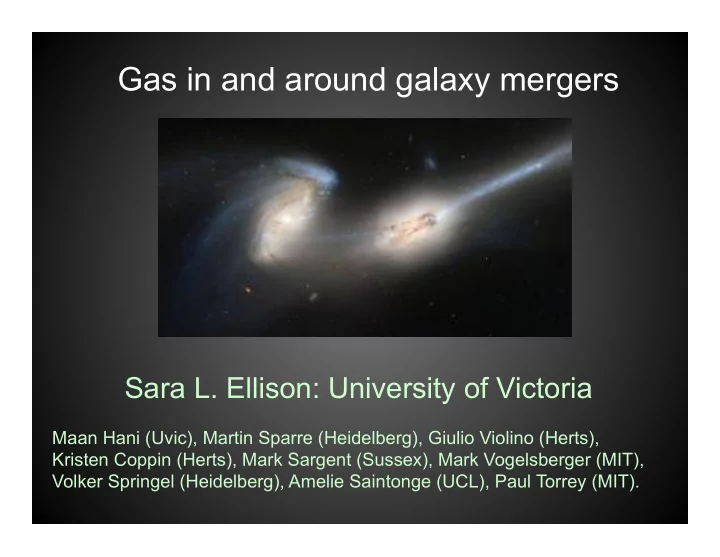
Gas in and around galaxy mergers Sara L. Ellison: University of - - PowerPoint PPT Presentation
Gas in and around galaxy mergers Sara L. Ellison: University of Victoria Maan Hani (Uvic), Martin Sparre (Heidelberg), Giulio Violino (Herts), Kristen Coppin (Herts), Mark Sargent (Sussex), Mark Vogelsberger (MIT), Volker Springel (Heidelberg),
The effects of gas flows in mergers:
Torrey et al. (2012) Di Matteo et al (2005)
Simulations predict interactions should boost star formation, reduce central metallicity and increase nuclear activity.
14,000 pairs from SDSS: Projected separation <80 kpc ΔV <300 km/s Mass ratio 0.1 – 10 97 post-mergers from Galaxy Zoo Observational tests of merger induced transformations: Galaxy pairs in the SDSS And stellar mass matched control samples
Observational confirmation of theoretical predictions using SDSS
E.g. Ellison et al. 2008, 2011, 2013; Scudder et al. 2012; Patton et al. 2016
Asymmetry enhancement
Log SFR enhancement Log O/H enhancement
No evidence that mergers consume their global gas reservoir
Ellison et al (2015); Violino, Ellison et al. (submitted) Molecular gas reservoir is boosted in mergers by factor 2-3 Log fgas(merger) – log fgas(control)
Studying the CGM with galaxy simulations Led by PhD student Maan Hani (Uvic)
- Zoom-in simulation of a merger selected from Illustris, re-run at 40x
resolution (Sparre & Springel 2016).
- Major merger (mass ratio = 1:1.16) at z=0.66 resulting in a Milky
Way mass galaxy at z=0.
- Physics model (Grand et al. 2016, Marrinacci et al 2014,
Vogelsberger et al 2013):
- Metal enrichment from SNIa, SNII, AGB
- SN feedback
- AGN feedback (quasar and radio mode)
- Radiative heating (UVB, AGN) and cooling (primordial
and metal)
CGM size evolution
Covering fraction of H and metals increases after a merger and is long lived.
Hani, Sparre, Ellison et al. (in prep)
CGM metallicity evolution
Long lived factor of ~2 increase in CGM metallicity
6 7 8 9 10 11 12 13 14 Age of the Universe [Gyr] −0.4 −0.2 0.0 0.2 0.4 0.6 0.8 ∆ log(O/H) 0.5 1 redshift
R ∈ [0, 10] kpc R ∈ [75, 100] kpc R ∈ [100, 150] kpc
6.58Gyr 7.69Gyr 8.98Gyr
Lower covering fraction of most commonly observed species
Hani, Sparre, Ellison et al. (in prep)
7 8 9 10 11 12 13 14 Age of the Universe [Gyr] 10 20 30 40 SFR [M/yr] 38 40 42 44 46 log(Lbol [erg/s])
Radio Quasar
0.0 0.3 0.6 0.9 1.2 1.5 1.8 C.F.
log(NHI) = 17.0 log(NCIV) = 13.0 log(NOVI) = 14.0
Future work
- Simulated spectra through CGM-merger simulations.
- Larger merger simulation suite to investigate effect of orbits and mass
ratios.
- Observational tests of theoretical predictions: 34 orbits with COS
(Cycle 22, PI Bordoloi) to study sightlines through 11 galaxy pairs.
Summary
- Mergers can trigger AGN, enhance SFRs and dilute central
metallicity: Ellison et al. (2008, 2011, 2013); Scudder et al. 2012.
- Mergers do not significantly deplete their global gas reservoir and
molecular gas fraction is boosted: Ellison et al. 2015; Violino et al. (submitted).
- Simulations show that mergers puff-up their CGM in both gas and
metals: Hani et al. (in prep).
- Simulations also predict a long-lived factor of ~2 metallicity