Games we will consider Deterministic Discrete states and decisions - - PDF document

games we will consider
SMART_READER_LITE
LIVE PREVIEW

Games we will consider Deterministic Discrete states and decisions - - PDF document

Games we will consider Deterministic Discrete states and decisions CS 331: Artificial Intelligence Finite number of states and decisions Adversarial Search Perfect information i.e. fully observable Two agents whose actions


slide-1
SLIDE 1

1

1

CS 331: Artificial Intelligence Adversarial Search

2

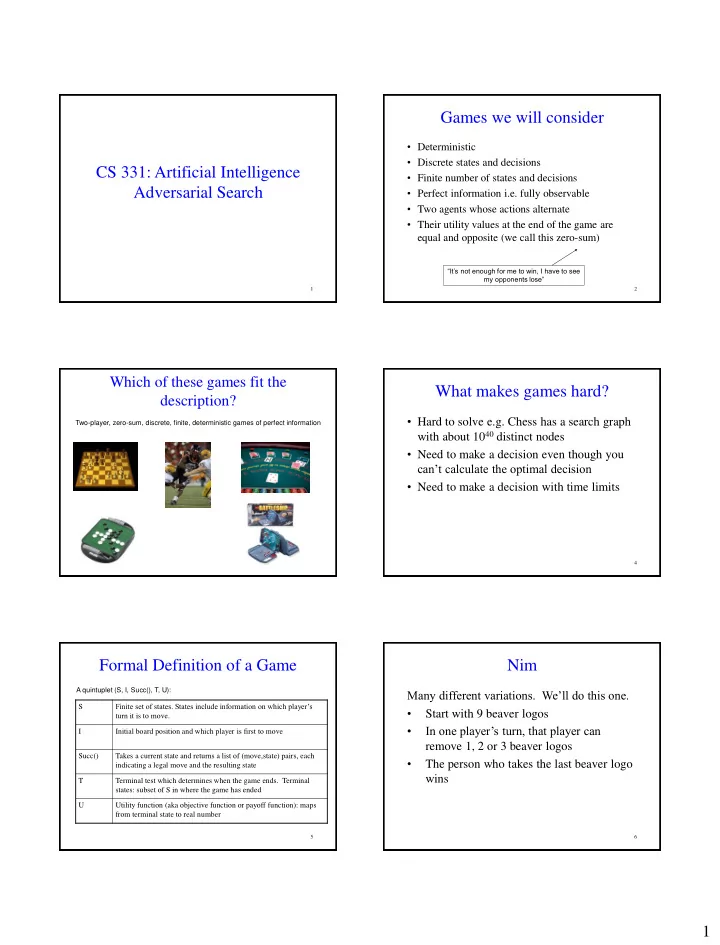
Games we will consider

  • Deterministic
  • Discrete states and decisions
  • Finite number of states and decisions
  • Perfect information i.e. fully observable
  • Two agents whose actions alternate
  • Their utility values at the end of the game are

equal and opposite (we call this zero-sum)

“It’s not enough for me to win, I have to see my opponents lose”

Which of these games fit the description?

Two-player, zero-sum, discrete, finite, deterministic games of perfect information

4

What makes games hard?

  • Hard to solve e.g. Chess has a search graph

with about 1040 distinct nodes

  • Need to make a decision even though you

can’t calculate the optimal decision

  • Need to make a decision with time limits

5

Formal Definition of a Game

A quintuplet (S, I, Succ(), T, U):

S Finite set of states. States include information on which player’s turn it is to move. I Initial board position and which player is first to move Succ() Takes a current state and returns a list of (move,state) pairs, each indicating a legal move and the resulting state T Terminal test which determines when the game ends. Terminal states: subset of S in where the game has ended U Utility function (aka objective function or payoff function): maps from terminal state to real number

6

Nim

Many different variations. We’ll do this one.

  • Start with 9 beaver logos
  • In one player’s turn, that player can

remove 1, 2 or 3 beaver logos

  • The person who takes the last beaver logo

wins

slide-2
SLIDE 2

2

7

Nim

8

Formal Definition of Nim

A quintuplet (S, I, Succ(), T, U):

S Max(IIIII), Max(III), Max(II), Max(I) Min(IIII), Min(III), Min(II), Min(I) I Max(IIIII) Succ()

Succ(Max(IIIII)) = {Min(IIII),Min(III),Min(II)} Succ(Min(IIII)) = {Max(III),Max(II),Max(I)} Succ(Max(III)) = {Min(II),Min(I)} Succ(Min(III)) = {Max(II),Max(I)} Succ(Max(II)) = {Min(I)} Succ(Min(II)) = {Max(I)}

T Max(I), Max(II), Max(III), Min(I), Min(II), Min(III) U Utility(Max(I) or Max(II) or Max(III)) = +1, Utility(Min(I) or Min(II) or Min(III)) = -1

Notation: Max(IIIII)

# matches left Who’s move

Nim Game Tree

IIIII IIII III II III II I II I I

  • 1

II I I I

Max Min Max Min Max Min

+1 +1 +1

  • 1

+1 +1

  • 1

+1

  • 1
  • 1

+1

  • 1

I

We’ll call the players Max and Min, with Max starting first

10

How to Use a Game Tree

  • Max wants to maximize his utility
  • Min wants to minimize Max’s utility
  • Max’s strategy must take into account what

Min does since they alternate moves

  • A move by Max or Min is called a ply

The Minimax Value of a Node

The minimax value of a node is the utility for MAX of being in the corresponding state, assuming that both players play optimally from there to the end of the game

Minimax value maximizes worst-case outcome for MAX

) VALUE(

  • MINIMAX

max

) (

s

n Successors s

) VALUE(

  • MINIMAX

min

) (

s

n Successors s

) UTILITY(n  ) VALUE(

  • MINIMAX

n

If n is a MIN node If n is a MAX node

If n is a terminal state

12

Nim Game Tree

IIIII IIII III II III II I II I I

  • 1

II I I I

Max Min Max Min Max Min

+1 +1 +1

  • 1

+1 +1

  • 1

+1

  • 1
  • 1

+1

  • 1

I

slide-3
SLIDE 3

3

13

Minimax Values in Nim Game Tree

IIIII IIII III II III II I II I I

  • 1

II I I I

Max Min Max Min Max Min

+1 +1 +1

  • 1

+1 +1

  • 1

+1

  • 1
  • 1

+1

  • 1

I +1

14

Minimax Values in Nim Game Tree

IIIII IIII III II III II I II I I

  • 1

II I I I

Max Min Max Min Max Min

+1 +1 +1

  • 1

+1 +1

  • 1

+1

  • 1
  • 1

+1

  • 1

I

  • 1
  • 1

+1

  • 1
  • 1

15

Minimax Values in Nim Game Tree

IIIII IIII III II III II I II I I

  • 1

II I I I

Max Min Max Min Max Min

+1 +1 +1

  • 1

+1 +1

  • 1

+1

  • 1
  • 1

+1

  • 1

+1 I +1

  • 1

+1

  • 1

+1 +1 +1

  • 1
  • 1

+1

16

Minimax Values in Nim Game Tree

IIIII IIII III II III II I II I I

  • 1

II I I I

Max Min Max Min Max Min

+1 +1 +1

  • 1

+1 +1

  • 1

+1

  • 1
  • 1

+1

  • 1

+1 I +1

  • 1

+1

  • 1
  • 1
  • 1

+1 +1 +1

  • 1
  • 1

+1 +1

17

Minimax Values in Nim Game Tree

IIIII IIII III II III II I II I I

  • 1

II I I I

Max Min Max Min Max Min

+1 +1 +1

  • 1

+1 +1

  • 1

+1

  • 1
  • 1

+1

  • 1

+1 I +1

  • 1

+1

  • 1
  • 1
  • 1

+1 +1 +1

  • 1
  • 1

+1 +1 +1

18

Minimax Values in Nim Game Tree

IIIII IIII III II III II I II I I

  • 1

II I I I

Max Min Max Min Max Min

+1 +1 +1

  • 1

+1 +1

  • 1

+1

  • 1
  • 1

+1

  • 1

+1 I +1

  • 1

+1

  • 1
  • 1
  • 1

+1 +1 +1

  • 1
  • 1

+1 +1 +1

Minimax decision at the root: taking this action results in the successor with highest minimax value

slide-4
SLIDE 4

4

19

Another Example

A 3 12 8 2 4 6 14 5 2 MIN MAX B C D = Maximizing player = Minimizing player

20

Another Example

A 3 12 8 2 4 6 14 5 2 MIN MAX B C D 3 2 2

21

Another Example

A 3 12 8 2 4 6 14 5 2 MIN MAX B C D 3 2 2 3

22

The MINIMAX Algorithm

function MINIMAX-DECISION(state) returns an action inputs: state, current state in game v ← MAX-VALUE(state) return the action in SUCCESSORS(state) with value v function MAX-VALUE(state) returns a utility value if TERMINAL-TEST(state) then return UTILITY(state) v ← - Infinity for a, s in SUCCESSORS(state) do v ← MAX(v, MIN-VALUE(s)) return v function MIN-VALUE(state) returns a utility value if TERMINAL-TEST(state) then return UTILITY(state) v ← Infinity for a, s in SUCCESSORS(state) do v ← MIN(v, MAX-VALUE(s)) return v

23

The MINIMAX algorithm

  • Computes minimax decision from the current state
  • Depth-first exploration of the game tree
  • Time Complexity O(bm) where b=# of legal

moves, m=maximum depth of tree

  • Space Complexity:

– O(bm) if all successors generated at once – O(m) if only one successor generated at a time (each partially expanded node remembers which successor to generate next)

24

Minimax With 3 Players

(1,2,6) (4,2,3) (6,1,2) (7,4,1) (5,1,1) (1,5,2) (7,7,1) (5,4,5) A B C A Now have a vector of utilities for players (A,B,C). All players maximize their

  • utilities. Note: In two-player, zero-sum games, we have a single value

because the values are always opposite.

slide-5
SLIDE 5

5

25

Minimax With 3 Players

(1,2,6) (4,2,3) (6,1,2) (7,4,1) (5,1,1) (1,5,2) (7,7,1) (5,4,5) A B C (1,2,6) (6,1,2) (1,5,2) (5,4,5)

26

Minimax With 3 Players

(1,2,6) (4,2,3) (6,1,2) (7,4,1) (5,1,1) (1,5,2) (7,7,1) (5,4,5) A B C (1,2,6) (6,1,2) (1,5,2) (5,4,5) (1,2,6) (1,5,2)

27

Minimax With 3 Players

(1,2,6) (4,2,3) (6,1,2) (7,4,1) (5,1,1) (1,5,2) (7,7,1) (5,4,5) A B C (1,2,6) (6,1,2) (1,5,2) (5,4,5) (1,2,6) (1,5,2) (1,2,6)

28

Subtleties With Multiplayer Games

  • Alliances can be made and broken
  • For example, if A and B are weaker than C,

they can gang up on C

  • But A and B can turn on each other once C

is weakened

  • But society considers the player that breaks

the alliance to be dishonorable

29

Pruning

  • Can we improve on the time complexity of

O(bm)?

  • Yes if we prune away branches that cannot

possibly influence the final decision

Pruning in Nim

IIIII IIII III II III II I II I I

  • 1

II I I I

Max Min Max Min Max Min

+1 +1 +1

  • 1

+1 +1

  • 1

+1

  • 1
  • 1

+1

  • 1

+1 I +1

  • 1

+1

  • 1
  • 1
  • 1

+1 +1 +1

  • 1
  • 1

+1 +1 +1

If we know that the only two outcomes are +1 and -1, what branches do we not need to explore when minimax backtracks?

slide-6
SLIDE 6

6

Pruning in Nim

IIIII IIII III II III II I II I I

  • 1

II I I I

Max Min Max Min Max Min

+1 +1 +1

  • 1

+1 +1

  • 1

+1

  • 1
  • 1

+1

  • 1

+1 I +1

  • 1

+1

  • 1
  • 1
  • 1

+1 +1 +1

  • 1
  • 1

+1 +1 +1

If we know that the only two outcomes are +1 and -1, what branches do we not need to explore when minimax backtracks?

32

Pruning in Nim

IIIII IIII III II III II I II I I

  • 1

II I I I

Max Min Max Min Max Min

+1 +1 +1

  • 1

+1 +1

  • 1

+1

  • 1
  • 1

+1

  • 1

+1 I +1

  • 1

+1

  • 1
  • 1
  • 1

+1 +1 +1

  • 1
  • 1

+1 +1 +1

What happens if we have more than just two

  • utcomes?

33

Pruning Intuition (General Case)

MAX MIN 5 10 1 5 ≤1

Suppose we just went down this

  • branch. We know that the minimax

value of its parent will be ≤ 1 The max player will never choose the right subtree

  • nce it knows that it is

upper bounded by 1

34

Pruning Example

A 3 12 8 2 14 5 2 B C D x y

MINIMAX-VALUE(root) = max(min(3,12,8),min(2,x,y),min(14,5,2)) = max(3,min(2,x,y),2) = max(3,z,2) where z ≤ 2 = 3

MAX MIN

35

Pruning Intuition

Remember that minimax search is DFS. At any one time, we only have to consider the nodes along a single path in the tree In general, let:

  •  = highest minimax value of all of the MAX player’s choices expanded on

current path (best score for MAX so far)

  •  = lowest minimax value of all of the MIN player’s choices expanded on

current path (best score for MIN so far)

  • If at a MIN player node, prune if minimax value of node ≤ 
  • If at a MAX player node, prune if minimax value of node ≥ 

36

ALPHA-BETA Pseudocode

function ALPHA-BETA-SEARCH(state) returns an action inputs: state, current state in game v ← MAX-VALUE(state, -∞, +∞) return the action in SUCCESSORS(state) with value v function MAX-VALUE(state, , ) returns a utility value inputs: state, current state in game , the value of the best alternative for MAX along the path to state , the value of the best alternative for MIN along the path to state if TERMINAL-TEST(state) then return UTILITY(state) v ← -∞ for a, s in SUCCESSORS(state) do v ← MAX(v, MIN-VALUE(s, , )) if v ≥  then return v  ← MAX(, v) return v

slide-7
SLIDE 7

7

37

ALPHA-BETA Pseudocode

function MIN-VALUE(state, , ) returns a utility value inputs: state, current state in game , the value of the best alternative for MAX along the path to state , the value of the best alternative for MIN along the path to state if TERMINAL-TEST(state) then return UTILITY(state) v ← +∞ for a, s in SUCCESSORS(state) do v ← MIN(v, MAX-VALUE(s, , )) if v ≤  then return v  ← MIN(, v) return v

38

Illustrating the Pseudocode

  • In the example to follow, the notation

(-∞, +∞) represents the (, ) values for the corresponding node

  • This example is intended to illustrate how the

actual implementation of Alpha-Beta pruning works

A (-∞, +∞) B C D

= Maximizing player = Minimizing player

Alpha-Beta Pruning Example

A 3 (-∞, +∞) (-∞, 3) B C D A 3 12 (-∞, +∞) (-∞, 3) B C D A 3 12 8 (-∞, +∞) (-∞, 3) B C D b) c) d) A (-∞, +∞) (-∞, +∞) B C D a)

Alpha-Beta Pruning Example

A 3 12 8 (3, +∞) B C D f) g) h) e) A 3 12 8 (3, +∞) B C D (3, +∞) A 3 12 8 2 (3, +∞) B C D (3, +∞) A 3 12 8 2 (3, +∞) B C D Pruning happens: 2 ≤  (=3)

Alpha-Beta Pruning Example

j) k) l) i) A 3 12 8 2 (3, +∞) B C D (3, +∞) A 3 12 8 2 14 (3, +∞) B C D (3, 14) A 3 12 8 2 14 5 (3, +∞) B C D (3, 5) A 3 12 8 2 14 5 (3, +∞) B C D 2 Pruning happens: 2 ≤  (=3) but not much

is pruned since we’re at the bottom

42

Effectiveness of Alpha-Beta

  • Depends on order of successors
  • Best case: Alpha-Beta reduces complexity

from O(bm) for minimax to O(bm/2)

  • This means Alpha-Beta can lookahead

about twice as far as minimax in the same amount of time

slide-8
SLIDE 8

8

43

Implementation Details

  • In games we have the problem of

transposition

  • Transposition means different permutations
  • f the move sequence that end up in the

same position

  • Results in lots of repeated states
  • Use a transposition table to remember the

states you’ve seen (similar to closed list)

44

What you should know

  • Be able to draw up a game tree
  • Know how the Minimax algorithm works
  • Know how the Alpha-Beta algorithm works
  • Be able to do both algorithms by hand