SLIDE 1 CS70: Jean Walrand: Lecture 31.
Nonlinear Regression
- 1. Review: joint distribution, LLSE
- 2. Quadratic Regression
- 3. Definition of Conditional expectation
- 4. Properties of CE
- 5. Applications: Diluting, Mixing, Rumors
- 6. CE = MMSE
Review
Definitions Let X and Y be RVs on Ω.
◮ Joint Distribution: Pr[X = x,Y = y] ◮ Marginal Distribution: Pr[X = x] = ∑y Pr[X = x,Y = y] ◮ Conditional Distribution: Pr[Y = y|X = x] = Pr[X=x,Y=y] Pr[X=x] ◮ LLSE: L[Y|X] = a+bX where a,b minimize E[(Y −a−bX)2].
We saw that L[Y|X] = E[Y]+ cov(X,Y) var[X] (X −E[X]). Recall the non-Bayesian and Bayesian viewpoints.
Nonlinear Regression: Motivation
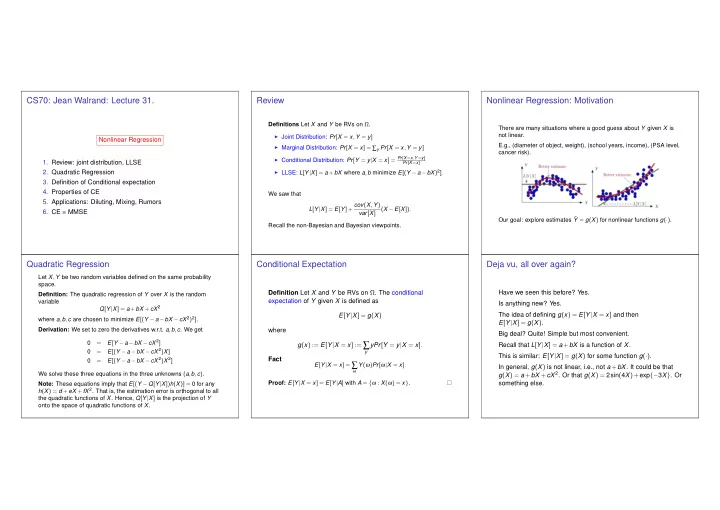
There are many situations where a good guess about Y given X is not linear. E.g., (diameter of object, weight), (school years, income), (PSA level, cancer risk). Our goal: explore estimates ˆ Y = g(X) for nonlinear functions g(·).
Quadratic Regression
Let X,Y be two random variables defined on the same probability space. Definition: The quadratic regression of Y over X is the random variable Q[Y|X] = a+bX +cX 2 where a,b,c are chosen to minimize E[(Y −a−bX −cX 2)2]. Derivation: We set to zero the derivatives w.r.t. a,b,c. We get = E[Y −a−bX −cX 2] = E[(Y −a−bX −cX 2)X] = E[(Y −a−bX −cX 2)X 2] We solve these three equations in the three unknowns (a,b,c). Note: These equations imply that E[(Y −Q[Y|X])h(X)] = 0 for any h(X) = d +eX +fX 2. That is, the estimation error is orthogonal to all the quadratic functions of X. Hence, Q[Y|X] is the projection of Y
- nto the space of quadratic functions of X.
Conditional Expectation
Definition Let X and Y be RVs on Ω. The conditional expectation of Y given X is defined as E[Y|X] = g(X) where g(x) := E[Y|X = x] := ∑
y
yPr[Y = y|X = x]. Fact
E[Y|X = x] = ∑
ω
Y(ω)Pr[ω|X = x]. Proof: E[Y|X = x] = E[Y|A] with A = {ω : X(ω) = x}.
Deja vu, all over again?
Have we seen this before? Yes. Is anything new? Yes. The idea of defining g(x) = E[Y|X = x] and then E[Y|X] = g(X). Big deal? Quite! Simple but most convenient. Recall that L[Y|X] = a+bX is a function of X. This is similar: E[Y|X] = g(X) for some function g(·). In general, g(X) is not linear, i.e., not a+bX. It could be that g(X) = a+bX +cX 2. Or that g(X) = 2sin(4X)+exp{−3X}. Or something else.
SLIDE 2 Properties of CE
E[Y|X = x] = ∑
y
yPr[Y = y|X = x] Theorem (a) X,Y independent ⇒ E[Y|X] = E[Y]; (b) E[aY +bZ|X] = aE[Y|X]+bE[Z|X]; (c) E[Yh(X)|X] = h(X)E[Y|X],∀h(·); (d) E[h(X)E[Y|X]] = E[h(X)Y],∀h(·); (e) E[E[Y|X]] = E[Y]. Proof:
(a),(b) Obvious (c) E[Yh(X)|X = x] = ∑
ω
Y(ω)h(X(ω)Pr[ω|X = x] = ∑
ω
Y(ω)h(x)Pr[ω|X = x] = h(x)E[Y|X = x]
Properties of CE
E[Y|X = x] = ∑
y
yPr[Y = y|X = x] Theorem (a) X,Y independent ⇒ E[Y|X] = E[Y]; (b) E[aY +bZ|X] = aE[Y|X]+bE[Z|X]; (c) E[Yh(X)|X] = h(X)E[Y|X],∀h(·); (d) E[h(X)E[Y|X]] = E[h(X)Y],∀h(·); (e) E[E[Y|X]] = E[Y]. Proof: (continued)
(d) E[h(X)E[Y|X]] = ∑
x
h(x)E[Y|X = x]Pr[X = x] = ∑
x
h(x)∑
y
yPr[Y = y|X = x]Pr[X = x] = ∑
x
h(x)∑
y
yPr[X = x,y = y] = ∑
x,y
h(x)yPr[X = x,y = y] = E[h(X)Y].
Properties of CE
E[Y|X = x] = ∑
y
yPr[Y = y|X = x] Theorem (a) X,Y independent ⇒ E[Y|X] = E[Y]; (b) E[aY +bZ|X] = aE[Y|X]+bE[Z|X]; (c) E[Yh(X)|X] = h(X)E[Y|X],∀h(·); (d) E[h(X)E[Y|X]] = E[h(X)Y],∀h(·); (e) E[E[Y|X]] = E[Y]. Proof: (continued)
(e) Let h(X) = 1 in (d).
Properties of CE
Theorem (a) X,Y independent ⇒ E[Y|X] = E[Y]; (b) E[aY +bZ|X] = aE[Y|X]+bE[Z|X]; (c) E[Yh(X)|X] = h(X)E[Y|X],∀h(·); (d) E[h(X)E[Y|X]] = E[h(X)Y],∀h(·); (e) E[E[Y|X]] = E[Y]. Note that (d) says that E[(Y −E[Y|X])h(X)] = 0. We say that the estimation error Y −E[Y|X] is orthogonal to every function h(X) of X. We call this the projection property. More about this later.
Application: Calculating E[Y|X]
Let X,Y,Z be i.i.d. with mean 0 and variance 1. We want to calculate E[2+5X +7XY +11X 2 +13X 3Z 2|X]. We find E[2+5X +7XY +11X 2 +13X 3Z 2|X] = 2+5X +7XE[Y|X]+11X 2 +13X 3E[Z 2|X] = 2+5X +7XE[Y]+11X 2 +13X 3E[Z 2] = 2+5X +11X 2 +13X 3(var[Z]+E[Z]2) = 2+5X +11X 2 +13X 3.
Application: Diluting
At each step, pick a ball from a well-mixed urn. Replace it with a blue
- ball. Let Xn be the number of red balls in the urn at step n. What is
E[Xn]? Given Xn = m, Xn+1 = m −1 w.p. m/N (if you pick a red ball) and Xn+1 = m otherwise. Hence, E[Xn+1|Xn = m] = m −(m/N) = m(N −1)/N = Xnρ, with ρ := (N −1)/N. Consequently, E[Xn+1] = E[E[Xn+1|Xn]] = ρE[Xn],n ≥ 1. = ⇒ E[Xn] = ρn−1E[X1] = N(N −1 N )n−1,n ≥ 1.
SLIDE 3
Diluting
Here is a plot:
Diluting
By analyzing E[Xn+1|Xn], we found that E[Xn] = N( N−1
N )n−1,n ≥ 1.
Here is another argument for that result. Consider one particular red ball, say ball k. At each step, it remains red w.p. (N −1)/N, when another ball is picked. Thus, the probability that it is still red at step n is [(N −1)/N]n−1. Let Yn(k) = 1{ball k is red at step n}. Then, Xn = Yn(1)+···+Yn(N). Hence, E[Xn] = E[Yn(1)+···+Yn(N)] = NE[Yn(1)] = NPr[Yn(1) = 1] = N[(N −1)/N]n−1.
Application: Mixing
At each step, pick a ball from each well-mixed urn. We transfer them to the other urn. Let Xn be the number of red balls in the bottom urn at step n. What is E[Xn]? Given Xn = m, Xn+1 = m +1 w.p. p and Xn+1 = m −1 w.p. q where p = (1−m/N)2 (B goes up, R down) and q = (m/N)2 (R goes up, B down). Thus, E[Xn+1|Xn] = Xn +p −q = Xn +1−2Xn/N = 1+ρXn, ρ := (1−2/N).
Mixing
We saw that E[Xn+1|Xn] = 1+ρXn, ρ := (1−2/N). Hence, E[Xn+1] = 1+ρE[Xn] E[X2] = 1+ρN;E[X3] = 1+ρ(1+ρN) = 1+ρ +ρ2N E[X4] = 1+ρ(1+ρ +ρ2N) = 1+ρ +ρ2 +ρ3N E[Xn] = 1+ρ +···+ρn−2 +ρn−1N. Hence, E[Xn] = 1−ρn−1 1−ρ +ρn−1N,n ≥ 1.
Application: Mixing
Here is the plot.
Application: Going Viral
Consider a social network (e.g., Twitter). You start a rumor (e.g., Walrand is really weird). You have d friends. Each of your friend retweets w.p. p. Each of your friends has d friends, etc. Does the rumor spread? Does it die out (mercifully)? In this example, d = 4.
SLIDE 4
Application: Going Viral
Fact: Let X = ∑∞
n=1 Xn. Then, E[X] < ∞ iff pd < 1.
Proof:
Given Xn = k, Xn+1 = B(kd,p). Hence, E[Xn+1|Xn = k] = kpd. Thus, E[Xn+1|Xn] = pdXn. Consequently, E[Xn] = (pd)n−1,n ≥ 1. If pd < 1, then E[X1 +···+Xn] ≤ (1−pd)−1 = ⇒ E[X] ≤ (1−pd)−1. If pd ≥ 1, then for all C one can find n s.t. E[X] ≥ E[X1 +···+Xn] ≥ C. In fact, one can show that pd ≥ 1 = ⇒ Pr[X = ∞] > 0.
Application: Going Viral
An easy extension: Assume that everyone has an independent number Di of friends with E[Di] = d. Then, the same fact holds. To see this, note that given Xn = k, and given the numbers of friends D1 = d1,...,Dk = dk of these Xn people, one has Xn+1 = B(d1 +···+dk,p). Hence, E[Xn+1|Xn = k,D1 = d1,...,Dk = dk] = p(d1 +···+dk). Thus, E[Xn+1|Xn = k,D1,...,Dk] = p(D1 +···+Dk). Consequently, E[Xn+1|Xn = k] = E[p(D1 +···+Dk)] = pdk. Finally, E[Xn+1|Xn] = pdXn, and E[Xn+1] = pdE[Xn]. We conclude as before.
Application: Wald’s Identity
Here is an extension of an identity we used in the last slide. Theorem Wald’s Identity Assume that X1,X2,... and Z are independent, where Z takes values in {0,1,2,...} and E[Xn] = µ for all n ≥ 1. Then, E[X1 +···+XZ] = µE[Z]. Proof: E[X1 +···+XZ|Z = k] = µk. Thus, E[X1 +···+XZ|Z] = µZ. Hence, E[X1 +···+XZ] = E[µZ] = µE[Z].
CE = MMSE
Theorem E[Y|X] is the ‘best’ guess about Y based on X. Specifically, it is the function g(X) of X that minimizes E[(Y −g(X))2].
CE = MMSE
Theorem CE = MMSE g(X) := E[Y|X] is the function of X that minimizes E[(Y −g(X))2]. Proof: Let h(X) be any function of X. Then E[(Y −h(X))2] = E[(Y −g(X)+g(X)−h(X))2] = E[(Y −g(X))2]+E[(g(X)−h(X))2] +2E[(Y −g(X))(g(X)−h(X))]. But, E[(Y −g(X))(g(X)−h(X))] = 0 by the projection property. Thus, E[(Y −h(X))2] ≥ E[(Y −g(X))2].
E[Y|X] and L[Y|X] as projections
L[Y|X] is the projection of Y on {a+bX,a,b ∈ ℜ}: LLSE E[Y|X] is the projection of Y on {g(X),g(·) : ℜ → ℜ}: MMSE.
SLIDE 5 Summary
Conditional Expectation
◮ Definition: E[Y|X] := ∑y yPr[Y = y|X = x] ◮ Properties: Linearity,
Y −E[Y|X] ⊥ h(X); E[E[Y|X]] = E[Y]
◮ Some Applications:
◮ Calculating E[Y|X] ◮ Diluting ◮ Mixing ◮ Rumors ◮ Wald
◮ MMSE: E[Y|X] minimizes E[(Y −g(X))2] over all g(·)