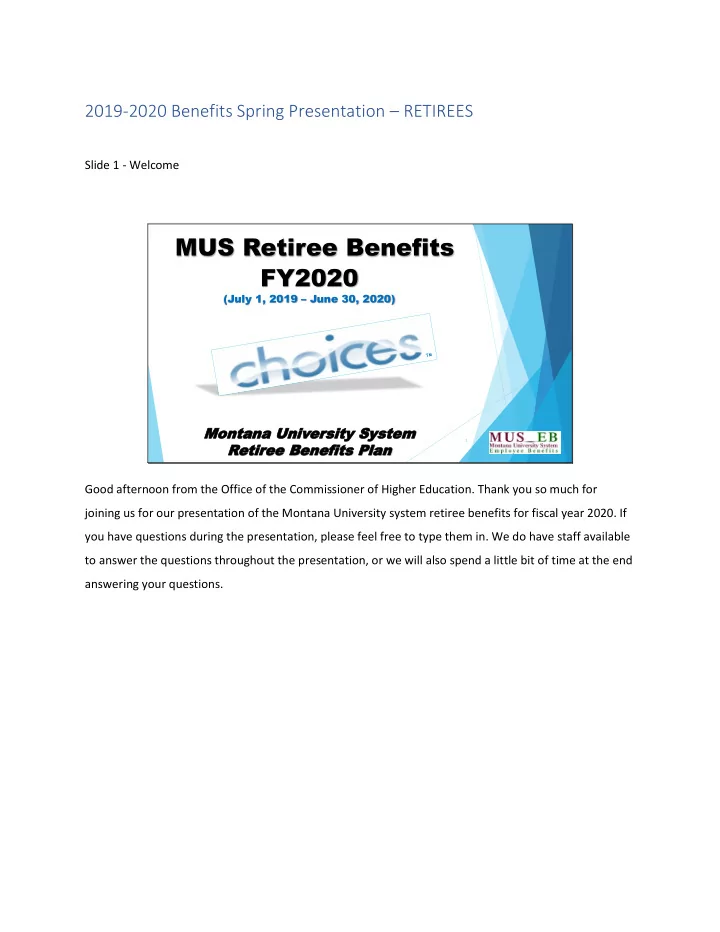
SLIDE 16 Slide 15 – Non-Medicare Monthly Rates
MUS US CHO HOICES ES FY2020 – NON NON-MEDICA EDICARE R E RETI ETIREE M EE MEDICA EDICAL MON ONTHL THLY RATES TES
No Non-Medicare Retiree Monthly y Rate tes, s, as of July 1, 2019 Al Allegiance Bl BlueCr Cross ss Blue ueShiel hield Pacifi ficSource Ret etiree ee/Sur urvivor
Only $1,048 ($131) $981 ($122) $1,099 ($138) Retiree + On One $2,096 ($262) $1,962 ($244) $2,197 ($275) Retiree + Two or More $2,619 ($327) $2,452 ($304) $2,746 ($343) Retiree + Spouse se *(mp mp) $1,447 ($181) $1,354 ($168) $1,517 ($190) Ret etiree ee + Spo pouse use *(mp mp) ) + Chil hildr dren en $1,971 ($247) $1,845 ($229) $2,066 ($258) Survi vivor + Chil Children $1,572 ($197) $1,471 ($182) $1,648 ($206)
*(mp) = Medicare Prime
➢ Rates vary based on what plan you select and whether you cover dependents. ➢ 14.21% aggregate increase to Medical Plan rates for FY2020. ➢ Change in monthly premium rates due to claims utilization and to maintain the
medical loss ratio at 115% for Non-Medicare Retirees.
15
Onto what is probably the topic of the day, which is the new premium rates for retirees for fiscal year
- 2020. I know that it's not easy to see your rates increase, and I will tell you it's not easy for the inner unit
benefits, benefits committee, the commissioner, or any of us here on the benefits staff to have to give you a news that the premiums are increasing. I will tell you there was a long, thoughtful, considerate discussion about what we should do with these premiums this year, and the bottom line was that in
- rder to keep the loss ratios where they have been set, and for those of you who have been to our
presentations in the past, you may recall that for non-Medicare retirees, that loss ratio is set at 115%, and what that means is that for every dollar we collect in premiums, we expect to spend a $1.15 on
- claims. The active employees, actually we collect a little bit more in premium than we pay out in claims,
and that's where we get that extra 15% that we're able to pay out on the non-Medicare retiree claims. Unfortunately the claims utilization continued to trend upwards this year, and so you will see that there is an increase to the premiums that will begin on July 1 of 2019. In aggregate, it's a 14.21% increase, and
- n the slides we are showing you not only what the new rates are, but what the increase is in dollars,
because I know when you're trying to do a household budget, those hard dollars really are what you have to be able to account for. You will see that they range anywhere from $122 up to a little bit over $300 depending on who you're covering, and which third party administrator you've selected. I don't like to be the deliverer of this news, but the alternative, if we took another route, and tried to increase the subsidy, so that we were paying out, say if we had increased it to 125%, and paid out a $1.25 for