FY2016 interim Results Presentation Main Q&A Q. About the - - PDF document

fy2016 interim results presentation main q a
SMART_READER_LITE
LIVE PREVIEW

FY2016 interim Results Presentation Main Q&A Q. About the - - PDF document

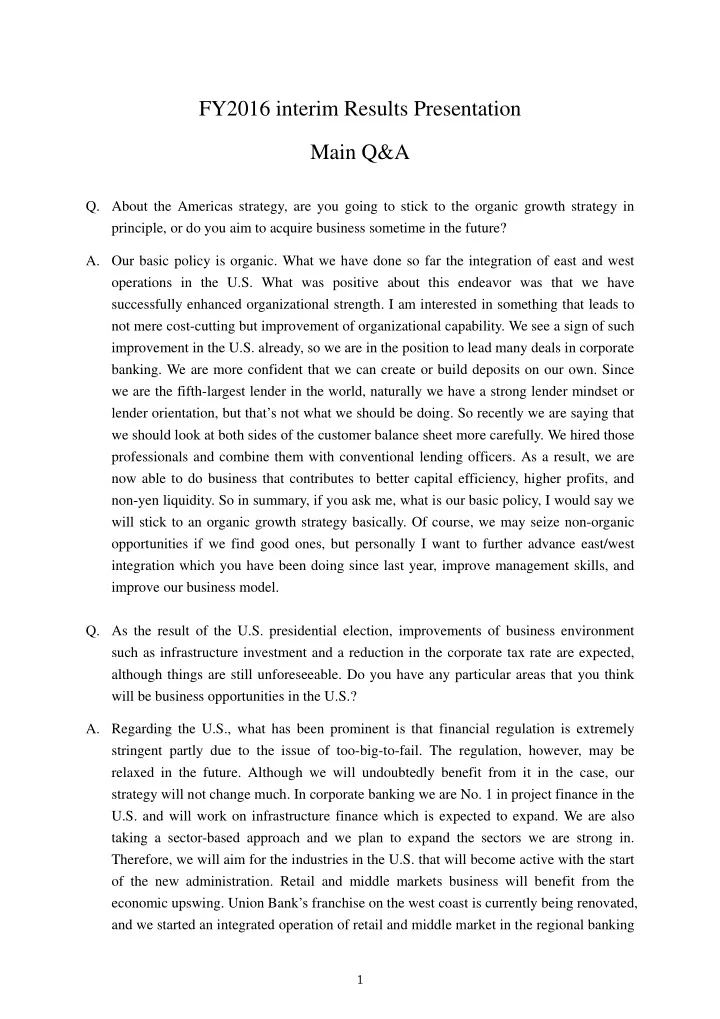
FY2016 interim Results Presentation Main Q&A Q. About the Americas strategy, are you going to stick to the organic growth strategy in principle, or do you aim to acquire business sometime in the future? A. Our basic policy is organic. What


slide-1
SLIDE 1

1

FY2016 interim Results Presentation Main Q&A

  • Q. About the Americas strategy, are you going to stick to the organic growth strategy in

principle, or do you aim to acquire business sometime in the future?

  • A. Our basic policy is organic. What we have done so far the integration of east and west
  • perations in the U.S. What was positive about this endeavor was that we have

successfully enhanced organizational strength. I am interested in something that leads to not mere cost-cutting but improvement of organizational capability. We see a sign of such improvement in the U.S. already, so we are in the position to lead many deals in corporate

  • banking. We are more confident that we can create or build deposits on our own. Since

we are the fifth-largest lender in the world, naturally we have a strong lender mindset or lender orientation, but that’s not what we should be doing. So recently we are saying that we should look at both sides of the customer balance sheet more carefully. We hired those professionals and combine them with conventional lending officers. As a result, we are now able to do business that contributes to better capital efficiency, higher profits, and non-yen liquidity. So in summary, if you ask me, what is our basic policy, I would say we will stick to an organic growth strategy basically. Of course, we may seize non-organic

  • pportunities if we find good ones, but personally I want to further advance east/west

integration which you have been doing since last year, improve management skills, and improve our business model.

  • Q. As the result of the U.S. presidential election, improvements of business environment

such as infrastructure investment and a reduction in the corporate tax rate are expected, although things are still unforeseeable. Do you have any particular areas that you think will be business opportunities in the U.S.?

  • A. Regarding the U.S., what has been prominent is that financial regulation is extremely

stringent partly due to the issue of too-big-to-fail. The regulation, however, may be relaxed in the future. Although we will undoubtedly benefit from it in the case, our strategy will not change much. In corporate banking we are No. 1 in project finance in the U.S. and will work on infrastructure finance which is expected to expand. We are also taking a sector-based approach and we plan to expand the sectors we are strong in. Therefore, we will aim for the industries in the U.S. that will become active with the start

  • f the new administration. Retail and middle markets business will benefit from the

economic upswing. Union Bank’s franchise on the west coast is currently being renovated, and we started an integrated operation of retail and middle market in the regional banking

slide-2
SLIDE 2

2

  • business. We expect this domain to become a large growth area.
  • Q. The rise in the long-term interest rate in the U.S. is leading to capital outflow from the

emerging markets. Are there any risks that you think require more attention now on credit to the emerging markets?

  • A. We must be prepared for the increased volatility in emerging markets business. In China,

we are mainly centering on corporate banking for creditworthy corporate clients, so we are not concerned. Latin America is of slight concern but we have good prospects. Russia is not a concern, as we have reduced our large exposures. The Middle East is slightly

  • worrying. Southeast Asia is stable. It is an emerging market and is showing currency

volatility, but domestic demand is increasing and the economy is stable. The decrease in trade is not directly affecting the Southeast Asian economy as it used to. That is my rough

  • perception. At any rate, we will remain cautious as the weak economies will be impacted

by the market volatility.

  • Q. Following the U.S. presidential election, investors sold U.S. Treasury notes, sending

Treasury yields high. Given the current level of the Treasury position of MUFG, am I right to assume that there is nothing to worry about in your portfolio? Some people say that long-term interest rates in the U.S. will go up sharply. How do you see the risks associated with the long-term rate going up?

  • A. Of course the recent jump in yields would compress unrealized gains. By the same token,

if we had unrealized loss, then it would increase; that is the direction. But as of today, we do not see any negative impact beyond our expectations as far as our portfolio is

  • concerned. As to your second question, I do not know how the rates will move down the

road, so I am aware that adjustments might be necessary at some point in the future, but then when is that timing? It is difficult to say when. So I can’t answer definitively at this point in time. If the outlook gets more elusive or fishy, we might sell our position at a loss.

  • Q. You have enormous unrealized gains on securities. On the other hand, in light of

imminent rate hikes, some investors say that you should cash in unrealized gains now as it would raise shareholders’ value. What is your view on this point?

  • A. Basically, we put an emphasis on stable portfolio management. Therefore, it’s not our

core business to make money by grabbing opportunities provided by rising or falling interest rates. That holds true to our response to the so-called Kuroda bazooka three years

  • ago. As a consequence, I think we contributed to market stability back then. Having said

that, some flexibility is necessary in doing business, so we aim for stable asset liability

slide-3
SLIDE 3

3

management that commercial banks are expected to do.

  • Q. About trust banking business I would like to hear your views on this business.
  • A. I believe the trust bank function will be more important in the future as there is growing

need for inheritance, business succession, asset formation, and so forth as a result of structural changes in Japanese society, such as aging. In other words, trust banks will play a great role as a social solution provider. MUFG positions MUTB as an asset management house. That is the area the trust bank will be focusing on going forward.

  • Q. Could you share with me your basic stance regarding expense control? Which is more

correct: whether you try to stem a rise of expenses or you would go as far as to reduce expenses? And if you will cut costs, will you do so across the board or focus on some business units?

  • A. To give you the conclusion first, I think we can only stem the overall increase. It would

be difficult to reduce the absolute amount, so some segments, businesses, regions, entities, may cut costs in net terms. For example, expenses in Retail and Japanese corporate banking units have come done, and on the other hand expenses are on the rise in Global banking business unit, in IS/AM business, due to acquisition abroad for the latter. So the global markets business also incurred more expenses due to the process of S&T integration, so in this way we must accommodate the higher priority needs of different business units or regions. So financial targets in the current mid-term business plan include an expense ratio of approximately 60 percent, but I’m afraid the ratio is worsening now. So with that target in mind, we will work hard not to increase expenses

  • anymore. I think we must show with greater certitude the expense level we aim for, even

if that is a target which may require a relatively longer time. Several expense reduction projects are under way simultaneously and we hope to make improvements in the expense ratio.

  • Q. How about are your evaluation on the ROE results and the future direction?
  • A. The trend is not at a commendable level, not high, especially on a JPX basis. We use the

phrase “productivity of people, goods, and money” in the current mid-term business plan,

  • f which productivity of money is ROE. Sales offices set a RORA target which is leading

to the employees’ behavior based on RORA. ROE and RORA are linked with the size of equity capital, which is the responsibility of CFO, and board members actively discuss this point. When we divide this into two components, for the latter, equity capital, we have maintained a stable dividend and conducted flexible share buyback. The environment is difficult with uncertainty in regulation and market volatility, but we have

slide-4
SLIDE 4

4

monitored the progress of the discussions and took actions accordingly. Therefore, I feel that we have a good capital control framework in place. The bigger challenge is RORA. It is facing a headwind so we must transform our business model. We are already taking a few actions. Regarding top line, we are shifting from interest income to fee income and also taking the risks that we can take. One typical example is hybrids. BTMU and MUSHD are collaborating. ROE management is a pressure on not only us, but also our client companies. Therefore, our clients are also being ROE-oriented. It is higher risk and higher return than senior bonds. That is how we take risks. Thirdly, we are diversifying

  • geographically. Overseas business is expanding to retail and middle market. We are doing

acquisitions in Thailand and investing in Vietnam and the Philippines. It may take some time but the changes in our business profile will increase our return.

  • Q. Regarding regulations and capital policy, there will be more clarity to Basel discussions

in near future. When the discussion becomes completely clear, naturally unpredictability

  • r uncertainty will diminish. Depending on the conclusion of discussions, you may end

up with higher surplus capital.

  • A. We try to foresee regulatory development to some extent and stay ahead, but we don’t

think we are preempting too much. When we see the conclusion of discussions, if there is a gap between final regulations and my prediction or anticipation, then that will result in surplus capital. But there is still a great deal of uncertainty. So when regulation is finalized, we will respond as necessary, checking where we stand. But there is one point we must bear in mind, frankly speaking: we must pay heed to ratings. Since we are not an investment bank we do a lot of business based on ratings and that is key or central to our business because we depend on the trust and confidence of our customers. Rating agencies are not necessarily interested in regulatory capital, so we must make sure that

  • ur ratings will not downgrade if we return to shareholder surplus capital when calculated
  • n a regulatory capital basis. So in any case, we will respond as necessary.
  • Q. Regarding the sale of equity holdings, what is the salient feature of the progress in this

fiscal half?

  • A. I am under the impression that our peers started to move. We are now able to negotiate

even with non-core customers whom we thought would not agree to enter negotiations. We are making progress ahead of schedule, but personally I am not surprised by this progress because this is within what I think we can achieve.