Future of Quality 1. Changing Global Scenario 2. Challenges Theme - - PDF document

future of quality
SMART_READER_LITE
LIVE PREVIEW

Future of Quality 1. Changing Global Scenario 2. Challenges Theme - - PDF document

Lucas-TVS Ltd Lucas-TVS Ltd Contents National Quality Conclave Future of Quality 1. Changing Global Scenario 2. Challenges Theme : Perspective on Industry 3. Delivering Customer Value by 4. Quality Evolution Dr N Ravichandran 5. Future


slide-1
SLIDE 1

1

Lucas-TVS Ltd

  • Dr. N. Ravichandran

1

Dr N Ravichandran

Chief Executive Officer Lucas-TVS Ltd, Padi, Chennai 600 050

by

National Quality Conclave

Future of Quality

Theme : Perspective on Industry

11th February 2011 New Delhi

Lucas-TVS Ltd

  • Dr. N. Ravichandran

2

Contents

  • 1. Changing Global Scenario
  • 2. Challenges
  • 3. Delivering Customer Value
  • 4. Quality Evolution
  • 5. Future Focus
  • 6. Conclusion

Lucas-TVS Ltd

  • Dr. N. Ravichandran

3

  • 1. Changing Global Scenario

Lucas-TVS Ltd

  • Dr. N. Ravichandran

4

Competitiveness in the Global Business Environment

  • Fast changing Business Environment is characteristic of 21st Century.
  • Rapid pace of Globalisation & Technological progress have changed

market conditions & competitive strength.

  • Business potential depends on Quality, Speed, Technical superiority,

Service and Product differentiation.

Lucas-TVS Ltd

  • Dr. N. Ravichandran

5

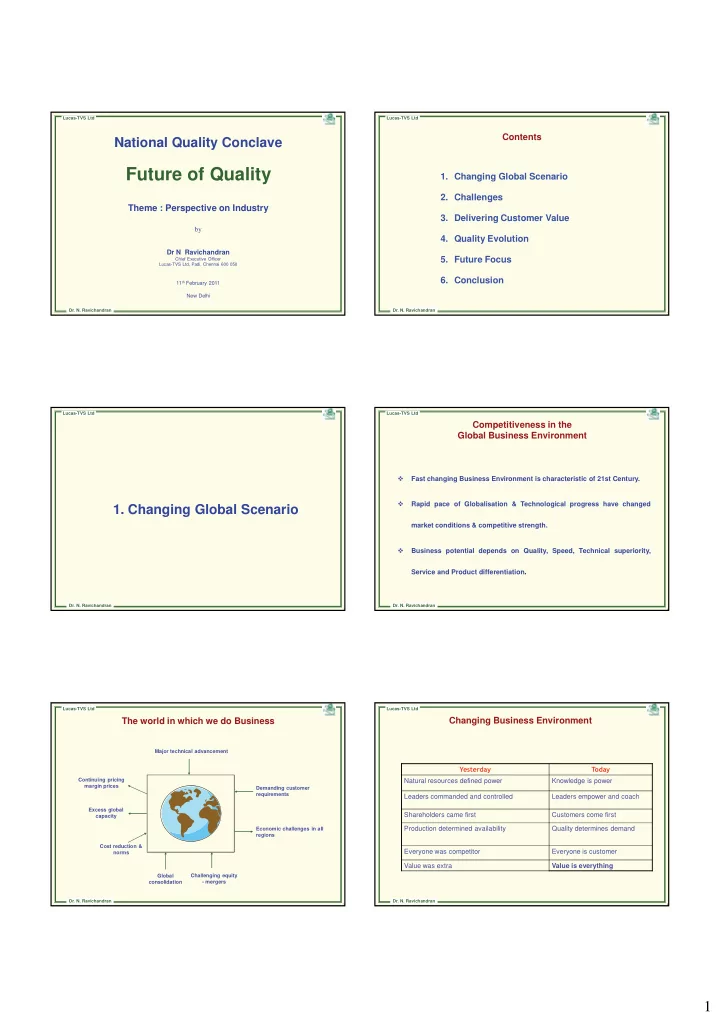
The world in which we do Business

Major technical advancement Demanding customer requirements Economic challenges in all regions Challenging equity

  • mergers

Global consolidation Cost reduction & norms Excess global capacity Continuing pricing margin prices

Lucas-TVS Ltd

  • Dr. N. Ravichandran

6

Changing Business Environment

  • Natural resources defined power

Knowledge is power Leaders commanded and controlled Leaders empower and coach Shareholders came first Customers come first Production determined availability Quality determines demand Everyone was competitor Everyone is customer Value was extra Value is everything

slide-2
SLIDE 2

2

Lucas-TVS Ltd

  • Dr. N. Ravichandran

7

  • 2. Challenges

Lucas-TVS Ltd

  • Dr. N. Ravichandran

8

Futuristic Product

Lucas-TVS Ltd

  • Dr. N. Ravichandran

9

Challenges of global Market

  • Stronger Competitiveness
  • Higher Productivity
  • Higher Growth
  • Consistent Products
  • Continuous Quality Improvement
  • Environmentally responsible Company
  • Flexibility
  • Increase of Product Complexity
  • Decrease the Production depth
  • Faster reaction
  • Global Market
  • ISO 14001 & OHSAS 18001

OBJECTIVES REQUIREMENTS

Lucas-TVS Ltd

  • Dr. N. Ravichandran

10

  • 3. Delivering Customer Value

Lucas-TVS Ltd

  • Dr. N. Ravichandran

11

  • Delivering Customer Value

Lucas-TVS Ltd

  • Dr. N. Ravichandran

12

  • 4. Quality evolution
slide-3
SLIDE 3

3

Lucas-TVS Ltd

  • Dr. N. Ravichandran

13

‘A measure of excellence’

Quality

Lucas-TVS Ltd

  • Dr. N. Ravichandran

14

Subjective term for which each person has his or her own definition. In technical usage, quality can have two meanings:

  • 1. The characteristics of a product or service that bear on its ability to satisfy stated or

implied needs.

  • 2. A product or service free from deficiencies.

Note: ISO 9000 : 2000 version defines Quality as “Degree to which a set of inherent characteristics fulfils requirements.

Quality

Lucas-TVS Ltd

  • Dr. N. Ravichandran

15

Philosophies & Frameworks

W EDWARDS DEMING PHILIP B CROSBY KAORU ISHIKAWA SHIGEO SHINGO GENICHI TAGUCHI CLAUS MOLLER

  • There are no short cuts to Quality.
  • No Quick Fixes.
  • Improvement requires full commitment and

support from top.

  • Extensive training needed.
  • Participation of all employees needed.

Lucas-TVS Ltd

  • Dr. N. Ravichandran

16

Principles

Participation and Team work

Infrastructure Tools and Techniqu Practices

Scope of Total Quality

Lucas-TVS Ltd

  • Dr. N. Ravichandran

17

Organization benefits Costs Cycle time Employee turnover Employee satisfaction Safety and health Productivity Customer satisfaction Index of overall satisfaction Customer retention Complaints Competitiveness Market share Profits Product and service Quality Reliability On-time delivery Errors of defects Quality systems and employee involvement Leadership for continuous improvement

Total Quality Model

Lucas-TVS Ltd

  • Dr. N. Ravichandran

18

  • 5. Future Focus
slide-4
SLIDE 4

4

Lucas-TVS Ltd

  • Dr. N. Ravichandran

19

  • S. No

Area Conventional Quality System Current Quality System Future Quality System

1 Customer Customer satisfaction Customer satisfaction Customer loyalty 2 Management Leadership not stressed Leadership mentioned Inspiring leadership to help people reach their full potential 3 Employees Taylorism, Fear driven drudgery A few experts rest of people passive True empowerment, freedom, joy in the workplace 4 Organization Vertical structure Tall Pyramid Departments the norm Flat pyramid, teams the building block 5 System ISO-9000; QS-9000 Quality mindedness promoted World class system business excellence a superordinate value 6 Tools 7QC Tools, PDCA & 8-D Classical DOE Shainin DOE, MEOST, QFD, TPM, NOAC, VE & Cycle time

Future Quality System

Lucas-TVS Ltd

  • Dr. N. Ravichandran

20

  • S. No

Area Conventional Quality System Current Quality System Future Quality System

7 Design Design in isolation Computer simulation Design in half the time, half the defects, half the costs, half the manpower 8 Suppliers Dictatorial & remote control relationship Laissez-faire Win-win partnership, based

  • n ethics, trust & active help

9 Manufacturing Leans on inspection Leans on Leans on perfection 10 Field Service contracts to cover product weaknesses FMEAs MEOST, built in diagnostics 11 Support services No business on quality Quality appreciation Quality initiatives 12 Measurement / results Quality improvement for its

  • wn sake

Encourages return on quality investment - 2:1 to 4:1 Return on quality in vestment:

  • ver 10:1; profit

improvement: minimum 2:1

Future Quality System

Lucas-TVS Ltd

  • Dr. N. Ravichandran

21

Advancement Achievement Action Alignment Appreciation Awareness

Lucas-TVS Ltd

  • Dr. N. Ravichandran

22

What makes the difference

People

Lucas-TVS Ltd

  • Dr. N. Ravichandran

23

12 Steps

1. Customer orientation 2. Participation 3. Training 4. Motivation 5. Products and Services 6. Processes and Procedures 7. Information 8. Suppliers 9. Culture 10. Planning 11. Communication 12. Accountability

Lucas-TVS Ltd

  • Dr. N. Ravichandran

24

Five value systems 1. Pride 2. Desire 3. Teamwork 4. Attention to detail 5. Follow through

slide-5
SLIDE 5

5

Lucas-TVS Ltd

  • Dr. N. Ravichandran

25

  • 1. Customer focused Organization
  • 2. Leadership
  • 3. Involvement of people
  • 4. Process orientation
  • 5. System approach to management
  • 6. Continuous Improvement
  • 7. Factual approach to decision making
  • 8. Mutually beneficial supplier relationships.

Quality Management Principles standardized Quality Management Principles standardized

Lucas-TVS Ltd

  • Dr. N. Ravichandran

26

  • 1. Identification of customers ( Internal & external )
  • 2. Understanding stated and implied needs / expectations.
  • 3. Establishing measures of satisfaction customer needs/ expectations.
  • 4. Determining how far customer needs are being met at present.
  • 5. Efficient processing of customer complaints.
  • 6. Establishing customer focus down the line including distributors.
  • 7. Seeking customer feedback and its analysis for taking measures to improve customer

satisfaction.

  • 1. Customer focused Organization

Organizations depend

  • n

their customers and therefore should understand current and future needs, meet customer requirements and strive to exceed customer expectations. This requires :

Lucas-TVS Ltd

  • Dr. N. Ravichandran

27

  • 2. Leadership
  • 1. Establish long term vision and strategy.
  • 2. Enlist others in a common vision by

appealing to their values, interests, hopes and dreams.

  • 3. Search for challenging opportunities to change, grow, innovate and improve.
  • 4. Experiment, take risk and learn from the mistakes.
  • 5. Foster collaboration by promoting cooperative goals and building trust.
  • 6. Strengthening others by sharing information and power and increasing their discretion

and visibility.

  • 7. Set an example by behaving in the ways that is consistent with the stated values.
  • 8. Plan small wins that promote consistent progress and build commitment.
  • 9. Recognize individual contributions to the success of every project.

Leaders establish unity of purpose and direction of the

  • rganization. They should create and maintain the

internal environment in which people can become fully involved in achieving the organization's objectives. This requires the following steps :

Lucas-TVS Ltd

  • Dr. N. Ravichandran

28

  • Employees must be treated with dignity and respect.
  • They must be trained to build competence where required.
  • Each employee must know what exactly is required to be done and where possible must be

able to assess the quality of his work.

  • Fear must be totally removed from the organization and employees must be encouraged to

bring out weakness in the system.

  • 3. Involvement of people

People at all levels are the essence

  • f

an

  • rganization and their full involvement enables their

abilities to be used for the organization’s benefit.

Lucas-TVS Ltd

  • Dr. N. Ravichandran

29

  • 4. Process orientation
  • 1. Planning of processes to meet customer requirements.
  • 2. Process capability study and qualification of process.
  • 3. Establishment of mechanism to keep process under control.
  • 4. Ownership of process with full responsibility of quality.
  • 5. Verification of product/ service for conformance before instruments.
  • 6. Maintenance/ calibration of process equipments and measuring instruments.
  • 7. Analysis of process data for improvement.

A desired result is achieved more efficiently when related resources and activities are managed as a process.

Lucas-TVS Ltd

  • Dr. N. Ravichandran

30

  • 5. System approach to management

Identifying, understanding and managing a system of interrelated processes for a given

  • bjective

improves the

  • rganization’s

effectiveness and efficiency. This requires -

  • 1. Clear objectives.
  • 2. Organizational structure with well defined authority and responsibility.
  • 3. Planning for Quality .
  • 4. Control of functions affecting quality.
  • 5. Coordinating of interrelated processes.
  • 6. Audit mechanism for self regulated organization.
slide-6
SLIDE 6

6

Lucas-TVS Ltd

  • Dr. N. Ravichandran

31

  • 6. Continuous Improvement
  • 1. Measurement of quality.
  • 2. Analysis of quality data and investigations for non conformities.
  • 3. Seeking opportunities for improvement rather than reacting to quality problems.
  • 4. Benchmarking.
  • 5. Organization for quality improvement like quality circles, quality improvement teams for taking up specific

projects.

  • 6. Review of Q.I.P’s ( Quality Improvement Projects ) by top management.
  • 7. Recognition of significant achievements.

Continuous improvement should be a permanent objective of the organization. This requires :

Lucas-TVS Ltd

  • Dr. N. Ravichandran

32

  • 1. Recording of data on :

– Quantitative production – Equipment failures – Process conditions – Delivery performance – Customer complaints – Quality costs – Supplier performance.

  • 2. Ensuring the data is accurate, reliable and accessible.
  • 3. Analysis of data to understand the impact on organizational performance and cost implications and for

deciding corrective actions.

  • 4. Data on results of application of corrective action.
  • 7. Factual approach to decision making

Effective decisions are based on the analysis of data and information. This requires :

Lucas-TVS Ltd

  • Dr. N. Ravichandran

33

  • 8. Mutually beneficial supplier relationships.
  • 1. Consideration of quality capability while selecting vendors.
  • 2. Specification of quality on purchase documents.
  • 3. Clear understanding of supplier needs.
  • 4. Mutual trust and share responsibility and accountability.
  • 5. Clear and open communication.
  • 6. Mutual commitment for continuous improvement.

An organization and its suppliers are interdependent, and a mutually beneficial relationship enhances the ability of both to create value. This requires :

Lucas-TVS Ltd

  • Dr. N. Ravichandran

34

Quality, Cost & Profit relationship

Lucas-TVS Ltd

  • Dr. N. Ravichandran

35

Many people think that quality costs money and adversely effects

  • profits. But these costs are the costs of doing it wrong first time .

Quality in the long run results in increased profitability.

Lucas-TVS Ltd

  • Dr. N. Ravichandran

36

For example if we design the product right first time , build it right first time - we save all the costs of redesign , rework, scrap, resetting, repair, warranty work etc.

Quality , Cost and Profit relationship. Cost

slide-7
SLIDE 7

7

Lucas-TVS Ltd

  • Dr. N. Ravichandran

37

Quality and Profit : Traditional thinking Cost

Lucas-TVS Ltd

  • Dr. N. Ravichandran

38

Quality and Profit : Paradigm shift Cost

Lucas-TVS Ltd

  • Dr. N. Ravichandran

39

  • 6. Conclusion

Lucas-TVS Ltd

  • Dr. N. Ravichandran

40

  • Lucas-TVS Ltd
  • Dr. N. Ravichandran

41

Level – II Inspection Level – I Accident Level - III Quality Assurance Level - IV Prevention Level - V Perfection Level - VI Creation

Lucas-TVS Ltd

  • Dr. N. Ravichandran

42

Lean Green Model

Customer Delight Competitiveness Quality Cost Delivery

TQM

High Energy People

World Class Manufacturing

Lean Manu- facturing Contem- porary Techno- logy Green Manu- facturing

Vision Directed Management

slide-8
SLIDE 8

8

Lucas-TVS Ltd

  • Dr. N. Ravichandran

43

Lean & Green Manu- facturing

Technology Methodology People

Quality - Zero Defect Quantity - Exact Delivery - On time Morale - High performance Society - Responsible Citizen

Lucas-TVS Ltd

  • Dr. N. Ravichandran

44

  • Execution Excellence

Customer Satisfaction

  • Source: Dr. Noriaki Kano
  • Lucas-TVS Ltd
  • Dr. N. Ravichandran

45

  • CS + ES + SS

QUALITY Goal and strategy

Seven Tools New 7 Tools Q C Story Quality Deployment Multivariate Policy Management Daily Management X – Matrix Q C Circles QUALITY Marketing & Management PDCA

Motivational Approach Intrinsic Technology General Education and Political Stability

Lucas-TVS Ltd

  • Dr. N. Ravichandran

46

Total Quality Management Approach

Six Sigma Statistical Process Control Design of Experiments Taguchi Methods

Lean Production System Design

Level Production Supplier Pull System Cells & Layout Quick Changeover Standardised Work

Problem-Solving

Mistake Proofing Brainstorming Cause and Effect Pareto

Workplace Organisation CANDO/5S Visual Management Teams

Mistake Proofing

Problem-Solving

Mistake Proofing

Problem-Solving

Autonomous Maintenance Planned Maintenance Quality Maintenance OEE Analysis Early Equipment Management Reliability Centred Maintenance

Total Productivity Maintenance Approach Cost Focus Delivery Focus Quality Focus

World Class Manufacturing Techniques

Lucas-TVS Ltd

  • Dr. N. Ravichandran

47

OUR JOURNEY - PHASE I

1986 1990 1993 1997 2001 2002 2004 2003 1963 1985 -95 1995 -1999 1999 -2004 Stage II Stage - 1 Stage III Stage IV 1963 -85 1999 1995

Traditional manufacturing methods Inflexible manpower Inspection by Quality auditor not by operators Cris -cross movement of materials Introduction of SGA [QCC] Cellular manufacturing methods Product based layouts Standing operation Operator responsible for Quality Multimachine manning Decentralisation

  • f functions

Single Piece Flow Multi Process Handling SMED Small batch Production Large cell Introduction of SPC, Poka Yoke, Jidoka Introduction of DRM Formation of Voluntary Work Teams

ISO 9001 QS 9000

  • ISO 14001
  • Audited for

TS16949

Our Journey Towards Excellence

1985 1998 2005 2006 2007 1992 2005…………….

  • Self directed

Work Teams

  • Frost & Sullivan Award
  • Launching TPM
  • Full utilisation
  • f IT in

manufacturing OSHAS 2009

  • Challenging Japanese

Quality Medal 2012

Stage V

  • Challenging

Deming Application Prize by 2004

Our Journey Towards Excellence Through People

2012

  • Recharging Mfg System

2010-11

  • Lucas-TVS Ltd
  • Dr. N. Ravichandran

48

NATIONAL AGENDA FOR QUALITY Objective : To raise standards of Indian manufacturing industries to Global standards and create an atmosphere for Quality innovation. Focus areas : Establish a National Regulatory Authority to ensure uniform standards among various Regulatory, Standardisation, Conformity bodies. To continuously upgrade National standard in line with international standards by benchmarking the processes. To create Centres of Excellence in each Sector / City which will help in propagating quality and share best practices with other industries. Human Resources : Impart knowledge and skill for Workers, Engineers, Managers through proper training and practices through educational institutions / Quality Professional Associations. Learning through Cluster approach. To cultivate quality culture in all organizations and institutions.

slide-9
SLIDE 9

9

Lucas-TVS Ltd

  • Dr. N. Ravichandran

49

A/c Culture AC Achievement Culture PC Culture PC Performance Culture Information carrier Culture IC Improvement Culture Argument Culture AC Alignment Culture Cell Culture (Cell Phone) CC Cell Culture (Natural Group) Talk Culture TC Target Culture Fault Culture FC Focus Culture Defect Culture DC Distinction Culture Waste Culture WC Wealth Culture

Cultural Change

Lucas-TVS Ltd

  • Dr. N. Ravichandran

50

End of presentation