Further Discussions and Beyond EE630 Further Discussions and Beyond - - PowerPoint PPT Presentation

further discussions and beyond ee630 further discussions
SMART_READER_LITE
LIVE PREVIEW

Further Discussions and Beyond EE630 Further Discussions and Beyond - - PowerPoint PPT Presentation

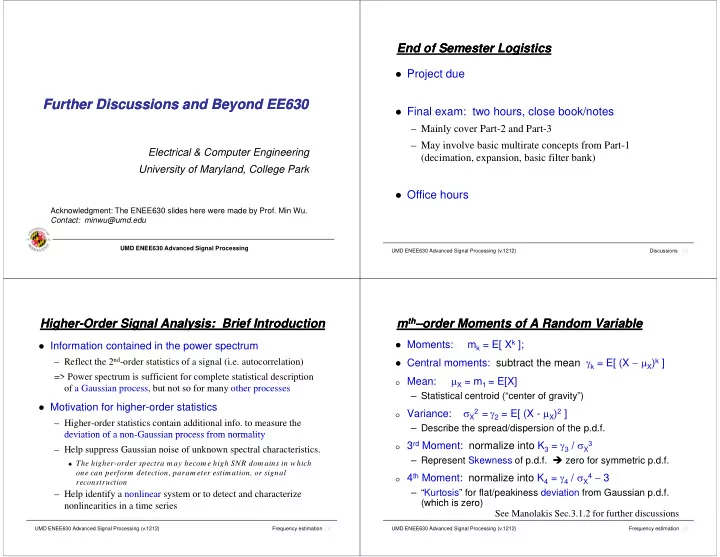
End of Semester Logistics End of Semester Logistics g Project due Further Discussions and Beyond EE630 Further Discussions and Beyond EE630 Final exam: two hours, close book/notes Mainly cover Part-2 and Part-3 May involve


slide-1
SLIDE 1

Further Discussions and Beyond EE630 Further Discussions and Beyond EE630

Electrical & Computer Engineering p g g University of Maryland, College Park

Acknowledgment: The ENEE630 slides here were made by Prof. Min Wu. Contact: minwu@umd.edu

UMD ENEE630 Advanced Signal Processing

@

End of Semester Logistics End of Semester Logistics g

 Project due  Final exam: two hours, close book/notes

– Mainly cover Part-2 and Part-3 – May involve basic multirate concepts from Part-1 (d i ti i b i filt b k) (decimation, expansion, basic filter bank)

 Office hours

UMD ENEE630 Advanced Signal Processing (v.1212) Discussions [2]

Higher Higher-

  • Order Signal Analysis: Brief Introduction

Order Signal Analysis: Brief Introduction

 Information contained in the power spectrum

– Reflect the 2nd-order statistics of a signal (i.e. autocorrelation) g ( ) => Power spectrum is sufficient for complete statistical description

  • f a Gaussian process, but not so for many other processes

 Motivation for higher-order statistics

– Higher-order statistics contain additional info. to measure the deviation of a non Gaussian process from normality deviation of a non-Gaussian process from normality – Help suppress Gaussian noise of unknown spectral characteristics.

 The higher-order spectra m ay becom e high SNR dom ains in w hich

  • ne can perform detection, param eter estim ation, or signal

reconstruction

– Help identify a nonlinear system or to detect and characterize

UMD ENEE630 Advanced Signal Processing (v.1212) Frequency estimation [3]

nonlinearities in a time series

mth

th–order Moments of A Random Variable

  • rder Moments of A Random Variable

 Moments: mk = E[ Xk ];  Central moments: subtract the mean k = E[ (X  X)k ]

Central moments: subtract the mean k E[ (X X) ]

  • Mean: X = m1 = E[X]

– Statistical centroid (“center of gravity”) ( g y )

  • Variance: X

2 = 2 = E[ (X - X)2 ]

– Describe the spread/dispersion of the p.d.f.

  • 3rd Moment: normalize into K3 = 3 / X

3

– Represent Skewness of p.d.f.  zero for symmetric p.d.f.

  • 4th Moment: normalize into K4 = 4 / X

4  3

– “Kurtosis” for flat/peakiness deviation from Gaussian p.d.f. (which is zero)

UMD ENEE630 Advanced Signal Processing (v.1212) Frequency estimation [4]

(which is zero) See Manolakis Sec.3.1.2 for further discussions

slide-2
SLIDE 2

First five cumulants for zero-mean r.v.

( Figures/Equations are from Manolakis Book Section 3.1; Note moments of 3rd and abo e for Ga ssian

UMD ENEE630 Advanced Signal Processing (v.1212) Discussions [5]

Note – moments of 3rd and above for Gaussian can be expressed in terms of  and .)

Relations Among 3+ Samples of a Random Process Relations Among 3+ Samples of a Random Process

 Generalize from autocorrelation function between a pair of

samples for a zero-mean stationary random process f

d

 Triplets of samples: 3rd order cumulant  Quadruplets of samples: 4th order cumulant

UMD ENEE630 Advanced Signal Processing (v.1212) Frequency estimation [7]

[ Eq. from Manolakis Book Section 12.1 ]

High High-

  • order Spectra
  • rder Spectra

 Multi-variable DTFT on cumulant functions

– Bispectrum & Trispectrum: may exhibit patterns in magnitude & phase

 Extend properties under LTI to high-order stats See Manolakis et al. McGraw Hill book “Statistical & Adaptive S.P.” Sec.12.1 High-order statistics for further discussions

UMD ENEE630 Advanced Signal Processing (v.1212) Discussions [8]

[ Eq. from Manolakis Book Section 12.1 ]

UMD ENEE630 Advanced Signal Processing (v.1212) Discussions [9]

slide-3
SLIDE 3

Resource on Signal Processing Resource on Signal Processing

 IEEE Signal Processing Magazine

– E-copy on IEEE Xplore; Hard-copy by student membership E copy on IEEE Xplore; Hard copy by student membership

 IEEE “Inside Signal Processing eNewsletter”

http:/ / signalprocessingsociety.org/ newsletter/ p / / g p g y g/ /

 Signal Processing related journals/transactions  Related conferences: ICASSP, ICIP, etc.  Additional 2-cents beyond courses

– Attend talks/seminars to broaden your vision O l i ti ( l t ti t )

UMD ENEE630 Advanced Signal Processing (v.1212) Discussions [10]

– Oral communications (oral exams, presentations, etc)

Related Courses Beyond EE630 Related Courses Beyond EE630

 Adaptive and space-time signal processing: ENEE634*  Image/video & audio/speech processing: ENEE631*, 632  Detection/estimation & information theory: ENEE621* 627*  Detection/estimation & information theory: ENEE621 , 627

 See also SP for digital com m unication in ENEE623

P tt iti d hi l i ENEE633

 Pattern recognition and machine learning: ENEE633  Special topic courses and seminars in signal processing:

Special topic courses and seminars in signal processing:

Occasionally offered. E.g. on info forensics & multimedia security, compressive sensing, etc.

UMD ENEE630 Advanced Signal Processing (v.1212) Discussions [11]

 See also related applied math and statistics courses

Figure is from slides at Gonzalez/ Woods DIP book website (Chapter 8). Use “previous pixel predictor”. Difference image has mid-range gray representing UMD ENEE630 Advanced Signal Processing (v.1212) Discussions [12] zero and amplifying factor of 8.

Digital Image and Video Processing (ENEE631) Digital Image and Video Processing (ENEE631)

 Human visual perception; color vision  Image enhancement  Image restoration

g

 Image transform, quantization and coding  Motion analysis and video coding  Feature extraction and analysis

Feature extraction and analysis

 Security and forensic issues

……

UMD ENEE630 Advanced Signal Processing (v.1212) Discussions [13]

slide-4
SLIDE 4

Forensic Question on “Time” and “Place”

500 600

  • 90
  • 80

300 400 500

m e (in seconds)

  • 120
  • 110
  • 100

90 9 6 10 10 4 10 8 100 200

Tim

  • 150
  • 140
  • 130
  • When was the video actually shot? And where?
  • Was the sound track captured at the same time as the

9.6 10 10.4 10.8

Frequency (in Hz)

  • Was the sound track captured at the same time as the

picture? Or super-imposed afterward?

  • Explore the fingerprint influenced by power grid onto
  • Explore the fingerprint influenced by power grid onto

sensor recordings

UMD ENEE630 Advanced Signal Processing (v.1212)

Ubiquitous Forensic Fingerprints from Power Grid

400 500

  • nds)
  • 40
  • 20

0.7 0.8 0.9 efficient 400 500 600

nds)

  • 100
  • 90
  • 80

100 200 300

Time (in seco

  • 100
  • 80
  • 60

30 20 10 10 20 30 0.3 0.4 0.5 0.6 Correlation co 100 200 300

Time (in seco

  • 150
  • 140
  • 130
  • 120
  • 110

49.5 50 50.5 51 51.5

Frequency (in Hz)

  • 30
  • 20
  • 10

10 20 30 Time frame lag

ENF matching result demonstrating similar variations in the ENF

Video ENF signal Power ENF signal Normalized correlation

9.6 10 10.4 10.8

Frequency (in Hz)

  • Electric Network Frequency (ENF): 50/60 Hz nominal
  • Varies slightly over time; main trends consistent in same grid

signal extracted from video and from power signal recorded in India

  • Varies slightly over time; main trends consistent in same grid
  • Can be “seen” or “heard” in sensor recordings
  • Help determine recording time, detect tampering, etc.
  • Other potential applications on smart grid & media management

 Ref: Garg et al. ACM Multimedia 2011, CCS 2012 and APSIPA 2012

Tampering Detection Using ENF Tampering Detection Using ENF

ENF signal from Video

ENF matching result demonstrating the detection of video tampering based on the ENF traces

10 10.1 10.2 10.3 equency (in Hz)

Inserted li

160 320 480 640 800 960 10 Time (in seconds) Fre 50.2 n Hz)

Ground truth ENF signal

clip

160 320 480 640 800 49.9 50 50.1 Ti (i d ) Frequency (in

 Adding a clip between the original video leads to discontinuity in

the ENF signal extracted from video Cli i ti l b d t t d b i th id ENF

Time (in seconds)

 Clip insertion can also be detected by comparing the video ENF

signal with the power ENF signal at corresponding time

16 16 UMD ENEE630 Advanced Signal Processing (v.1212)

Aliasing Revisit: Aliasing Revisit: Downsample Downsample A Sinusoid A Sinusoid

“If the RF signal [white] is not sampled at least twice per cycle, aliasing will occur. But by properly adjusting the sampling interval [indicated by vertical lines], you can down-convert the RF to whatever lower frequency is desired [blue and yellow].”

UMD ENEE630 Advanced Signal Processing (v.1212) Discussions [17]

IEEE Spectrum Magazine April 2009 “Universal Handset” – Alias Harnessed for software-defined radio http://spectrum.ieee.org/computing/embedded-systems/the-universal-handset/0/cellsb01

slide-5
SLIDE 5

ENEE6 ENEE6 L k Ah d L k Ah d ENEE630 ENEE630 Look Ahead Look Ahead

Introduction to Adaptive Filtering Introduction to Adaptive Filtering

Electrical & Computer Engineering University of Maryland, College Park

Acknowledgment: the additional overview/introductory slides for beyond ENEE630 were made by Prof. Min Wu and FFP Teaching Fellow Mr. Wei- Hong Chuang, with reference to textbooks by Hayes and Haykins and ENEE634 class notes by Prof Ray Liu Contact: minwu@umd edu

UMD ENEE630 Advanced Signal Processing (ver.1112)

ENEE634 class notes by Prof. Ray Liu. Contact: minwu@umd.edu

Stationarity Stationarity Assumption in Wiener Filtering Assumption in Wiener Filtering

 Wiener filtering is optimum in a stationary environment

– Unfortunately most real signals are non-stationary – Unfortunately, most real signals are non-stationary

 One remedy: process the non-stationary signal in blocks,

where the signal is assumed to be stationary where the signal is assumed to be stationary

 Not always effective

For rapidly varying signals the block length may be too small to – For rapidly varying signals, the block length may be too small to estimate relevant parameters – Can’t accommodate step changes within analysis intervals Ca acco

  • da e s ep c a ges w

a a ys s e va s – Solution imposes incorrect data model, i.e., piecewise stationary => Try to begin with non-stationarity to develop solutions => Try to begin with non-stationarity to develop solutions

UMD ENEE630 Advanced Signal Processing (ver.1212) Adaptive Filtering [2]

Recursive Update of Filter Coefficients Recursive Update of Filter Coefficients

 Wiener Filtering: solve the normal equation

r R

 If non-stationary, optimal filter coefficients will depend

ti

dx x

r w R 

  • n time n

Not always feasible (e g high computational complexity)

) ( ) ( n n

dx n x

r w R 

– Not always feasible (e.g. high computational complexity)

 Can be much simplified with adaptive filtering:  Can be much simplified with adaptive filtering:

=> Form wn+1 by adding correction ∆wn to wn at each iteration

w w w   

1

UMD ENEE630 Advanced Signal Processing (ver.1212) Adaptive Filtering [3]

n n n

w w w  

1

General Structure of Adaptive Filtering General Structure of Adaptive Filtering

(Fig. from Hayes’ book p495)

 Measure the error e(n) at each time n, determine how

to update filter coefficients accordingly to update filter coefficients accordingly

UMD ENEE630 Advanced Signal Processing (ver.1212) Adaptive Filtering [4]

slide-6
SLIDE 6

FIR Adaptive Filter FIR Adaptive Filter

(Fig. from Hayes’ book Chapter 9)  Simple & efficient algorithms for coefficient adjustment  Often perform well enough  Stability is easily controlled  Feasible performance analysis  Feasible performance analysis

UMD ENEE630 Advanced Signal Processing (ver.1212) Adaptive Filtering [5]

Coefficient Update: Coefficient Update: Desired Properties Desired Properties

 Corrections should reduce mean-square error

 

2

) ( ) ( 

 In a stationary environment, wn should converge to

 

2

) ( ) ( n e E n  

Wiener-Hopf solution

d

r R w

1

lim

 Avoid explicit signal statistics for ∆wn if possible

dx x n n

r R w lim

 

– “Built-in” estimation of statistics

 If non-stationary, filter should track the solution

y,

UMD ENEE630 Advanced Signal Processing (ver.1212) Adaptive Filtering [6]

Steepest Steepest-

  • Descent Adaptive Filter

Descent Adaptive Filter

(Fig. from Hayes’ book Chapter 9)

 Recall direct approach: minimizing the MSE by setting

partial derivative = 0 (this may involve matrix inverse) => Alternative: search solution iteratively using a numerical method of steepest descent

 Find the filter coefficients

that minimize the error on that minimize the error on the error surface

 At every iteration moves  At every iteration, moves

along the direction of the steepest descent of error

UMD ENEE630 Advanced Signal Processing (ver.1212) Adaptive Filtering [7]

Method of Steepest Descent Method of Steepest Descent

(Fig. from Hayes’ book Chapter 9)

 The steepest direction is given by gradient  Update Equation

– μ: step size, controls the rate at which the coefficients move

UMD ENEE630 Advanced Signal Processing (ver.1212) Adaptive Filtering [8]

slide-7
SLIDE 7

Method of Steepest Descent Method of Steepest Descent

UMD ENEE630 Advanced Signal Processing (ver.1212) Adaptive Filtering [9]

Stability of Steepest Descent Stability of Steepest Descent

 It can be shown that

If ( ) d d( )

 If x(n) and d(n) are w.s.s.,

– Correction term is zero if (i.e., a fixed point of the update)

D th ffi i t d t ?

 Does the coefficient update converge?

UMD ENEE630 Advanced Signal Processing (ver.1212) Adaptive Filtering [10]

Convergence of Steepest Descent Convergence of Steepest Descent

 For w.s.s. d(n) and x(n), the steepest descent adaptive

filter converges to Wiener-Hopf solution g p if the step size satisfies

– λmax: maximal eigenvalue of Rx – Can be shown by diagonalizing R Can be shown by diagonalizing Rx

 Convergence rate (how fast the update converges) is

determined by the spread of eigenvalues determined by the spread of eigenvalues

UMD ENEE630 Advanced Signal Processing (ver.1212) Adaptive Filtering [11]

Effects of Condition Number on Convergence Effects of Condition Number on Convergence

(Error surface figures from Hayes’ book Chapter 9) Chapter 9)

small eigenvalue spread large eigenvalue spread

UMD ENEE630 Advanced Signal Processing (ver.1212) Adaptive Filtering [12]

small eigenvalue spread large eigenvalue spread

slide-8
SLIDE 8

Least Mean Squares (LMS) Least Mean Squares (LMS) Algotithm Algotithm

 Recall the update in steepest descent:

– Practical challenge: the expectation may be unknown or g p y difficult to estimate on the fly

 The LMS replaces the expectation by an “one-shot”  The LMS replaces the expectation by an one shot

estimate

– Very crude estimate, but often performs well in practice

UMD ENEE630 Advanced Signal Processing (ver.1212) Adaptive Filtering [13]

LMS Algorithm for LMS Algorithm for pth pth-

  • order FIR Adaptive Filter
  • rder FIR Adaptive Filter

UMD ENEE630 Advanced Signal Processing (ver.1212) Adaptive Filtering [14]

(Algorithm from Hayes’ book Chapter 9)

Randomness of the LMS Algorithm Randomness of the LMS Algorithm

(Fig. from Hayes’ book Chapter 9)  The one-shot estimate approximates the steepest descent

direction (i.e., the statistical average)

 The one-shot nature makes wn move randomly in a

neighborhood, even if initialized from the Wiener solution

UMD ENEE630 Advanced Signal Processing (ver.1212) Adaptive Filtering [15]

Example: Adaptive Linear Prediction Example: Adaptive Linear Prediction

UMD ENEE630 Advanced Signal Processing (ver.1212) Adaptive Filtering [16]

(Fig: Hayes’book p509)

slide-9
SLIDE 9

Example: Adaptive Linear Prediction Example: Adaptive Linear Prediction

1.2728 1.2728

  • 0.81
  • 0.81

μ=0.004: slower convergence, more stable μ=0.02: faster convergence, less stable

UMD ENEE630 Advanced Signal Processing (ver.1212) Adaptive Filtering [17]

Convergence of the LMS Algorithm Convergence of the LMS Algorithm

 Examine convergence properties of LMS under a

statistical framework

 For w.s.s. d(n) and x(n) the LMS adaptive filter

( ) ( ) p converges in the mean sense if

 More stringent condition is required for convergence

in mean square sense

UMD ENEE630 Advanced Signal Processing (ver.1212) Adaptive Filtering [18]

Typical Learning Curves: MSE vs. time Typical Learning Curves: MSE vs. time

μ=0.004 (slower convergence, smaller misadjustment) μ=0.02

UMD ENEE630 Advanced Signal Processing (ver.1212) Adaptive Filtering [20]

Recursive Least Squares (RLS) Algorithm Recursive Least Squares (RLS) Algorithm

 Mean-square error v.s. least squares error

– Mean-square error does not depend on incoming data but – Mean-square error does not depend on incoming data, but their ensemble statistics – Least squares error depends explicitly on x(n) and d(n)

 RLS: minimizes least squares error, where old data

are gradually “forgotten” are gradually forgotten

0 < λ < 1: “forgetting” factor

UMD ENEE630 Advanced Signal Processing (ver.1212) Adaptive Filtering [21]

slide-10
SLIDE 10

Recursive Least Squares (RLS) Algorithm Recursive Least Squares (RLS) Algorithm

 Least squares normal equation  Rx(n) and rdx(n) can be calculated recursively  Rx(n) and rdx(n) can be calculated recursively  Rx

  • 1(n) can also be calculated recursively using

Matrix Inversion Formula Matrix Inversion Formula

UMD ENEE630 Advanced Signal Processing (ver.1212) Adaptive Filtering [22]

Learning Rates of RLS and LMS Learning Rates of RLS and LMS

UMD ENEE630 Advanced Signal Processing (ver.1212) Adaptive Filtering [23]

http://www.mathworks.com/matlabcentral/fileexchange/32498-performance-of-rls-and-lms-in-system-identification

Characteristics of RLS Algorithm Characteristics of RLS Algorithm

 Convergence rate is an order of magnitude faster

than that of LMS, at the cost of higher complexity , g p y

 Convergence rate is insensitive to eigenvalue spread  In theory, RLS produces zero excess error or

misadjustment misadjustment

 RLS can be understood under the unifying framework

f K l filt i

  • f Kalman filtering

UMD ENEE630 Advanced Signal Processing (ver.1212) Adaptive Filtering [24]

Summary Summary

 Adaptive filters

– Address non-stationary signal processing – Low computational complexity – Recursive update of filter coefficients

 Method of steepest descent

– Moves in the negative gradient direction – converges to Wiener-Hopf if stationary

 LMS algorithm

– Crude one-shot gradient estimation; reasonable practical performance

RLS l ith

i l i i i l t

 RLS algorithm: recursively minimizes least-squares error

UMD ENEE630 Advanced Signal Processing (ver.1212) Adaptive Filtering [25]

slide-11
SLIDE 11

References for Further Explorations References for Further Explorations

 M. Hayes, Statistical Digital Signal Processing and

Modeling, Wiley, 1996. Chapter 9 g, y, p

– All figures except one used in this lecture are from the book

 S. Haykin, Adaptive Filter Theory, 4th edition,

Prentice-Hall, 2002, Chapters 4 & 5 => See more detailed development in ENEE634 See more detailed development in ENEE634 (offered in alternating spring semester)

UMD ENEE630 Advanced Signal Processing (ver.1212) Adaptive Filtering [26]