
SLIDE 1
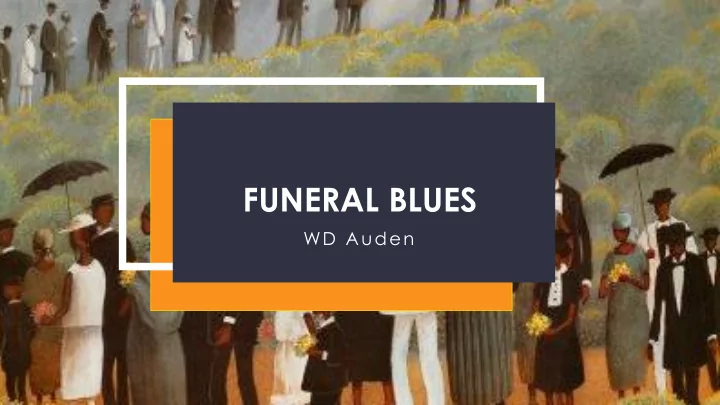
FUNERAL BLUES WD Auden WH AUDEN Pulitzer prize winning English - - PowerPoint PPT Presentation
FUNERAL BLUES WD Auden WH AUDEN Pulitzer prize winning English poet, author and playwright Married a woman to allow her to leave Nazi Germany safely Spent majority of his life with partner, Chester Kallman Poems influenced by
author and playwright
Nazi Germany safely
Chester Kallman
T H E G E N R E D E V E L O P E D F R O M R O O T S I N AF R I C AN M U S I C AL T R AD I T I O N S , AF R I C AN - AM E R I C AN WO R K S O N G S , S P I R I T U AL S , AN D E U R O P E AN - AM E R I C AN F O L K M U S I C . - G C S E B I T E S I Z E “ P E R S O N AL WO E S I N A WO R L D O F H AR S H R E AL I T Y : A L O S T L O VE , T H E C R U E L T Y O F P O L I C E O F F I C E R S , O P P R E S S I O N AT T H E H AN D S O F WH I T E F O L K , [ AN D ] H AR D T I M E S . " - E WAN
Four quatrains written in rhyming couplets Language of an elegy
Domestic Universal Public
The speaker lists the things he wants done to make his mourning clear. These are based on traditional rituals of mourning that a family would do in preparation for a funeral, to show their personal grief.
Stop all the clocks, cut off the telephone, Prevent the dog from barking with a juicy bone, Silence the pianos and with muffled drum Bring out the coffin, let the mourners come.
Negative verbs show that the speaker wants these things to
imperatives. The sounds that must stop are those normal domestic sounds. This image of enjoyment is not allowed. The only ‘allowed’ verbs link with funeral arrangements. There are all typical symbols of death and funerals. The sound devices here help create an atmosphere of suppressed sound. The alliteration in the ‘m’ sounds like humming. The onomatopoeia and assonance reiterate the dull thud of the drum.
The speaker focuses on public mourning. His demands (not literal) show how he cannot bear the idea of normal life continuing as usual – he wants everyone to acknowledge this dreadful loss and share his grief .
Let aeroplanes circle moaning overhead Scribbling on the sky the message 'He is Dead'. Put crepe bows round the white necks of the public doves, Let the traffic policemen wear black cotton gloves.
Decidedly public shows of mourning – grand gestures to mimic the enormity of his loss. Use of capital letters. ‘He’ – perhaps the speaker thinks everyone should know who he is. ‘D’ to emphasise the finality of death. Contrasting colours catch our attention. Interesting indicators of loss. Bows around the small, fragile necks of the doves and soft cotton gloves as
usually wear. The continuation of the gentler verbs suggest he knows these are unrealistic requests. The onomatopoeia of the moaning planes mimics the sound of someone in terrible emotional anguish. The personification suggests that the writing is shaky perhaps as one who is distraught would write.
The deceased meant everything to the speaker and seems to have been his entire life. He assumed that they would be together forever but that was not meant to be.
The repetition
possessive adjective emphasizes the possessiveness
The metaphor comparing his loved one to the points of the compass saying, in other words, he was his entire world and gave him direction. Things that bring joy to life. Synecdoche (represents the day) – their loved one pervaded every hour of their day. The loss was unanticipated and therefore even more traumatic. The alliteration links the words that highlight the pervasiveness of the loved one in the speaker’s life.
As the ultimate expression of grief, the speaker proposes the demolition of the entire universe. Without his beloved, there is no pleasure to be found in life. The world is a broken, barren place with no hope for anything positive ever again.
The stars are not wanted now; put out every one, Pack up the moon and dismantle the sun, Pour away the ocean and sweep up the wood; For nothing now can ever come to any good.
These instructions all link to deconstruction
unrealistic but indicative of his mindset. Make it sound like no one wants them, but really it is just him. Traditional images in poetry that symbolize life/love/nature. Ends on a very defeatist and hopeless tone. The speaker can see no point in the things which normally bring joy/wonder. Interesting alliteration of the ‘n’ sound which reinforces the negative words and therefore the negative mood of this stanza.