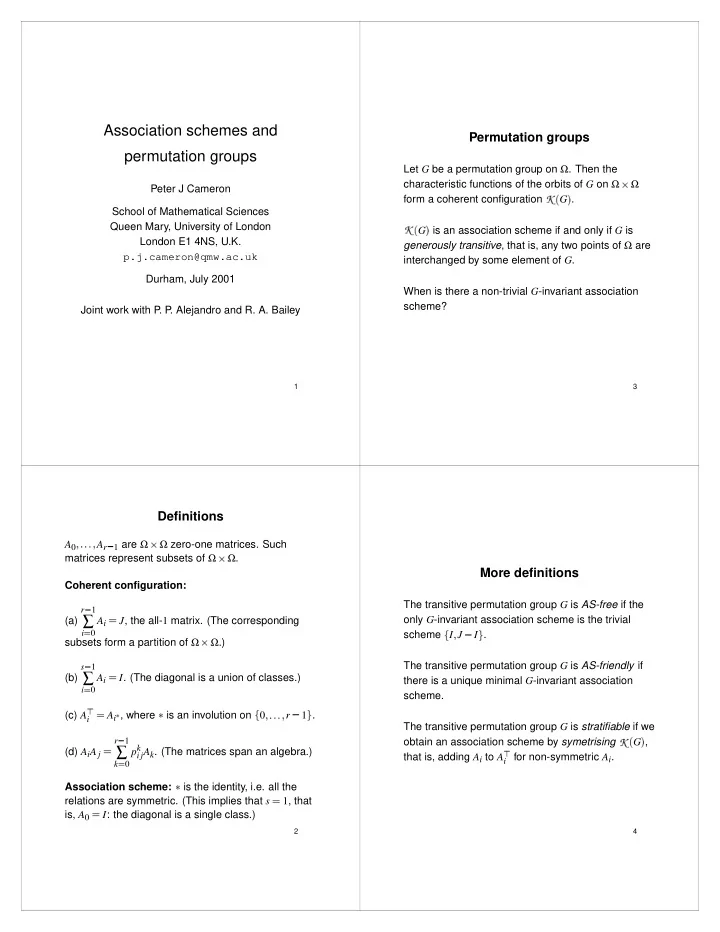

SLIDE 1
Association schemes and permutation groups
Peter J Cameron School of Mathematical Sciences Queen Mary, University of London London E1 4NS, U.K. p.j.cameron@qmw.ac.uk Durham, July 2001 Joint work with P . P . Alejandro and R. A. Bailey
1
Definitions
A0
✂✁✂✁✄✁✂ Ar ☎ 1 are Ω ✆ Ω zero-one matrices. Suchmatrices represent subsets of Ω
✆ Ω.Coherent configuration: (a)
r
☎ 1∑
i
✝ 0Ai
✞J, the all-1 matrix. (The corresponding subsets form a partition of Ω
✆ Ω.)(b)
s
☎ 1∑
i
✝ 0Ai
✞- I. (The diagonal is a union of classes.)
(c) A
✟i
✞Ai
✠ , where ✡ is an involution on ☛ 0 ✂✁✂✁✂✁✂ r ☞1
✌ .(d) AiA j
✞r
☎ 1∑
k
✝ 0pk
i jAk. (The matrices span an algebra.)
Association scheme:
✡ is the identity, i.e. all therelations are symmetric. (This implies that s
✞1, that is, A0
✞I: the diagonal is a single class.)
2
Permutation groups
Let G be a permutation group on Ω. Then the characteristic functions of the orbits of G on Ω
✆ Ωform a coherent configuration
✍✏✎ G ✑ . ✍✏✎ G ✑ is an association scheme if and only if G isgenerously transitive, that is, any two points of Ω are interchanged by some element of G. When is there a non-trivial G-invariant association scheme?
3
More definitions
The transitive permutation group G is AS-free if the
- nly G-invariant association scheme is the trivial
scheme
☛ I J ☞I
✌ .The transitive permutation group G is AS-friendly if there is a unique minimal G-invariant association scheme. The transitive permutation group G is stratifiable if we
- btain an association scheme by symetrising
that is, adding Ai to A
✟i for non-symmetric Ai.
4