Funding to Fight It John Bliss Valerie Flores 1 4745 Mangels - - PowerPoint PPT Presentation

funding to fight it
SMART_READER_LITE
LIVE PREVIEW

Funding to Fight It John Bliss Valerie Flores 1 4745 Mangels - - PowerPoint PPT Presentation

California Burning: Funding to Fight It John Bliss Valerie Flores 1 4745 Mangels Blvd, Fairfield, California 94534 Recent Wildland Fire History in California Acres Burned 9,000,000 8,000,000 7,000,000 6,000,000 5,000,000 4,000,000


slide-1
SLIDE 1

1

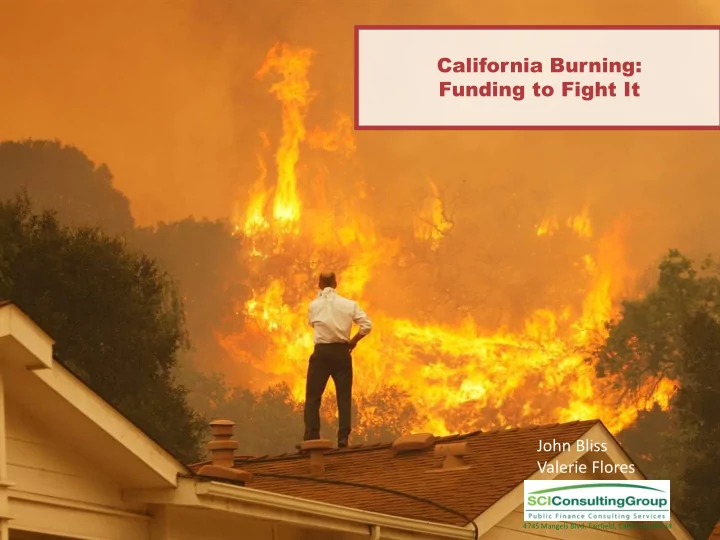
California Burning: Funding to Fight It

4745 Mangels Blvd, Fairfield, California 94534

John Bliss Valerie Flores
slide-2
SLIDE 2

Recent Wildland Fire History in California

2

Source: CalFire 2018 fire season was the deadliest and most destructive wildfire season on record in CA, with 1.89 million acres burned 2019 expected burned acres are estimated

1,000,000 2,000,000 3,000,000 4,000,000 5,000,000 6,000,000 7,000,000 8,000,000 9,000,000 1960s 1970s 1980s 1990s 2000s 2010s estimated

Acres Burned

slide-3
SLIDE 3

Recent Wildland Fire History

  • Of the top 20 most destructive wildfires since 1923, 10 (50%) have
  • ccurred in just the last 4 years (2015-2018).
  • Almost 2,400,000 acres burned, causing 144 deaths and the loss of over

33,000 structures.

  • The most recently devastating Camp Fire burned about 153,000 acres

and almost 19,000 structures and caused the most deaths (85). The human and economic impacts have been staggering.

  • This is a radically different pattern from the prior 1923 to 2015 period.
slide-4
SLIDE 4

Areas Burned in California

(1980s to 2017)

Source: CalFire 2018 fires are not included in this map 2018 fires burned over 1.89 million acres (almost 2% of the State)

4

slide-5
SLIDE 5
  • 1. Jumped the Wildland Urban Interface

Game Changer for Cities: 2017 Tubbs Fire

5

slide-6
SLIDE 6

Pre 2017 Tubbs Fire: Normal

slide-7
SLIDE 7

Post 2017 Tubbs Fire: New Normal

slide-8
SLIDE 8
slide-9
SLIDE 9
slide-10
SLIDE 10
slide-11
SLIDE 11
  • 1. Fire Suppression
  • 2. Vegetation Management
  • 3. Structure Resiliency (House Hardening)
  • 4. Additional Funding

How Local Agencies Can Effectively Implement Changes?

11

slide-12
SLIDE 12
  • 1. Better, Faster Equipment
  • Night-time aviation, drones, etc.
  • 2. Better Evacuation Communications/Prep/Drills
  • 3. Public Education
  • Defensible space and structure hardening informational inspections
  • 1. Fire Suppression

12

slide-13
SLIDE 13

13

slide-14
SLIDE 14
slide-15
SLIDE 15

15

slide-16
SLIDE 16

16

slide-17
SLIDE 17

Emergency Evacuation Planning with Other First Responders

  • Planning
  • Coordination
  • Communications
  • Annual drills
  • Dedicated evacuation

routes

17

slide-18
SLIDE 18
  • 1. Defensible Space
  • 2. Fire break maintenance

a. Shaded Fuel Breaks

  • 3. Roadside clearances and other public area fuel reduction
  • 4. Fuel chipping programs (FireSafe Council, community forums)
  • 2. Vegetation Management

18

slide-19
SLIDE 19

19

slide-20
SLIDE 20

20

slide-21
SLIDE 21

21

slide-22
SLIDE 22

22

slide-23
SLIDE 23
  • 1. State Building Standards
  • 2. Local Building Standards
  • 3. Retrofits
  • 4. Inspections
  • 3. Structure Resiliency (House Hardening)

23

slide-24
SLIDE 24
  • 3. Structure Resiliency (House Hardening) Cont.

24

  • Roof
  • Vents
  • Eaves and Soffits
  • Windows
  • Decks
  • Rain Gutters
  • Patio Cover
  • Chimney
  • Garage
  • Fences
  • Driveways and Access Roads
slide-25
SLIDE 25

25

slide-26
SLIDE 26

26

slide-27
SLIDE 27

27

slide-28
SLIDE 28

28

slide-29
SLIDE 29

29

slide-30
SLIDE 30
  • 4. Additional Funding to Fight It

30

slide-31
SLIDE 31

The “Five-Legged Stool” Approach

  • Impact Fees
  • CFDs
  • Fees
  • Grants
  • Special Taxes and/or Benefit Assessments
  • You already collect Ad Valorem property taxes

31

slide-32
SLIDE 32
  • Require balloting
  • Long term, reliable funding sources

Special Taxes or Benefit Assessments

32

slide-33
SLIDE 33
  • 1. Improvement plan
  • 2. Engineer’s Report
  • 3. Board review & resolutions
  • 4. Mail notice and ballots
  • 5. Public hearing
  • 6. Tabulate ballots

Benefit Assessments – Prop 218

33

slide-34
SLIDE 34

Benefit Assessment Issues

34

  • General vs special benefit
  • Proportionality
  • Law is unclear
  • HJTA
slide-35
SLIDE 35

Special Taxes

  • Improvement plan
  • Methodology
  • Resolution of consolidation
  • Polling place vs mailed ballot
  • Tabulate votes

35

slide-36
SLIDE 36

Criteria Special Tax Assessment Who votes? Registered Voters Property Owners Who created requirements? Jarvis Taxpayers Jarvis Taxpayers Election venue Polling Booth Mailed Ballot Election period 1 Day 45 Days Deadline to place on County tax bill Does everyone who will pay get a vote? August 10 No August 10 Yes Are votes proportional to overall burden? No Yes Threshold of vote required for success Super Majority (66.6%+) Weighted Majority (50%+) Most common local funding option for fire Yes Yes Special benefit required No Yes Use of funds Wide Range Somewhat Limited

Comparison of Taxes vs Assessments

36

slide-37
SLIDE 37

Next Steps

37

  • Public opinion survey
  • Community outreach
  • Ballot measure
slide-38
SLIDE 38

Public Opinion Surveys

38

Why surveys are useful

  • Identify winnable rate
  • Identify key messages
  • Choose optimal funding mechanism

Phone vs mail vs online

slide-39
SLIDE 39

Community Outreach

39

  • Start early
  • Be…
  • authentic
  • transparent
  • approachable
  • clear
  • credible
  • Face-to-face
  • Detailed financials and services
  • Time intensive
slide-40
SLIDE 40

Summary

40

  • This problem won’t solve itself
  • There’s something we can do about it
  • If we have the money
  • Funding options are available
  • Look before you leap
  • Put in the work
slide-41
SLIDE 41

Questions & Answers

41