Functions The function f maps A to B f : A B f ( a ) = b where a A - - PowerPoint PPT Presentation

functions
SMART_READER_LITE
LIVE PREVIEW

Functions The function f maps A to B f : A B f ( a ) = b where a A - - PowerPoint PPT Presentation

Functions http://localhost/~senning/courses/ma229/slides/functions/slide01.html Functions http://localhost/~senning/courses/ma229/slides/functions/slide02.html Functions prev | slides | next prev | slides | next Let A and B be sets. A function


slide-1
SLIDE 1

Functions http://localhost/~senning/courses/ma229/slides/functions/slide01.html 1 of 1 09/07/2003 04:37 PM prev | slides | next

Functions

1 2 3 4 5 6 7 8 9 10 11 12 13 14 15 16 17 18

Functions http://localhost/~senning/courses/ma229/slides/functions/slide02.html 1 of 1 09/07/2003 04:37 PM

Functions

prev | slides | next

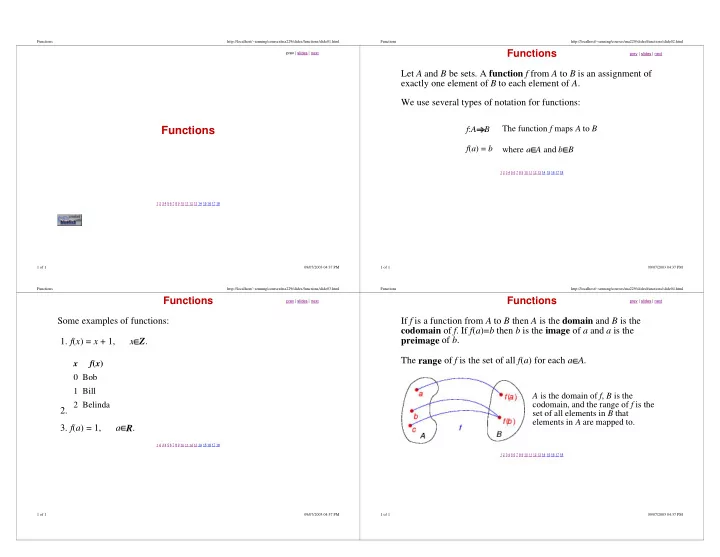
Let A and B be sets. A function f from A to B is an assignment of exactly one element of B to each element of A. We use several types of notation for functions:

f:A B The function f maps A to B f(a) = b where a A and b B

1 2 3 4 5 6 7 8 9 10 11 12 13 14 15 16 17 18

Functions http://localhost/~senning/courses/ma229/slides/functions/slide03.html 1 of 1 09/07/2003 04:37 PM

Functions

prev | slides | next

Some examples of functions: f(x) = x + 1, x Z. 1.

x f(x) 0 Bob 1 Bill 2 Belinda

2. f(a) = 1, a R. 3.

1 2 3 4 5 6 7 8 9 10 11 12 13 14 15 16 17 18

Functions http://localhost/~senning/courses/ma229/slides/functions/slide04.html 1 of 1 09/07/2003 04:37 PM

Functions

prev | slides | next

If f is a function from A to B then A is the domain and B is the codomain of f. If f(a)=b then b is the image of a and a is the preimage of b. The range of f is the set of all f(a) for each a A.

A is the domain of f, B is the codomain, and the range of f is the set of all elements in B that elements in A are mapped to.

1 2 3 4 5 6 7 8 9 10 11 12 13 14 15 16 17 18

slide-2
SLIDE 2

Functions http://localhost/~senning/courses/ma229/slides/functions/slide05.html 1 of 1 09/07/2003 04:37 PM

Functions

prev | slides | next

Given A={a,b,c,d}, B={1,2,3,4} which of the following are functions?

1 2 3 4 5 6 7 8 9 10 11 12 13 14 15 16 17 18

Functions http://localhost/~senning/courses/ma229/slides/functions/slide06.html 1 of 1 09/07/2003 04:37 PM

Functions

prev | slides | next

If f1 and f2 are functions from A to R then (f1 + f2)(x) = f1(x) + f2(x) 1. (f1 f2)(x) = f1(x) f2(x) 2. define the sum and product of f1 and f2. These new functions are functions from A to R as well.

1 2 3 4 5 6 7 8 9 10 11 12 13 14 15 16 17 18

Functions http://localhost/~senning/courses/ma229/slides/functions/slide07.html 1 of 1 09/07/2003 04:37 PM

Functions

prev | slides | next

If f is a function from A to B and S A then f(S) is a subset of B and is defined f(S) = { f(s) | s S }. Suppose A={0,1,2,...,9} and f(a) = a+10. If B={10,11,12,...,19} or any set containing this set then f is a function from A to B. If S={2,4,6} then f(S)={12,14,16} and f(S) B.

1 2 3 4 5 6 7 8 9 10 11 12 13 14 15 16 17 18

Functions http://localhost/~senning/courses/ma229/slides/functions/slide08.html 1 of 1 09/07/2003 04:37 PM

Functions

prev | slides | next

A function f is one-to-one or injective if and only if f(x)=f(y) implies x=y for all x and y in the domain of f. A function that is one-to-one is an injection.

  • ne-to-one

not one-to-one

1 2 3 4 5 6 7 8 9 10 11 12 13 14 15 16 17 18

slide-3
SLIDE 3

Functions http://localhost/~senning/courses/ma229/slides/functions/slide09.html 1 of 1 09/07/2003 04:37 PM

Functions

prev | slides | next

Whether or not a function is one-to-one can depend on it’s domain. For example, f(x)=sin(x) is not one-to-one if the domain is R but is

  • ne-to-one if the domain is - /2
  • x
  • /2.

Is f(x) = x2 one-to-one? (answer)

1 2 3 4 5 6 7 8 9 10 11 12 13 14 15 16 17 18

Functions http://localhost/~senning/courses/ma229/slides/functions/slide10.html 1 of 1 09/07/2003 04:37 PM

Functions

prev | slides | next

If every element of the codomain of a function is the image of some element in the domain then the function is said to be onto, or is called a surjection. A function f:A B is onto or surjective if and only if b B a A with f(a)=b. A function that is onto is a surjection.

  • nto

not onto

1 2 3 4 5 6 7 8 9 10 11 12 13 14 15 16 17 18

Functions http://localhost/~senning/courses/ma229/slides/functions/slide11.html 1 of 1 09/07/2003 04:37 PM

Functions

prev | slides | next

If a function is both one-to-one and onto it is called a one-to-one correspondence or a bijection. Exercise: Construct a function on the integers that is onto but not

  • ne-to-one. (possible solution)

Exercise: Construct a function on the integers that is one-to-one but not onto. (possible solution)

1 2 3 4 5 6 7 8 9 10 11 12 13 14 15 16 17 18

Functions http://localhost/~senning/courses/ma229/slides/functions/slide12.html 1 of 1 09/07/2003 04:37 PM

Functions

prev | slides | next

Consider a function f:A B that is a one-to-one correspondence: in this case it is both one-to-one and onto. Notice that if we turn the arrows around we have a function from B to A. This function is also a one-to-one correspondence.

1 2 3 4 5 6 7 8 9 10 11 12 13 14 15 16 17 18

slide-4
SLIDE 4

Functions http://localhost/~senning/courses/ma229/slides/functions/slide13.html 1 of 1 09/07/2003 04:37 PM

Functions

prev | slides | next

Let f be a one-to-one correspondence from A to B. The inverse function of f is the function that assigns to each element b of B an element a of A such that f(a)=b. We denote the inverse function f -1. f -1(b) = a when f(a) = b. The identity function on A is i

A:A

A where i

A(a)=a for each a A.

This is a one-to-one correspondence and so is invertible. It is, in fact, its own inverse. The function f:Z Z such that f(a)=a-4 for each a Z is a one-to-one correspondence with f -1(a)=a+4.

1 2 3 4 5 6 7 8 9 10 11 12 13 14 15 16 17 18

Functions http://localhost/~senning/courses/ma229/slides/functions/slide14.html 1 of 1 09/07/2003 04:38 PM

Functions

prev | slides | next

Let g be a function g:A B and let f:B

  • C. The composition of the

functions f and g is denoted f g and is defined (f g)(a) = f(g(a))

1 2 3 4 5 6 7 8 9 10 11 12 13 14 15 16 17 18

Functions http://localhost/~senning/courses/ma229/slides/functions/slide15.html 1 of 1 09/07/2003 04:38 PM

Functions

prev | slides | next

Let A = B = { x | x is a positive integer } and let f(x) = 2x, g(x) = x+5. What is (f g)(x)? (answer) What is (g f)(x)? (answer) Conclusion

1 2 3 4 5 6 7 8 9 10 11 12 13 14 15 16 17 18

Functions http://localhost/~senning/courses/ma229/slides/functions/slide16.html 1 of 1 09/07/2003 04:38 PM

Functions

prev | slides | next

Recall that the cartesian product of A and B is A x B = { (a,b) | a A and b B } and notice that { (a,b) | a A and b=f(a) } A x B if f is a function f:A B. In other words, (a,f(a)) A x B for all a A.

1 2 3 4 5 6 7 8 9 10 11 12 13 14 15 16 17 18

slide-5
SLIDE 5

Functions http://localhost/~senning/courses/ma229/slides/functions/slide17.html 1 of 1 09/07/2003 04:38 PM

Functions

prev | slides | next

Let f be a function f:A

  • B. The graph of function f is the set of
  • rdered pairs

{ (a,b) | a A and f(a) = b } Example: Let f(x) = 2x-1 be a function on Z. The graph of f is

1 2 3 4 5 6 7 8 9 10 11 12 13 14 15 16 17 18

Functions http://localhost/~senning/courses/ma229/slides/functions/slide18.html 1 of 1 09/07/2003 04:38 PM

Functions

prev | slides | next

The floor function assigns to the real number x the largest integer that is less than or equal to x. It is denoted with x . The ceiling function assigns to the real number x the smallest integer that is greater than or equal to x. It is denoted with x . Note that both of these functions map the reals to the integers: x :R Z, x :R Z. Question: Are these functions

  • ne-to-one?
  • nto?

invertible?

1 2 3 4 5 6 7 8 9 10 11 12 13 14 15 16 17 18