Functions as First Class Values Readings: HtDP , sections 19-20. - - PDF document

functions as first class values
SMART_READER_LITE
LIVE PREVIEW

Functions as First Class Values Readings: HtDP , sections 19-20. - - PDF document

Functions as First Class Values Readings: HtDP , sections 19-20. Language level: Intermediate Student Topics: Consuming functions Producing functions Binding functions Storing functions Contracts and types Simulating structures Intro


slide-1
SLIDE 1

Functions as First Class Values

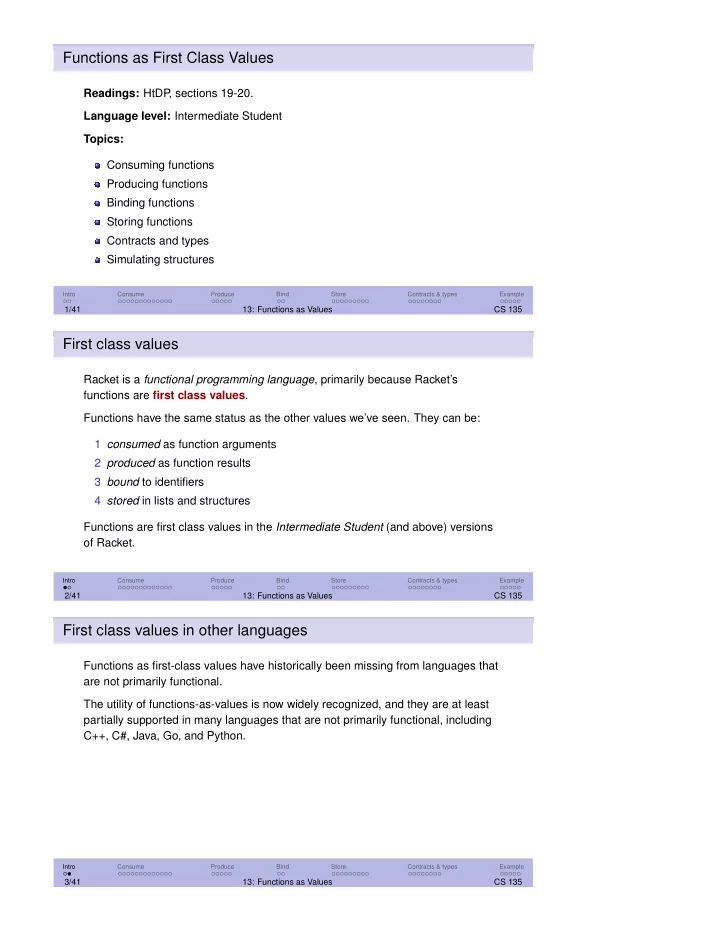
Readings: HtDP , sections 19-20. Language level: Intermediate Student Topics: Consuming functions Producing functions Binding functions Storing functions Contracts and types Simulating structures

Intro Consume Produce Bind Store Contracts & types Example

1/41 13: Functions as Values CS 135

First class values

Racket is a functional programming language, primarily because Racket’s functions are first class values. Functions have the same status as the other values we’ve seen. They can be: 1 consumed as function arguments 2 produced as function results 3 bound to identifiers 4 stored in lists and structures Functions are first class values in the Intermediate Student (and above) versions

  • f Racket.

Intro Consume Produce Bind Store Contracts & types Example

2/41 13: Functions as Values CS 135

First class values in other languages

Functions as first-class values have historically been missing from languages that are not primarily functional. The utility of functions-as-values is now widely recognized, and they are at least partially supported in many languages that are not primarily functional, including C++, C#, Java, Go, and Python.

Intro Consume Produce Bind Store Contracts & types Example

3/41 13: Functions as Values CS 135

slide-2
SLIDE 2

Consuming functions

In Intermediate Student a function can consume another function as an argument:

(define (foo f x y) (f x y)) (foo + 2 3) ⇒ (+ 2 3) ⇒ 5 (foo * 2 3) ⇒ (* 2 3) ⇒ 6 (foo append '(a b c) '(1 2 3))

⇒ (append '(a b c) '(1 2 3)) ⇒ '(a b c 1 2 3)

Is this useful? Consider two similar functions, eat-apples and keep-odds.

Intro Consume Produce Bind Store Contracts & types Example

4/41 13: Functions as Values CS 135

> Example: Eating apples

Consider two similar functions, eat-apples and keep-odds.

(define (eat-apples lst) (cond [(empty? lst) empty] [(not (symbol=? (first lst) 'apple)) (cons (first lst) (eat-apples (rest lst)))] [else (eat-apples (rest lst))]))

Intro Consume Produce Bind Store Contracts & types Example

5/41 13: Functions as Values CS 135

> Example: Keeping odd numbers

Consider two similar functions, eat-apples and keep-odds.

(define (keep-odds lst) (cond [(empty? lst) empty] [(odd? (first lst)) (cons (first lst) (keep-odds (rest lst)))] [else (keep-odds (rest lst))]))

Intro Consume Produce Bind Store Contracts & types Example

6/41 13: Functions as Values CS 135

slide-3
SLIDE 3

> Example: Abstracting out differences

What these two functions have in common is their general structure. Where they differ is in the specific predicate used to decide whether an item is removed from the answer or not. Because functions are first class values, we can write one function to do both these tasks because we can supply the predicate to be used as an argument to that function.

Intro Consume Produce Bind Store Contracts & types Example

7/41 13: Functions as Values CS 135

> Abstracting keep-odds to my-filter

(define (keep-odds lst) (cond [(empty? lst) empty] [(odd? (first lst)) (cons (first lst) (keep-odds (rest lst)))] [else (keep-odds (rest lst))])) (define (my-filter pred? lst) (cond [(empty? lst) empty] [(pred? (first lst)) (cons (first lst) (my-filter pred? (rest lst)))] [else (my-filter pred? (rest lst))]))

Intro Consume Produce Bind Store Contracts & types Example

8/41 13: Functions as Values CS 135

» Tracing my-filter

(my-filter even? (list 0 1 2 3 4))

⇒ (cons 0 (my-filter even? (list 1 2 3 4))) ⇒ (cons 0 (my-filter even? (list 2 3 4))) ⇒ (cons 0 (cons 2 (my-filter even? (list 3 4)))) ⇒ (cons 0 (cons 2 (my-filter even? (list 4)))) ⇒ (cons 0 (cons 2 (cons 4 (my-filter even? empty)))) ⇒ (cons 0 (cons 2 (cons 4 empty)))

my-filter handles the general operation of removing items from lists.

Functions such as my-filter that consume a (listof X) and a function to generalize it are called abstract list functions (abbreviated ALFs) or higher

  • rder functions.

We’ll see more ALFs in the next lecture module.

Intro Consume Produce Bind Store Contracts & types Example

9/41 13: Functions as Values CS 135

slide-4
SLIDE 4

» my-filter, visually

DaCapo 4 2 1 2 DaCapo 4 3

even ? even ? even ? even ? even ?

Intro Consume Produce Bind Store Contracts & types Example

10/41 13: Functions as Values CS 135

> Using my-filter

(define (keep-odds lst) (my-filter odd? lst)) (define (not-symbol-apple? item) (not (symbol=? item 'apple))) (define (eat-apples lst) (my-filter not-symbol-apple? lst))

The function filter, which behaves identically to our my-filter, is built into Intermediate Student and full Racket.

filter and other abstract list functions provided in Racket are used to apply

common patterns of simple recursion. We’ll discuss how to write contracts for them shortly.

Intro Consume Produce Bind Store Contracts & types Example

11/41 13: Functions as Values CS 135

Exercise 1

Use filter to write a function that consumes a (listof Num) and keeps only values between 10 and 30, inclusive.

(keep-inrange '(-5 10.1 12 7 30 3 19 6.5 42)) ⇒ '(10.1 12 30 19)

slide-5
SLIDE 5

Exercise 2

Use filter to write a function that consumes a (listof Str) and removes all strings of length greater than 6.

;; (keep-short L) Keep all the values in L of length at most 6. ;; keep-short: (listof Str) → (listof Str) ;; Example: (check-expect (keep-short '("Strive" "not" "to" "be" "a" "success" "but" "rather" "to" "be" "of" "value")) '("Strive" "not" "to" "be" "a" "but" "rather" "to" "be" "of" "value"))

Exercise 3

Use filter to write a function that keeps all multiples of 3.

(keep-multiples3 '(1 2 3 4 5 6 7 8 9 10)) ⇒ '(3 6 9)

Exercise 4

Use filter to write a function that keeps all multiples of 2 or 3.

(keep-multiples23 '(1 2 3 4 5 6 7 8 9 10)) ⇒ '(2 3 4 6 8 9 10)

slide-6
SLIDE 6

> Advantages of functional abstraction

Functional abstraction is the process of creating abstract functions such as

  • filter. Advantages include:

Reducing code size. Avoiding cut-and-paste. Fixing bugs in one place instead of many. Improving one functional abstraction improves many applications. We will do more of this in the next lecture module.

Intro Consume Produce Bind Store Contracts & types Example

12/41 13: Functions as Values CS 135

Producing functions

We saw in lecture module 12 how local could be used to create functions during a computation, to be used in evaluating the body of the local. But now, because functions are values, the body of the local can produce such a function as a value. Though it is not apparent at first, this is enormously useful. We illustrate with a very small example.

Intro Consume Produce Bind Store Contracts & types Example

13/41 13: Functions as Values CS 135

> Example: make-adder

(define (make-adder n) (local [(define (f m) (+ n m))] f))

What is (make-adder 3)? We can answer this question with a trace.

(make-adder 3)

⇒ (local [(define (f m) (+ 3 m))] f) ⇒ (define (f_42 m) (+ 3 m)) f_42

(make-adder 3) is the

renamed function f_42, which is a function that adds 3 to its argument. We can apply this function immediately, or we can use it in another expression, or we can put it in a data structure.

Intro Consume Produce Bind Store Contracts & types Example

14/41 13: Functions as Values CS 135

slide-7
SLIDE 7

> Example: make-adder applied immediately

((make-adder 3) 4)

⇒ ((local [(define (f m) (+ 3 m))] f) 4) ⇒ (define (f_42 m) (+ 3 m)) (f_42 4) ⇒ (+ 3 4) ⇒ 7

Before First position in an application must be a built-in or user-defined function. A function name had to follow an open parenthesis. Now First position can be an expression (computing the function to be applied). Evaluate it along with the other arguments. A function application can have two or more

  • pen parentheses in a row:

((make-adder 3) 4).

Intro Consume Produce Bind Store Contracts & types Example

15/41 13: Functions as Values CS 135

» A note on scope

(define (add3 m) (+ 3 m)) (define (make-adder n) (local [(define (f m) (+ n m))] f))

In add3 the parameter m is of no consequence after add3 is applied. Once add3 produces its value, m can be safely forgotten. However, our earlier trace of make-adder shows that after it is applied the parameter n does have a consequence. It is embedded into the result, f, where it is “remembered” and used again, potentially many times.

Intro Consume Produce Bind Store Contracts & types Example

16/41 13: Functions as Values CS 135

> Producing and consuming functions

In the next lecture module we’ll see an easier way to produce functions. That will allow us to produce functions “on the spot” to be consumed by functions such as

  • filter. This is very useful.

Intro Consume Produce Bind Store Contracts & types Example

17/41 13: Functions as Values CS 135

slide-8
SLIDE 8

Binding functions to identifiers

The result of make-adder can be bound to an identifier and then used repeatedly.

(define add2 (make-adder 2)) (define add3 (make-adder 3)) (add2 3) ⇒ 5 (add3 10) ⇒ 13 (add3 13) ⇒ 16

Intro Consume Produce Bind Store Contracts & types Example

18/41 13: Functions as Values CS 135

» Tracing a bound identifier

How does this work?

(define add2 (make-adder 2))

⇒ (define add2 (local [(define (f m) (+ 2 m))] f)) ⇒ (define (f_43 m) (+ 2 m)) ; rename and lift out f

(define add2 f_43) (add2 3)

⇒ (f_43 3) ⇒ (+ 2 3) ⇒ 5

Intro Consume Produce Bind Store Contracts & types Example

19/41 13: Functions as Values CS 135

Storing functions in lists & structures

Recall our code in lecture module 11 for evaluating arithmetic expressions (just + and * for simplicity):

(define-struct ainode (op args)) ;; An AINode is a (make-ainode (anyof '+ '*) (listof AExp))) ;; An AExp is (anyof Num AINode) ;; (eval ex) evaluates the arithmetic expression ex. ;; eval: AExp → Num (check-expect (eval 3) 3) (check-expect (eval (make-ainode '+ '(2 3 4))) 9) (check-expect (eval (make-ainode '+ '())) 0)

Intro Consume Produce Bind Store Contracts & types Example

20/41 13: Functions as Values CS 135

slide-9
SLIDE 9

> Example: eval and apply from M11

;; (eval ex) evaluates the arithmetic expression ex. ;; eval: AExp → Num (define (eval ex) (cond [(number? ex) ex] [(ainode? ex) (my-apply (ainode-op ex) (ainode-args ex))])) ;; (my-apply op exlist) applies op to the list of arguments. ;; my-apply: op (listof AExp) → Num (define (my-apply op args) (cond [(empty? args) (cond [(symbol=? op '+) 0] [(symbol=? op '*) 1])] [(symbol=? op '+) (+ (eval (first args)) (my-apply op (rest args)))] [(symbol=? op '*) (* (eval (first args)) (my-apply op (rest args)))]))

Intro Consume Produce Bind Store Contracts & types Example

21/41 13: Functions as Values CS 135

> Example: Evaluating expressions with functions

In ainode we could replace the symbol that represents a function with the function itself:

(define-struct ainode (op args)) (check-expect (eval 3) 3) (check-expect (eval (make-ainode + '(2 3 4))) 9) (check-expect (eval (make-ainode + '())) 0)

Some observations about Intermediate Student that will be handy:

(+ 1 2) ⇒ 3 (+ 1) ⇒ 1 (+ ) ⇒ 0 (* 2 3) ⇒ 6 (* 2) ⇒ 2 (* ) ⇒ 1

Intro Consume Produce Bind Store Contracts & types Example

22/41 13: Functions as Values CS 135

> Example: Evaluating expressions with functions

eval does not change. Here are the changes to my-apply:

Old:

(define (my-apply op args) (cond [(empty? args) (cond [(symbol=? op '+) 0] [(symbol=? op '*) 1])] [(symbol=? op '+) (+ (eval (first args)) (my-apply op (rest args)))] [(symbol=? op '*) (* (eval (first args)) (my-apply op (rest args)))]))

New:

(define (my-apply op args) (cond [(empty? args) (op )] [else (op (eval (first args)) (my-apply op (rest args)))]))

Intro Consume Produce Bind Store Contracts & types Example

23/41 13: Functions as Values CS 135

slide-10
SLIDE 10

> Example: Observations

This works for any binary function that is also defined for zero arguments.

Next steps:

We know that a structure with n fields can be replaced with an n-element list. Quoting gives a really compact notation that may be easier to read. For example:

(eval '(+ 1 (* 3 3 3)))

vs.

(eval (make-ainode + (list 1 (make-ainode * (list 3 3 3)))))

Seems like a ‘win’, but now our operator is a symbol again!

Intro Consume Produce Bind Store Contracts & types Example

24/41 13: Functions as Values CS 135

> Example: Functions in a table (1/2)

(define trans-table (list (list '+ +) (list '* *))) ;; (lookup-al key al) finds the value in al corresponding to key ;; lookup-al: Sym AL -

→ ???

(define (lookup-al key al) (cond [(empty? al) false] [(symbol=? key (first (first al))) (second (first al))] [else (lookup-al key (rest al))]))

Now (lookup-al '+ trans-table) produces the function +.

((lookup-al '+ trans-table) 3 4 5) ⇒ 12

Intro Consume Produce Bind Store Contracts & types Example

25/41 13: Functions as Values CS 135

> Example: Functions in a table (2/2)

;; (eval ex) evaluates the arithmetic expression ex. ;; eval: AExp → Num (define (eval ex) (cond [(number? ex) ex] [(cons? ex) (my-apply (lookup-al (first ex) trans-table) (rest ex))])) ;; (my-apply op exlist) applies op to the list of arguments. ;; my-apply: op (listof AExp) → Num (define (my-apply op args) (cond [(empty? args) (op )] [else (op (eval (first args)) (my-apply op (rest args)))]))

Intro Consume Produce Bind Store Contracts & types Example

26/41 13: Functions as Values CS 135

slide-11
SLIDE 11

> Functions in lists and structures (summary)

We’ve stored functions in both a structure and a list. Using a function instead of a symbol got rid of a lot of boiler-plate code in

apply.

Using quote notation made our expressions much more succinct, but forced us to again deal with symbols to represent functions. Putting symbols and functions in an association list provided a clean solution. Adding a new binary function (that is also defined for 0 arguments) only requires a one line addition to trans-table.

Intro Consume Produce Bind Store Contracts & types Example

27/41 13: Functions as Values CS 135

Functions as first class values (summary)

As a first class value, we can do anything with a function that we can do with other

  • values. We saw them all in the last example:

Consume: my-apply consumes the operator Produce: lookup-al looks up a symbol, producing the corresponding function Bind: results of lookup-al to op Store: stored in trans-table

Intro Consume Produce Bind Store Contracts & types Example

28/41 13: Functions as Values CS 135

Contracts and types

Contracts describe the type of data consumed by and produced by a function. Until now, the type of data was either a basic (built-in) type, a defined (struct) type, an anyof type, or a list type such as (listof Sym). What is the type of a function consumed or produced by another function?

Intro Consume Produce Bind Store Contracts & types Example

29/41 13: Functions as Values CS 135

slide-12
SLIDE 12

> Contracts as types

We can use the contract for a function as its type. For example, the type of > is (Num Num → Bool), because that’s the contract of that function. We can then use type descriptions like this in contracts for functions which consume or produce other functions.

Intro Consume Produce Bind Store Contracts & types Example

30/41 13: Functions as Values CS 135

> Contracts as types: Example

(define trans-table (list (list '+ +) (list '* *))) ;; (lookup-al key al) finds the value in al corresponding to key ;; lookup-al: Sym (listof (list Sym (Num Num → Num))) → ;; (anyof false (Num Num → Num)) (define (lookup-al key al) (cond [(empty? al) false] [(symbol=? key (first (first al))) (second (first al))] [else (lookup-al key (rest al))]))

Intro Consume Produce Bind Store Contracts & types Example

31/41 13: Functions as Values CS 135

> Contracts for abstract list functions

filter consumes a function and a list, and produces a list.

We might be tempted to conclude that its contract is

(Any → Bool) (listof Any) → (listof Any).

But this is not specific enough. Consider the application (filter odd? (list 1 2 3)). This does not obey the contract (the contract for odd? is Int → Bool) but still works as desired. The problem: there is a relationship among the two arguments to filter and the result of filter that we need to capture in the contract.

Intro Consume Produce Bind Store Contracts & types Example

32/41 13: Functions as Values CS 135

slide-13
SLIDE 13

> Parametric types

An application of (filter pred? lst) can work on any type of list, but the predicate provided should consume elements of that type of list. In other words, we have a dependency between the type of the predicate and the type of list. To express this, we use a type variable, such as X, and use it in different places to indicate where the same type is needed.

Intro Consume Produce Bind Store Contracts & types Example

33/41 13: Functions as Values CS 135

> The contract for filter

filter consumes a list of type (listof X).

That implies that the predicate must consume an X. The predicate must also produce a Boolean. It thus has a contract (and type!) of (X → Bool).

filter produces a list of the same type it consumes.

Therefore the contract for filter is:

;; filter: (X → Bool) (listof X) → (listof X)

Here X stands for the unknown data type of the list. We say filter is polymorphic or generic; it works on many different types of data.

Intro Consume Produce Bind Store Contracts & types Example

34/41 13: Functions as Values CS 135

> Type variables

We have used type variables in contracts for a long time. For example, (listof X). What is new is using the same variable multiple times in the same contract. This indicates a relationship between parts of the contract. For example, filter’s list and predicate are related. We will soon see examples where more than one type variable is needed in a contract.

Intro Consume Produce Bind Store Contracts & types Example

35/41 13: Functions as Values CS 135

slide-14
SLIDE 14

> Using contracts to understand

Many of the difficulties one encounters in using abstract list functions can be

  • vercome by careful attention to contracts.

For example, the contract for the function provided as an argument to filter says that it consumes one argument and produces a Boolean value. This means we must take care to never use filter with an argument that is a function that consumes two variables, or that produces a number.

Intro Consume Produce Bind Store Contracts & types Example

36/41 13: Functions as Values CS 135

Example: Simulating structures

We can use the ideas of producing and binding functions to simulate structures. Consider a structure representing a point:

(define-struct point (x y)) ;; A Point is a (make-point Num Num)

This can be simulated with a function:

;; (mk-point x y) produces a "structure" representing (x,y). ;; mk-point: Num Num → (define (mk-point x y) (local [(define (symbol-to-value s) (cond [(symbol=? s 'x) x] [(symbol=? s 'y) y]))] symbol-to-value))

Intro Consume Produce Bind Store Contracts & types Example

37/41 13: Functions as Values CS 135

> Tracing mk-point (1/2)

(define p1 (mk-point 3 4))

⇒ (define p1 (local [(define (symbol-to-value s)

(cond [(symbol=? s 'x) 3] [(symbol=? s 'y) 4]))] symbol-to-value))

Notice how the parameters have been substituted into the local definition. We now rename symbol-to-value and lift it out.

⇒ (define (symbol-to-value_38 s)

(cond [(symbol=? s 'x) 3] [(symbol=? s 'y) 4])) (define p1 symbol-to-value_38) p1 is now a function with the x and y values we supplied to mk-point coded in.

Intro Consume Produce Bind Store Contracts & types Example

38/41 13: Functions as Values CS 135

slide-15
SLIDE 15

> Tracing mk-point (2/2)

To get out the x value, we can use (p1 'x):

(p1 'x) ⇒ (symbol_to_value_38 'x) ⇒ ... ⇒ 3

We can define a few convenience functions to simulate the structure accessor functions point-x and point-y:

(define (point-x p) (p 'x)) (define (point-y p) (p 'y))

If we apply mk-point again with different values, it will produce a different rewritten and lifted version of symbol-to-value, say symbol-to-value_39. We have just seen how to implement structures without using lists.

Intro Consume Produce Bind Store Contracts & types Example

39/41 13: Functions as Values CS 135

> Simulating structures summary

Our trace made it clear that the result of a particular application, say

(mk-point 3 4), is a “copy” of symbol-to-value with 3 and 4 substituted for x and y, respectively.

That “copy” can be used much later, to retrieve the value of x or y that was supplied to mk-point. This is possible because the “copy” of symbol-to-value, even though it was defined in a local definition, survives after the evaluation of the local is finished.

Intro Consume Produce Bind Store Contracts & types Example

40/41 13: Functions as Values CS 135

Goals of this module

You should understand the idea of functions as first-class values: how they can be supplied as arguments, produced as values, bound to identifiers, and placed in lists and structures. You should understand how a function’s contract can be used as its type. You should be able to write contracts for functions that consume and/or produce functions.

Intro Consume Produce Bind Store Contracts & types Example

41/41 13: Functions as Values CS 135