Functional Dependencies and Normalization There are many forms of - - PDF document

functional dependencies and normalization
SMART_READER_LITE
LIVE PREVIEW

Functional Dependencies and Normalization There are many forms of - - PDF document

Functional Dependencies and Normalization There are many forms of constraints on relational database schemata other than key dependencies. Undoubtedly most important is the functional dependency. A functional dependency, or FD, is a


slide-1
SLIDE 1

Functional Dependencies and Normalization

· There are many forms of constraints on relational

database schemata other than key dependencies.

· Undoubtedly most important is the functional

dependency.

· A functional dependency, or FD, is a constraint

  • n a single relation schema.

· Basically, it is a key constraint on a subset of the

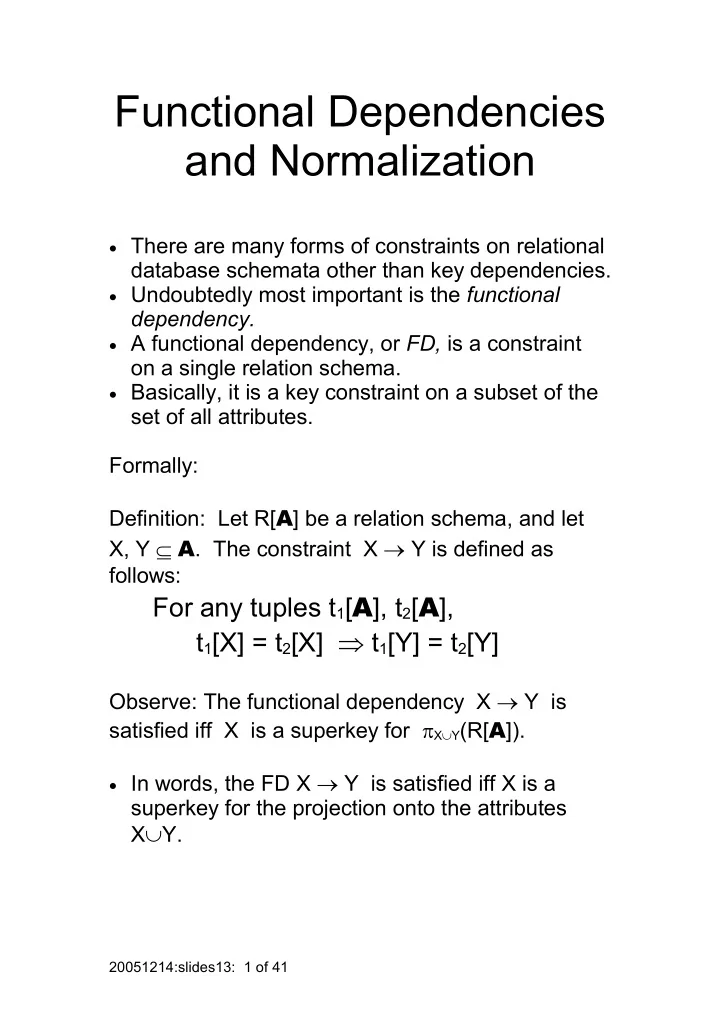
set of all attributes. Formally: Definition: Let R[A] be a relation schema, and let X, Y  A. The constraint X  Y is defined as follows:

For any tuples t1[A], t2[A], t1[X] = t2[X]  t1[Y] = t2[Y]

Observe: The functional dependency X  Y is satisfied iff X is a superkey for XY(R[A]).

· In words, the FD X  Y is satisfied iff X is a

superkey for the projection onto the attributes XY.

20051214:slides13: 1 of 41

slide-2
SLIDE 2

Example: Rail_Schedule Engineer Train Date Departure Platform {Train}  {Departure} {Engineer, Date, Departure}  {Train} {Train, Date}  {Engineer, Platform}

20051214:slides13: 2 of 41

slide-3
SLIDE 3

Semantic Consequence:

It is often the case that if certain FD’s hold, then

  • thers must hold as well.

Examples: If {Train, Date}  {Engineer, Platform} and {Engineer, Date, Departure}  {Train} hold then so does {Engineer, Date, Departure}  {Platform}. If {Train}  {Departure} holds then so does {Train, Engineer}  {Departure}. Formally, let A be a set of attributes, and let F1, F2, .., Fn, and G be FD’s over A. G is a semantic consequence of {F1, F2, .., Fn}, written

{F1, F2, .., Fn}  G

if the FD G holds whenever all of the elements of {F1, F2, .., Fn} do. (This applies to any relation whatever on the attribute set A.) If {G1, G2, .., Gm } is a set of FD’s, then

{F1, F2, .., Fn}  {G1, G2, .., Gm }

means that {F1, F2, .., Fn}  GI for each i, 1  i  m.

20051214:slides13: 3 of 41

slide-4
SLIDE 4

Examples: {{Train, Date}  {Engineer, Platform} {Engineer, Date, Departure}  {Train}}  {Engineer, Date, Departure}  {Platform} {{Train}  Departure}}  {Train, Engineer}  {Departure}. Closure: The set G of all FD’s for which {F1, F2, .., Fn}  G holds is called the (semantic) closure of {F1, F2, .., Fn}, and is denoted {F1, F2, .., Fn}+. Two sets of FD’s F and G are said to be equivalent if F+ = G+. Exterior: The set G of all FD’s for which {F1, F2, .., Fn}  G does not hold, written

{F1, F2, .., Fn} / G

is called the (semantic) exterior of {F1, F2, .., Fn}, and is denoted {F1, F2, .., Fn}. Example: {{Train}  {Departure} {Engineer, Date, Departure}  {Train} {Train, Date}  {Engineer, Platform} } / {Departure}  {Train}.

20051214:slides13: 4 of 41

slide-5
SLIDE 5

Question: How is the relation  determined?

· Purely semantic approaches are possible, but

  • impractical. (Compare truth tables in

propositional logic.)

· Syntactic inference system: A syntactic inference

system is a collection of rules which allows us to conclude new assertions (i.e., FD’s) from existing

  • nes.

Example: FD’s obey a transitive rule. If A  B and B  C both hold (for any attributes A, B, and C whatever), then so too does A  C. Thus, we might include such a rule in a syntactic system. For an inference system, the symbol which is typically used is  . Thus,

{F1, F2, .., Fn}  G

means that G can be deduced from {F1, F2, .., Fn} by application of the extant system of syntactic rules. (Alternately, there is a proof of G from {F1, F2, .., Fn}.) Example: A possible rule is { A  B, B  C}  A  C.

20051214:slides13: 5 of 41

slide-6
SLIDE 6

A Syntactic Proof System:

In the following rules, let A be a set of attributes, and let W, X, Y, and Z be arbitrary subsets of A. A1 (Reflexivity): { Y  X }  X  Y. A2 (Augmentation): { X  Y }  XZ  YZ. A3 (Additivity) : { X  Y, X  Z }  X  YZ. A4 (Projectivity): { X  YZ }  X  Y. A5 (Transitivity): { X  Y, Y  Z }  X  Z. A6 (Pseudotransitivity): { X  Y, YZ  W }  XZ  W. Contrary to the assertion in the text, we cannot “prove” these rules. However, it can be established that they have certain fundamental logical

  • properties. But first, we must be clear about what is

meant by an inference.

20051214:slides13: 6 of 41

slide-7
SLIDE 7

Definition: Let  be an inference relation, and let 1, 2, ..., n, and  be assertions. A proof of  from {1, 2, ..., n} is a sequence of assertions

1, 2, .., i, i+1, .., k-1, k

with the property that

  • 1. The final element in the list is the conclusion

which is sought; i.e., k = .

  • 2. Every element in the list is either one of the I’s
  • r else a consequence, via , of some of the

preceding elements in the list. Formally, for each i, 1  i  k, either i  {1, 2, ..., n} or else  

i for some   {1, 2, .., i-1}.

20051214:slides13: 7 of 41

slide-8
SLIDE 8

Example: Prove {Engineer, Date, Departure}  {Platform} from the axioms of the earlier example. 1. {Train}  {Departure} (Given) 2. {Engineer, Date, Departure}  {Train} (Given) 3. {Train, Date}  {Engineer, Platform} (Given) 4. {Engineer, Date, Departure}  {Train, Date} (A2: Augmentation of 2) 5. {Engineer, Date, Departure}  {Engineer, Platform} (A5: Transitivity on 4 and 3)

6.

{Engineer, Date, Departure}  {Platform}. (A4: Projectivity on 5)

20051214:slides13: 8 of 41

slide-9
SLIDE 9

Formal properties of inference systems:

· Soundness: Everything which can be proven is

  • true. Formally, If {1, 2, ..., n}  , then

{1, 2, ..., n}  .

· Completeness: Everything which is true can be

  • proven. Formally, if {1, 2, ..., n}  , then

{1, 2, ..., n}  .

· Decidability: There is an algorithm which can

apply the proof rules and determine whether or not there is a proof of the desired conclusion from the axioms. (The process cannot loop forever in a search.) Fact: The axioms A1-A6 are sound and complete, and possess a decidable inference algorithm. (It is easy to see that things are decidable in this

  • context. Why?)

Fact: The subset consisting of just A1 (Reflexivity), A2 (Augmentation), and A6 (Pseudotransitivity) is complete.

20051214:slides13: 9 of 41

slide-10
SLIDE 10

A more intuitive inference system for FD’s:

The following system is based upon directed acyclic graphs (DAG):

· Reduce all FD’s to those with only one attribute

  • n the right-hand side (RHS).

Example: {Train, Date}  {Engineer, Platform} becomes: {Train, Date}  {Engineer} {Train, Date}  { Platform} Clearly, these two FD’s are equivalent to the one

  • above. Call such an FD simple.

· Represent each simple FD by a DAG in which the

nodes are attributes and the edges run from left- hand side (LHS) attributes to right-hand side (RHS) attributes. Example: The FD {Train, Date}  {Engineer} is represented as follows.

20051214:slides13: 10 of 41

Train Date Engineer

slide-11
SLIDE 11

Derivations are represented by gluing these graphs

  • together. For example, here is a derivation of

{Engineer, Date, Departure}  {Platform}. This graph embodies the FD’s {Engineer, Date, Departure}  {Train} {Train, Date}  {Platform} as axioms. It derives the FD {Engineer, Date, Departure}  {Platform} because

· The LHS attributes are the initial nodes of the

graph.

· All RHS attributes are named in nodes which are

connected to these initial nodes. Fact: This DAG procedure is sound and complete for inference on FD’s. (D. Maier, The Theory of Relational Databases, Computer Science Press, 1983.)

20051214:slides13: 11 of 41

Train Date Platform Engineer Departure

slide-12
SLIDE 12

Normalization:

· Schemata constrained by arbitrary sets of FD’s

have certain anomalies which make them

  • undesirable. To remedy this situation, there have

been quite a number of normal forms proposed which deal with these issues.

· There are two approaches to normalization: · In the decomposition approach, one starts with

a relational database schema with perhaps only

  • ne or a very few relations, and decomposes

the relations (using projection) into smaller

  • nes in an effort to remove the problems.

· In the synthetic approach, one starts with a set

  • f FD’s, and then attempts to construct a

relational database schema which embodies those FD’s while avoiding any anomalies.

· Each approach as its advantages and

  • disadvantages. However, the synthetic approach

has the more serious drawbacks, so we will focus

  • n the much more common decomposition

approaches.

· First, we need to consider some normal forms.

20051214:slides13: 12 of 41

slide-13
SLIDE 13

Normal Forms:

· In early papers, E. F. Codd, who is credited with

“inventing” the relational model, introduced three normal forms.

First Normal Form:

This just says that domains consist of atomic values, and may not themselves be structured. In most modern work, this property is built into the model.

20051214:slides13: 13 of 41

slide-14
SLIDE 14

Second Normal Form:

Consider a slight modification of the Rail Schedule example. Rail_Schedule Engineer Train Date Departure Platform {Train}  {Departure, Platform} {Engineer, Date, Departure}  {Train} {Train, Date}  {Engineer} A train now must depart from the same platform every day. There is a so-called anomaly in this schema.

· Note that the values of Departure and Platform

are determined by the value of the attribute Train alone, and so many tuples replicate this information. Rail_Schedule Engineer Train Date Departure Platform Ola 12 23 0800 4 Kari 12 24 0800 4 Ola 12 25 0800 4 Renée 13 23 0930 5 René 13 24 0930 5 Renée 13 25 0930 5

20051214:slides13: 14 of 41

slide-15
SLIDE 15

· If the platform or departure time for a train are to

be changed, they must be changed in every tuple associated with that train. (Update anomaly)

· To insert a new train, we must have information

  • n a date for that train, and for an engineer for

each such date. (Insertion anomaly)

· If no information for any date is available for a

train, its departure and platform information are

  • lost. (Deletion anomaly)

20051214:slides13: 15 of 41

slide-16
SLIDE 16

· These problems may be (partially) remedied by

decomposing the relation into two pieces.

· In the following solution, we break the single

relation into two as follows. Now, the update anomalies have disappeared. Train Departure Platform 12 0800 4 13 0930 5 Engineer Train Date Ola 12 23 Kari 12 24 Ola 12 25 Renée 13 23 René 13 24 Renée 13 25

20051214:slides13: 16 of 41

slide-17
SLIDE 17

Formalization of 2NF: Let R[A] be a relation schema, and let F be a set of FD’s on R[A]. Assume, without loss of generality, that all FD’s in F have only a single element on the

  • RHS. Then F is said to be in 2NF if for each FD

X  {B}  F with B X, the following condition is satisfied: If

· There is a candidate key K such that

X  K; and

· There is no candidate key L such that

B  L (i.e., B is not a prime attribute); Then

· X = K. · In this case, it is said that B is fully dependent, or

irreducibly dependent, upon each candidate key, because there can be no proper subset of such a key upon which B depends.

· So, a schema is in 2NF if each nonprime attribute

is fully dependent upon each candidate key.

· · The original single-relation schema violates 2NF

for

20051214:slides13: 17 of 41

slide-18
SLIDE 18

· The candidate keys of the original single-relation

schema are {Train, Date} and {Engineer, Date, Departure}.

· The dependency {Train}  {Platform} violates

the conditions of 2NF, since Train is a prime attribute which is not a candidate key, while Platform is not a prime attribute.

· Verify that the decomposed schema is in 2NF:

{Train}  {Departure, Platform} {Engineer, Date, Departure}  {Train} {Train, Date}  {Engineer} Train Departure Platform Engineer Train Date

· This is trivial since each relation contains only

  • ne of the original FDs, and the left-hand side of

each of those FDs is a key for that relation.

· · Note that the second FD is no longer recaptured

by a relation! (The decomposition is not dependency preserving. More on this later.)

20051214:slides13: 18 of 41

slide-19
SLIDE 19

Here is an alternate solution which is also in 2NF: Train Departure Platform 12 0800 4 13 0930 5 Engineer Train Date Departure Ola 12 23 0800 Kari 12 24 0800 Ola 12 25 0800 Renée 13 23 0930 René 13 24 0930 Renée 13 25 0930

· Note that an update anomaly remains.

20051214:slides13: 19 of 41

slide-20
SLIDE 20

Verify that it is in 2NF: {Train}  {Departure, Platform} {Engineer, Date, Departure}  {Train} {Train, Date}  {Engineer} Train Departure Platform Engineer Train Date Departure

· The first relation is trivially in 2NF, since

{Train}  {Departure, Platform} is its only FD.

· · In the second relation, the candidate keys are

{Engineer, Date, Departure} and {Train, Date}.

· Note that all atributes in the second relation are

prime; therefore, it must be in 2NF.

· Note that each FD is embodied in at least one of

the relations. (The decomposition is dependency preserving. More on this later.)

20051214:slides13: 20 of 41

slide-21
SLIDE 21

Third Normal Form:

Now let us modify the schema a bit further, adding a new attribute Loco (for Locomotive), and add the assumption that an engineer always drives the same locomotive, and a locomotive is only used for

  • ne train. The constraints then become:

Rail_Schedule Engineer Loco Train Date Departure Platform {Train}  {Departure, Platform} {Engineer}  {Loco} {Loco}  {Train} {Train, Date}  {Engineer} Example instance: Rail_Schedule Engineer Loco Train Date Departure Platform Ola A12 12 23 0800 4 Kari A12 12 24 0800 4 Ola A12 12 25 0800 4 Renée A22 13 23 0930 5 René A22 13 24 0930 5 Renée A22 13 25 0930 5

20051214:slides13: 21 of 41

slide-22
SLIDE 22

· This schema is not even in 2NF. · The candidate keys are {Train, Date},

{Loco, Date}, and {Engineer, Date}.

· Platform is not a prime attribute, so

{Train}  {Platform} violates 2NF.

20051214:slides13: 22 of 41

slide-23
SLIDE 23

The decomposition Train Departure Platform 12 0800 4 13 0930 5 Engineer Loco Train Ola A12 12 Kari A12 12 Renée A22 13 René A22 13 Engineer Train Date Ola 12 23 Kari 12 24 Ola 12 25 Renée 13 23 René 13 24 Renée 13 25 is easily verified to be in 2NF.

· Yet, there is an anomaly because of the

{Loco}  {Train} relationship in the second relation.

20051214:slides13: 23 of 41

slide-24
SLIDE 24

· A set of FD’s is said to be in third normal form

(3NF) with respect to a set F of FD’s if for every X  Y  F with Y  X, either X is a superkey, or else Y consists entirely of prime attributes.

· Note that {Loco}  {Train} violates this condition

in the second relation of the decomposition, since Engineer is the only key.

· The following decomposition resolves the

problem, providing a 3NF decomposition. Train Departure Platform 12 0800 4 13 0930 5 Engineer Train Date Ola 12 23 Kari 12 24 Ola 12 25 Renée 13 23 René 13 24 Renée 13 25 Engineer Loco Loco Train Ola A12 A12 12 Kari A12 A22 13 Renée A22 René A22

20051214:slides13: 24 of 41

slide-25
SLIDE 25

Fact: 3NF  2NF (trivially). Why is 3NF strictly stronger than 2NF?

· In 2NF, it is possible to have an FD X  A in

which none of the elements of X nor the attribute A are members of any candidate key.

· In 3NF, if X is not a superkey, then A must be a

member of a candidate key. We can verify that, for the example, all dependencies are embodied in one of the relations, so the decomposition is dependency preserving. {Train}  {Departure, Platform} {Engineer}  {Loco} {Loco}  {Train} {Train, Date}  {Engineer} Train Departure Platform Engineer Train Date Engineer Loco Loco Train

20051214:slides13: 25 of 41

slide-26
SLIDE 26

Boyce-Codd Normal Form:

Return to the example used in 2NF. Rail_Schedule Engineer Train Date Departure Platform {Train}  {Departure, Platform} {Engineer, Date, Departure}  {Train} {Train, Date}  {Engineer} Train Departure Platform 12 0800 4 13 0930 5 Engineer Train Date Departure Ola 12 23 0800 Kari 12 24 0800 Ola 12 25 0800 Renée 13 23 0930 René 13 24 0930 Renée 13 25 0930

· It is easy to see that this schema is in 3NF · {Train}  {Departure} does not violate 3NF in

the second relation, since Departure is a prime attribute.

20051214:slides13: 26 of 41

slide-27
SLIDE 27

3NF says:

· If the RHS of an FD is not a member of a

candidate key, then the LHS must be a superkey.

· If the RHS of an FD is a member of a

candidate key, then there is no restriction on the LHS.

· Boyce-Codd normal form remedies this situation

by strengthening the condition:

· A set of FD’s is said to be in Boyce-Codd normal

form (BCNF) with respect to a set F of FD’s if for every X  Y  F with Y  X, X is a superkey, regardless of whether or not Y consists entirely of prime attributes.

· The example schema is not in BCNF.

20051214:slides13: 27 of 41

slide-28
SLIDE 28

· The first decomposed schema from the 2NF

example is in BCNF: {Train}  {Departure, Platform} {Engineer, Date, Departure}  {Train} {Train, Date}  {Engineer} Train Departure Platform Engineer Train Date

· So is the 3NF example:

{Train}  {Departure, Platform} {Engineer}  {Loco} {Loco}  {Train} {Train, Date}  {Engineer} Train Departure Platform Engineer Train Date Engineer Loco Loco Train

20051214:slides13: 28 of 41

slide-29
SLIDE 29

Question: Is BCNF really the “best” form of decomposition? Fact: It is always possible to decompose a relational database schema while preserving dependencies into 3NF, but the same is not true for BCNF.

· While BCNF is “better” than 3NF in terms of

avoiding update anomalies, it is worse in that dependencies may be lost, or at least FD’s may need to be verified by checking several relations.

20051214:slides13: 29 of 41

slide-30
SLIDE 30

Dependency-Preserving Decompositions:

· Let R[A] be a relation schema, and let F be a set

  • f FD’s on A. Let B  A. The full projection of F
  • nto B, denoted B(F+), is the set of all elements

X  Y  F+ for which XY  B.

· Let R[A] be a relation schema, and let F be a set

  • f FD’s on A. Let

D = {R1[A1], R2[A2],.., Rn[An]} be a decomposition of R[A] into projections. The decomposition D is said to be dependency preserving if:

((F+)  (F+)  …  (F+))+ = F+

· Reexamine the examples.

20051214:slides13: 30 of 41

slide-31
SLIDE 31

Finding a dependency-preserving 3NF decomposition of an arbitrary schema constrained by FD’s: Algorithm: Input: A single relation schema R[A], together with a set F of FD’s on A.

  • 1. Find a minimal cover C for F. (Requires another

algorithm in general – see the textbook Algorithm 10.2 (14.2 in the 3rd Ed.) Usually easily done by inspection for toy examples.)

  • 2. Group the FD’s in C by LHS.

G1 = {X1  A1j | 1  j  m1} G2 = {X2  A2j | 1  j  m2}  Gn = {Xn  Anj | 1  j  mn}

  • 3. For each group Gi = {XI  Aij | 1  j  mi}, let

Yi = Xi  { Aij | 1  j  mi}. Include in the decomposition the relation schema

[R], together with the constraints in (F+).

  • 4. If Y1  Y2  ..  Yn  A, include a relation

schema, with no nontrivial dependencies, on attributes A \ (Y1  Y2  ..  Yn).

20051214:slides13: 31 of 41

slide-32
SLIDE 32

· It is clear that this produces a dependency-

preserving schema, since every FD is embodied in one of the constructed relations.

· It is less clear that this produces a 3NF

decomposition; this will not be proven here.

· If there is already more than one relation in the

schema to be decomposed, decompose each

  • separately. As long as the input is a 3NF

schema, so too will be the output.

· Examples: The running examples of these slides

are fairly trivial for this algorithm, since the dependencies already form a minimal cover of themselves, and each has a distinct LHS.

20051214:slides13: 32 of 41

slide-33
SLIDE 33

Other examples: Consider the very simple example R[ABC], with F = {A  B, B  C, A  C }.

· The full schema is not in 3NF, since B is not a

superkey and C is not prime. (Hence B  C is a “problem” dependency.)

· The decomposition algorithm produces:

R1[AB] with FD set {A  B} and R2[BC] with FD set {B  C}.

· Note that the original set of dependencies is

not a minimal cover of itself; A  C is

  • redundant. If we had included A  C in the

algorithm, the (non-3NF) decomposition R1[ABC] with FD set {A  B, A  C} and R2[BC] with FD set {B  C} would have been obtained.

· Thus, the process of finding a minimal cover is

essential.

20051214:slides13: 33 of 41

slide-34
SLIDE 34

Consider next the simple example R[ABC] with F = {A  B}.

· The algorithm constructs the schema

R1[AB] with FD set {A  B},

· It then adds the schema

R2[C] with empty FD set . to achieve attribute preservation.

· This is a “bad” decomposition, since C may

depend upon A and B in other ways. There is no way that we can recover the original relation on R [ABC] from the projections R1[AB] and R2[C].

· This is not the case with the previous example;

there the original relation could be recovered from the projections.

20051214:slides13: 34 of 41

slide-35
SLIDE 35

Lossless Decompositions:

· Let R[A] be a relation schema, and let F be a set

  • f FD’s on A. Let

D = {R1[A1], R2[A2],.., Rn[An]} be a decomposition of R[A] into projections. The decomposition D is said to be lossless if for any relation r  Sat(R[A],F),

(r)  (r)  …  (r) = r.

· It is difficult to envision a situation in which a lossy

decomposition would be acceptable. To repair the algorithm for 3NF decomposition, the following step is added.

  • 5. If none of the resulting schemata contains a key
  • f the original relation, create one additional

relation which consists of such a (minimal) key. To repair the example on the previous slide, add a

  • key. It is easy to see that AC is the only candidate

key, so add the relation schema R2[AC]. The old schema R2[C] may be removed, since it is subsumed by R2[AC].

20051214:slides13: 35 of 41

slide-36
SLIDE 36

General Ideas Regarding Lossless Decompositions:

Fact: Let R[A] be a relation schema, and let F be a set of FD’s on A. Let D = {R1[A1], R2[A2]} be a decomposition of R[A] into two projections. Then D is lossless if and only if at least one of the following conditions is satisfied.

· The FD A1

 A2  A1 \ A2  F+.

· The FD A1

 A2  A2 \ A1  F+.

In words, the common attributes must form a key for at least one of the two relations. Unfortunately, this condition does not extend to the case of a decomposition into three or more relations. Example: The relation schema R[ABCD] with FD set {A  C, B  D} has the following lossless decomposition: R1[AB] with FD set . R2[ACD] with FD set {A  C}. R3[BCD] with FD set { B  D}.

· However, the above conditions are not satisfied

for any two of the relations.

· Furthermore it is not the case that joining just two

  • f the projections will yield the original relation,

even though all of the attributes are covered.

20051214:slides13: 36 of 41

slide-37
SLIDE 37

There is a general theory of lossless

  • decompositions. The highlights:

· Instead of working with FD’s, one may work

directly with “decomposition dependencies:”

· multivalued dependencies · join dependencies · Niceness is related to a property called

“acyclicity,” which roughly corresponds to the idea that losslessness may be verified by checking the underlying schemata “two at a time.”

· This “niceness” is related to many other

“desirable” properties of database schemata, including efficient query processing and management of distributed databases.

20051214:slides13: 37 of 41

slide-38
SLIDE 38

Dependency-preserving BCNF decompositions:

· It is not always possible to decompose an

arbitrary relation schema, constrained by FD’s, into a BCNF relational schema, while preserving dependencies.

· In this sense, BCNF is not “better” – it cannot

always be realized! Algorithm to realize BCNF (may not be dependency preserving): Input: A single relation schema R[A], together with a set F of FD’s on A.

  • 1. Set Decomp  {R[A]}.
  • 2. While there is an S  Decomp which is not in

BCNF do:

· Choose an S[B]  Decomp which is not in

BCNF.

· Choose an FD X  Y  B(F+) which is not

a “BCNF FD;” i.e., the LHS is not a superkey for S[B]. Let B1 = XY, and let B2 = B \ Y.

· Decompose S[B] into S1[B1] and S2[B2]. · The resulting schema will always be lossless,

because with every decomposition step, one

  • f the components will contain a key for the

entire schema.

20051214:slides13: 38 of 41

slide-39
SLIDE 39

Example: Rail_Schedule Engineer Train Date Departure Platform {Train}  {Departure, Platform} {Engineer, Date, Departure}  {Train} {Train, Date}  {Engineer}

· The candidate keys are:

{Engineer, Date, Departure} {Train, Date}

· Thus,

{Train}  {Departure, Platform} is a non-BCNF FD. The new schema is Train Departure Platform Engineer Train Date Which is the schema obtained earlier. Note that it is not dependency preserving, since {Engineer, Date, Departure}  {Train} is lost.

· This schema is in BCNF.

20051214:slides13: 39 of 41

slide-40
SLIDE 40

· Note that most commercial DBMS’s effectively

force BCNF with respect to FD’s, because they

  • nly allow key constraints.

· They also allow foreign keys, which are

recaptured via inclusion dependencies. The theory is complex and not very satisfactory, so we shall not pursue it here.

An alternative: the synthetic approach:

· Advantages: · Need not start out with a schema in which

arbitrary design decisions are incorporated.

· Disadvantages: · Loss of non-FD associations.

20051214:slides13: 40 of 41

slide-41
SLIDE 41

Problems with the projection of FD’s:

Here is an interesting example: R[ABCD] with FD set F = {A  D, B  D, CD  A}. The view is the projection onto ABC: R1[ABC]. Facts:

· There is no set of FD’s which expresses the

constraints on R1[ABC].

· For any integer n, there is a relation r1 on

attributes AB, containing exactly n tuples, with the property that it is not a projection of any relation r  Sat(R[ABCD],F) yet any relation obtained by deleting one or more tuples from r is a projection of a legal relation in Sat(R[ABC],F).

· Thus, for no n is it “n-easy” to check the

constraints on R1[ABC].

· The constraints on R1[ABC] are nonetheless of

the ()..() variety.

20051214:slides13: 41 of 41