FSILG Village Kickoff Steve Baker 84 MAR 88, AILG Chair Stephen - - PDF document

fsilg village kickoff
SMART_READER_LITE
LIVE PREVIEW

FSILG Village Kickoff Steve Baker 84 MAR 88, AILG Chair Stephen - - PDF document

6/6/2016 FSILG Village Kickoff Steve Baker 84 MAR 88, AILG Chair Stephen DeFalco, 83, SM 88, Chair David Dellal 17, IFC President Bob Ferrara 67, Senior Director, Div. of Student Life Pamela Gannon, 84, Parent 16, 18, AILG


slide-1
SLIDE 1

6/6/2016 1

Steve Baker ‘84 MAR ‘88, AILG Chair Stephen DeFalco, ’83, SM ’88, Chair David Dellal ‘17, IFC President Bob Ferrara ‘67, Senior Director, Div. of Student Life Pamela Gannon, ‘84, Parent ‘16, ‘18, AILG Parent Outreach Chair Caitlyn Mason ‘17, Panhel President Pravina Samaratunga, ‘18, LGC Speaker

FSILG Village Kickoff

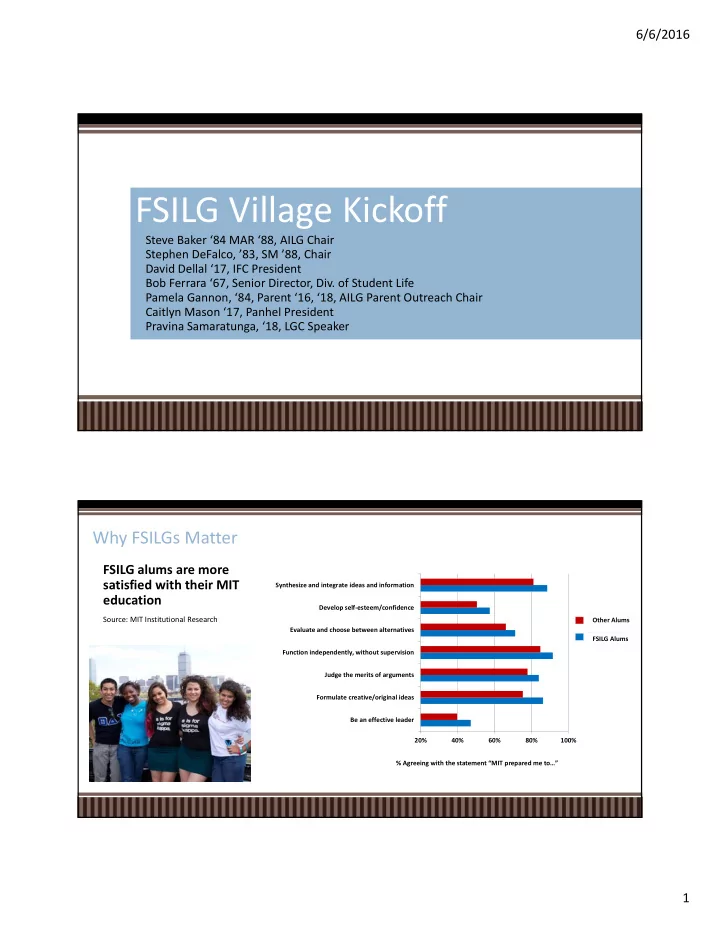
Why FSILGs Matter

FSILG alums are more satisfied with their MIT education

Source: MIT Institutional Research

% Agreeing with the statement “MIT prepared me to…” 20% 40% 60% 80% 100% Be an effective leader Formulate creative/original ideas Judge the merits of arguments Function independently, without supervision Evaluate and choose between alternatives Develop self‐esteem/confidence Synthesize and integrate ideas and information Other Alums FSILG Alums

slide-2
SLIDE 2

6/6/2016 2

Why FSILGs Matter

FSILG alums exhibit greater entrepreneurship and business leadership

Source: MIT Institutional Research

0% 10% 20% 30% 40% 50% 60%

Is your current employer a start‐up? Are you currently developing a start‐up? Have you ever started a company? Are you on a corporate board of directors? Are you a member of a professional, academic,

  • r business association?

% answering Yes Other Alums FSILG Alums

Why FSILGs Matter

FSILG alums are more engaged with MIT

Source: MIT Institutional Research

0% 20% 40% 60% 80% 100% $0 $200 $400 $600 $800 $1,000 1920+ 1940+ 1960+ 1980+ 2000+

Average Annual Giving

Year of Degree Average Annual Giving (1979-2003)

Dormitory FSILG Percent who lived in FSILGs

slide-3
SLIDE 3

6/6/2016 3

  • Leadership skills learned in MIT FSILG drive career success which leads to life

fulfillment and generosity to the Institute

  • FSILG community has been stressed the past 20 years and there are a few

difficult trend lines, especially for fraternities and other Boston based groups

  • This effort is an opportunity to provide housing for the growing sorority

community

  • West Campus planning effort timing creates a unique window of opportunity
  • Ultimately, this is about ensuring the FSILG community is a vibrant part of the

MIT experience for the next generation of students

Rationale for the Initiative FSILG Village Concept Progress

  • Jim Champy, MIT Exec Committee, ‘63 convenes group – March, 2014
  • Meeting with Chancellor – late April
  • Community meeting ‐ 6/11 before AILG Annual Meeting
  • Two Senior Administration meetings – July & August
  • Formal request for Assessment survey – late September
  • Survey launched – October 24, Survey closes ‐ November 17
  • Data analysis & report drafting – November & early December
  • By December 15, presentation of recommendations and interest level by FSILGs
  • Taskforce convened June 30th
  • Draft recommendations reviewed with West Campus planning committee on August 31
  • Draft recommendations reviewed with Chancellor and DSL office on September 17th
  • Plan presented and well received by DSL visiting committee on November 4, 2015
  • Follow up meeting with Dean Columbo on January 19, 2016 where taskforce effort is mobilized
  • Meeting with Chancellor Barnhart on January 26, 2016 to review materials and forward approach
  • Letter sent to community soliciting volunteers in April 2016, kick‐off session June 8th, 2016
slide-4
SLIDE 4

6/6/2016 4

  • A voluntary option that will

potentially be available

  • A longer range 3‐8 year plan
  • Being driven by concerned alums

with support of MIT

  • An approach to a unified plan for

the ILGs to support the next generation of MIT students

  • A unique opportunity to be part of

MIT’s long‐range planning

  • A mandated approach

where one size fits all

  • Relief to the short term

issues of the FSILG community

  • A completed plan which has

the full benefit of student input

What this is . . . . . What this is not . . . . .

  • Create a voluntary option for those organizations that desire to move into

a purposefully built student village as part of the West Campus planning process

  • Each organization could own and customize their house and enter into a

long‐term lease for the land with MIT

  • Similar to today, alums house corporations would work with the

undergraduate leaders to budget, manage and lead each individual house

The Key Elements of the FSILG Village Proposal Are:

slide-5
SLIDE 5

6/6/2016 5

FSILG Village Steering Committee FSILG Community Sustainability Benchmarking Other Universities Student Design Workshops Analyze the current health of the system from a financial and

  • ccupancy

perspective as well as trend lines over the last 10 years Goal Visits and discussion with other universities to learn best practices that could be incorporated into an MIT design Student involvement to help design FSILG Village concept in a way that it preserves leadership/community experience of current system with a sustainable going‐forward model Working Groups

FSILG Community Sustainability Working Group

Leadership – Jono Goldstein, Max Haubenstock Participants – Students, AILG, DSL

Activities

  • Analyze occupancy/recruitment trends
  • Analyze MIT enrollment trends
  • Evaluate current financial situation

across system looking at existing cash flow and deferred maintenance

  • Understand the current lease

agreements

  • Catalog risk events and implications of
  • utside influence on MIT decisions

End Products

  • Analyses of 20 year trend lines of

FSILG housing

  • Analysis of sustainability in FSILG

housing based on occupancy trends and financial health

  • Assessment of current occupancy and

financial condition of system

slide-6
SLIDE 6

6/6/2016 6

Benchmarking Other Universities Working Group

Leadership – Bob Ferrara, Justine Cheng Participants – Students, AILG, DSL Office, MITIMCO

Activities

  • Develop list of universities to benchmark

(initial list: Middlebury, Carnegie Mellon, Stanford, Dartmouth, Bucknell, Georgia Tech,

  • Univ. of Maryland, Washington University)
  • Compose interview guide and benchmarking

data request

  • Conduct pre‐visit interviews
  • Visit subset of campuses

End Products

  • List of best practices in developing and

managing FSILGs

  • Potential recruitment of thought leaders for

future committees

  • Understand range of ownership options
  • Outline various student governance models

Student Design Workshop Working Group

Leadership – Robert Binkowski, Panhel rep, ILG rep Participants – Students, Recent alums, MIT Architecture Faculty, DSL staff

Activities

  • Review background materials developed previously
  • Brainstorming of ideal FSILG living environment for

the future generation of MIT students

  • Develop an understanding of the differing needs of

fraternities, sororities and independent living groups

  • Recruit additional students/recent alums to

participate in one‐day or ongoing design workshops

  • Development of plan/conditions for potential FSILG

Village End Products

  • Generate guidelines that frame concept so

it works for MIT and is attractive to students

  • Support for FSILG Village concept or

alternate proposal

slide-7
SLIDE 7

6/6/2016 7

  • A chance to create our future
  • Opportunity to design new sustainable housing model
  • Option for unhoused FSILG chapters
  • More integration among the community
  • New housing with greater amenities, with potential for lower operating

costs

  • Chance to grow and diversify student choices

Benefits to the FSILG Community Timeline

Apr May Jun Jul Aug Sep Oct Nov Dec Jan

X X X X X X X X X X

Steering Committee Sustainability Benchmarking Design Steering Committee Recommendations

Preliminary Final

slide-8
SLIDE 8

6/6/2016 8

  • Working group orientation and workplanning
  • Summer/Fall for sustainability, benchmarking
  • Fall for design
  • Integrate activities with West Campus planning work
  • Individual meetings with each living group to discuss initiative
  • Keep in touch: http://ailg.mit.edu/committees/fsilg‐village/

Next Steps

Questions and Discussion