
SLIDE 1
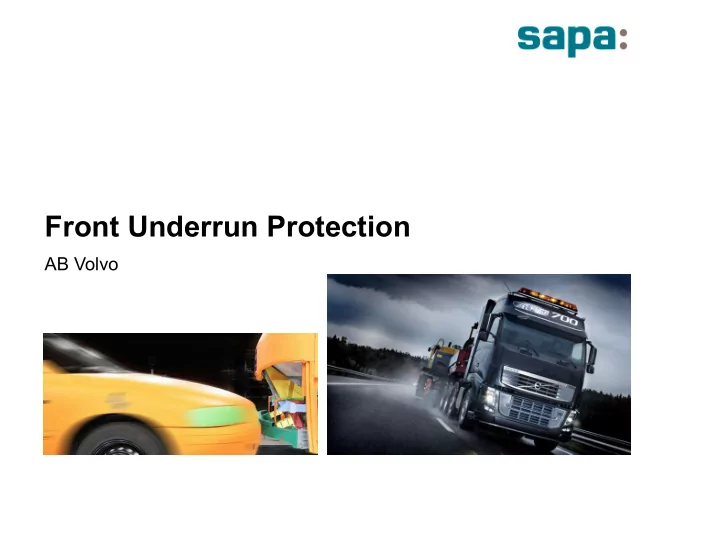
Front Underrun Protection AB Volvo Conditions A system which is - - PowerPoint PPT Presentation
Front Underrun Protection AB Volvo Conditions A system which is designed to ensure safety features of passanger cars are deployed during a front-on collision and prevent underrunning. The system is expected to reduce fatalities and the
P1: Y= -1075 mm F = 80 kN P2: Y= -577 mm F = 160 kN P3: Y= 0 mm F = 80 kN
Crash pads allowed to same shape as the beam.
Other adding requirements could be:
more hinges for the Frontstep)
Brand 1 only to fulfil legal requirement Brand 2 have increased crash requirements with
Different interfacing parts and concept between
Customer want robustness and progressive deformation characteristic to handle collisions with cars in 70 km/h, 50% offset Crash box and shear bolts Material in the beam is steel (T=4,0 mm; Rp0,2 = 590 MPa) Material in the crash box is steel (T=3,0 mm; Rp0,2 = 350 MPa) Weight beam = 48,2 kg (+6,3 kg for brackets) Weight crash boxes = 10,6 kg
Fulfil the crash requirements Match all interfaces Crash box and shear bolt bracket not included EN/AW 6005A-T6 Weight beam = 20,0 kg => 60% saving (1m in front of the Front Axle) Weight brackets = 2,7 kg => 60% saving
”Simple” simulations in Catia only on the beam to find the first draft of section design Original beam in steel Sapa beam in aluminium
P1 P2 LS-dyna simulations at Sapa Technology to find the right behavoir and strengt levels
CAE simulations at customer on complete system/truck to verify correct behavior
Same package space as current model Same interfacing part to be used Front and rear sheet in steel T=3,0 mm Weight Steel 34,8 kg
Fulfil the crash requirement Match all interfaces EN/AW 6005A-T6 Material thickness between 4-8 mm Weight beam = 20,3 kg => 42% saving
Main force is bending in x-direction All walls have not same strength requirements Disadvantages with steel Same thickness all over Advantages with Aluminium Thickness can be variated where it´s needed lower weight Ductility – crash performace … 6260 6063
Sapa can find solutions fulfil all requirements Weight saving on 60% Sapa have the skills and knowledge to make complex concept solutions including simulations