From the Postulator's Desk No. 31 September 2010 Donal S. Blake - - PDF document

from the postulator s desk no 31 september 2010 donal s
SMART_READER_LITE
LIVE PREVIEW

From the Postulator's Desk No. 31 September 2010 Donal S. Blake - - PDF document

From the Postulator's Desk No. 31 September 2010 Donal S. Blake CFC, Edmund Rice Postulator As I sit writing this letter, Pope Benedict XVI has just touched down in the UK at the beginning of his State Visit there. The late John Paul II in 1982


slide-1
SLIDE 1

From the Postulator's Desk

  • No. 31 September 2010

Donal S. Blake CFC, Edmund Rice Postulator

As I sit writing this letter, Pope Benedict XVI has just touched down in the UK at the beginning of his State Visit there. The late John Paul II in 1982 merely came on a pastoral

  • visit. This time the Pope is being received as Head of the Vatican State by Queen Elizabeth at

Holyrood Palace in Edinburgh, and will later meet the Prime Minister and the Deputy Prime Minister in London. This is truly a great historic occasion, hopefully putting to rest centuries

  • f Penal Laws against Catholics and bringing closer together the two great Christian

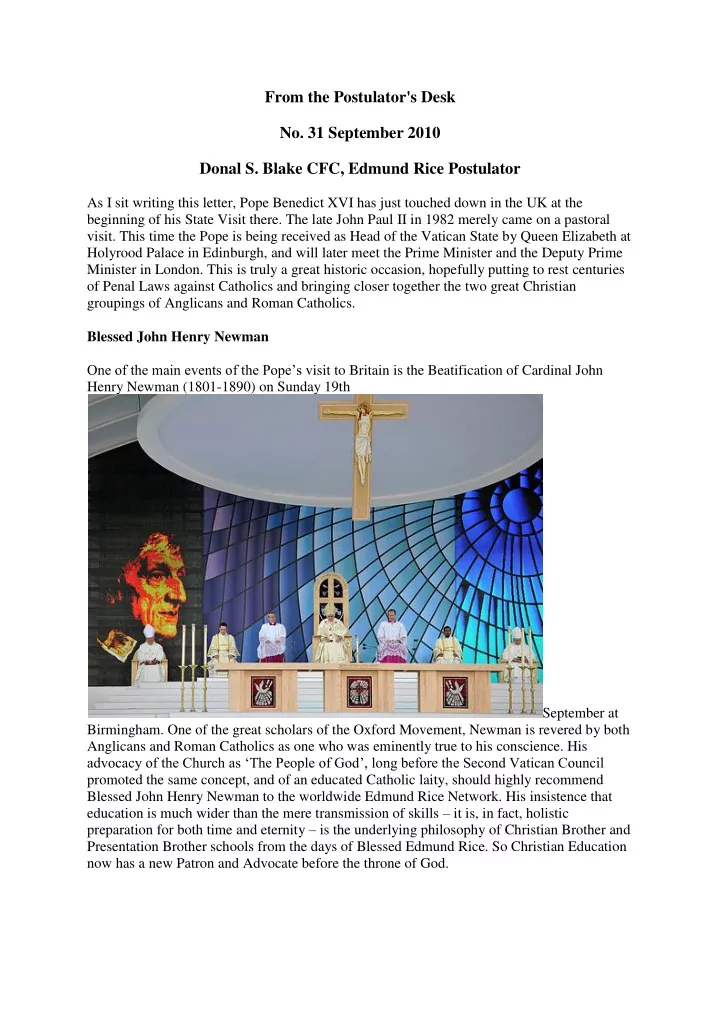
groupings of Anglicans and Roman Catholics. Blessed John Henry Newman One of the main events of the Pope’s visit to Britain is the Beatification of Cardinal John Henry Newman (1801-1890) on Sunday 19th September at

  • Birmingham. One of the great scholars of the Oxford Movement, Newman is revered by both

Anglicans and Roman Catholics as one who was eminently true to his conscience. His advocacy of the Church as ‘The People of God’, long before the Second Vatican Council promoted the same concept, and of an educated Catholic laity, should highly recommend Blessed John Henry Newman to the worldwide Edmund Rice Network. His insistence that education is much wider than the mere transmission of skills – it is, in fact, holistic preparation for both time and eternity – is the underlying philosophy of Christian Brother and Presentation Brother schools from the days of Blessed Edmund Rice. So Christian Education now has a new Patron and Advocate before the throne of God.

slide-2
SLIDE 2

Speaking to a male audience, Newman once summarised the product of education as “a Gentleman, a Scholar, and a Saint.” The central theme of the Pope’s visit to Britain is based

  • n a phrase found in Newman’s vast writings – “Heart speaks unto heart”[Cor ad cor

loquitur]. So, despite Newman’s enviable intellectual capacity, he urges us to reach out and speak not just head-to-head but heart-to-heart. If there is not an engagement of hearts, there may never be an engagement of minds. It reminds us of the prayer used by the Brothers at the end of their religious exercises, “Live Jesus in our hearts forever.” It reminds us too of Ricean spirituality which emphasises “the providential presence of God in our lives, and to respond to Christ present and appealing to us in the poor.” Long before Vatican II, Newman saw the value of going back to our roots – if we do not know where we are coming from, how can we plan with any enthusiasm for today’s and tomorrow’s journey? It was by Newman returning to the Church Fathers and the Scriptures that he identified the orthodoxy and authenticity of the Roman Church. Thus the importance

  • f history. So we are challenged to return to our Gospel and Edmundian origins so that we

can advance into the future to serve today’s world and today’s Church in the true spirit of Blessed Edmund. Blessed John Henry Newman’s hymn, ‘Lead Kindly Light Amid the Encircling Gloom,’ should give us peace and confidence in our search. With him, in another

  • f his hymns, we realise that the aim of all our journeying is: ‘Praise to the Holiest in the

Height’. An attractive challenge that Newman throws down is the use of IMAGINATION in the promotion of the Church and its institutions and ministries. Taking up this challenge, I now urge the readers of this communication to share with me how imagination might be harnessed to promote the Canonisation of Blessed Edmund Rice and the various ministries, projects and endeavours undertaken under his inspiration. By ‘imagination’ I think Newman means not

  • nly the use of images in a new way but imaginative approaches to what we are about – in

fact, lateral thinking. I can be reached with your imaginative suggestions at postulatorcfc@gmail.com Our congratulations reach out to the various Newman Societies and to schools and colleges named after the new ‘Beatus’ - there are several in the British Midlands– but I think in particular of Newman College, Buenos Aires, Argentina, founded by the Christian Brothers in 1948. I wonder, too, would it be a bridge too far in these secular times “amid the encircling gloom” for University College Dublin (UCD), the present day descendant of Newman’s 1854 Catholic University, for whom he wrote ‘The Idea of a University’, to consider a name change to Newman University? Would this be an over-use of “imagination”, the term used by Newman all those years ago? I also remember with special affection Newman University College, Birmingham, where I spent two happy and fruitful years, 1990-1992, as Newman Postgraduate Research Fellow, in preparation for the establishment in Ireland of the St Helen’s Education Office in 1992. Blessed John Henry Newman, pray for us and our educational endeavours. Edmund Rice Cause and Miracles People keep enquiring about the progress of the Edmund Rice Cause and the role of miracles. I am very conscious that because of recent bouts of ill-health I haven’t been as attentive as I would have liked. My present term as Roman Postulator comes to an end next summer and I will then have to consider my future role in the Edmund Rice Cause. Returning to miracles,

slide-3
SLIDE 3

there is both encouragement and disappointment in this area. There is encouragement in the number of people from all over the world who write in to claim that through the intercession

  • f Blessed Edmund Rice their prayers have been answered. Many indeed claim to have

experienced a physical or spiritual healing through such prayers. All of this is encouragement that there is true devotion to Blessed Edmund out there. Monsignor Robert Sarno, my mentor at the Congregation for the Causes of Saints, Rome, keeps reassuring me that everything, bar the approval of a miracle, is now in place for Edmund’s canonisation. He says we should bombard heaven, being always mindful that there is our time – and God’s time. We should, too, be mindful of the saying: “Act as if everything depends on you; pray as if everything depends on God.” The disappointment comes from the fact that the vast majority of ‘cures’ that we have on file do not generate sufficient medical evidence to convince the Congregation for the Causes of Saints in Rome, despite the fact that the people involved are convinced that there has been an exceptional answer to their prayers. Thus, we have had reports of ‘cures’ in Cork, Waterford, Callan, St Lucia, Buenos Aires, Melbourne, Liverpool, Toronto, India, to name but a few

  • locations. An added disappointment is that I only hear about some possible cures, merely by

accident, despite the many requests to Provinces and Regions to forward all information. One Region (whose blushes I wish to spare)) has still not forwarded details of a supposed ‘cure’ that occurred over two years ago, despite several requests from me and promises from them! Maybe we don’t wish to have Edmund canonised? As we all know, miracles do not grow on trees The advance of medical science makes it more difficult to prove that what has happened is indeed a miracle. Blessed Dominic Barberi (1792-1849), the Passionist who received Blessed John Henry Newman into the Church in 1845, was beatified by Pope Paul VI in 1964. Since then, nothing! I see from an old newspaper clipping of mine (1984) that his then Postulator, Fr Eugene Keenan CP, stated with a sigh: “Miracles are always a problem.” Fr James Walsh SJ, another Postulator from the 1980s, claimed 25 cases for miracles for one particular Cause – and all were turned down! When a journalist put it to him that miracles are becoming hard to come by, he replied: “You could say that having to go through these astringent tests sorts

  • ut the men from the boys! It is a big claim one is making after all. What might happen is that

miracles will change from the physical to the moral type; a hardened non-believer becoming converted could then be considered.” I suppose, at one level, the greatest miracle is that good works arising from the inspiration of Edmund Rice continue hundred of years after the time he lived and worked in our world. Anniversaries often trigger off a surge in enthusiasm. The date, 1 June 2012, will mark the 250th anniversary of the birth of Blessed Edmund Rice. I suggest that we set about a vigorous campaign of prayer for an accepted miracle between now and 1 June 2012. 2012: 250th Anniversary of the Birth of Blessed Edmund Rice As mentioned briefly above, 1 June 2012 marks the 250th anniversary of the birth of Blessed Edmund Rice in 1762 at Westcourt, Callan. Without this wondrous event in the family of Robert and Margaret Rice 250 years ago in the troubled Penal Days of Ireland’s past history, Irish educational and religious history might have panned out differently. True, the Servant of God, Nano Nagle, had taken up the challenge to Ireland’s Catholic laity to provide appropriate Catholic education for girls, by founding the Presentation Sisters in Cork in 1775. But if there was no Edmund Rice, to whom would she have passed on the torch for the

slide-4
SLIDE 4

Catholic education of boys? Recent research I have undertaken connected with the bicentenary of the founding of the North Monastery, Cork, in 1811, suggests that Bishop Moylan of Cork would have encouraged the foundation of a congregation of Presentation Brothers without any connection with Edmund Rice’s venture in Mount Sion, Waterford. Which brings me back to the celebrations in 2012. I am sure that Christian Brothers and Presentation Brothers and various manifestations of the Edmund Rice Network will wish to honour the occasion in a meaningful way. But at the moment there are so many different groupings and organisations sharing in one way or another in the life and heritage of Blessed Edmund Rice (Just look at the many websites that are listed if one types in ‘Edmund Rice’) that I wonder at times if the whole Edmund Rice ‘thing’ is in danger of being diluted. Despite my best efforts, I am not always informed of what is being planned by various

  • groups. Where does the Edmund Rice Postulator fit in to all of this? I speak merely as being

anxious not to lose the window of opportunity in the promotion of Edmund as Saint that could and should be provided by a well-thought out plan of campaign for the celebration of

  • 2012. By the way, I have not the slightest ambition (or, indeed, ability or energy) to wish to

take over any of the functions of the many excellent Edmund Rice-connected organisations that are already achieving excellent results for young people and others in today’s world and today’s Church. Any suggestions? Please get in touch. ‘EDMUND RICE – Restoring the Circle to the Celtic Cross’ Book on Edmund Rice by Br Peter Hardiman CFC, [Private Publication] Brisbane, Australia, July 2010 A new book, a labour of love, quite a few years in gestation, by Australian Christian Brother, Peter Hardiman, has just been produced. Because of a mailing hiccup, I hadn’t got my hands

  • n my own personal eagerly awaited copy of the book until yesterday. Peter, as some of you

know, has recently arrived in Mount Sion, Waterford, from the Philippines as a member of the staff of the International Heritage Centre and Chapel. We wish him a ‘céad mile fáilte’ to Waterford, and much happiness. He is interested in exploring the possibilities of Mount Sion as an Edmund Rice Studies Centre. While I was stationed in Rome six or seven years ago, I met Peter and read in draft form a number of the chapters of the new book and I can promise you a challenging and inspiring read. Now that I have taken a superficial glance at the book’s 521 pages while on a train journey from Waterford to Dublin yesterday afternoon, I can say at once that this is a fascinating book. The number of illustrations is impressive, even if their size is on the small side. The book is not meant to be an easy read, in the sense of a continuous narrative. Rather is it a combination of the insights of theology, history, philosophy, Celtic spirituality, Aboriginal ‘dreamtime’, story-telling, sociology, myth, folklore, cosmology, art, iconography, etc., brought to bear on the life and times of Blessed Edmund Rice and his message, yesterday and today. The book is divided into 29 chapters, and each chapter ends with five or six ‘Points for Reflection’. Professor Michael Jackson, who was close to Peter in his study of theology at Notre Dame University, Western Australia, speaks thus of the new book: “This is an exceptionally imaginative and deeply insightful work. In a wonderfully creative and quite Celtic mode of story-telling, the author uses an abundance of images, imaginary dialogue-partners and poets to chronicle Rice’s deeper spiritual conversion, his inspired use of money to the advantage of the poor, his establishing of a new form of

slide-5
SLIDE 5

monasticism as ‘monastery in the street’, together with his schools for the disadvantaged and programs of ‘liberation through liberation’ on behalf of the poor, young apprentices, and those pursuing catechetical and vocational goals.” My own review of the book will have to wait until the next edition of the ‘Postulator’s Desk.’ I can already see that this book should fit in excellently with The Way of the People ,the soon-be be published English translation of the late Br Phil Canny’s major study of the 18th -century Penal Law domestic Gaelic-speaking Church of the countryside that Edmund Rice experienced as a young man growing up near Callan in Co. Kilkenny. I am collaborating

  • n this with Br Leo Canny, Phil’s brother. The author of the new book, Br Peter Hardiman

cfc, may be contacted in Waterford to discuss the background of his new magnum opus on Edmund Rice at ptrhardiman@yahoo.com.au or at 087-6558331. He may also be able to update you on where the book may be obtained in your part of the world. I append below the short review of the book that appeared in the Oceania Christian Brothers. Newsletter,July 2010: A well-researched, thematically developed treatment of the life of Edmund Rice, this book examines the story from the angle of Celtic spirituality. Leading readers through dreamworld, myth, and otherworld, the writer gives major attention to the significance of the Celtic cross, which differs from an ordinary cross in that it contains a circle where the vertical and horizontal arms meet. Hardiman uses this feature to say that whereas an

  • rdinary cross speaks of adversity, the circle draws attention to the loving creativity of God.

His thesis is that Edmund Rice, coming on the scene towards the close of Ireland’s difficult Penal times, brought something of the joy of creation to the deprived youth of Ireland and the many needy who touched his compassionate heart. The author presents Rice’s difficult, declining years in great detail, where the cross is much more apparent than the circle. Giving rein to his imagination, Hardiman occasionally becomes a dramatist and a novelist to create the atmosphere for his story. He also uses a multitude of images to emphasise the points he is making. Copies of the book may be obtained from Xavier Grafix, 28 Moorak St, Taringa, Queensland, 4068, Australia.

  • Source: Oceania Christian Brothers Newsletter, July 2010.

Bicentenary of the North Monastery, Cork, 2011 The year 2011 marks the Bicentenary of the coming of Edmund Rice’s Brothers to Cork. Bishop Moylan of Cork was experiencing difficulties concerning the quantity and quality of untrained teachers that were employed in the City to staff a series of voluntary Catholic schools for poor boys established by the Cork Charitable Society since 1793. He looked enviously at the schools for girls founded by Nano Nagle’s Presentation Sisters. He even sent a young man named O’Shea over to London to train at Joseph Lancaster’s Monitorial

  • School. However, on his return, this young man proved a disaster. Then he heard that a man

named Edmund Rice had set up a series of schools for poor boys in the neighbouring Diocese

  • f Waterford and Lismore staffed by dedicated religious men who followed a Rule of Life

based on an adaptation of the Presentation Sisters’ Rule. Bishop Moylan visited Waterford in 1809 to see for himself. He met Edmund Rice. He was very impressed by Edmund and his ‘Brothers of the Presentation’ that he saw there. Back in Cork he asked for volunteers to go to Waterford to train as Brothers for the Cork

  • schools. The first two to answer the call were Jerome O’Connor (33) and John Leonard (25),
slide-6
SLIDE 6

two young businessmen of stainless reputation. Having completed their religious and teacher training under Edmund Rice at Mount Sion in Waterford, they returned to Cork in November 1811, and the rest, as they say, is history. At first they occupied a temporary dwelling and taught in the old school that had been set up by the Cork Charitable Society in Chapel Lane near the Cathedral or North Chapel, as it was called. In time others followed in the footsteps

  • f the pioneers. A young architect, Michael Riordan, joined up in 1814. He designed a

purpose-built school building and a religious residence. Bishop Moylan died in 1815 and left whatever money he had for the completion of the new buildings. He was replaced by Bishop John Murphy. The Brothers moved into the new residence or monastery in 1816, but the new school was adapted to become a temporary hospital because of an outbreak of a virulent form of typhus which is estimated to have claimed the lives of 25% of the population of the

  • city. The Brothers volunteered as nurses of the sick and, sadly, two of them, Ignatius

McDermott and Francis Ryan, martyrs of charity, succumbed to the illness. It was only in 1818 that the depleted community took possession of the new school building. Seated on a hill to the north of the city, the school was officially titled ‘Our Lady’s Mount.’ But it was as the North Monastery that this very successful school became known far and

  • wide. In time it became the inspiration for other schools north and south of the River Lee.

Simplistically, in a new reorganization of the Brothers, those north of the river continued to look to Edmund Rice as their inspiration and leader (Superior General) and became known as Christian Brothers (CFC) in the mid-1820s, while at the same time those south of the river also looked to Edmund Rice as their inspiration but chose to follow Bishop Murphy as their leader – they retained the old name ‘Presentation Brothers’ in a new totally separate congregation of Brothers. (FPM). Thus, in time, Blessed Edmund became venerated as the Founder of two distinct congregations of teaching brothers that developed separately after 1826 and spread around the world. In more recent years both groups have co-operated wholeheartedly to bring about Edmund’s Beatification (declared ‘Blessed’) in 1996 and, hopefully, Canonisation (declared ‘Saint’) in the not too distant future. Amen to that! A whole series of celebrations and publications is being planned by a Bicentenary Committee in events that will span the twelve months from November 2010 to November 2011. The next issue of the ‘Postulator’s Desk’, as well as the Christian Brother and Presentation Brother websites will carry further details. Mission Prayer of Blessed Cardinal Newman Finally, as a reflection for all members of the Edmund Rice Network, I conclude with the rather well-known Mission Prayer of Blessed Cardinal John Henry Newman. I think it is very apt for where we are today. It repays slow prayerful reading: God has created me to do him some definite service; He has committed some work to me which He has not committed to another. I have my mission – I may never know it in this life, but I shall be told it in the next. I am a link in the chain, a bond of connection between persons. He has not created me for naught. I shall do good: I shall do His work.

slide-7
SLIDE 7

I shall be an angel of peace, a preacher of truth in my own place while not intending it – if I but keep His commandments. Therefore I will trust him. Whatever, wherever I am. I can never be thrown away. If I am in sickness, my sickness may serve Him; in perplexity, my perplexity may serve Him. He does nothing in vain. He knows what He is about. He may take away my friends; he may throw me among strangers. He may make me feel desolate, make my spirit sink, hide my future from me – Still He knows what He is about. Donal Blake cfc, Edmund Rice Roman Postulator/ Congregation Historian, postulatorcfc@gmail.com ; 086-300 5604 Edmund Rice House 1, North Richmond Street Dublin 1, Ireland. 16 September 2010