From m Contain inme ment t to Conseq equen uence ces s of - - PowerPoint PPT Presentation

from m contain inme ment t to conseq equen uence ces s of
SMART_READER_LITE
LIVE PREVIEW

From m Contain inme ment t to Conseq equen uence ces s of - - PowerPoint PPT Presentation

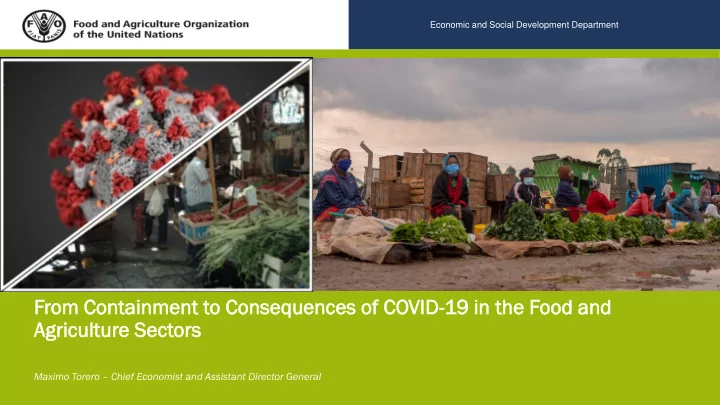
Economic and Social Development Department R e s o u r c e M o b i l i z a t i o n D i v i s i o n From m Contain inme ment t to Conseq equen uence ces s of COVID-19 9 in in the e Food d and d Agr gric iculture ulture Sec ector


slide-1
SLIDE 1

R e s o u r c e M o b i l i z a t i o n D i v i s i o n

From m Contain inme ment t to Conseq equen uence ces s of COVID-19 9 in in the e Food d and d Agr gric iculture ulture Sec ector

  • rs

Maximo Torero – Chief Economist and Assistant Director General

Economic and Social Development Department

slide-2
SLIDE 2

R e s o u r c e M o b i l i z a t i o n D i v i s i o n

The issue

 The coronavirus pandemic has been a crushing one-two punch to the global economy, delivering a dual shock to supply and demand in quick succession.  It’s a serious threat to food security because even though there is enough food for everyone in the world, it’s not a given that people have access to it.  The first jab was the disruption to the global food supply chain.  The second blow is a global recession. Surging job losses means that people are losing income to buy

  • food. It could trigger a food crisis induced by lack of income rather than high food price.

 Inequalities will be exacerbated specially on gender and minorities.

slide-3
SLIDE 3
  • 5.2

4.2

  • 7.0

3.9

  • 2.5

4.6

  • 8
  • 4

4 8

2010 2011 2012 2013 2014 2015 2016 2017 2018 2019 2020 2021

World Advanced economies EMDEs

Percent Source: World Bank.

Note: EMDEs = emerging market and developing economies. Shaded area indicates forecasts. Data for 2019 are estimates. Aggregate growth rates calculated using GDP weights at 2010 prices and market exchange rates.

Then Impacts of COVID-19 on GDP Growth

slide-4
SLIDE 4

Then Impacts of COVID-19 on Global Extreme Poverty

89-117 million people pushed to extreme poverty in 2020

slide-5
SLIDE 5

The Regional Distribution of the COVID-19 Induced Poor

slide-6
SLIDE 6

OECD – The recovery will be slow and uncertain

110 105 100 95 90 85

2019 2020 2021

World GDP

Constant prices, index, 2019Q4 =100

November 2019 projections Single-hit scenario Double-hit scenario

Source: OECD

slide-7
SLIDE 7
slide-8
SLIDE 8
slide-9
SLIDE 9
slide-10
SLIDE 10
slide-11
SLIDE 11
slide-12
SLIDE 12
slide-13
SLIDE 13
slide-14
SLIDE 14

Highest Valued Exports

slide-15
SLIDE 15
slide-16
SLIDE 16

Rising undernourishment in net food importing countries

slide-17
SLIDE 17

Jobs at risk

*Source: FAO/IFPRI unpublished estimates, based on ILO 2020 – ILO extrapolation scenario. Not annualized. Jobs represent formal employment; livelihoods cover a broad array of self-employed, informal, migrant and seasonal labor.

slide-18
SLIDE 18
slide-19
SLIDE 19

R e s o u r c e M o b i l i z a t i o n D i v i s i o n

UPDATE with your Division: Business Development and Resource Mobilization Division

What to do?

Health-Food- Development Tri-

  • logy
slide-20
SLIDE 20

Apple’s mobility data

slide-21
SLIDE 21
slide-22
SLIDE 22

What to do?

Meet immediate needs of vulnerable populations: Emergency Food Assistance, nutrition interventions and safety nets enhanced and made more accessible

Food Systems Transformation

Ensure that emergency food needs are fully met Protect basic consumption needs of vuhierable populations S cale up nutritional support S upport management and prevention of undernutrition Promote school feeding Adjust social protection programmes for food prices Allow free and predictable fl ow of food assistance Ensure that local purchases

  • f food and food components

for humanitarian purposes are exempt from restrictions Explore the establishment

  • f effi cient and effective

humanitarian food reserves Reach all households with pertinent public information

  • n food assistance, nutrition and

hardship alleviation programmes

School feeding programs– without schools

slide-23
SLIDE 23

A healthy diet is unaffordable for the poor in every region of the world

a) Cost of an energy sufficient diet compared with the international poverty line b) Cost of a healthy diet compared with the international poverty line

NOTES: Maps show the affordability of each of the three reference diets (energy sufficient, nutrient adequate and healthy diet) by comparing the cost of each of them with the international poverty line (USD 1.90 PPP a day) in 159 countries in year 2011, converted to international dollars using purchasing power parity (PPP). Unaffordability occurs here when the cost of a diet is higher than USD 1.33, i.e. 70 percent of USD 1.90 PPP a day, which accounts for a portion of the poverty line that can be credibly reserved for food. SOURCE: Herforth, A., Bai, Y., Venkat, A., Mahrt, K., Ebel, A. & Masters, M. 2020. Cost and affordability of healthy diets across countries. Background paper for the State of Food Security and Nutrition in the World 2020. FAO, Rome. Unpublished.
slide-24
SLIDE 24

What todo?

Meet immediate needs of vulnerable populations: Urgent increases in food availability from smallholder farmer food production

Food Systems Transformation

Promote E-commerce for agriculture

slide-25
SLIDE 25

Food Systems Transformation

Immediately review trade and t axat ion policy options and their likely impacts Avoid generalized subsidies for food consumers Reduce restrictions on use of stocks Improve efficiency

  • f trade facilitation

Encourage better functioning food markets through improved regional political and economic integration and better functioning for t radein food Use limited strategic grain reserves Minimize use of export restrictions Reduce import tarif fs and

  • ther restrictions

Temporarily reduce VAT and other taxes

Meet immediate needs of vulnerable populations: Issues on trade and tax policies

Adjustments to trade and tax policies

slide-26
SLIDE 26

R e s o u r c e M o b i l i z a t i o n D i v i s i o n

What to do?

Health-Food- Development Tri-

  • logy
slide-27
SLIDE 27
slide-28
SLIDE 28

R e s o u r c e M o b i l i z a t i o n D i v i s i o n

UPDATE with your Division: Business Development and Resource Mobilization Division

Prepare for the future?

slide-29
SLIDE 29

Before After

slide-30
SLIDE 30

Robotics Automatization

slide-31
SLIDE 31

Horizontal farming Vertical farming

slide-32
SLIDE 32

E-commerce

slide-33
SLIDE 33

THANK YOU

Food Systems Transformation