From Chernobyl to Fukushima: Responses during Nuclear Emergencies - - PowerPoint PPT Presentation

from chernobyl to fukushima responses during nuclear
SMART_READER_LITE
LIVE PREVIEW

From Chernobyl to Fukushima: Responses during Nuclear Emergencies - - PowerPoint PPT Presentation

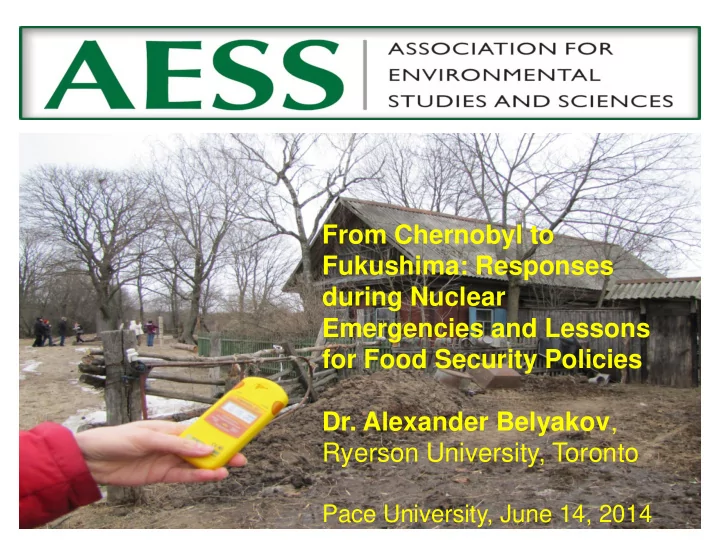
From Chernobyl to Fukushima: Responses during Nuclear Emergencies and Lessons for Food Security Policies Dr. Alexander Belyakov , Ryerson University, Toronto Pace University, June 14, 2014 Content Why Do I Research This Topic? Risks


slide-1
SLIDE 1

From Chernobyl to Fukushima: Responses during Nuclear Emergencies and Lessons for Food Security Policies

  • Dr. Alexander Belyakov,

Ryerson University, Toronto

Pace University, June 14, 2014

slide-2
SLIDE 2

Content

  • Why Do I Research This Topic?
  • Risks in the Food Systems after Chernobyl Disaster
  • The Most Affected Groups
  • Problems with Responses
  • How Bureaucracy Affects Responses During Nuclear Emergencies

– Example of Arithmetic Obfuscation

  • Mutual Influence of Economic and Political Factors
  • Chernobyl vs. Fukushima Disaster
  • Similarities in Risks During Emergencies
  • Lessons Learned from Japan
  • Lessons for Food Security Policies
  • What We Can Do for Resilience Strategy
  • Q & A
slide-3
SLIDE 3

Why Do I Research This Topic?

My personal experience:

  • Various visits to the affected areas in

Ukraine and Belarus in 1992-2011.

  • Member of the International Chernobyl

Research and Information Network (UNDP, IAEA, UNICEF, WHO).

  • Journalist for the national newspaper

“Robitnycha Gazeta” (Worker’s Newspaper), Kyiv, Ukraine, 1993-1997, and the national newspaper "Echo Chernobylja" (Echo of Chernobyl), Kyiv, Ukraine, 1992-1993.

  • Member, Board of Advisors, Chernobyl

Foundation, Toronto, Canada.

  • Speaker about Chernobyl.
slide-4
SLIDE 4
slide-5
SLIDE 5

Risks in the Food Systems after Chernobyl Disaster

Source: http://users.owt.com/smsrpm/Chernobyl/glbrad.html

slide-6
SLIDE 6

The Most Affected Groups

  • People who were

first resettled from 30 km zone and returned back, though it was not

  • fficially allowed at

the beginning (samosely) – disruption in food supply, malnutrition

  • Professional

fishermen

  • Clean-up workers
slide-7
SLIDE 7

The Most Affected Groups (cont.)

  • Local & indigenous residents whose diet

depend on fish or wild berries/mushrooms

  • r local dairy products and meat
  • Farmers dealing with irrigated agricultural

products (or dairy)

  • Pregnant women
  • Children
  • Seniors
  • Vulnerability analysis
slide-8
SLIDE 8

Problems with Responses

  • Ineffective risk communication
  • Main approach – relocation based on

assessing doses depending on soil contamination and distance from the nuclear plant (Lifelong dose depends on

  • ther factors, including food intake and

natural radiation)

  • Relocation of nearly one million people

from areas with contaminated soil was prescribed to avoid exposure to low levels

  • f radiation. This measure was later

accessed as pointless, both medically (as avoided external exposure dose was small) and socially (Filyshkin 1996)

  • Low attention to food security
slide-9
SLIDE 9

How Bureaucracy Affects Responses During Nuclear Emergencies

Gould analyzed seven ways that bureaucrats respond to a nuclear crisis:

– Suppression or covering up – Defining the problem away – Authoritative belittling – Arithmetic obfuscation – Public relations – Creative deception and – Information reduction

(Gould, 1990, 113).

slide-10
SLIDE 10

Example of Arithmetic Obfuscation

  • The way in which numerical risks

are presented is crucial.

  • With Chernobyl, the same cancer

risk could have been conveyed in the following ways: – 131 cancers expected in the lifetimes of the 24.000 people within 15 kilometers

  • f the plant

– A 2.6 percent increase in cancer rate of that exposed population or – An increase in cancer of .0047 percent of the population among 75 million people exposed in Ukraine and Belarus

(Wilson, Crouch, 1987; Susskind, 1996, 116).

slide-11
SLIDE 11

Mutual Influence of Economic and Political Factors

  • Chernobyl as one of the factors of the USSR collapse.
  • Consequences of the Soviet Union crisis

– “In Ukraine, abandonment rates reached 55.4% of all farmland in uncontaminated regions (i.e., outside the evacuation and relocation zones), compared to only 14.8% in the post-Chernobyl period” – “The collapse of the Soviet Union resulted in land abandonment rates that were even slightly higher (36% at the study region level) than those caused by the Chernobyl meltdown (33%)”. (Hostert et al, 2011).

  • Ukraine had also survived 10,000% inflation, a breakdown of

food supply and a deficit of basic food after the USSR collapse.

  • Reduction in food production, processing, delivery, storage.
  • What would be the impact of nuclear disaster on food supply

in a short and long-term perspective?

slide-12
SLIDE 12
slide-13
SLIDE 13
slide-14
SLIDE 14

Chernobyl vs. Fukushima Disaster

(Tetsunari, 2013)

slide-15
SLIDE 15

Map Showing the Fukushima Plume as it Expands Across the Pacific

http://cerea.enpc.fr/HomePages/bocquet/Doc/fukushima-Cs137-wide.swf

slide-16
SLIDE 16

Similarities During Nuclear Emergencies

  • New legislation - Act on

Protection of Specified Secrets in Japan.

  • Ineffective risk

communication related to food security

  • Cognitive dissonance

and panic (unusual food choices)

  • “Mental health crisis"

among Fukushima residents” (McCurry, 2013, p.791).

slide-17
SLIDE 17

Lessons Learned from Japan

1. Trust is essential. 2. Two way communications are vital.

  • 3. Resilience requires

expecting the unexpected and thinking the unthinkable.

  • 4. Recovery is long-term

(Spencer, 2013).

slide-18
SLIDE 18

Lessons for Food Security Policies

  • Ineffective risk communication has directly affected

political statements and decision-making processes (including in food security policies).

  • The United States government rewrites its plans for

responding to radiation contamination focusing on long-term cleanup instead of emergency response. Planners are referred to guidance

  • n radioactive contamination in

food from the U.S. Food and Drug Administration (FDA).

slide-19
SLIDE 19

Lessons for Food Security Policies (cont.)

Management measures after any nuclear disaster should include:

– Preventing consumption of contaminated food – Handling safe disposure of contaminated food – Proposing consumers alternative safe food and making sure people (especially relocated ones and those still living in contaminated areas) have access to safe, affordable food – Informing them on effective food choices – Informing on governmental decisions concerning food security.

slide-20
SLIDE 20

Lessons for Food Security Policies (cont.)

The National Diet of Japan Fukushima Nuclear Accident Independent Investigation Commission provided its recommendations: “It is more important that the government communicates in ways that are clearly helpful to the public:

– Identifying what is edible, – What the tolerable intake level is, – Which foods continue to be safe, and – Whether tests are reliable“ (2012, 9).

slide-21
SLIDE 21

Lessons for Food Security Policies

  • Preventive actions: 4.6 million residents of

Switzerland received iodine tablets in 2014 (costs $32.9 million covered by the power companies).

  • If iodine-131 is released, affected population should

avoid or at least minimize consumption of locally grown food ingredients and groundwater for minimum 8 days (the half-life of iodine-131)

  • r 2 to 3 months

(Christodouleas et al, 2011).

slide-22
SLIDE 22

Lessons for Food Security Policies (cont.)

  • The action plan must include dietary advice
  • The most significant contribution to the

internal dose after Chernobyl is from:

– Contaminated milk (70-75%), – Meat (7%), – Vegetables (7%), – Other foods (9%), – Water (1-2%), – Air (1%) (Onishi et al. 2007, 123).

slide-23
SLIDE 23

Lessons for Food Security Policies (cont.)

Introduction of obligatory control

  • f contamination levels of food:

– First of all milk and meat - on farms, for retailers and on markets. – Control system should be accompanied by adequate educational campaign to prevent confusion among consumers.

slide-24
SLIDE 24

Lessons for Food Security Policies (cont.)

  • Handing out some foods,

which are natural radioprotectors: fruit candies or marshmallows prepared from fruit puree – both are high in pectin.

  • Promote food processing

(both industrial and during home cooking), which can decrease incorporation of radionuclides with food

slide-25
SLIDE 25

Lessons for Food Security Policies (cont.)

Agricultural Decontamination & Long-Term Monitoring: The UK Food Standards Agency has the UK Post- Chernobyl Monitoring Program. A live sheep monitoring program ‘Mark and Release’ ensured that the level of consumer risk decreased enormously. About 2.5% percentage of sheep still have the potential to exceed 1,000 Bq/kg of radiocaesium (Field 2011).

slide-26
SLIDE 26

Lessons for Food Security Policies (cont.)

The restrictions on some food:

  • Germany, Austria, Italy, Sweden, Finland,

Lithuania and Poland: wild game (including boar and deer), wild mushrooms, berries and carnivorous fish from lakes - several thousand Bq per kg

  • f caesium-137,
  • Germany: caesium-137 levels in wild

boar muscle reached 40,000 Bq/kg. The average level is 6,800 Bq/kg, more than ten times the EU limit of 600 Bq/kg (Fairlie, Sumner 2006, p. 9).

slide-27
SLIDE 27

Lessons for Food Security Policies (cont.)

Need of big-scale government- supported research on food Case of Ukraine: donor funding was mostly devoted to other

  • issues. Even data, which was

regularly collected (on contamination of milk for example), was neither properly analyzed (on a large-scale in wide temporal frame) nor communicated.

slide-28
SLIDE 28

Current Approaches to Resilience Strategy

The Food and Agriculture Organization of the United Nations (2013) developed resilience strategy that addresses the following four pillars:

– Institutional capacity building and risks and crisis governance – Early warning systems and information – Protection, prevention and mitigation approaches – Preparedness and response to crises.

slide-29
SLIDE 29

What We Can Do For Resilience Strategy

  • Study perspectives of a disturbed system to restore its former

functioning after nuclear disasters

  • Development on separate food security resilience strategy for

nuclear disasters

  • How human factors affect all processes
  • Vulnerability analysis of food-insecure and vulnerable

households after the disasters is needed

  • Research into properties of food to accumulate radionuclides

and act as radioprotectors

  • Preventive measures to minimize the risk that radioactively

contaminated food is produced and consumed

slide-30
SLIDE 30

What We Can Do For Resilience Strategy (cont.)

  • Combining short-term response (not only relocation) focusing
  • n food security with long-term monitoring of agricultural

systems

  • Developing dose models based on not only on soil

contamination, but on other sources of exposure (food, water)

  • Focus on effective timely risk communication, vulnerabilities
  • Interdisciplinary collaboration (open to suggestions &

projects)

  • Fundraising for research (The Rockefeller Foundation and
  • thers)
slide-31
SLIDE 31
slide-32
SLIDE 32
  • Dr. Alexander Belyakov

Ryerson University Toronto, Canada Belyakov@ryerson.ca http://alexbelyakov.com All Chernobyl photos taken by the author

Other Images from GraphicStock.com

(Royalty Free License Agreement)

Full bibliography available on request