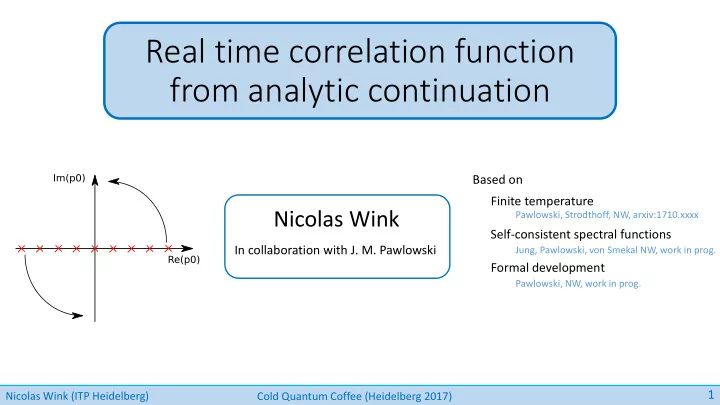
from analytic continuation Based on Finite temperature Nicolas - - PowerPoint PPT Presentation

from analytic continuation
SMART_READER_LITE
LIVE PREVIEW

from analytic continuation Based on Finite temperature Nicolas - - PowerPoint PPT Presentation

Real time correlation function from analytic continuation Based on Finite temperature Nicolas Wink Pawlowski, Strodthoff, NW, arxiv:1710.xxxx Self-consistent spectral functions In collaboration with J. M. Pawlowski Jung, Pawlowski, von


slide-1
SLIDE 1

Real time correlation function from analytic continuation

Nicolas Wink

In collaboration with J. M. Pawlowski Based on Finite temperature

Pawlowski, Strodthoff, NW, arxiv:1710.xxxx

Nicolas Wink (ITP Heidelberg) Cold Quantum Coffee (Heidelberg 2017)

Formal development

Pawlowski, NW, work in prog.

Self-consistent spectral functions

Jung, Pawlowski, von Smekal NW, work in prog.

1

slide-2
SLIDE 2

Why real time correlation functions?

Bound state spectrum Transport coefficients

PACS-CS collaboration Christiansen, Haas, Pawlowski, Strodthoff PRL, 115 (2015) no.11, 112002

Nicolas Wink (ITP Heidelberg) Cold Quantum Coffee (Heidelberg 2017) Motivation

2

slide-3
SLIDE 3

Outline

  • Correlation functions and their analytic continuation

(simple truncations)

  • Results for the O(N) model
  • Extension to self consistency and reformulation as integral equation

Nicolas Wink (ITP Heidelberg) Cold Quantum Coffee (Heidelberg 2017)

3

slide-4
SLIDE 4

Use analyticity constrains and KMS condition to obtain real time correlation functions form Matsubara formalism Continuation from Matsubara frequencies Matsubara contour Schwinger-Keldysh contour

From imaginary to real times

Continuation procedure Nicolas Wink (ITP Heidelberg) Cold Quantum Coffee (Heidelberg 2017)

4

slide-5
SLIDE 5

Calculate for Calculate Matsubara sum

Illustrative example – one-loop perturbation theory

Two bosonic fields with

Continuation procedure Nicolas Wink (ITP Heidelberg) Cold Quantum Coffee (Heidelberg 2017)

5

slide-6
SLIDE 6

Replace sum by contour integral: Bosonic occupation number

Illustrative example

Continuation procedure Nicolas Wink (ITP Heidelberg) Cold Quantum Coffee (Heidelberg 2017)

6

slide-7
SLIDE 7

Identify ambiguity of the analytic continuation Unique physical analytic continuation identified by setting everywhere Analytic off the imaginary axis Correct decay behaviour at infinity Mathematically rigorous

Baym and Mermin, Journal of Mathematical Physics 2, 232 (1961)

Illustrative example

Continuation procedure Nicolas Wink (ITP Heidelberg) Cold Quantum Coffee (Heidelberg 2017)

7

slide-8
SLIDE 8

No new conceptual problems

Generalisation to the FRG

Regulator poles No changes Additional poles

Kamikado, Strodthoff, von Smekal, Wambach, Eur.Phys.J. C74, 2806 (2014) Tripolt, Strodthoff , von Smekal, Wambach, Phys.Rev. D89, 034010 (2014)

Continuation procedure

Pawlowski, Strodthoff, Phys.Rev. D92 (2015)

Nicolas Wink (ITP Heidelberg) Cold Quantum Coffee (Heidelberg 2017)

8

slide-9
SLIDE 9

Calculate spectral functions of the O(N) model Effective description of the lightest mesons

Application to the O(N)-Model

Vacuum : Finite Temperature :

Results O(N)-model Nicolas Wink (ITP Heidelberg) Cold Quantum Coffee (Heidelberg 2017)

9

slide-10
SLIDE 10

Application to the O(N)-Model

Temperature evolution of the spectral function

Results O(N)-model

Pawlowski, Strodthoff, NW, arxiv:1710.xxxx

Nicolas Wink (ITP Heidelberg) Cold Quantum Coffee (Heidelberg 2017)

10

slide-11
SLIDE 11

Application to the O(N)-Model

Temperature evolution of the spectral function

Results O(N)-model

Pawlowski, Strodthoff, NW, arxiv:1710.xxxx

Nicolas Wink (ITP Heidelberg) Cold Quantum Coffee (Heidelberg 2017)

11

slide-12
SLIDE 12

Application to the O(N)-Model

Imaginary part of the retarded two-point function

Pion

Results O(N)-model

Pawlowski, Strodthoff, NW, arxiv:1710.xxxx

Nicolas Wink (ITP Heidelberg) Cold Quantum Coffee (Heidelberg 2017)

12

slide-13
SLIDE 13

Application to the O(N)-Model

Imaginary part of the retarded two-point function

Sigma meson

Results O(N)-model

Pawlowski, Strodthoff, NW, arxiv:1710.xxxx

Nicolas Wink (ITP Heidelberg) Cold Quantum Coffee (Heidelberg 2017)

13

slide-14
SLIDE 14

Application to the O(N)-Model

Finite temperature spectral function for various external momenta

Pion meson

Results O(N)-model

Pawlowski, Strodthoff, NW, arxiv:1710.xxxx

Nicolas Wink (ITP Heidelberg) Cold Quantum Coffee (Heidelberg 2017)

14

slide-15
SLIDE 15

Application to the O(N)-Model

Finite temperature spectral function for various external momenta

Sigma meson

Results O(N)-model

Pawlowski, Strodthoff, NW, arxiv:1710.xxxx

Nicolas Wink (ITP Heidelberg) Cold Quantum Coffee (Heidelberg 2017)

15

slide-16
SLIDE 16

Open problems so far

  • How to handle branch cuts and vertices
  • Small values of ε makes numerical calculations hard
  • Self-consistency at finite temperature next to impossible

Generic structure real part Generic structure imaginary part Retarded Greens function

Self consistency Nicolas Wink (ITP Heidelberg) Cold Quantum Coffee (Heidelberg 2017)

16

slide-17
SLIDE 17

Extension to branch cuts

Analytic structure propagator Gluon vacuum polarization Integration contour Analytic structure gluon polarization diagram

Self consistency

Pawlowski, Strodthoff, NW, arxiv:1710.xxxx

Nicolas Wink (ITP Heidelberg) Cold Quantum Coffee (Heidelberg 2017)

17

slide-18
SLIDE 18

Gluon vacuum polarization Integration contour Analytic structure gluon polarization diagram Integration contour

Extension to branch cuts

Self consistency

Pawlowski, Strodthoff, NW, arxiv:1710.xxxx

Nicolas Wink (ITP Heidelberg) Cold Quantum Coffee (Heidelberg 2017)

18

slide-19
SLIDE 19

Gluon vacuum polarization Integration contour Integration contour Finite temperature Multiply with Multiply with Recovers unique analytic continuation

Extension to branch cuts

Self consistency

Pawlowski, Strodthoff, NW, arxiv:1710.xxxx

Nicolas Wink (ITP Heidelberg) Cold Quantum Coffee (Heidelberg 2017)

19

slide-20
SLIDE 20

Gluon vacuum polarization

Spectral representation

Integration contour

Contour integral along branch cut Cuts have “Spectral” representation Generalized spectral representation of propagator Directly use spectral representation of propagators Solve Matsubara sum analytically Choose correct analytic continuation trivially by hand

Mass poles, Regulator poles, ….

Self consistency

Pawlowski, Strodthoff, NW, arxiv:1710.xxxx

Nicolas Wink (ITP Heidelberg) Cold Quantum Coffee (Heidelberg 2017)

20

slide-21
SLIDE 21

FRG as Integral equation

Integral equation

Structure of the FRG Rewrite as integral equation Conveniently solved by iteration Mass poles, Regulator poles, …. Analytic structure manifest with spectral representations

  • Taking the limit ε → 0 makes numerical calculations easier
  • All poles of the regulated propagator equations close in Minkowski space-time
  • Vertices work the same (more later)

Pawlowski, NW, work in progress Jung, Pawlowski, von Smekal, NW, work in progress

Nicolas Wink (ITP Heidelberg) Cold Quantum Coffee (Heidelberg 2017)

21

slide-22
SLIDE 22

Application to scalar field

Integral equation

preliminary

Jung, Pawlowski, von Smekal, NW, work in progress

Nicolas Wink (ITP Heidelberg) Cold Quantum Coffee (Heidelberg 2017)

22

slide-23
SLIDE 23

Application to scalar field

Integral equation

preliminary

Jung, Pawlowski, von Smekal, NW, work in progress

Nicolas Wink (ITP Heidelberg) Cold Quantum Coffee (Heidelberg 2017)

23

slide-24
SLIDE 24

Application to scalar field

Integral equation

preliminary

Jung, Pawlowski, von Smekal, NW, work in progress

Nicolas Wink (ITP Heidelberg) Cold Quantum Coffee (Heidelberg 2017)

24

slide-25
SLIDE 25

Application to scalar field

Integral equation Plotted with ε>0 for convenience

preliminary

Jung, Pawlowski, von Smekal, NW, work in progress

Nicolas Wink (ITP Heidelberg) Cold Quantum Coffee (Heidelberg 2017)

25

slide-26
SLIDE 26

Spectral representation

Spectral representation

How to construct spectral representations:

  • 1. Fourier transform correlation function to time domain
  • 2. Make θ-functions from time ordering explicit
  • 3. Rewrite θ-functions as integral representation (Fourier space)
  • 4. Fourier transform correlation function back to frequency domain
  • 5. Use KMS condition/cyclicity to regroup terms
  • 6. Obtain spectral functions by inversion

Spectral representation propagator

Evans, Phys.Lett. B249 (1990) Evans, Nucl.Phys. B374 (1992) Bodeker, Sangel, JCAP 1706 (2017) Pawlowski, NW, work in progress

Nicolas Wink (ITP Heidelberg) Cold Quantum Coffee (Heidelberg 2017)

26

slide-27
SLIDE 27

preliminary

Spectral representation

Spectral representation

Three-point function

Evans, Phys.Lett. B249 (1990) Evans, Nucl.Phys. B374 (1992) Bodeker, Sangel, JCAP 1706 (2017) Pawlowski, NW, work in progress

Spectral representation: Spectral functions: Degenerate for a identical fields

Propagator

Spectral representation: Spectral function:

Nicolas Wink (ITP Heidelberg) Cold Quantum Coffee (Heidelberg 2017)

27

slide-28
SLIDE 28

Analytic continuations

Spectral representation

Constrained by Consider Analytically continue with Two-point function Retarded Advanced Identities: and Three-point function Identities: and There are n-point functions

  • f which are independent

Number of different analytic continuations unknown for general n

Evans, Nucl.Phys. B374 (1992) Hou, Wang, Heinz, J.Phys. G24 (1998) Pawlowski, NW, work in progress

Nicolas Wink (ITP Heidelberg) Cold Quantum Coffee (Heidelberg 2017)

28

slide-29
SLIDE 29

Analytic continuations

Spectral representation

Constrained by Consider Analytically continue with

Four-point function

More analytic continuations (32) than retarded/advanced basis functions (16) Signs of individual ε’s does not fix signs of all possible sums The 8 simple retarded/advanced functions The other 6 retarded/advanced functions Obtained from a single analytic continuation Superposition of four analytic continuations Four possibilities for the signs of is the direct linear superposition

Evans, Nucl.Phys. B374 (1992) Hou, Wang, Heinz, J.Phys. G24 (1998) Aurenche, Becherrawy, Nucl.Phys. B379 (1992) Pawlowski, NW, work in progress

Nicolas Wink (ITP Heidelberg) Cold Quantum Coffee (Heidelberg 2017)

29

slide-30
SLIDE 30

Application to scalar field

Spectral representation

preliminary

1st iteration for a scalar field Euclidean three point function

Nicolas Wink (ITP Heidelberg) Cold Quantum Coffee (Heidelberg 2017)

30

Pawlowski, NW, work in progress

slide-31
SLIDE 31

Application to scalar field

Spectral representation

preliminary

1st iteration for a scalar field Real part of analytic continued three-point function

Nicolas Wink (ITP Heidelberg) Cold Quantum Coffee (Heidelberg 2017)

31

Pawlowski, NW, work in progress

slide-32
SLIDE 32

Application to scalar field

Spectral representation

preliminary

1st iteration for a scalar field Imaginary part of analytic continued three-point function

Nicolas Wink (ITP Heidelberg) Cold Quantum Coffee (Heidelberg 2017)

32

Pawlowski, NW, work in progress

slide-33
SLIDE 33

Application to scalar field

Spectral representation

preliminary

1st iteration for a scalar field Three-point spectral density

Nicolas Wink (ITP Heidelberg) Cold Quantum Coffee (Heidelberg 2017)

33

Pawlowski, NW, work in progress

slide-34
SLIDE 34

Application to scalar field

Spectral representation

1st iteration for a scalar field

preliminary preliminary

Spectral function Euclidean Dressing

Reconstruction two-point function

Nicolas Wink (ITP Heidelberg) Cold Quantum Coffee (Heidelberg 2017)

34

Pawlowski, NW, work in progress

slide-35
SLIDE 35

Application to scalar field

Spectral representation

1st iteration for a scalar field

preliminary preliminary

Spectral function Euclidean Dressing

Reconstruction three-point function

Nicolas Wink (ITP Heidelberg) Cold Quantum Coffee (Heidelberg 2017)

35

Pawlowski, NW, work in progress

slide-36
SLIDE 36
  • Conceptual algorithm easy for analytic continuation
  • Finite temperature spectral functions
  • Formulation as Integral equation
  • Spectral presentations

Summary & Outlook

  • Application to different (more interesting) models
  • Self consistent spectral function at finite temperature
  • Spectral representation for n>=4
  • Bound states from vertices, …

Nicolas Wink (ITP Heidelberg) Cold Quantum Coffee (Heidelberg 2017)

36

slide-37
SLIDE 37

Application to the O(N)-Model

Vacuum spectral function

NW, Master thesis

Nicolas Wink (ITP Heidelberg) Cold Quantum Coffee (Heidelberg 2017)

37

slide-38
SLIDE 38

Retarded Greens function

Retarded Greens function Take limit analytically Numerical extrapolation

Nicolas Wink (ITP Heidelberg) Cold Quantum Coffee (Heidelberg 2017)

38

slide-39
SLIDE 39

Application to the O(N)-Model

Pawlowski, Strodthoff, NW, arxiv:1710.xxxx

Results O(N)-model Nicolas Wink (ITP Heidelberg) Cold Quantum Coffee (Heidelberg 2017)

39

slide-40
SLIDE 40

Application to the O(N)-Model

Pawlowski, Strodthoff, NW, arxiv:1710.xxxx

Results O(N)-model Nicolas Wink (ITP Heidelberg) Cold Quantum Coffee (Heidelberg 2017)

40

slide-41
SLIDE 41

Application to the O(N)-Model

Pawlowski, Strodthoff, NW, arxiv:1710.xxxx

Results O(N)-model Nicolas Wink (ITP Heidelberg) Cold Quantum Coffee (Heidelberg 2017)

41

slide-42
SLIDE 42

Application to the O(N)-Model

Pawlowski, Strodthoff, NW, arxiv:1710.xxxx

Results O(N)-model Nicolas Wink (ITP Heidelberg) Cold Quantum Coffee (Heidelberg 2017)

42

slide-43
SLIDE 43

Application to the O(N)-Model

Pawlowski, Strodthoff, NW, arxiv:1710.xxxx

Results O(N)-model Nicolas Wink (ITP Heidelberg) Cold Quantum Coffee (Heidelberg 2017)

43

slide-44
SLIDE 44

Application to the O(N)-Model

Pawlowski, Strodthoff, NW, arxiv:1710.xxxx

Results O(N)-model Nicolas Wink (ITP Heidelberg) Cold Quantum Coffee (Heidelberg 2017)

44

slide-45
SLIDE 45

Application to the O(N)-Model

Pawlowski, Strodthoff, NW, arxiv:1710.xxxx

Results O(N)-model Nicolas Wink (ITP Heidelberg) Cold Quantum Coffee (Heidelberg 2017)

45

slide-46
SLIDE 46

Application to the O(N)-Model

Pawlowski, Strodthoff, NW, arxiv:1710.xxxx

Results O(N)-model Nicolas Wink (ITP Heidelberg) Cold Quantum Coffee (Heidelberg 2017)

46