Friction, reversibility, fluctuations in nonequilibrium and chaotic - - PowerPoint PPT Presentation

friction reversibility fluctuations in nonequilibrium and
SMART_READER_LITE
LIVE PREVIEW

Friction, reversibility, fluctuations in nonequilibrium and chaotic - - PowerPoint PPT Presentation

Friction, reversibility, fluctuations in nonequilibrium and chaotic hypothesis (V.Lucarini & GG) Stationary states: probab. distrib. on phase space. Collections of stationary states ensembles E : in equilibrium give the statistics


slide-1
SLIDE 1

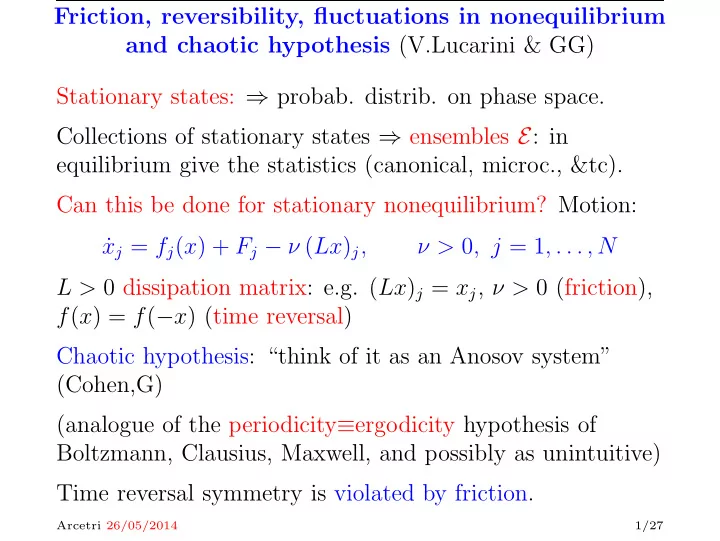
Friction, reversibility, fluctuations in nonequilibrium and chaotic hypothesis (V.Lucarini & GG) Stationary states: ⇒ probab. distrib. on phase space. Collections of stationary states ⇒ ensembles E: in equilibrium give the statistics (canonical, microc., &tc). Can this be done for stationary nonequilibrium? Motion: ˙ xj = fj(x) + Fj − ν (Lx)j, ν > 0, j = 1, . . . , N L > 0 dissipation matrix: e.g. (Lx)j = xj, ν > 0 (friction), f(x) = f(−x) (time reversal) Chaotic hypothesis: “think of it as an Anosov system” (Cohen,G) (analogue of the periodicity≡ergodicity hypothesis of Boltzmann, Clausius, Maxwell, and possibly as unintuitive) Time reversal symmetry is violated by friction.

Arcetri 26/05/2014 1/27

slide-2
SLIDE 2

BUT it is a fundamental symmetry: ⇒ possible to restore? How? in which sense? Start from a special case: the Lorenz96 eq. (periodic b.c.) ˙ xj = xj−1(xj+1 − xj−2) + F − νxj, j = 0, . . . , N − 1 Vary ν and let µν stationary distrib. Let E =

j ˙

x2

i µν:

this is “ensemble” (viscosity ensemble) Equivalent ensembles conjecture: replace ν by α(x) =

  • i Fxi
  • i x2

i

New Eq. has E(x) =

i x2 i as exact constant of motion

˙ xj = xj−1(xj+1 − xj−2) + F − α(x)xj, and volume contracts by ∂j(a(x)xj) σ(x) = (N − 1)α(x), p = τ −1 τ σ(x(t))dt/ σ

Arcetri 26/05/2014 2/27

slide-3
SLIDE 3

Equivalent ensembles (conjecture): Stationary states µE label by E ⇒ E (“energy ensemble”). µν ∼ µE ← → E = µν(E(·)) ← → ν = µE(α(·)) Give the same statistics in the limit of large R = F

ν2.

Analogy canonical µβ = microcanonical µE if µβ(E(.)) = E ← → µE(K(.)) = 3 2βN in the limit of large volume (fixed density or specific E). Why? several reasons. Eg. chaoticity implies α(x(t)) =

  • i Fxi
  • i x2

i

“self − averaging′′

Arcetri 26/05/2014 3/27

slide-4
SLIDE 4

Tests performed at N = 32 (with checks up to N = 512) and high R (at R > 8, system is very chaotic with > 20 Lyap.s exponents and at larger R it has ∼ 1

2N L.e.)

1) µE(α) = ν ← →µν(E) = E 2) If g is reasonable (“local”) observable 1

T

T

0 g(Stx)dt has

same statistics in both 3) The “Fluctuation Relation” holds for the fluctuations of phase space vol (reversible case): reflect chaotic hypothesis 4) Found its N-independence and ensemble independence (Livi,Politi,Ruffo) 5) In so doing found or confirmed several scaling and pairing rules for Lyapunov exponents (somewhat surprising) and checked a local version of the F.R.

Arcetri 26/05/2014 4/27

slide-5
SLIDE 5

Scaling of energy-momentum (irreversible model): E =

  • i

x2

i ,

M =

  • i

xi E

i R

N ∼ cER4/3, M

i R

N ∼ 2cER1/3 cE = 0.59 ± 0.01 std(E)i

R

N =

  • E2i

R − (E i R)21/2

N = ˜ cER4/3, ˜ cE ∼ 0.2cE std(M)i

R

N = ˜ cMR2/3 ˜ cE ∼ 0.046 ± 0.001 ti,M

dec ∼ cMR−2/3

cM = 1.28 ± 0.01 The first two confirm Lorenz96, the 3d,4th “new”, 5th is the “decorrelation” time M(t)M(0)

Arcetri 26/05/2014 5/27

slide-6
SLIDE 6

Irreversible model Lyapunov exponents arranged pairwise

1 2 3 4 5 6 7 8 9 10 11 12 13 14 15 16 −150 −100 −50 50 100 150

N/2 + 1/2 − |N/2 + 1/2 − j|

Black: Lyap. exp.s R = 2048 Magenta: π(j) = (λj + λN−j+1)/2. Blue: Lyap. exp.s R = 256 value of π(j) at R = 252 (invisible below magenta).

Arcetri 26/05/2014 6/27

slide-7
SLIDE 7

Irreversible model Lyapunov exponents arranged pairwise

2 4 6 8 10 12 14 16 −150 −100 −50 50 100 150

j

Black: Lyap. exp.s R = 2048 Magenta: π(j) = (λj + λN−j+1)/2. Blue: Lyap. exp.s R = 256 value of π(j) at R = 252 (invisible below magenta).

Arcetri 26/05/2014 6/27

slide-8
SLIDE 8

Pairing accuracy. Irreversible model.

1 2 3 4 5 6 7 8 9 10 11 12 13 14 15 16 −2.2 −2 −1.8 −1.6 −1.4 −1.2 −1 −0.8 −0.6

j

Blue: π(j) = (λj + λN−j+1)/2, 8 < R < 2048, N = 32. Almost constant: as it can be seen if compared to λj. The small variation reflects the fact that the spectrum shows an asymptotic shape.

Arcetri 26/05/2014 7/27

slide-9
SLIDE 9

Pairing accuracy. Irreversible model.

2 4 6 8 10 12 14 16 −3 −2.5 −2 −1.5 −1 −0.5

j

Blue: π(j) = (λj + λN−j+1)/2, 8 ≤ R ≤ 2048, N = 32. Almost constant: as it can be seen if compared to λj. The small variation reflects the fact that the spectrum shows an asymptotic shape.

Arcetri 26/05/2014 7/27

slide-10
SLIDE 10

Continuous limit of Lyapunov Spectrum (LPR): asymptotics in N = 32, 256 at R fixed:

0.1 0.2 0.3 0.4 0.5 −40 −30 −20 −10 10 20 30 40

1/2 + |1 − j/(N + 1)|

0.5 −2 −1

R = 256: λj for N = 256 and Black mark N = 32 red line π(j) = (λj + λN−j+1)/2 for N = 256 and marker for N = 32 ; zoom

Arcetri 26/05/2014 8/27

slide-11
SLIDE 11

Scaling Lyapunov Spectrum: 8 ≤ R = 2n ≤ 2048 x = j N + 1 ⇒ |λ(x) + π(x)| ∼ cλ |2x − 1|5/3 R2/3 ∼ |λ(x) + 1| ∼ cλ |2x − 1|5/3 R2/3, cλ ∼ 0.8

1 4 8 12 16 17 21 25 29 32 0.2 0.4 0.6 0.8 1 1.2

j

Blue: |λj + 1|/(cλR2/3), Black: |2j/(N + 1) − 1|5/3

Arcetri 26/05/2014 9/27

slide-12
SLIDE 12

Dimension of Attractor The |λ(x) + 1| ∼ cλ |2x − 1|5/3 R2/3 yields the full spectrum: hence can compute the KY dimension N − dKY = N 1 + cλR

2 3 −

− − →

R→∞ 0,

∀ N attractor has a dimension virtually indistinguishable from that of the full phase space. However SRB distribution deeply different from equidistribution (often confused with ergodicity): made clear by the equivalence (if holding) and the validity of the Fluctuation Relation needs test

Arcetri 26/05/2014 10/27

slide-13
SLIDE 13

Reversible-Irreversible ensembles equivalence:

−15 −10 −5 5 10 15 20 25 30 35 40 −0.06 −0.04 −0.02 0.02 0.04 0.06

M/N

20 40 −5 5 x 10

−4

Black: pdf for M/N rev, R = 2048. Blue − pdf for M/N irrev for R = 2048. Red black + blue line. Note vertical scales. 6 Arcetri 26/05/2014

11/27

slide-14
SLIDE 14

Check Fluctuation Relation (FR) p = 1

τ τ

0 σ(x(t))dt

σ srb 1 τσR log P R

τ (p)

P R

τ (−p) = 1

???

0.5 1 1.5 2 2.5 3 3.5 4 4.5 5 0.5 1 1.5 2 2.5 3 3.5 4 4.5 5

p

ξ (p)−ξ (−p) σ+ τ = 0.2 τ = 0.1 τ = 0.02 τ = 0.01

F.R. slope c(τ) − − − →

R→∞ 1, R = 512

c(τ) = 1 + tr,σ

dec,R

τ 4/3 = 1 + cσ τ 4/3 R−8/9

Arcetri 26/05/2014 12/27

slide-15
SLIDE 15

Check Fluctuation Relation

0.5 1 1.5 2 2.5 3 3.5 4 4.5 5 0.5 1 1.5 2 2.5 3 3.5 4 4.5 5

p

ξ (p)−ξ (−p) σ+ τ = 0.2 τ = 0.1 τ = 0.02 τ = 0.01

F.R. R = 2048, approach 1 as τ ↑ beyond decorrelation time

Arcetri 26/05/2014 13/27

slide-16
SLIDE 16

Local Fluctuation Relation

0.5 1 1.5 2 2.5 3 0.5 1 1.5 2 2.5 3

p

1 τ σ β

R

P R

τ (p)

P R

τ (−p)

τ = 0.2 τ = 0.1 τ = 0.02 τ = 0.01

Local F.R. for R = 2048 1 τ log P R

τ (p)

P R

τ (−p) = σβRp + O(τ −1) = βσRp + O(τ −1)

Arcetri 26/05/2014 14/27

slide-17
SLIDE 17

Lyapunov exp. reversible ≡ irrev

1 2 3 4 5 6 7 8 9 10 11 12 13 14 15 16 −150 −100 −50 50 100 150

N/2 + 1/2 − |N/2 + 1/2 − j|

Red: Lyap exps R = 2048. Magenta (λj + λN−j+1)/2. Blue Lyaps R = 256. Black: (λj + λN−j+1)/2

Arcetri 26/05/2014 15/27

slide-18
SLIDE 18

Lyapunov exp. reversible ≡ irrev

2 4 6 8 10 12 14 16 −40 −30 −20 −10 10 20 30 40

j R = 256

Red: Lyap exps R = 2048. Magenta (λj + λN−j+1)/2. Blue Lyaps R = 256. Black: (λj + λN−j+1)/2

Arcetri 26/05/2014 15/27

slide-19
SLIDE 19

Lyapunov exp. reversible ≡ irrev

2 4 6 8 10 12 14 16 −150 −100 −50 50 100 150

j R = 2048

Red: Lyap exps R = 2048. Magenta (λj + λN−j+1)/2. Blue Lyaps R = 256. Black: (λj + λN−j+1)/2

Arcetri 26/05/2014 15/27

slide-20
SLIDE 20

Reversible pairing

1 4 8 12 1617 21 25 29 32 0.2 0.4 0.6 0.8 1 1.2

j

Blue |λj + 1|/(cλF 2/3) for F (growing as arrows) ≥ 8 to ≤ 2048. Black: |2j/(N + 1) − 1|5/3

Arcetri 26/05/2014 16/27

slide-21
SLIDE 21

Equivalent Ensembles (more) general theory E(x) observable s.t. N

j=1 ∂jE(x)(Lx)j = M(x) > 0 x = 0.

E.g. L = 1, E(x) = 1

2

  • j x2

j, ⇒ M(x) = x2.

˙ xj = fj(x) + Fj − ν(Lx)j, ν > 0, j = 1, . . . , N ˙ xj = fj(x) + Fj − α(x)(Lx)j, α(x)

def

= N

j=1 Fj∂jE

M(x) Dissipation balanced on E(x) ⇒ E(x(t)) = const Define E and E: conjectured is equivalence at large forcing (when both satisfy Chaotic hypothesis for α(x(t))α(x(0)) is finite). Lorenz96 is one example Other examples: NS equation (periodic container O)

Arcetri 26/05/2014 17/27

slide-22
SLIDE 22

with viscosity ν ˙

  • u + (

u · ∂) u = −∂p + g + ν∆ u = 0, ∂ · u = 0 and equivalent eq. balanced on the “dissipation” observable E( u) =

  • O(∂

u(x))2dx ˙

  • u + (

u · ∂) u = −∂p + g + α( u)∆ u, ∂ · u = 0 α( u)

def

=

  • k

k2 g

k ·

u−

k

  • k

k4| u

k|2

, D = 2 If D = 3 similar expression (more involved because vorticity is not conserved in inviscid case)

Arcetri 26/05/2014 18/27

slide-23
SLIDE 23

N = 168: R2 = 106; viscous NS (+),energy (∗), enstr (⊡)

  • 2000
  • 1000

1000 2000 20 40 60 80

λ k λ 2K-k-1

k R = 10

2 6

Arcetri 26/05/2014 19/27

slide-24
SLIDE 24

Lyap exps N = 168: R2 = 106, force on ±(4, −3), ±(3, −4) viscous (+) at force on ±(4, −3), ±(3, −4) (×) = (λk + λ′

k)/2

energy (∗) enstrophy (⊡), or palinstrophy (). Runs lengths T ∈ [125, 250], units of 1/λmax, λmax. Error bars identified with symbols size. Overlap of the 4 spectra (approximate, because of numerical fluctuations in quantities that should be exact constants) NS too ⇒ hints at extending equivalence to spectra.

Arcetri 26/05/2014 20/27

slide-25
SLIDE 25

Particle system: thermostats and ensembles x = ( X0, ˙

  • X0,

X1, ˙

  • X1, . . . ,

Xν, ˙

  • Xν)

C

1

C

2

C

3

C0

Ω 1 Ω 0 Ω 2

Equations of motion m ¨

  • X0i =−∂iU0(

X0) −

j>0

  • ∂iU0,j(

X0, Xj) + ∂iΨ( Xj) + Φi( X0) m ¨

  • Xji = − ∂iUj(

Xj) − ∂iU0,j( X0, Xj) + ∂iΨ( Xj) Uj( Xj) =

  • q,q′∈

Xj

ϕ, U0,j( X0, Xj) =

  • q∈Ω0,q′∈Ωj

ϕ, Ψ(X) =

  • q

ψ(q) Initial state: infinite Gibbs at density δj and temp. β−1

j

Arcetri 26/05/2014 21/27

slide-26
SLIDE 26

Time evolution Thermostats should admit evolution but are ∞ Enclose all particles in a ball Λn (side 2nrϕ) ⇒ Then time evolution exists x → S(n,0)

t

x ⇒ it should exist also limn→∞ S(n,0)

t

x = S(0)

t x ??

and is thermostats temperature defined for t > 0 ? More generally are intensive quantities constants of motion? lim

Λ→∞

1 |Λ ∩ Ωj|Kj,Λ(x(t)) = d 2β−1

j δj

lim

Λ→∞

1 |Λ ∩ Ωj|Nj,Λ(x(t)) = δj lim

Λ→∞

1 |Λ ∩ Ωj|Uj,Λ(x(t)) = uj Temp., density, energy dens. should be fixed ∀t, j > 0

Arcetri 26/05/2014 22/27

slide-27
SLIDE 27

Entropy production: thermostats entropy increases by σ0(x) =

  • j>0

Qj kBTj(x), Qj

def

= − ˙

  • Xj · ∂

XjU0,j(

X0, Xj)) Alternative models (Λn–regularized thermostats) m ¨

  • X0i = − ∂iU0(

X0) −

j>0

  • ∂iU0,j(

X0, Xj) + ∂iΨ( Xj) + Φi( X0) m ¨

  • Xji =−∂iUj(

Xj) − ∂iU0,j( X0, Xj) + ∂iΨ( Xj) − αj,n ˙ Xji With αj,n s.t. Uj,Λn + Kj,Λn = Ej,Λn is exact constant αj,n

def

= Qj d NjkBTj(x), Qj

def

= − ˙

  • Xj · ∂jU0,j(

X0, Xj) with m ˙

  • X2

j def

= 2Kj,Λn(x)

def

= d NjkBTj(x)= Thermostats temperature

Arcetri 26/05/2014 23/27

slide-28
SLIDE 28

Entropy Qj

def

= − ˙

  • Xj · ∂

XjU0,j(

X0, Xj), heat σ0(x) =

  • j>0

Qj kBTj(x), Hamiltonian entropy production σ(x) =

  • j>0

Qj kBTj(x) + β0( ˙ K0 + ˙ U0 + ˙ Ψ0)

def

= σ0(x) + ˙ F(x) Theorem (Presutti, G): with µ0–probability 1, ∀t > 0 lim

n→∞ S(n,1) t

x = lim

n→∞ S(n,0) t

x, dµt(dx) dt = −σ(x) µt(dx) Remarkable: Entropy production = volume contraction + a time derivative: possible to define entropy prod. in Hamilt. context: it coincides with the definition of entropy as phase space contraction (“up to a derivative”, of course)

Arcetri 26/05/2014 24/27

slide-29
SLIDE 29

Equivalence Equivalence? (in therm. lim. Λn → ∞) Idea: Qj

def

= − ˙

  • Xj · ∂jU0,j(

X0, Xj) is O(1) (Williams,Searles,Evans 2004) hence αj =

Qj d NjkBTj,n(x) ⇒ 0 as n → ∞.

But is Tj,n(x) ≥ c > 0 ?? Theorem (Presutti, G): with µ0–probability 1

Kj,Λn(x) |Λn∩Ωj|

≥ 1

4 d δj kBTj

(hence α − − − →

n→∞ 0).

Entropy production = volume contraction + a time derivative In nonequilibrium several quantities are defined up to an additive time derivative, as in equilibrium several quantities are defined up to a an additive constant

Arcetri 26/05/2014 25/27

slide-30
SLIDE 30

Macroscopic constants of motion ⇒ (average of σ) ≡ ( average of σ0) All this provided βj(x) is a constant of motion as n → ∞ and βj(Stx) = βj In other words: very generally phase space contraction can be identified with physically defined entropy production. Theorem: Let Γ be a pair potential and ϕ + εΓ be superstable for |ε| small and P(ϕ + εΓ) (twice) differentiable at ε = 0 (i.e. “no phase trans.”)) g(Stx)

def

= lim

Λn→∞

1 Λn ∩ Ωj

  • q,q′∈x

Γ(q(t) − q′(t)) = g with µ0-probability 1 and for all t > 0: i.e. g(x) constant of motion. ⇒ Infinitely many constants of motion.

Arcetri 26/05/2014 26/27

slide-31
SLIDE 31

References [1, 2]

  • G. Gallavotti and V. Lucarini.

Equivalence of Non-Equilibrium Ensembles and Representation of Friction in Turbulent Flows: The Lorenz 96 Model. arXiv:1404.6638, 2014:1–43, 2014.

  • G. Gallavotti and E. Presutti.

Nonequilibrium, thermostats and thermodynamic limit. Journal of Mathematical Physics, 51:015202 (+32), 2010. Also http://arxiv.org & http://ipparco.roma1.infn.it

Arcetri 26/05/2014 27/27