Fraudulent Conveyance Actions: y TOUSA Revisited Strategies for - - PowerPoint PPT Presentation

fraudulent conveyance actions y tousa revisited
SMART_READER_LITE
LIVE PREVIEW

Fraudulent Conveyance Actions: y TOUSA Revisited Strategies for - - PowerPoint PPT Presentation

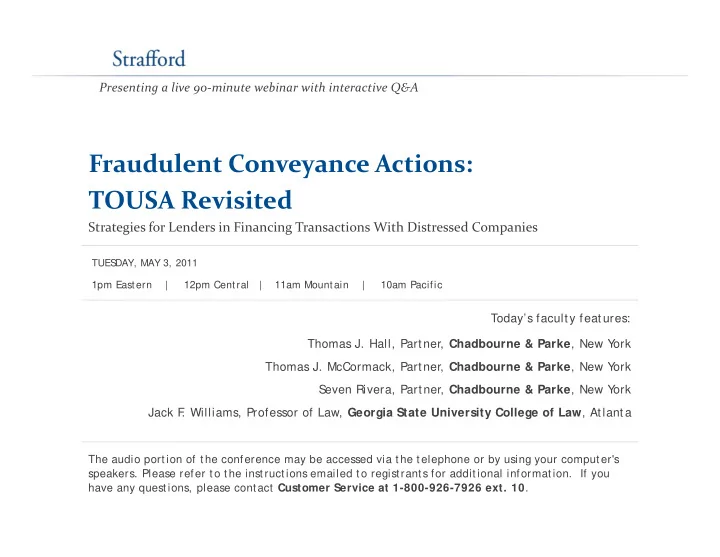
Presenting a live 90 minute webinar with interactive Q&A Fraudulent Conveyance Actions: y TOUSA Revisited Strategies for Lenders in Financing Transactions With Distressed Companies TUES DAY, MAY 3, 2011 1pm Eastern | 12pm Central


slide-1
SLIDE 1

Presenting a live 90‐minute webinar with interactive Q&A

Fraudulent Conveyance Actions: y TOUSA Revisited

Strategies for Lenders in Financing Transactions With Distressed Companies

T d ’ f l f

1pm Eastern | 12pm Central | 11am Mountain | 10am Pacific TUES DAY, MAY 3, 2011

Today’s faculty features: Thomas J. Hall, Partner, Chadbourne & Parke, New Y

  • rk

Thomas J. McCormack, Partner, Chadbourne & Parke, New Y

  • rk

S even Rivera, Partner, Chadbourne & Parke, New Y

  • rk

Jack F . Williams, Professor of Law, Georgia State University College of Law, Atlanta

The audio portion of the conference may be accessed via the telephone or by using your computer's

  • speakers. Please refer to the instructions emailed to registrants for additional information. If you

have any questions, please contact Customer Service at 1-800-926-7926 ext. 10.

slide-2
SLIDE 2

Conference Materials

If you have not printed the conference materials for this program, please complete the following steps:

  • Click on the + sign next to “ Conference Materials” in the middle of the left-

hand column on your screen hand column on your screen.

  • Click on the tab labeled “ Handouts” that appears, and there you will see a

PDF of the slides for today's program.

  • Double click on the PDF and a separate page will open.

Double click on the PDF and a separate page will open.

  • Print the slides by clicking on the printer icon.
slide-3
SLIDE 3

Continuing Education Credits

FOR LIVE EVENT ONLY

For CLE purposes, please let us know how many people are listening at your location by completing each of the following steps:

  • Close the notification box
  • In the chat box, type (1) your company name and (2) the number of

attendees at your location

  • Click the blue icon beside the box to send
slide-4
SLIDE 4

Tips for Optimal Quality

S d Q lit S

  • und Quality

If you are listening via your computer speakers, please note that the quality of your sound will vary depending on the speed and quality of your internet connection. If the sound quality is not satisfactory and you are listening via your computer speakers, you may listen via the phone: dial 1-866-873-1442 and enter your PIN when prompted Otherwise please send us a chat or e mail when prompted. Otherwise, please send us a chat or e-mail sound@ straffordpub.com immediately so we can address the problem. If you dialed in and have any difficulties during the call, press *0 for assistance.

Viewing Qualit y

To maximize your screen, press the F11 key on your keyboard. To exit full screen, press the F11 key again press the F11 key again.

slide-5
SLIDE 5

FRAUDULENT CONVEYANCE FRAUDULENT CONVEYANCE ACTIONS: TOUSA REVISITED

Strafford Webinar Symposium

h ll Thomas J. Hall Thomas J. McCormack Seven Rivera Jack F Williams Jack F. Williams May 3, 2011

slide-6
SLIDE 6

6

DISCLAIMER

The written materials distributed and the presentations made by this panel are intended for educational and discussion purposes only. Our panelists p p y p are involved in the TOUSA litigation. Any views or opinions expressed during the course of this presentation are not intended to be attributable to clients of our panelists, and are not intended to bind any of our panelists or their clients to any positions they may or may not take in the TOUSA their clients to any positions they may or may not take in the TOUSA litigation.

slide-7
SLIDE 7

7

The Speakers

  • Thomas J. Hall – Commercial litigation partner with Chadbourne & Parke LLP and

co-head of Chadbourne’s Commercial Litigation Practice. (212) 408-5487, thall@chadbourne.com. h C k C l l h Ch db P k

  • Thomas J. McCormack – Commercial litigation partner with Chadbourne & Parke

LLP with over 25 years of experience. (212) 408-5182, tmccormack@chadbourne.com.

  • Seven Rivera – Bankruptcy and restructuring partner with Chadbourne & Parke LLP

representing secured and unsecured lenders creditors debtors and creditor representing secured and unsecured lenders, creditors, debtors, and creditor committees in Chapter 11 cases. (212) 408-5529, srivera@chadbourne.com.

  • Jack F. Williams – Professor at Georgia State University College of Law and Senior

Managing Director of Mesirow Financial Consulting LLC (404) 413-9149 Managing Director of Mesirow Financial Consulting, LLC. (404) 413-9149, jwilliamsgsu.edu.

  • Chadbourne & Parke LLP represents Citicorp North America, Inc., as Agent for the

$315 million Revolver Loan and $200 million First Lien Term Loan to TOUSA, and

.

$ $ , certain lenders in those syndicates. Jack Williams served as consulting expert.

slide-8
SLIDE 8

8

Recent Appellate Decisions

The United States District Court for the Southern District of Florida recently decided two appeals in the TOUSA case: 1 A fraudulent conveyance suit against TOUSA’s Revolver lenders Official

  • 1. A fraudulent conveyance suit against TOUSA s Revolver lenders. Official

C’tee of Unsecured Creditors of Tousa, Inc. v. Citigroup North America, Inc., 2011 U.S. Dist. LEXIS 40518 (S.D. Fla. March 4, 2011).

  • 2. A fraudulent conveyance suit against TOUSA’s Term Loan lenders and

Transeastern lenders. 3V Capital Master Fund Ltd. v. Official C’tee of Unsecured Creditors of Tousa, Inc., 2011 U.S. Dist. LEXIS 14019 (S.D. Fla. Feb. 11, 2011).

slide-9
SLIDE 9

9

Recent Appellate Decisions Recent Appellate Decisions (cont.)

  • The Revolver Appeal: District Court affirms dismissal of claims because,

even though amended and drawn upon during the alleged period of insolvency, the Revolver loan and liens securing it predated the alleged y g p g insolvency. The Transeastern Appeal: District Court rejects finding that TOUSA’s

  • The Transeastern Appeal: District Court rejects finding that TOUSA s

subsidiaries received less than reasonably equivalent value from the settlement of litigation against their parent that had been threatening the entire enterprise. Also rejected finding that the Transeastern lenders who were paid off with the new financing were recipients of a fraudulent conveyance.

slide-10
SLIDE 10

6

  • Background

Outline of Presentation

g

  • Bankruptcy Court Rulings
  • District Court Rulings on Appeal

K R bl E i l t V l I

  • Key Reasonably Equivalent Value Issues

1. How to define property? 2. Can intangible benefits constitute value? 3. How to quantify value

  • 11th Circuit Issues
  • Lender Strategies

g

  • Conclusions
  • Questions
slide-11
SLIDE 11

7

Background

  • TOUSA, Inc. and its subsidiaries were a residential homebuilding enterprise.
  • TOUSA, Inc. and subsidiaries allegedly became insolvent in July 2007.

Citi i th t f th fi t li l i dit f ilit i i ll t d d t

  • Citicorp is the agent for the first-lien revolving credit facility, originally extended to

TOUSA in 2006 and amended several times thereafter including on July 31, 2007.

  • Citicorp is also the agent for a syndicated $200 million term loan sharing first-priority

lien status with the Revolver and extended to TOUSA, Inc. and subsidiaries on July 31, , J y , 2007 to finance TOUSA, Inc.’s settlement with the Transeastern lenders.

  • The Transeastern Lenders had extended a loan of over $600 million to a TOUSA, Inc.

joint venture on which TOUSA, Inc. issued guarantees. Following default, those lenders sued TOUSA Inc on its guarantees On July 31 2007 TOUSA Inc settled that lenders sued TOUSA, Inc. on its guarantees. On July 31, 2007, TOUSA, Inc. settled that lawsuit.

  • A judgment against TOUSA, Inc. of $10 million or more would have constituted a

default under its $1.1 billion in bond financings and under its Revolver loan. g

slide-12
SLIDE 12

8

Background (cont.)

  • TOUSA, Inc.’s subsidiaries were guarantors of the bond debt and co-borrowers on the

Revolver loan and had pledged their assets as security for the Revolver loan.

  • To finance the settlement, TOUSA, Inc. and subsidiaries borrowed $500 million ($200

To finance the settlement, TOUSA, Inc. and subsidiaries borrowed $500 million ($200 million first lien and $300 million second lien term loans) and pledged their assets as security.

  • Committee asserted the loan obligations assumed by, and the lien pledges given by,

g y p g g y the subsidiaries were constructive fraudulent conveyances because they were not

  • bligated on the Transeastern loan and therefore did not receive reasonably equivalent

value for extinguishing their parent’s obligation on the Transeastern loan. C itt l h ll d f th l d ’ it i t t i J l

  • Committee also challenged as a preference the lenders’ security interest, given on July

31, 2007, in a 2007 tax refund totaling $207 million and received by TOUSA in March 2008, contending that that security interest did not attach until January 1, 2008, following the close of the tax year, and therefore was a transfer within 90 days of the January 28 2008 bankruptcy filing January 28, 2008 bankruptcy filing.

slide-13
SLIDE 13

9

The Parties

The Debtor: TOUSA Inc and subsidiaries involved in the home construction

The Parties

  • The Debtor: TOUSA, Inc. and subsidiaries involved in the home construction

business.

  • Ch. 11 Bankruptcy Proceedings

Pl i tiff Offi i l C itt f U d C dit f TOUSA ti

  • Plaintiff: Official Committee of Unsecured Creditors of TOUSA representing

unsecured creditors of TOUSA

  • Owed more than $1 billion in bond debt
  • Defendants:
  • Revolver Lenders ($315 million outstanding)
  • First Lien Term Loan ($200 million)
  • Second Lien Term Loan ($300 million)
  • Transeastern Lenders who were paid off from the Term Loans
slide-14
SLIDE 14

10

Bankruptcy Code Section 548

  • Constructive fraudulent conveyance:
  • “The trustee may avoid any transfer . . . or any obligation . . . incurred by the

debtor that was made or incurred on or within 2 years before the date of the debtor, that was made or incurred on or within 2 years before the date of the filing of the petition, if the debtor . . . received less than a reasonably equivalent value in exchange for such transfer or obligation; and . . . was insolvent on the date that such transfer was made or such obligation was incurred.”

slide-15
SLIDE 15

Th R li B l

11

The Rulings Below

The Revolver Case

  • The Revolver Case
  • $800 million Revolver loan extended to TOUSA, Inc. in January 2006.

Subsidiaries are guarantors. O t b 2006 A d t S b idi i l d ll t l t

  • October 2006 Amendment: Subsidiaries pledge collateral to secure

Revolver.

  • January 2007 Amendment: Subsidiaries become co-borrowers.

J l 1 A d All d f l d d d

  • July 31, 2007 Amendment: Allowed for term loans and reduced

Revolver availability from $800 million to $700 million.

  • August 2007-January 2008 – Additional draws on Revolver.
  • October-December 2007 – Additional amendments waiving defaults.
  • January 28, 2008 – TOUSA, Inc. and subsidiaries file for Chapter 11

protection.

slide-16
SLIDE 16

Th R li B l ( t )

12

The Rulings Below (cont.)

  • $315 million outstanding on Petition Date
  • Fraudulent conveyance claims against the Revolver agent dismissed by

Bankruptcy Court Bankruptcy Court.

  • Court was “troubled by the notion that the transfer occurs at a time

after the granting of the lien.” C t j t “th iti th t i t f i ti ll t l

  • Court rejects “the proposition that in respect of existing collateral, . . .

that a new lien was created by virtue of the entry of the parties into a new lending agreement.” Court further rejects the concept that each draw on a pre established

  • Court further rejects the concept that each draw on a pre-established

credit line constitutes a separate transfer.

slide-17
SLIDE 17

13

The Rulings Below (cont.)

The Term Loan/Transeastern Case

  • Bankruptcy Court finds for the Committee in sweeping 180 page opinion adopted almost verbatim from

the proposed findings of fact and conclusions of law submitted by the Committee.

  • TOUSA, Inc. and its subsidiaries were insolvent in and after July 2007.
  • Subsidiaries received “no direct benefits” from $500 million term loans and settlement of Transeastern

litigation.

  • Subsidiaries received “at most minimal indirect benefits” from transaction as Transeastern settlement

benefited TOUSA parent, not subsidiaries.

  • Savings clause limiting debtors’ obligations to amount necessary to avoid a fraudulent conveyance held

“entirely too cute to be enforced ” “entirely too cute to be enforced.”

  • As TOUSA had no right to tax refund until the close of the year, the transfer of the security interest in it
  • ccurred at that time, not when UCC Statement filed 5 months earlier, and thus was a preferential

transfer within 90 days of bankruptcy.

slide-18
SLIDE 18

14

The Remedial Structure

  • Transeastern Lenders
  • Disgorged $403 million in payments plus 9% interest = over

g g $ p y p $500 million

  • Restoration of unsecured claims against TOUSA, Inc. and

TOUSA Homes, LP

  • The First and Second Lien Term Loan Lenders
  • Obligations and liens of Subsidiaries avoided
  • Disgorge all payments received in connection with Term Loans
  • Disgorge all payments received in connection with Term Loans
slide-19
SLIDE 19

15

The Remedial Structure (cont.)

  • The Conveying Subsidiaries to use Transeastern lenders’

disgorged funds to pay:

  • Costs associated with adversary proceeding
  • Transaction costs for July 31 Transaction

A t l t di i ti i l f li

  • Amount equal to diminution in value of liens
  • First and Second Lien Term Loan Lenders:
  • Receive all remaining disgorged funds
slide-20
SLIDE 20

16

Savings Clause

  • “Each Borrower agrees if such Borrower’s joint and several liability

hereunder, or if any Liens securing such joint and several liability, would, but for the application of this sentence, be unenforceable under but for the application of this sentence, be unenforceable under applicable law, such joint and several liability and each such Lien shall be valid and enforceable to the maximum extent that would not cause such joint and several liability or such Lien to be unenforceable under li bl l d h j i t d l li bilit d h Li h ll b applicable law, and such joint and several liability and such Lien shall be deemed to have been automatically amended accordingly at all relevant times.”

slide-21
SLIDE 21

17

Invalidation of the Savings Clause

Savings Clauses held invalid because: The savings clause is unenforceable under Section 541(c)(1)(b), which provides that an interest of the debtor in property becomes property of the estate notwithstanding any interest of the debtor in property becomes property of the estate, notwithstanding any “provision in an agreement” that is “conditioned on the insolvency or financial condition of the debtor” that “effects or gives an option to effect a forfeiture, modification, or termination of the debtor's interest in property.” Efforts to contract around provisions of the Bankruptcy Code are invalid: “If given effect, the only purpose served by the savings clauses is to ensure that the transferee can preserve its claim to every last penny of the debtor's remaining assets without providing reasonably equivalent value. The savings clauses are a frontal assault on the protections that section 548 provides to other creditors. They are, in short, entirely too cute to be enforced.” , y

slide-22
SLIDE 22

Invalidation of the Savings Clause

18

Invalidation of the Savings Clause (cont.)

“There is something inherently distasteful about really clever lawyers overreaching. Some problems cannot be drafted around. The fact that this sort of drafting was felt necessary by Citi ought to have given it pause that maybe this deal was not necessary by Citi ought to have given it pause that maybe this deal was not

  • possible. In any event, Citi and the rest of the Defendants assumed the risk that the

Transaction would be regarded by a reviewing court as a fraudulent transfer.” Th i t f lti l i l t i d fi it t t “Th l The existence of multiple savings clauses creates an indefinite contract. “The value

  • f A can be determined only after knowing the value of B; but the value of B can be

determined only after knowing the value of A." The express provisions of the loan agreements require a written amendment to effectuate a modification of the loan (the reduction of the liability of a subsidiary which is deemed to occur as a result of a savings clause), and no such further writing existed. g

slide-23
SLIDE 23

19

Appeal Analysis

  • Revolver Loan:
  • Dismissal of claims against Revolver affirmed. Amended loan

agreement continued pre-existing obligations and were transfers agreement continued pre-existing obligations and were transfers

  • ccurring on initial loan date, not dates of amendments or subsequent

draws. f d d d f l d d f d

  • Liens re-perfected during period of insolvency are deemed transferred
  • n the date of the original perfection.
  • Post-insolvency draws on Revolver – District Court does not reach

Post insolvency draws on Revolver District Court does not reach substance of issue as it affirmed on waiver grounds.

slide-24
SLIDE 24

20

Appeal Analysis (cont.)

  • Term Loan:
  • Determination that subsidiaries received less than reasonably equivalent value from

Term Loan reversed. Avoidance of default under bond debt and Revolver loan, as ll th id f b k t if t i di t b fit well as the avoidance of bankruptcy even if temporary, was an indirect benefit. Additional indirect benefits can be recognized under the “identity of interests” doctrine.

  • Transeastern lenders did not receive a transfer from the subsidiaries and thus were
  • Transeastern lenders did not receive a transfer from the subsidiaries and, thus, were

not liable for fraudulent conveyance. The diligence/good-faith standard imposed by the Bankruptcy Court on lenders collecting antecedent debts was “patently unreasonable and unworkable.”

  • Because the District Court quashed the Bankruptcy Court’s fraudulent conveyance

findings, the savings clause issue is not reached.

  • Because only the claims against the Transeastern lenders have been adjudicated on

appeal so far the tax refund preference issue not yet reached appeal so far, the tax refund preference issue not yet reached.

slide-25
SLIDE 25

21

Transeastern Lender Liability

  • Transeastern Lenders not liable under Section 548:

 As “direct transferees” of the New Loan proceeds.  As entities "for whose benefit" the Conveying Subsidiaries transferred the liens to the New Lenders.

  • Section 548 applies only to a transfer "of an interest of the debtor" in property.
  • The Subsidiaries never had any property interest in the Term Loan proceeds,

and thus transferred nothing.

  • The "for whose benefit" language indicates that the benefit must derive directly

f th t f d t f th t hi h it i t b th t f from the transfer and not from the use to which it is put by the transferee.

  • Because the Transeastern Lenders were subsequent transferees of the proceeds

backed by the liens, they do not qualify as "entities for whose benefit" the transfers were made. transfers were made.

slide-26
SLIDE 26

22

3 Key Reasonably Equivalent Value Issues

  • 1. How to Define Property?
  • 2. Can Intangible Benefits Constitute Property/Value?
  • 3. How to Quantify?
slide-27
SLIDE 27

How to Define Property?

23

How to Define Property?

Section 548(d)(2)(A) provides that for the purposes of that section “value” is defined as: “property, or satisfaction or securing of a present or antecedent debt of the debtor but does securing of a present or antecedent debt of the debtor, but does not include an unperformed promise to furnish support to the debtor or to a relative of the debtor.”

slide-28
SLIDE 28

How to Define Property? (cont )

24

How to Define Property? (cont.)

  • Bankruptcy Ct. (p. 148):
  • As a matter of natural usage, legal usage, and bankruptcy-law usage, the Conveying

Subsidiaries could not receive "property" unless they obtained some kind of enforceable entitlement to some tangible or intangible article See WEBSTER'S enforceable entitlement to some tangible or intangible article. See WEBSTER S THIRD NEW INT'L DICTIONARY 1818 (1986) (defining "property" in its broadest sense as "something . . . in which or to which a person has a right protected by law") (emphasis added); 11 U.S.C. § 541(a)(1) (defining "[p]roperty of the estate" to include "all legal or equitable interests of the debtor in property as of the commencement of all legal or equitable interests of the debtor in property as of the commencement of the case") (emphasis added); see also Bracewell v. Kelley (In re Bracewell), 454 F.3d 1234, 1239 (11th Cir. 2006) (debtor's "hope to an entitlement" not a property interest until it is legally cognizable.)

slide-29
SLIDE 29

How to Define Property? (cont )

25

How to Define Property? (cont.)

  • Bankruptcy Ct (p 148):
  • Bankruptcy Ct. (p. 148):
  • To the extent that Defendants' claims of indirect benefits rest on the avoidance
  • f default and bankruptcy by the Conveying Subsidiaries, those claims are

p y y y g , equally flawed. "Avoiding default" is not "property" and therefore is not cognizable as "value" under the statute.

slide-30
SLIDE 30

How to Define Property? (cont )

26

How to Define Property? (cont.)

District Ct (p 67):

  • District Ct. (p. 67):
  • In addition, the Bankruptcy Court's narrow dictionary definition of property is

contrary to the meaning of the term in the Bankruptcy Code. The legislative co y o e e g o e e e up cy Co e e eg s e history for the Bankruptcy Reform Act of 1978 provides that "[a]lthough 'property' is not construed in [Section 102 of the Code], it is used consistently throughout the Code in its broadest sense, including cash, all interests in property, such as liens, and every kind of consideration including promises to act property, such as liens, and every kind of consideration including promises to act

  • r forbear to act as in section 548(d)." Statements by Legislative Leaders, 124
  • CONG. REC. 11,089 (1978), reprinted in 1978 U.S.C.C.A.N. 6439, 6508.
slide-31
SLIDE 31

How to Define Property? (cont )

27

How to Define Property? (cont.)

  • District Ct. (p. 64):
  • Nonetheless, I conclude that the Bankruptcy Court committed legal error in

holding that the "avoidance of default and bankruptcy by the Conveying Subsidiaries" is as a matter of law "not property and therefore is not cognizable as 'value' under" Section 548 of the Bankruptcy Code. [Op., p. 148].

slide-32
SLIDE 32

Can Intangible Benefits

28

Can Intangible Benefits Constitute Value?

  • District Ct. (p. 71):

Th El h Ci i h h d h i id h

  • The Eleventh Circuit has not yet had the opportunity to consider the

application of the "reasonably equivalent value" test to the intricacies and complexities of the factual circumstances like the July 31 Transaction at issue. Nonetheless, other circuits, such as the Third Circuit, have rejected the Nonetheless, other circuits, such as the Third Circuit, have rejected the notion that a debtor must receive a direct, tangible economic benefit in order to receive "value" for purposes of Section 548(a)(2).

slide-33
SLIDE 33

Can Intangible Benefits

29

Can Intangible Benefits Constitute Value? (cont.)

  • District Ct. (p. 73):
  • Contrary to the Bankruptcy Court's legal conclusion, the weight of

authority supports the view that indirect, intangible, economic benefits, including the opportunity to avoid default, to facilitate the enterprise's rehabilitation and to a oid bankr ptc e en if it pro ided enterprise's rehabilitation, and to avoid bankruptcy, even if it provided to be short lived, may be considered in determining reasonable equivalent value. An expectation, such as in this case, that a settlement which would avoid default and produce a strong p g synergy for the enterprise, would suffice to confer "value" so long as that expectation was legitimate and reasonable.

slide-34
SLIDE 34

Can Intangible Benefits Constitute

30

Can Intangible Benefits Constitute Value? (cont.)

  • District Ct. (p. 83):
  • By virtue of the Transeastern Settlement, the Conveying

Subsidiaries' "net worth" was preserved and imminent default was avoided, thereby preserving, at that point of time, the interests

  • f the Committee's unsecured creditors by allowing the enterprise to
  • f the Committee s unsecured creditors by allowing the enterprise to

continue to meet its bond interest obligations and Revolver loan

  • payments. As such, additional Revolver payments were paid out in

excess of $65 million following the Transeastern Settlement, that allowed the enterprise's business to continue until the real estate industry totally collapsed later that year in a manner that was not foreseen at the time of the settlement.

slide-35
SLIDE 35

How to Quantify Value?

31

How to Quantify Value?

  • Bankruptcy Ct. (July 8, 2009 Decision p. 6):

p y J y p

  • Although the Plaintiff has both the burden of going forward in attempting to

establish that the Conveying Subsidiaries did not receive "value" directly, and h th lti t b d f f it i ll th th t i f i has the ultimate burden of proof, it is equally the case that upon a prima facie showing by the Plaintiff of no direct value, the Defendants have the burden of going forward to establish that the Conveying Subsidiaries received indirect "value," In re Aqua Clear Technologies, Inc., 361 B.R. 567, 582 (Bankr. S.D. Fla. 2007) d th t h i di t l t ibl t d tifi d ith 2007), and that such indirect value was tangible, concrete, and quantified with reasonable precision. In re Richards & Conover Steel Co., 267 B.R. 602, 614 (8th

  • Cir. BAP 2001)*.
slide-36
SLIDE 36

How to Quantify Value? (cont )

32

How to Quantify Value? (cont.)

  • District Ct. (p. 76):
  • Having concluded that the Bankruptcy Court erred in its legal definition of value,

and in its determination that the Conveying Subsidiaries did not receive value in th t ti th B k t C t f th l ll d b t the transaction, the Bankruptcy Court further legally erred by not considering the "totality of the circumstances" in measuring reasonable

  • equivalency. This test, as adopted by the Third Circuit in In re R.M.L., Inc., has

been applied in this Circuit by U.S. District Courts and U.S. Bankruptcy Courts i Fl id in Florida.

slide-37
SLIDE 37

H t Q tif V l ? ( t )

33

How to Quantify Value? (cont.)

  • District Ct. (p. 84):

U d h i t f th f f " tifi ti " i d t

  • Under such circumstances, no further proof of "quantification" was required to

establish reasonably equivalent value, and the Bankruptcy Court further erred as a matter of law in requiring the same. Even the Committee concedes in its brief that "courts sometimes can, without precise mathematical quantification, d id th t ti l f t d i t h th t d bt i d decide that particular facts and circumstances show that a debtor received reasonably equivalent value." [Committee's Br., p. 109 (emphasis in original)]. Thus, a per se rule, as applied by the Bankruptcy Court, that indirect benefits must be mathematically quantified is error.

slide-38
SLIDE 38

34

How to Quantify Value (cont.)

Official C'tee of Unsecured Creditors of Toy King Distrib., Inc. v. Liberty

  • Sav. Bank, FSB (In re Toy King Distrib., Inc.), 256 B.R. 1, 133-34 (Bankr.

M D Fla 2000): M.D. Fla. 2000): The first approach is an objective one that relies upon a mathematical formula to determine equivalence. Using this approach, a court will find a per g se lack of equivalent value when the transfer is for less than 70 percent of the market value of the debtor's property. The second approach is a subjective test which focuses on the fairness aspect Under this approach the consideration is pres med fair so long as it

  • aspect. Under this approach, the consideration is presumed fair so long as it

is not so far short of the real value of the property as to startle a correct mind

  • r shock the moral sense. One could characterize this approach as a "smell

test."

slide-39
SLIDE 39

35

How to Quantify Value (cont.)

The third approach is the "totality of the circumstances test." This test combines both objective and subjective elements. Using this approach, courts have looked to the totality of the circumstances surrounding the transaction to determine whether "fair consideration" or "reasonably transaction to determine whether fair consideration

  • r

reasonably equivalent value" is given in exchange for a transfer of property." In applying this test, the court considers the transfer in the context of the surrounding circumstances and from the perspective of the creditor.

slide-40
SLIDE 40

36

Future Decisions

  • Appellate issues to be reviewed by the 11th Circuit:
  • Will likely address whether Transeastern lenders received a transfer from the

TOUSA subsidiaries and whether the Term Loans were “for the benefit of” TOUSA subsidiaries and whether the Term Loans were for the benefit of the Transeastern lenders.

  • Reasonably equivalent value finding.
  • Unlikely at this stage to address the savings clause.

Di t i t C t till d t d id l f t f d f li

  • District Court still needs to decide appeal from tax refund preference ruling.
slide-41
SLIDE 41

37

Lender Strategies

  • 1. Amendments to loan agreements while borrower is financially distressed should

clearly specify that pre-existing obligations are continuing. 2 Providers of rescue financing can point to the avoidance of bankruptcy and

  • 2. Providers of rescue financing can point to the avoidance of bankruptcy and

default, even if temporary, as concrete value provided to debtors.

  • 3. Lenders may avoid fraudulent conveyance claims for loans to a corporate family
  • n a consolidated basis if benefits from loan to individual entities are clear.
  • 4. Lenders still lack a strong precedent validating savings clauses.
  • 5. Lenders collecting antecedent debts need not perform the extensive due diligence

that the reversed Bankruptcy Court opinion would have required.

slide-42
SLIDE 42

38

Conclusions

  • Many financing transactions have features at issue in TOUSA.

 Loans to consolidated corporate enterprise at time of financial distress.  Security interests in anticipated tax refunds.  Paydowns of antecedent debts at time of financial distress. Paydowns of antecedent debts at time of financial distress.

  • Lenders should pay careful attention to the TOUSA opinions to date, and future

decisions from the District Court and the 11th Circuit.

  • The outcome of the 11th Circuit appeals – and the extent to which the 11th Circuit

decides to engage or avoid certain issues – will give guidance on the types of financing transactions that carry significant fraudulent conveyance risk. g y g y

slide-43
SLIDE 43

39

QUESTIONS QUESTIONS